The McGurk Effect: Why Your Eyes Rewrite What You Hear
The McGurk effect is a perceptual illusion in which what you see a speaker's lips do can change what you actually hear. In the classic demonstration, a video of a person mouthing "ga" is dubbed with the sound "ba," and viewers report hearing "da," a syllable nobody had spoken. The trick still works today, even when you know exactly how it is done. Your eyes, it turns out, get a vote in what your ears report, and they usually win.
The McGurk effect is a sensory illusion in which mismatched lip movements and speech sounds make listeners hear a syllable that was never spoken. It was first reported by Harry McGurk and John MacDonald in 1976, and it shows that seeing a speaker's face is a normal, automatic part of hearing them talk.
- Harry McGurk and John MacDonald published the finding in the journal Nature in 1976 while working at the University of Surrey in England.
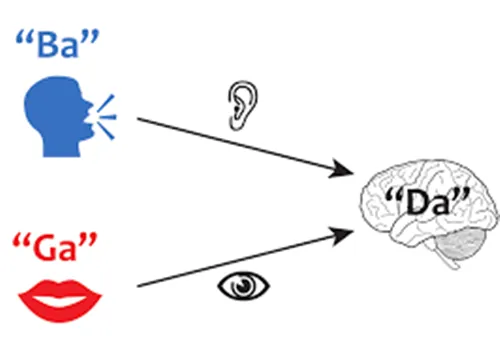
- In the classic demonstration, a video of lips saying "ga" is paired with the audio of a voice saying "ba," and most viewers report hearing "da."
- The effect persists even when participants are told what the real audio is, which is part of why it is considered a genuine perceptual illusion rather than a guess.
- Because vision can override hearing during speech, the effect is studied in research on how the brain combines information from different senses.
You're Watching Someone Say 'Ga-Ga', So Why Do You Hear 'Da-Da'?
Picture a short video clip. A man looks straight into the camera, and his lips clearly form ga-ga. The soundtrack underneath him is saying something else entirely: ba-ba. You watch, you listen, and your ears report back a word that nobody in that room ever spoke. You hear da-da.
That is the McGurk effect, an audiovisual illusion first described by the British cognitive psychologists Harry McGurk and John MacDonald in a 1976 paper in Nature. When what your eyes see on a speaker's lips and what your ears hear from the speaker's voice disagree, your brain does not pick a winner. It quietly builds a third sound, one that was never there to begin with.
The canonical demonstration is exactly the one above. The lips move as if saying ga-ga, the audio track plays ba-ba, and most viewers, without any prompting, report hearing da-da. The visual ga and the auditory ba get fused into a percept that matches neither source. You can know the trick is coming. You can watch the clip a dozen times, tell yourself the audio is ba-ba, and still hear da-da. The illusion is remarkably resistant to correction, which is part of why it has fascinated perception researchers for nearly fifty years.
What makes the effect so disarming is how ordinary it feels. There is no flickering screen, no spinning spiral, no optical puzzle you have to squint at. Just a face and a voice, the two things we trust most when someone is talking to us. And yet the McGurk effect shows that even here, at the most basic level of understanding speech, the brain is not reporting the world. It is constructing it.
The Locked Room: A Thought Experiment About Trusting Your Senses
Picture yourself sealed inside a room with no light, no sound, and no window to the world outside. You cannot see anything, you cannot hear anything, and you have no way to check what is really going on beyond those walls. Every so often, a man named McGurk walks in and tells you what is happening out there.
Most of the time, McGurk says reasonable, ordinary, boring things. The kind of small talk you would barely notice. But now and then he says something genuinely strange, something incredible, or something that is plainly false. So how long would it take before you started doubting him? How much of what he tells you would have to be true before you decided he was reliable? Sit with that discomfort for a moment, because it is not really about McGurk at all.
This little scenario is a philosophical setup, and it maps onto something you carry around every waking hour. We never touch the world directly. Everything we know about it arrives through our senses, which act as messengers. You trust your eyes and ears to hand you an accurate picture of what is out there, the same way the person in the dark room trusts the man who walks in. The question the thought experiment leaves hanging is simple and unsettling: how good are those messengers, really?
Not as good as we assume. Philosophers have suspected this for a long time, and neuroscientists have confirmed it again and again. The brain actively constructs the world rather than passively receiving it. It fills in details you never actually saw, alters or discards some information, and ignores much of the rest. Your eyes, for instance, hold sharp focus over only a tiny patch of the scene, and yet everything in front of you looks evenly detailed. That smooth, complete picture is a construction.
And sometimes the messengers simply disagree with each other. That is where the McGurk effect comes in. It is the most striking case of our senses tripping us up, and it shows just how sneaky and tangled the problem of perception can get. You are about to meet the man behind the name, and the accidental discovery that turned a routine afternoon in a lab into one of the most famous illusions in psychology.
An Accidental Discovery in a Dubbing Studio
The McGurk effect is an audiovisual illusion in which what your eyes see changes what your ears hear. When lip movements for one sound are paired with a completely different audio track, the brain does not choose one signal over the other. It merges them into a third sound that was never recorded. That is the whole trick, and it was found by accident.
Rewind to the 1970s, to a studio in the United Kingdom. Two British cognitive psychologists, Harry McGurk and John MacDonald, were working with a technician to dub speech sounds onto video. Something went wrong in a way that turned out to be right. As the story goes, the mismatch between the lips on screen and the audio on the tape created a confusing situation, and in that confusion the illusion showed itself. They were not hunting for a perceptual puzzle. They stumbled into one.
Here is the setup that produces it. The video shows a speaker's lips moving as if saying "gah, gah, gah." Over that footage, the audio track plays "bah, bah, bah." Watch it, and you do not hear "gah" and you do not hear "bah." You hear "dah, dah, dah," a sound that exists nowhere in the room. When the eyes and ears disagree, the brain resolves the conflict by inventing a compromise sound that was never there.
What makes the McGurk effect so stubborn is that it survives being explained. Knowing the trick does not disarm it. You can read the study, understand exactly which track carries which sound, and still hear "dah" when you press play. The illusion persists even when you know the trick, which is a strong hint that this fusion happens automatically, well below conscious control.
Why You Can't Un-Hear It
You know the trick. You know the audio says "ba" and the lips say "ga." And you still hear "da." That is the strangest part of the McGurk effect: it survives your own intelligence. Since Harry McGurk and John MacDonald published the finding in Nature in 1976, researchers have shown the illusion again and again, and it keeps working on people who fully understand it.
Knowing about a magic trick usually kills it. You watch the sleight of hand, you spot the hidden card, the wonder drains away. Not here. The McGurk effect is well known for resisting correction. You can read the study, watch the clip five times, tell yourself exactly what is happening, and the wrong sound still arrives. Your brain does not ask your permission.
That stubbornness is the real lesson. Multisensory integration is automatic and involuntary, closer to a reflex than a decision. Sight and sound do not reach you as separate reports that you then compare. They merge before you notice anything, and the result feels like ordinary hearing. There is no seam to pry open.
Which raises a bigger question. If such a small conflict is resolved without your awareness, what else is being resolved silently?
Philosophers had long suspected this, and neuroscientists later confirmed it. What they suspected, and what the lab work keeps confirming, is that the brain builds the world you live in. It fills in unseen details, alters or discards some information, and ignores much of the rest. Your eyes, for instance, hold a sharp focus over only a tiny patch of the scene. Everything else is stitched together from inference.
Descartes put the worry plainly in 1641, in the first of his Meditations on First Philosophy. He cautioned against placing full trust in anything that has deceived us, even once. Our senses have misled us many times. The McGurk effect is a demonstration you can replay anytime, and it keeps working no matter how well you understand it.
A Reported Baylor Experiment: A Computer Model That Predicts Who Falls for It
According to one widely shared account, researchers at Baylor College of Medicine in Houston built a computer model to figure out why the McGurk effect happens at all. The same account describes a three-step test. Participants closed their eyes and listened to a voice repeating "ba ba ba." Then the sound went off and they watched a face whose lips were shaping "ga ga ga." Finally both tracks played together, and most people said they heard "da da da," a sound that was never recorded. That specific Baylor study has not been independently confirmed, so treat the details as reported rather than established. What is well documented is the underlying illusion: when lips and audio disagree, the brain fuses them into a third percept, and knowing the trick does not stop it from working.
That stubbornness is what makes the effect so intriguing to researchers. Even with full knowledge of the trick, your ears still deliver the wrong sound. The effect is well known for resisting correction. So a model that could predict who will experience the illusion, as the report claims this one largely could, would need to distinguish between people whose senses fuse the signals and those whose senses do not. That predictive accuracy has not been independently verified.
Beyond the lab, the effect has practical implications for speech recognition. Companies that build systems meant to transcribe human speech currently work almost entirely from sound. If a smart speaker also had a camera and could read lip movements while it listened, it would have two streams of evidence instead of one, and it could resolve the ambiguities that trip up audio-only systems today. In a noisy room, "b," "d," and "g" sound frustratingly similar. Seen on a face, they are not.
The McGurk effect demonstrates that idea in reverse. It shows that the brain automatically fuses sight and sound, without permission and without effort. A machine that does the same would catch what a microphone alone would miss.
Descartes, Deception, and the Limits of What We Can Know
In 1641, the French philosopher René Descartes wrote in his Meditations on First Philosophy that it is wise not to trust completely those who have deceived us even once. That line hits hard after you have experienced the McGurk effect. Descartes was not thinking only of eyes and ears, but of the whole machinery of knowledge, and how one confirmed failure can poison confidence in everything that follows.
Here is the uncomfortable part. Our senses are not glitchy in the way a cheap microphone is glitchy. They are built to deceive us to some degree, by design, in the ordinary course of doing their job. The brain takes a thin stream of signals and builds a world out of it, coloring in the parts it never actually saw, filling gaps, quietly erasing details it decides do not matter. The McGurk effect is just one place where that construction becomes visible. There are others, and you walk past them every day without noticing.
So where does that leave us? Locked in the dark room, still listening to McGurk.
Think back to that sealed room with no light, no sound, no hint of what is happening outside. Every so often a man named McGurk walks in and tells you what the world is like. Most of what he says is reasonable, dull, believable. Then one day he says something strange, or impossible, or flatly wrong. Do you stop trusting him? How long does it take before you start doubting the ordinary things too? How much of what he tells you has to be true before you are willing to call him reliable?
You cannot leave the room. You cannot check for yourself. We cannot survive without our senses, and we have no other way to reach the world. So as long as our knowledge remains trapped in that dark room, we must trust the stranger's reports about the outside. That is not a comfortable conclusion. It is just the honest one.

Frequently asked questions
What is the McGurk effect in simple terms?
The McGurk effect is an audiovisual illusion. When a speaker's lips form one sound, say "ga-ga," while the dubbed audio plays a different one, "ba-ba," the brain refuses to pick a side and fuses the two conflicting streams into a third percept. Viewers reliably report hearing "da-da," a sound that was never recorded.
Why does the McGurk effect happen?
Your brain does not simply accept what your ears deliver. When lip movements imply one syllable and the audio carries another, the conflict gets resolved by merging both signals into a single, coherent percept. The result is a sound that exists nowhere in the recording, only inside the fusion of sight and hearing.
Who discovered the McGurk effect and when?
Harry McGurk and John MacDonald, two British cognitive psychologists, identified the phenomenon in the 1970s. According to the original account, they stumbled onto it by accident while dubbing speech sounds onto a video with a technician. The confusion that surfaced during that session became the canonical demonstration of the illusion.
Can you train yourself to overcome the McGurk effect?
No. The illusion is remarkably resistant to correction. Even when you know exactly what is happening, even when you have read the studies and understand the mechanism, the wrong sound still arrives. Knowing about the McGurk effect does not stop you from hearing it.
How could it improve speech recognition technology?
Speech recognition systems that rely on audio alone struggle in noisy rooms. If a device could also watch lip movements through a camera, it would have a second channel of information to cross-check against the sound. That kind of integration could substantially sharpen how accurately machines understand what people say. Editorial note: Details that are not firmly established, including the precise strength of the effect across different people and conditions, are described here as reported rather than settled.
Got a take on this? Add your voice to the conversation below →
No comments yet. Be the first.