Saber-Toothed Tiger: The Ice Age Wrestler That Vanished
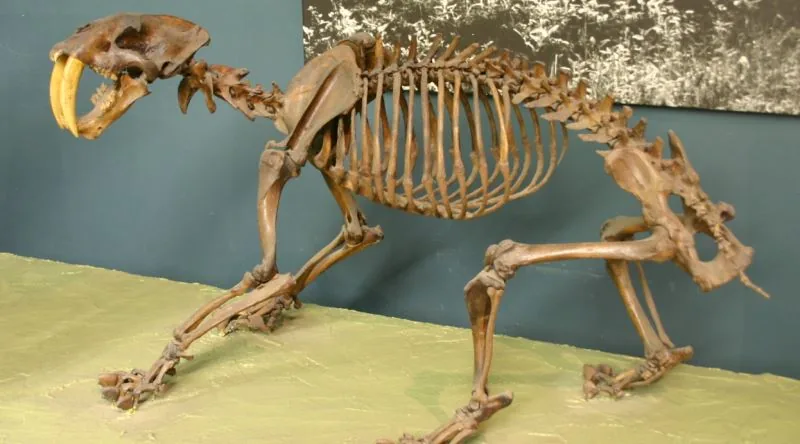
The saber-toothed tiger, known scientifically as Smilodon, was a heavily built Ice Age predator that roamed the Americas until roughly 12,000 years ago, wrestling mammoths and bison to the ground despite its famously fragile fangs. These powerful cats were less like modern lions and more like muscular wrestlers, and their dramatic disappearance remains one of paleontology's most compelling cold cases. When you picture the harsh, frozen landscapes of the last Ice Age, few creatures capture the imagination quite like this apex hunter, a beast whose very anatomy tells a story of brutal, close-quarters combat.
The saber-toothed tiger (Smilodon) was a stocky, powerful predator that lived in the Americas during the Pleistocene. It hunted large prey like bison and young mammoths using ambush tactics and immense forelimb strength, but went extinct around 12,000 years ago, likely due to climate change and the loss of its food sources.
- Smilodon lived in North and South America during the Pleistocene Epoch, which ended roughly 12,000 years ago.
- Unlike modern lions, Smilodon had a robust, bear-like build with powerful front legs designed for pinning down prey.
- Its iconic canine teeth were surprisingly brittle and were used for delivering precise, deep slashes to the throat after the prey was subdued.
- The most famous fossil deposits, found in the La Brea Tar Pits in Los Angeles, have yielded thousands of Smilodon skeletons.
- The leading theory for its extinction points to the disappearance of large Ice Age megafauna, its primary food source.
The Ice Age Wrestler That Wasn't Really a Tiger
Call it the saber-toothed tiger and you are technically wrong. The creature paleontologists know as Smilodon roamed North and South America until roughly 12,000 years ago, and it was no more a tiger than a raccoon is a panda. Despite the common name, this extinct felid shares no close genetic ties with modern lions, tigers, leopards, jaguars, snow leopards, cheetahs, or pumas. It belonged to an entirely separate lineage, one that evolved in North America and later pushed southward into South America.
Scientists recognize three species within the genus: S. fatalis, S. populator, and S. gracilis. The earliest of these, S. gracilis, appeared in North America first, and the later species dispersed into South America after the Great American Interchange connected the continents. Yet here is where the mystery deepens. Smilodon's body looks like nothing alive today, and that anatomical weirdness means its walking style, hunting technique, and daily behavior remain largely theoretical. Paleontologists can measure the bones, but reconstructing how this predator actually lived involves educated guesswork layered on fossil evidence.
The most striking feature, those long flattened canine teeth, actually complicates the story rather than clarifying it. Unlike the conical fangs of modern big cats, Smilodon's saber teeth were compressed sideways and more fragile, prone to breakage under lateral stress as fossil damage confirms. The animal also carried proportionally longer front legs and shorter hind legs than other felids, plus exceptionally large shoulder blades that anchored massive forelimb muscles. Its first two neck vertebrae, the atlas and axis, were extremely large and wide, and the skull region supporting neck muscles measured three to four times larger than that of a modern lion or tiger. This was a creature built for raw power, not athletic pursuit.
Curiously, Smilodon could open its lower jaw up to 95 degrees, while modern lions and tigers manage only about 65 degrees. Yet its bite force at the canines was only about one quarter as strong as a modern lion's. That combination, a huge gape with a weak bite, has left researchers puzzling over how these animals brought down prey like mammoths, mastodons, bison, giant ground sloths, giant deer, and giant camels. The leading hypothesis, still debated, suggests they may have hunted in packs, using their powerful forelimbs to grapple and wrestle prey to exhaustion before delivering a precise cutting bite with those fragile saber teeth. As the story goes, they competed with American cheetahs, dire wolves, short-faced bears, and American lions for food. When the Quaternary extinction event wiped out their large, slow prey, Smilodon could not adapt to smaller, faster quarry and vanished along with the megafauna it depended on.
Fragile Fangs: Why Smilodon's Teeth Weren't for Biting
Those iconic, knife-like canines of the saber-toothed tiger were never meant for crushing or clamping down on prey. In fact, they were surprisingly delicate, more like finely crafted blades than the sturdy daggers you might imagine. This fragility completely changes the story of how this Ice Age predator actually survived.
Let's talk about those famous teeth first. The popular image of the saber-toothed tiger often comes with a claim of canines reaching 30 centimeters in length, but that's an exaggeration. The exposed crown of the tooth typically measured between 15 and 20 centimeters, with the absolute maximum total length, including the root buried in the jaw, reaching about 28 centimeters, a figure that's still debated among researchers. What matters more than the length is the shape. Unlike the conical, thick teeth of modern big cats, Smilodon's canines were flattened sideways, compressed like the blade of a steak knife. This design made them exquisitely sharp but structurally vulnerable.
Fossil evidence from sites like the La Brea Tar Pits in California shows clear damage on many of these teeth, with chips and fractures that would have been painful and potentially deadly for the animal. The reason becomes clear when you compare them to modern lions and tigers. When a lion bites down on a struggling zebra's throat, its conical teeth are designed to lock in place and withstand force from all directions, applying steady, suffocating pressure. The saber-toothed tiger's flattened canines simply couldn't handle that kind of lateral stress. They would snap under the violent shaking of a struggling prey animal.
This raises a fascinating puzzle. If the saber-toothed tiger's most famous feature was too fragile for a typical cat-style kill, how did it manage to hunt at all? The answer lies not in the teeth, but in the rest of its remarkably specialized body, built not for biting, but for wrestling.
Built Like a Bodybuilder: The Anatomy of a Grappler
Forget everything you know about how a cat is put together. The saber-toothed tiger, known scientifically as Smilodon, broke the mold so completely that its skeleton reads less like a feline and more like a blueprint for a wrestler. It traded the sleek, athletic frame of a modern lion for something bulkier, stronger, and built for one specific purpose: taking down prey far larger than itself.
The most obvious oddity is in the proportions. Unlike every other cat, Smilodon had notably longer front legs and shorter hind legs, which gave its back a distinct, downward slope. This wasn't a design flaw. It was the foundation of a power build. Its shoulder blades were exceptionally large, and those bones existed to anchor massive forelimb muscles. The paws were tipped with longer digits than a typical cat's, and the entire front assembly was a mass of raw strength, designed to grapple and hold onto something that really did not want to be held.
That power didn't stop at the shoulders. The first two neck vertebrae, the atlas and the axis, which connect the skull to the spine, were extremely large and wide. They had to be. The part of the skull dedicated to supporting neck muscles was three to four times larger than that of a modern lion or tiger. The neck itself was thick, a muscular column that would have stabilized the head like a concrete block, preventing it from being violently shaken during a struggle.
Put it all together, and you see a creature that resembled a bear more than a cat. It wasn't built for speed or agility. It was built for resistance and sheer force, a living embodiment of the phrase "raw power." And that makes perfect sense when you consider its fragile, blade-like fangs, which simply couldn't withstand the violent thrashing that a modern cat's bite would involve.
The Hunt: Wrestling Mammoths and Bison to the Ground
The saber-toothed tiger couldn't kill the way modern big cats do, and the reason comes down to math. Its bite force measured only about one quarter of a modern lion's, and its long, flattened teeth were fragile enough to snap under heavy strain. Suffocating prey by clamping down on a throat was simply not an option.
Instead, evolution built this Ice Age predator for something far more physical: wrestling. While modern lions and tigers can open their mouths to about 65 degrees, the saber-toothed tiger's jaw swung open to a remarkable 95 degrees. That extreme gape wasn't for crushing, it was for positioning. Those blade-like canines, sharp along their front and back edges, worked like surgical knives, meant to slice flesh cleanly after the real work was done.
The real work happened with the body. Unlike the athletic, evenly proportioned build of today's big cats, the saber-toothed tiger had noticeably longer front legs and shorter hind legs, plus oversized shoulder blades built to anchor massive muscles. Its first two neck vertebrae, the atlas and axis, were extraordinarily large and wide, and the skull region supporting the neck muscles was three to four times bigger than a modern lion's or tiger's. All that bulk pointed in one direction: the forelimbs and neck were engineered for grabbing, holding, and pinning down prey that outweighed anything a lion would dare tackle.
The strategy was ambush, then grapple. When a saber-toothed tiger attacked, it used its enormous claws and crushing forelimb strength to latch onto the animal and lock on like a concrete weight, refusing to let go no matter how hard the victim thrashed. It struck from the back and the neck, not the throat, specifically to protect those precious canines from cracking against bone. Only after the prey was exhausted and subdued did those saber teeth come into play, slicing through hide and muscle with precision.
This approach made sense given the menu. The saber-toothed tiger hunted mammoths, mastodons, bison, giant ground sloths, giant deer, and giant camels, all creatures far too powerful to suffocate with a weak jaw. Whether it hunted in packs remains an open question. The pack-hunting theory is debated, so it's presented here as a hypothesis rather than a settled fact.
The saber-toothed tiger shared its world with serious rivals, including the American cheetah, dire wolves, short-faced bears, and American lions. But while those predators chased down swift, agile prey, the saber-toothed tiger carved out its own niche as the heavyweight wrestler of the Pleistocene, built to outlast the giants rather than outrun them.
The Vanishing Act: Why Saber-Toothed Tigers Disappeared
Around 12,000 years ago, the saber-toothed tiger vanished from the Earth, a casualty of the Quaternary extinction event that wiped out much of the world's megafauna. The very adaptations that made Smilodon a fearsome predator of giants became its undoing. When its large, slow prey disappeared, this specialized hunter simply could not pivot to survive.
Think about what Smilodon had become by the end of the Pleistocene. It was a wrestler built to grapple with mammoths, mastodons, bison, giant ground sloths, giant deer, and giant camels. Its body was a fortress of muscle concentrated in the shoulders, neck, and forelimbs. Its powerful frame could lock onto a massive beast and hold on through the most violent thrashing. But that entire physique was a gamble, a wager that the age of giants would last forever.
When the climate shifted and the megafauna began to collapse, the bet failed. The large, slow-moving prey that Smilodon depended on died out, and in their place remained smaller, quicker animals like deer and horses. These agile targets were no match for a predator built for endurance wrestling rather than sprinting. The American cheetah, a puma relative, and the American lion could chase down these fleet-footed creatures with ease, but the saber-toothed tiger, heavy and powerful, simply could not keep up.
The story of Smilodon's demise is a cautionary tale written in bone. Its specialization, once its greatest strength, became an inescapable trap. It had evolved so perfectly for one kind of prey that when that prey vanished, so did the saber-toothed tiger. In a world that changed too quickly, the ultimate ambush predator found itself with nowhere to go and nothing left to wrestle.
Frequently asked questions
What was the saber-toothed tiger?
The saber-toothed tiger was a prehistoric felid belonging to the genus Smilodon that roamed the Americas until roughly 12,000 years ago. Its most recognizable feature was a pair of long, flattened canine teeth that extended well past its lower jaw. Despite the common name, it was not a tiger at all.
Why did saber-toothed tigers go extinct?
The saber-toothed tiger vanished when its primary food source disappeared during the Quaternary extinction event, a wave of megafauna die-offs at the end of the last Ice Age. Their large, slow prey died out, and they simply could not adapt to chasing smaller, faster animals. The most recent confirmed Smilodon fossils date to around 12,000 years ago.
How did saber-toothed tigers hunt?
Saber-toothed tigers were ambush predators that targeted huge megafauna. They used their powerful forelimbs and massive neck muscles to wrestle prey to the ground, holding on with sheer strength rather than speed. Only after their victim was subdued did they use their blade-like fangs to slice through flesh.
Was the saber-toothed tiger actually a tiger?
No, the saber-toothed tiger was not closely related to modern tigers at all. It belonged to a separate evolutionary lineage called Machairodontinae, which branched off from the ancestors of today's big cats millions of years ago. The name stuck for historical reasons, but genetically, it had more in common with a house cat than a Bengal tiger.
What did saber-toothed tigers eat?
The saber-toothed tiger's menu consisted of large Ice Age herbivores, including mammoths, mastodons, bison, giant ground sloths, giant deer, and giant camels. These massive prey animals shaped every aspect of the predator's anatomy, from its brawny shoulders to its specialized slicing teeth. Isotopic analysis of fossil bones confirms this diet of oversized game.
How strong was a saber-toothed tiger's bite?
The saber-toothed tiger's bite was surprisingly weak, only about one quarter as strong as a modern lion's. However, it could open its jaws up to 95 degrees, far wider than the 65 degrees a lion or tiger can manage today. This trade-off allowed for those long fangs to clear the lower jaw while sacrificing crushing power.
Where did saber-toothed tigers live?
Saber-toothed tigers lived across North and South America, with three recognized species spanning the two continents. The most famous fossil site is Rancho La Brea in California, where countless specimens have been pulled from the tar pits. The genus evolved in North America before spreading south into South America.
Got a take on this? Add your voice to the conversation below →
No comments yet. Be the first.