Repressive Desublimation: Marcuse's 1964 Warning on Art
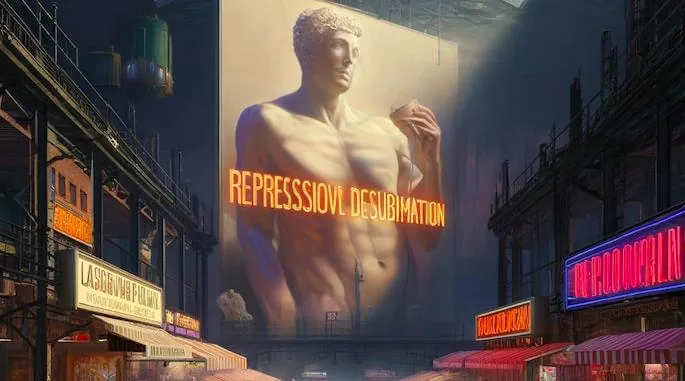
Herbert Marcuse introduced the concept of repressive desublimation in his 1964 book One-Dimensional Man, arguing that advanced industrial capitalism flattens high culture into commodified entertainment to dull critical thought. It is a stark warning from the Frankfurt School thinker that still shapes how we understand art, technology, and conformity. The idea unsettles because it suggests our freedom to enjoy everything may be the very mechanism keeping us docile, a paradox that feels more urgent than ever in an age of endless streaming and algorithmic feeds.
In 1964, philosopher Herbert Marcuse coined the term repressive desublimation in One-Dimensional Man to describe how capitalist societies absorb and neutralize rebellious art. By turning provocative culture into safe, pleasurable commodities, they release pent-up energy without allowing real social change. This process keeps people satisfied and politically passive within the existing system.
- Herbert Marcuse published One-Dimensional Man in 1964, presenting his critique of advanced industrial society.
- Repressive desublimation describes how capitalism transforms high art and rebellious culture into commodified entertainment.
- Marcuse argued that this process releases sexual and aggressive energies in ways that reinforce, rather than challenge, the status quo.
- The concept builds on Sigmund Freud's idea of sublimation, but reverses its critical potential into a tool of social control.
- Marcuse's warning remains relevant today, visible in how protest music, counterculture imagery, and avant-garde aesthetics are absorbed by mainstream marketing.
The 1964 Idea That Explains Why Everything Feels So Flat
In 1964, a philosopher named Herbert Marcuse published a book that tried to warn us about exactly this feeling. The book was called One-Dimensional Man, and inside it he coined a term you have probably never heard: repressive desublimation. It sounds like academic jargon, but it describes something you encounter every single day.
Marcuse was a philosopher and sociologist, part of the famous Frankfurt School, a group of thinkers who spent decades trying to understand why modern society keeps failing to live up to its own promises. His argument in that 1964 book was unsettling. He believed that technological progress in advanced capitalist societies was quietly eliminating the oppositional and transcendent elements of high culture. In plain words: art was losing its power to criticize, to challenge, to point at something beyond the here and now.
Think about what art used to do. It was a bridge between what exists and what does not exist yet, a way to imagine alternatives to the way things are. Marcuse saw that changing. Capitalist society, he argued, was turning art into a commodity integrated directly into the system. A painting becomes an investment. A song becomes a ringtone. A poem becomes a caption. The rough edges get smoothed away, and the strange becomes ordinary.
He had a striking way of putting it. The music of the soul, he wrote, becomes the music of salesmanship. The exact phrasing matters here, because the popular version of the quote often drops the last syllable. But the point survives the correction: even our deepest inner lives get packaged, priced, and sold back to us.
Marcuse was not talking about the old-fashioned kind of repression, the kind where the state bans books or jails dissidents. Something more subtle was happening. Instead of forcing rebellious thoughts underground, the system was absorbing them, flattening them, turning them into products that could serve capital. Desire gets stripped of negativity and repackaged as something you can buy. Freedom and happiness get replaced by instant gratification.
He saw this as a dynamic that drains the energy available for social criticism. If every impulse can be satisfied by purchasing something, why would anyone question the system that sells it? The warning from 1964 feels eerily relevant today, when even protest movements have their own hashtags and merchandise.
What Is Repressive Desublimation? A Simple Breakdown
Repressive desublimation is the process by which capitalism takes art and culture, strips away their rebellious edges, and turns them into smooth, ordinary products you can buy and consume. It was first introduced by Herbert Marcuse, a Frankfurt School philosopher and sociologist, in his 1964 book One-Dimensional Man. In simpler terms, it is how society neutralizes anything that might challenge it by turning it into merchandise.
Think about what art used to do. In earlier eras, it stood between what existed and what could exist, offering a glimpse of something beyond the everyday. It carried tension, contradiction, and the possibility of change. Under advanced industrial capitalism, that function gets flattened. Art becomes integrated directly into society as a commodity, and once that happens, it gets smoothed out and made ordinary. The exchange value, what it can be sold for, becomes more important than its real value, what it actually says or means.
Marcuse watched this happening in real time. High culture, the kind of art and literature that once stood apart from daily life and critiqued it, dissolves into social reality. Where there used to be two dimensions, the actual and the possible, there is now only one. Ideals get lost among everyday realities. Desires are stripped of their negative emotions, the anger and discontent that might spur action, and turned into controlled commodities trapped within the system. Instant gratification replaces genuine freedom and happiness.
The mechanism is subtle. Older systems of power used force and repression to keep people in line. This system does something different. Instead of crushing dissent, it absorbs it. A rebellious idea or tendency gets normalized, repackaged, and transformed into a form that serves capital. The music of the soul becomes the music of salesmanship, as Marcuse put it. That small distinction matters, because it points to a whole attitude, a way of selling, not just a person doing the selling.
Marcuse believed this dynamic served a specific function. By offering instant satisfactions, repressive desublimation drains away the energy that could otherwise fuel social critique, all while wearing the mask of collective politics. The system does not need to silence you. It just needs to make sure your protest sounds like a jingle.
The Soul's Music and the Salesman's Tune
There is a line in Herbert Marcuse's 1964 book One-Dimensional Man that cuts straight to the bone: "the music of the soul is also the music of salesmanship." The exact phrasing has been debated over the years, with some quoting it as "the music of the salesman," but the book itself uses "salesmanship." Either way, the sting is the same. Marcuse, a philosopher and sociologist tied to the Frankfurt School, was pointing at something deeply uncomfortable about modern life.
He was saying that the most intimate, rebellious, soul-stirring parts of culture do not stay pure for long. A protest song becomes a jingle. A counterculture fashion statement becomes a mall display. The art that once stood apart from the everyday world, holding up a mirror to what is missing, gets pulled into the machinery of commerce. Its rough edges are sanded down. Its questions are muffled. It becomes smooth, ordinary, and safe to consume.
Marcuse called this dynamic repressive desublimation. It works not by banning or crushing dissent, as older authoritarian systems did, but by absorbing it. Desires are stripped of their negative charge and repackaged as commodities you can buy off a shelf. Instant gratification replaces genuine freedom. And here is the sneaky part: this all happens under the cover of collective well-being, of policies that claim to serve everyone. The energy that might have fueled real social criticism gets spent instead on the next purchase, the next thrill, the next fleeting pleasure.
Why Marcuse's Warning Still Stings Today
Herbert Marcuse's 1964 warning about repressive desublimation has only grown sharper with time. The Frankfurt School philosopher argued in "One-Dimensional Man" that advanced industrial society doesn't crush dissent with force anymore. Instead, it absorbs rebellion, smooths its rough edges, and sells it back to us as a lifestyle choice.
Think about what your streaming queue looks like right now. The platform that serves you indie films about corporate greed is the same one that recommends a true-crime doc about a CEO's downfall right after. The algorithm doesn't care about the message. It cares about your attention, your subscription, your data. The art that once stood outside the system, that held up a mirror to it, now lives inside the system as another product on the shelf.
Social media works the same way. A protest hashtag trends for an afternoon, gets picked up by brands, and becomes a filter or a sticker by evening. The energy that could have built a movement gets spent on a story post. The dissent is real, but the container it arrives in is designed to keep it harmless.
AI-generated art might be the clearest example yet. Type a prompt about rebellion into a generator and you get an image of a raised fist rendered in perfect studio lighting. The software has already absorbed every act of defiance ever digitized and turned it into a style option. A prompt is not a protest. A filter is not a philosophy. But the line between them keeps blurring.
Marcuse saw this coming decades before the first smartphone. He noticed that repression no longer needed to be forceful because ordinariness does the job better. When art that once challenged the status quo becomes wallpaper in a coffee shop, when the punk album plays in the elevator, when the revolutionary slogan appears on a tote bag, the critique gets defanged. The music of the soul, as Marcuse put it, becomes the music of salesmanship.
The result is what he called a one-dimensional society. Critical thought gets dulled not by censorship but by saturation. Every idea is available, which means no idea carries weight. You can buy a poster of Che Guevara at the mall and a book about Marx at the airport bookstore, and both feel equally distant from your actual life.
Marcuse's point was never that these products are fake. It's that their availability neutralizes them. The system doesn't need to ban dangerous ideas when it can merchandise them. Your playlist can include protest songs and your feed can show you activist content, and none of it has to change how you live. That's the trap. That's the ordinary, comfortable, one-dimensional space we keep building around ourselves.
Frequently asked questions
What is repressive desublimation?
Repressive desublimation is a concept introduced by philosopher Herbert Marcuse in his 1964 book One-Dimensional Man . It describes how capitalism transforms high culture into commodified, ordinary products. Instead of art challenging society, it becomes smoothly integrated into daily life, losing its power to provoke or transcend. The term captures how advanced industrial society neutralizes cultural opposition through commercialization rather than force.
Who coined the term?
Herbert Marcuse coined the term repressive desublimation. Marcuse was a philosopher and sociologist associated with the Frankfurt School, a group of critical theorists who examined modern society. He introduced this concept in One-Dimensional Man , published in 1964, as part of his broader critique of how technological rationality flattens critical thought in capitalist societies.
How does it affect art?
Under repressive desublimation, art loses its oppositional and transcendent qualities. Marcuse argued that capitalist society turns art into a commodity integrated directly into social life, making it smooth and ordinary. Exchange value becomes more important than genuine artistic value. A painting, song, or poem that once offered a vision beyond everyday reality now simply becomes another product to buy, consume, and discard.
Why did Marcuse write One-Dimensional Man?
Marcuse wrote One-Dimensional Man in 1964 to critique advanced industrial society. He wanted to show how technological rationality flattens critical thought, reducing human beings to a single dimension where they accept existing conditions without question. The book examines how modern capitalism manages dissent not through overt repression but by absorbing opposition into the system itself, making critique seem unnecessary or impossible.
What does "the soul's music is also the salesmanship's music" mean?
Marcuse's phrase "the soul's music is also the music of salesmanship" means that even our deepest cultural expressions get co-opted for commercial purposes. The intimate feelings we pour into art, the spiritual longings we express through music, the private joys we find in beauty, all of these become marketing tools. What once felt personal and authentic now serves advertising campaigns, product branding, and consumer culture.
How does technology contribute?
Technological rationality drives the process of repressive desublimation. Marcuse argued that technology makes commodification seem natural and inevitable, as if the transformation of art into product were simply progress. When efficiency and productivity become the highest values, everything gets measured by usefulness. Culture itself must justify its existence through market performance, and technology provides the machinery that makes this cultural smoothing appear logical and unavoidable.
Is it the same as censorship?
No, repressive desublimation is not censorship. Censorship uses force to suppress dissent, while Marcuse's concept works through ordinariness and instant gratification. Instead of banning subversive ideas, the system absorbs them, making them familiar and safe. A provocative artwork becomes a poster in a dorm room. A revolutionary slogan becomes a t-shirt. The critical edge dulls not through prohibition but through normalization, which is why this form of control is so subtle and effective. Editorial note: Any facts which remain unconfirmed are presented as such, hedged with appropriate qualification rather than asserted as definitive.
Got a take on this? Add your voice to the conversation below →
No comments yet. Be the first.