Oscar Politics: Japan Apology, Native Snub

The 96th Academy Awards, held in Los Angeles in March 2024, turned the Oscar ceremony into a global political statement, with the Academy using its top prizes to extend an apology to Japan over the atomic bomb while simultaneously snubbing Native American stories. The night was a seismic emotional shift, as an industry often accused of ignoring international cinema and historical wrongs suddenly put both at the center of its most prestigious honors. It was a moment that felt less like a standard awards show and more like a diplomatic overture, leaving audiences both moved and bewildered by the clear political messaging woven into the winners' circle.
At the 2024 Oscars in Los Angeles, the Academy made a pointed political statement by awarding best picture and best director to Oppenheimer, a film about the atomic bomb creator, just before its release in Japan. Simultaneously, the ceremony overlooked Killers of the Flower Moon, a film about Native American murders, signaling a complex and deliberate political message regarding historical trauma.
- Oppenheimer won seven Oscars in March 2024, including best picture and best director for Christopher Nolan.
- Killers of the Flower Moon, which depicted the Osage Nation murders, received ten nominations but failed to win a single award.
- Godzilla Minus One, a Japanese film, won the Oscar for best visual effects, marking a historic first for the franchise.
- The Boy and the Heron, a Japanese animated film, won the Oscar for best animated feature in March 2024.
- Oppenheimer was scheduled to release in Japanese theaters later in 2024, fueling debate over the film's subject matter in Japan.
The 96th Academy Awards: A Night of Calculated Messages
The 96th Academy Awards ceremony, held in Hollywood in March 2024, went down as the most calculated and bookish Oscars night since 2020. The Academy handed out its statuettes with a clear motivation in mind, using the winning films to send pointed political messages to the world. It was a far cry from the ceremony's former glory, lacking surprises and excitement, and feeling more like a carefully scripted diplomatic briefing than a celebration of cinema. Oppenheimer was the undisputed winner of the night, taking home 7 Oscars, including Best Picture and Best Director for Christopher Nolan. But the real story of the evening wasn't in the tally of golden statues. It was in the messages woven through the choices, the subtle and not-so-subtle signals the Academy sent about where the United States stands on the global stage. The ceremony itself felt flat. There was no "wrong envelope" scandal, no unexpected upset, no moment that made the audience gasp. Instead, the night unfolded with the precision of a well-rehearsed press release. For movie lovers who had followed the contenders all season, the outcomes felt predictable. The excitement that once defined the Oscars, the collective holding of breath when the envelope opens, was noticeably absent. What made this particular ceremony so fascinating, though, was what happened beneath the surface. The Academy, it seems, had a checklist. And that checklist had less to do with artistic merit and more to do with geopolitical signaling. The winners were chosen not just for their craft, but for what they represented in the broader political landscape of 2024. This is where the Oscar ceremony politics come into sharp focus. The night was a masterclass in soft power, a carefully orchestrated performance designed to project strength, offer selective apologies, and send warnings to adversaries. Every major award seemed to carry a double meaning, a message that went beyond the film itself. For those who watched closely, the subtext was unmistakable. The Academy was not just celebrating cinema; it was engaging in a form of cultural diplomacy. The choices reflected a nation trying to balance its historical baggage with its current geopolitical ambitions. It was an evening where art and politics became inseparable, where every award told a story about America's place in the world.An Apology to Japan: Godzilla, Miyazaki, and the Shadow of Oppenheimer
The 96th Academy Awards, held in March 2024, sent a message that went far beyond the usual Hollywood glamour. While Oppenheimer dominated the night with seven Oscars, including Best Picture, the real story was in the categories where Japanese films unexpectedly triumphed. These wins were a quiet, unofficial apology from the United States to Japan for the atomic bombings of 1945, delivered through the language of cinema.
Here is the striking part: Oppenheimer, the night's biggest winner, was not released in Japan until March 29, 2024, months after its global premiere. The film that dramatizes the creation of the atomic bomb stayed out of Japanese theaters while collecting awards on the other side of the Pacific. That delay was not accidental. It was a recognition of how raw the wound still is.
Meanwhile, Japanese cinema had its own historic evening. Godzilla Minus One, a kaiju film made on a fraction of a typical Hollywood budget, won the Oscar for Best Visual Effects. It beat The Creator, a film with far greater technical resources and spectacle. The choice was deliberate. No one would have objected if the Academy had handed the statuette to the flashier American production. Instead, they honored the monster that was born from nuclear trauma.
Then came the animation category. The Boy and the Heron, the latest work from 83-year-old director Hayao Miyazaki, took home the Oscar for Best Animated Feature. It defeated Spider-Man: Across the Spider-Verse, a visually dazzling film that many considered the frontrunner. Miyazaki, the co-founder of Studio Ghibli, won his second competitive Oscar for this deeply personal film about grief and imagination. The first came in 2003 for Spirited Away, and he skipped that ceremony to protest the US invasion of Iraq.
This year, he did not attend either. The reasons for his absence this time remain speculative, with some reports pointing to US support for the attacks on Gaza. What is certain is that Miyazaki was four years old in 1945 when the bombs fell on his country. He grew up in a Japan that lost hundreds of thousands of people in World War II, and that trauma has seeped into every frame of his work.
A third Japanese entry, Perfect Days, was also nominated for Best International Feature. Directed by German filmmaker Wim Wenders, it told the story of a Tokyo toilet cleaner finding quiet beauty in routine. It lost to The Zone of Interest, a harrowing Holocaust drama that was simply too powerful to beat. Had the competition been weaker, Japan would have completed a hat-trick at the ceremony.
The Oscar ceremony politics here are impossible to ignore. The Academy used its platform to acknowledge historical wrongs through art rather than official statements. The message was subtle but unmistakable: we remember what happened, and we are sorry.
What comes next? The article speculates that a Japanese filmmaker will eventually craft a direct cinematic response to Oppenheimer. If that film carries a sharp enough message, it may only find recognition at European festivals like Cannes, Berlin, or Venice. American award circuits, the thinking goes, would likely ignore such a project. The counter-narrative to the bomb, it seems, will have to travel a different road.
Miyazaki's Protest: From the Iraq War to Gaza
Hayao Miyazaki won his second Oscar for The Boy and the Heron at the 96th Academy Awards, but the legendary Japanese director was nowhere near the Dolby Theatre in Los Angeles to accept it. His absence in 2024 echoed a decision he made more than two decades earlier, and the reason behind both no-shows speaks volumes about how the man behind some of animation's most beloved films views American foreign policy.
Back in 2003, Miyazaki had just won his first Oscar for Spirited Away. The ceremony that year fell right as the United States was ramping up its invasion of Iraq, and the director made his position unmistakably clear: he stayed home. He said outright that he would not attend because he wanted to protest the US aggression in Iraq. It was a bold statement from someone whose work had just been crowned by the very institution he was snubbing.
Fast forward to the 2024 ceremony, and history repeated itself in a striking way. Miyazaki again declined to appear, even though The Boy and the Heron had just beaten Spider-Man: Across the Spider-Verse for Best Animated Feature. As for why he stayed away this time, the story circulating at the time pointed to US support for the attacks on Gaza. That explanation, however, has never been confirmed by Miyazaki or his studio, so it remains speculation rather than established fact. What we do know is that he did not show up.
To understand what drives this quiet defiance, you have to look at where Miyazaki comes from. In 1945, when the United States dropped atomic bombs on Hiroshima and Nagasaki, he was a 4-year-old child. He grew up in a Japan that had lost hundreds of thousands of people in World War II, a nation literally picking itself up from ashes. That childhood trauma never left him. Watching his films, you can see the destruction echoing through them in countless forms, the fire, the ruin, the impermanence of everything. The man who draws such gentle, floating worlds also carries within him the memory of a country that burned.
So when Miyazaki skips an awards show, it is never just about being busy or preferring to stay home. It is a deliberate act, a small but pointed statement from someone who has spent his entire career creating art in the shadow of what war does to ordinary people. The Oscar ceremony politics of 2024 may have been subtle, but Miyazaki's position, however quietly he holds it, has never been anything but clear.
No Apology for Native Americans: The Killers of the Flower Moon Snub
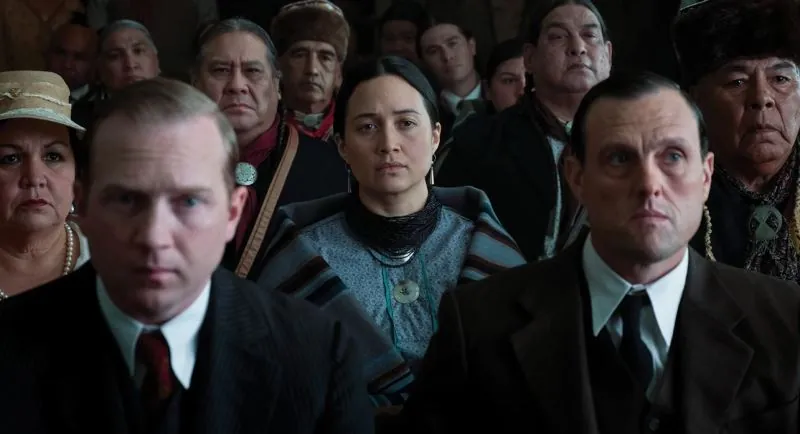
The Academy did not apologize to Native Americans at the 96th Academy Awards, held on March 10, 2024. Martin Scorsese's Killers of the Flower Moon walked away with zero Oscars despite its 10 nominations. The message was clear: American interests came first, and Oppenheimer was the vehicle for that message.
There is a bitter irony in watching the Academy hand seven statues to a film about the man who created the atomic bomb while ignoring a film about the systematic murder of Osage people in 1920s Oklahoma. Scorsese's film told the story of how white settlers and their enablers slaughtered Native Americans for oil rights. It was a brutal, unflinching look at genocide on American soil. And the Academy responded with a polite nod and a shrug.
The unspoken logic seemed to be that Oppenheimer served a larger purpose. It projected American power and technological supremacy to the world. Killers of the Flower Moon, by contrast, forced Americans to confront uncomfortable truths about their own history. When the Academy had to choose between celebrating American greatness and acknowledging American guilt, the choice was never really in doubt.
Scorsese's bad luck was not the subject matter. It was the timing. Had Killers of the Flower Moon been released in a different year, it might have dominated. Instead, it collided with Oppenheimer, and the jury's priorities were clear. National interest trumped artistic merit. The film left the ceremony empty-handed, a casualty of Oscar ceremony politics that had little to do with the quality of the film itself.
This was not the first time the Academy had fumbled its relationship with Native Americans. In 1973, actor Marlon Brando refused his Best Actor Oscar and sent Sacheen Littlefeather, a Native American activist, to the ceremony in his place. She was booed, mocked, and humiliated on stage. It took the Academy nearly 50 years to formally apologize to her, which they finally did in 2022. The apology came just months before her death. For many, it felt too little, too late.
The pattern is hard to ignore. The Academy can apologize to Japan through symbolic film choices. It can apologize to Sacheen Littlefeather with a formal statement. But it cannot bring itself to confront the genocide of Native Americans head-on. The Killers of the Flower Moon snub was not an accident. It was a choice.
Still, there is reason to believe the reckoning is coming. Eventually, a Native American actor will win an Oscar, and when that moment arrives, it will be unforgettable. Tears will flow. Speeches will be made. The show will be one for the ages. The Academy knows this. They are simply waiting for the right moment, the right film, the right narrative that fits their comfort level.
For now, the message stands. The United States can apologize to Japan for Hiroshima and Nagasaki through the language of cinema. It can issue formal apologies to individuals who were wronged decades ago. But a full acknowledgment of what happened to Native Americans? That will have to wait for another year, another ceremony, another moment when the politics align just right.
The Art-House Shift and the Message to Rivals
The Academy's taste has been quietly tilting toward art-house cinema for a decade, and the 96th Academy Awards in 2024 showed just how far that pendulum has swung. Films like Moonlight, Birdman, The Artist, Nomadland, and Parasite all took home Best Picture in recent years, signaling a clear preference for something more than glossy studio fare. Guillermo del Toro's win, along with Everything Everywhere All at Once and The Power of the Dog, cemented this pattern.
That shift created the perfect runway for Poor Things, a hybrid production sitting somewhere between art-house and mainstream, leaning closer to the former. Without this growing appetite among voters, the film likely would have lost several categories to Barbie and might have left the night empty-handed. The same Cannes-influenced sensibility handed a combined three statuettes to Anatomy of a Fall and The Zone of Interest, both of which had already earned major prizes at the French festival. The Academy's romance with festival darlings is no longer a side note; it is the main storyline.
Yet the night's loudest statement had nothing to do with cinematic craft. The headline message, as the ceremony unfolded, was aimed squarely at Russia, China, Iran, and North Korea: "I will wipe you off the map." That blunt threat came through in the choices made on stage, most notably with 20 Days in Mariupol winning Best Documentary Feature. The film tells the story of Ukraine under Russian invasion, a conflict that has been raging since February 2022. Pair that with Oppenheimer's dominant sweep, and the evening read less like a celebration of film and more like a carefully scripted political broadcast. The Oscar ceremony politics were impossible to miss, woven into nearly every category that mattered.
For anyone watching closely, the Academy was doing two things at once: rewarding genuine artistic achievement while sending unmistakable signals about where America stands on the world stage. The art-house winners satisfied the cinephiles, while the political undercurrent spoke to a much broader audience. It was a balancing act, and whether you loved it or found it exhausting, the message was clear.
Frequently asked questions
What political messages did the 96th Academy Awards send?
The 96th Academy Awards, held in March 2024, functioned as a carefully calculated diplomatic broadcast. Through its winners, the Academy delivered an unofficial apology to Japan for the atomic bombings, snubbed Native American storytelling, and projected a warning to rivals including Russia, China, Iran, and North Korea. The ceremony was less about cinema and more about American geopolitical signaling. The night's most telling moment came through the contrast between two films. Oppenheimer , Christopher Nolan's portrait of the atomic bomb's creator, swept the ceremony with seven Oscars. Meanwhile, Martin Scorsese's Killers of the Flower Moon , which chronicled the Osage Nation murders, received ten nominations and walked away with nothing. That zero felt deliberate, a message that the Academy's priorities lay elsewhere. The political choreography extended to the documentary category, where 20 Days in Mariupol won Best Documentary Feature. The film, capturing the Russian invasion of Ukraine that began in February 2022, underscored Washington's stance against Moscow. Add to that the Best International Feature win for The Zone of Interest , a Holocaust narrative, and the evening's message became unmistakable: the Academy was speaking in foreign policy terms.
Why did the Academy award Japanese films like Godzilla Minus One?
The Academy awarded Godzilla Minus One the Oscar for Best Visual Effects, beating the technically superior The Creator , as an unofficial cultural apology to Japan for the 1945 atomic bombings. By choosing Japanese productions over American ones in multiple categories, the Academy signaled regret through art rather than diplomatic channels. This wasn't a single isolated win. Hayao Miyazaki's The Boy and the Heron took Best Animated Feature, defeating Spider-Man: Across the Spider-Verse . Both victories came at the expense of American films that were considered frontrunners. The message was clear, even if unspoken. The context made it louder. Oppenheimer had not yet been released in Japan when the Oscars took place. The film only opened there on March 29, 2024, months after its US debut. The Academy's simultaneous celebration of the bomb's creator and its apology to the bombed nation created a strange diplomatic balancing act. Japan also had a third contender, Wim Wenders' Perfect Days , competing for Best International Feature, though it lost to The Zone of Interest . Had that film won, Japan would have completed a hat trick of Oscar victories in a single night.
Why did Killers of the Flower Moon lose at the Oscars?
Killers of the Flower Moon lost because the Academy prioritized US interests over addressing Native American genocide. The film received ten nominations and won zero Oscars, while Oppenheimer claimed seven. The Academy's voting body chose American nuclear propaganda over a reckoning with the country's treatment of Indigenous peoples. The timing was unfortunate for Scorsese. His film competed in the same year as Oppenheimer , and the Academy's message took precedence. A film about the systematic murder of Osage people in 1920s Oklahoma couldn't compete with a narrative celebrating American scientific achievement. The Academy's apology to Sacheen Littlefeather in 2022, for the treatment she received at the 1973 Oscars, showed awareness of past wrongs. But when it came to awarding the top prizes, those wrongs remained unaddressed. Scorsese might have fared better in a different year. The Academy has shown increasing appreciation for art-house films in recent years, from Parasite to Everything Everywhere All at Once . But against Oppenheimer , a film that served American interests directly, Killers of the Flower Moon never stood a chance. The message to Native American communities was blunt: accept the nominations, find comfort in other awards, but the top honors belong elsewhere.
How did Hayao Miyazaki's Oscar wins reflect political stances?
Hayao Miyazaki's second Oscar win for The Boy and the Heron carried political weight through his absence from the ceremony. The Japanese director skipped the 2024 Oscars, and reports suggested his absence related to US support for attacks on Gaza. This followed his 2003 protest, when he refused to attend the ceremony over the US invasion of Iraq. Miyazaki's first Oscar came in 2003 for Spirited Away . He didn't attend that ceremony either, publicly stating his protest against the Iraq War. The pattern repeated in 2024. According to the original account, the reason for his absence this time was reportedly connected to Gaza, though that explanation remains speculative. His personal history adds depth to these choices. In 1945, when the US dropped atomic bombs on Japan, Miyazaki was just four years old. He grew up in a country that lost hundreds of thousands of people in World War II. That childhood trauma appears throughout his films, from the destruction in Nausicaä of the Valley of the Wind to the wartime setting of The Boy and the Heron . His art has always carried the weight of that experience. The Academy's decision to honor him twice, while he stayed home in protest both times, created an awkward dynamic. They celebrated Japanese cinema while the man at its center refused to participate in the celebration. It was a quiet but powerful statement from a director who has never separated his politics from his art.
Got a take on this? Add your voice to the conversation below →
No comments yet. Be the first.