Nicolas Bourbaki: The Greatest Mathematician Who Never Existed
Nicolas Bourbaki is the most influential mathematician of the 20th century who never actually existed, a collective of young French mathematicians, founded in Paris in 1934, that wrote under this single pseudonym and reshaped modern mathematics. Behind the name stood real figures like André Weil and Henri Cartan, who crafted a fictional persona so convincing that Bourbaki even received letters, job offers, and a published obituary in 1968. The story of Nicolas Bourbaki is a fascinating blend of intellectual rigor, playful deception, and a lasting legacy that still touches how mathematics is taught and understood today.
Nicolas Bourbaki was a fictional mathematician created by a secret group of French mathematicians in Paris in 1934. The collective, including André Weil, published rigorous textbooks under the name, built a cult following, and even faked Bourbaki's death in 1968. Their work fundamentally changed modern mathematics.
- In 1934, a group of young French mathematicians in Paris formed a secret collective to write a new, rigorous calculus textbook, adopting the pseudonym Nicolas Bourbaki.
- The Bourbaki group's monumental work, Éléments de Mathématique, aimed to rebuild all of mathematics on the foundation of set theory, introducing the now-universal symbol ∅ for the empty set.
- André Weil, a founding member, helped craft the fictional Bourbaki persona, complete with a fabricated biography, a family tree, and an invented nationality, to lend the collective a single, authoritative voice.
- In 1968, the group published a satirical obituary for Nicolas Bourbaki in a French newspaper, a hoax that cemented his legend and highlighted the collective's playful spirit.
- The Bourbaki seminar, established in Paris in 1948, continues to run, hosting mathematicians who present recent advances, a direct and ongoing legacy of the original collective's influence.
The Greatest Mathematician Who Never Existed
Nicolas Bourbaki is one of the most influential mathematical minds of the twentieth century, credited with reshaping how the entire discipline is taught and understood. The catch? Nicolas Bourbaki never existed. The name belongs to a collective pseudonym adopted by a group of young French mathematicians in Paris in 1934.
The paradox runs deep. Here was a figure whose work touched nearly every corner of mathematics, whose textbooks became worldwide standards, and whose theorems still carry his name today. And yet, no such person ever sat in an office, wrote a paper, or gave a lecture. The fiction was so elaborate that the group behind it manufactured documents for Bourbaki's daughter Betty, including a wedding announcement and a baptism certificate, to make their imaginary colleague feel real.
That's not to say the deception was always harmless. When French mathematician André Weil visited Finland at the start of World War II, he was detained and interrogated on suspicion of espionage in 1939. According to the original account, officials reportedly found fake identity papers and business cards bearing the Bourbaki name on him, though the specifics of those documents remain uncertain. As the story goes, Weil was released only when an officer recognized him as a famous mathematician.
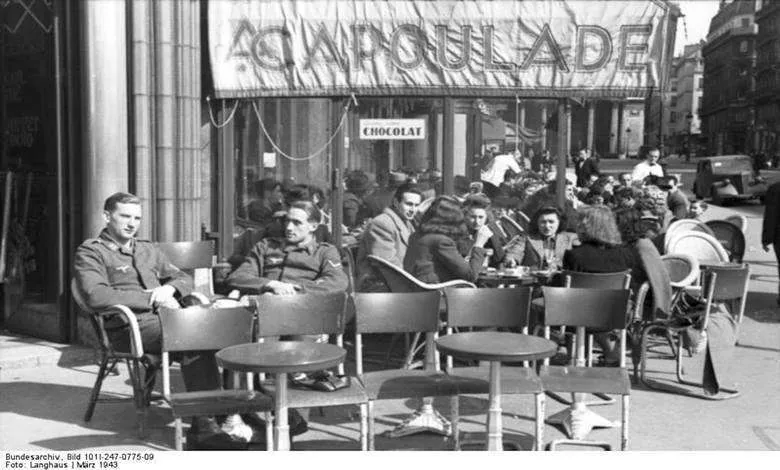
The name itself first appeared in 1934, during a turbulent stretch for French intellectual life. World War I had wiped out a generation of scholars, and university textbooks had grown desperately stale. The basic calculus book in use was more than twenty-five years old. Young professors André Weil and Henri Cartan needed a more rigorous way to teach Stokes' theorem, a foundational result in calculus. Weil called a meeting at the Café Capoulade in Paris on 10 December 1934, where nine mathematicians gathered and decided to write a joint analysis textbook together.
They hoped to finish in six months. They jokingly named themselves after General Charles-Denis Bourbaki, a French general who was deceived during the Franco-Prussian War. The joke outgrew them. What began as a plan for one textbook became an ambition to lay out the foundations of all mathematics, a project that would consume them for decades.
A Secret Meeting at Café Capoulade
On the evening of 10 December 1934, nine young mathematicians gathered at a bustling Paris café called Capoulade, and in doing so, they accidentally launched one of the most influential intellectual projects of the twentieth century. The man who pulled them together was André Weil, a newly appointed young professor who was frustrated with the state of French mathematics education. He and his colleague Henri Cartan, also freshly installed in his professorship, shared a specific irritation: the way Stokes' theorem was being taught felt sloppy, imprecise, and frankly outdated.
Their complaint ran deeper than one theorem. World War I had wiped out an entire generation of French intellectuals, and the standard calculus textbook still in use at universities was more than twenty-five years old. Weil suspected he and Cartan weren't alone in wanting something better, so he called a meeting. Nine mathematicians showed up at Capoulade that December evening, and over coffee, they hatched a deceptively simple plan: write a joint analysis treatise that would serve as the curriculum for a differential and integral calculus certificate, designed to remain valid for a quarter of a century. They figured the whole thing would take about six months.
The group needed a name for their little project, and in a spirit of pure mischief, they borrowed one from an old French general who had been famously tricked during the Franco-Prussian War. That general's name was Bourbaki, and with that joke, the collective pseudonym Nicolas Bourbaki was born. None of the nine men at that café table could have guessed that their six-month detour would spiral into a decades-long project that would reshape modern mathematics, nor that the fictional identity they created would eventually become more famous than any of their real names.
The Collective Behind the Name
What started as a practical fix for outdated textbooks became something far more ambitious: Nicolas Bourbaki, the fictional mathematician who never existed, evolved into a collective determined to rebuild the entire edifice of mathematics from its foundations. By the late 1930s, the group's original goal of clarifying Stokes' theorem had transformed into a sweeping project to lay out the logical groundwork for every branch of the discipline.
The transformation happened organically. After their first meeting on 10 December 1934 at the Café Capoulade in Paris, nine young mathematicians, including André Weil and Henri Cartan, initially planned a six-month project to write a modern analysis textbook. But as drafts piled up and discussions grew deeper, they realized they were chasing something much larger. Their ambition expanded to encompass set theory, algebra, topology, and beyond, a unified vision they would call Éléments de Mathématique.
To manage this monumental effort, the group established a rigorous rhythm. Three times a year, members gathered for what they called Bourbaki "conferences," intense working sessions where new chapters were dissected line by line. The process itself was grueling: one member would draft a section, then the entire group would read it aloud, offering corrections and objections. This cycle repeated until every single member agreed the text was ready for publication. The result was a publishing pipeline so demanding that individual chapters could take ten years or more to reach print.
Over generations, the ranks swelled with some of Europe's most brilliant mathematicians. Weil and Cartan were joined by Jean Dieudonné, Laurent Schwartz, Armand Borel, and eventually Alexander Grothendieck, each drawn to the group's uncompromising standards and collective spirit. The anonymity was absolute, and the collaboration was intense. What emerged from this cauldron of criticism and consensus was a body of work whose influence far exceeded what any single one of these towering figures could have achieved alone.
The Éléments de Mathématique and Its Legacy
What the group actually produced was not a quick textbook but a monumental, decades-long project called Éléments de Mathématique (Elements of Mathematics), an ambitious attempt to rebuild every branch of mathematics from its logical foundations upward. The popular version of the story claims the work was finished in 1939 at about 6,000 pages, but that is incorrect. The treatise appeared in multiple volumes over many decades, and today it exceeds 6,000 pages, a sprawling set of books still growing.
The volumes walk through set theory, abstract algebra, topology, analysis, Lie groups, and Lie algebras, examining theorems from the ground up without skipping a single step. Every definition, every lemma, every proof gets laid bare in the group's famously austere style. The ambition was total: to unify all of mathematics inside one logical framework, so that no result rested on unspoken assumptions.
That rigor left permanent fingerprints on the language mathematicians use every day. The Bourbaki group introduced the empty set symbol (∅) and popularized the terms injective, surjective, and bijective for describing how functions map elements. Before Bourbaki, these distinctions existed but lacked crisp, universally adopted names. Now they are standard vocabulary in classrooms worldwide.
The group's name also attaches to several significant results. The Bourbaki-Witt theorem, the Jacobson-Bourbaki theorem, and the Bourbaki-Banach-Alaoglu theorem all carry the collective moniker, reflecting the group's role in generalizing and sharpening earlier work. Mathematician Barbara Pieronkiewicz has noted that the Éléments provides a solid foundation for all of modern mathematics, a judgment shared by generations of researchers who reached for those green volumes as definitive references.
The Bourbaki Seminar and a Culture of Secrecy
Since 1948, the Bourbaki Seminar has drawn mathematicians to the Institut Henri Poincaré in Paris, and today it carries more weight in the field than the group's own books. The twist? The people presenting at these public lectures never reveal who they are. Members attend, deliver talks, and vanish back into anonymity, all while the audience knows full well that the speaker belongs to the collective known as Nicolas Bourbaki.
That secrecy is maintained as what members call a "fun tradition," but it serves a serious purpose. By keeping individual identities hidden, the books and lectures appear to emerge from mathematics itself, not from any single person's opinions or biases. The fiction runs deep. Over the years, the group fabricated documents to make their imaginary colleague feel real: a wedding announcement for Bourbaki's daughter Betty, a baptism certificate in her name, and an elaborate family genealogy tracing the lineage back to an ancestor reportedly raised as Napoleon's son.
The hoax occasionally collided with the real world in uncomfortable ways. At the start of World War II, the French mathematician André Weil was visiting Finland when officials detained him on suspicion of espionage. According to the account, they found on him fake identity papers, business cards printed in Bourbaki's name, and invitations from the Russian Academy of Sciences. The story goes that Weil was released only after an officer recognized him as a famous mathematician. The specific details of those papers and cards are not consistently confirmed, but the spy scare itself is documented fact from 1939.
Even as the seminars became the group's most visible export, the commitment to anonymity never wavered. Members kept producing texts according to their founding principles, and the lectures at the Institut Henri Poincaré continued to showcase the most important recent results in mathematics, all delivered by speakers whose names the audience would never learn.
The 1968 Obituary and a Continuing Legacy
In 1968, the collective behind Nicolas Bourbaki decided the joke had run its course and published a mock obituary for their fictional founder, packed with the kind of mathematical wordplay only insiders would fully appreciate. It was a fitting farewell for a man who never breathed, never wrote a line, and yet somehow reshaped modern mathematics. But here is the twist: the obituary did not end the story. It never does with this group.
New mathematicians kept joining the ranks, and the collective simply carried on. By then, their sprawling publications had already become standard reference works, consulted by serious researchers the way others consult dictionaries. The Bourbaki seminar, held regularly at the Institut Henri Poincaré in Paris, continues to this day, a fixture that draws mathematicians eager to hear the latest breakthroughs presented with the group's signature rigor.
The mock obituary stands as the final, perfect joke: a death announcement for someone who never lived, written by people who refused to die. The collective lives on, its influence still woven into the fabric of modern mathematics, proof that sometimes the most enduring minds are the ones that never existed at all.
Frequently asked questions
Who was Nicolas Bourbaki?
Nicolas Bourbaki never existed as a person. He was a fictional persona, a collective pseudonym adopted by a group of mostly French mathematicians who published groundbreaking work under that single name from 1934 onward. The name belonged to no individual, yet it became one of the most influential forces in twentieth-century mathematics. The joke started in Paris in 1934, when a handful of young professors decided they needed a fresh, rigorous approach to teaching calculus. They picked the name of a French general from the Franco-Prussian War, General Charles-Denis Bourbaki, who had been famously outmaneuvered in battle. The mathematicians found that irony irresistible. What began as a playful alias for nine colleagues grew into a multi-generational institution that reshaped how mathematics is written, taught, and understood.
Why did mathematicians create the Bourbaki collective?
In 1934, French universities were still relying on a calculus textbook that was more than twenty-five years old. Young professors André Weil and Henri Cartan found it painfully outdated, especially when teaching Stokes' theorem, a fundamental result that demanded precision. They wanted something better, so they decided to write it themselves. Weil organized a meeting at the Café Capoulade in Paris on 10 December 1934. Nine mathematicians attended and agreed to produce a joint analysis treatise that would serve as a curriculum for the next quarter century. They optimistically expected to finish in six months. Instead, the project expanded far beyond calculus, evolving into an ambitious attempt to rewrite the foundations of all mathematics. The six-month plan turned into decades of work.
How did the Bourbaki group keep its identity secret?
The group worked hard to make Nicolas Bourbaki seem real. Members fabricated documents, including a wedding announcement for Bourbaki's daughter Betty and a baptism certificate. They spread rumors that Bourbaki was a reclusive Russian genius who would only meet with a select few. They even corresponded with colleagues using the Bourbaki name. Anonymity was enforced even at public seminars. Members attended and presented while keeping their identities hidden, a tradition they maintained seriously. The secrecy was not merely playful. It reinforced the idea that the books were not individual opinions but the expression of mathematics itself, free from personal bias. The group believed collaboration mattered more than personality.
What contributions did Bourbaki make to mathematics?
The group published the multi-volume work Éléments de Mathématique , a comprehensive treatise covering set theory, abstract algebra, topology, analysis, Lie groups, and Lie algebras. The books built everything from first principles, proving theorems step by step without skipping any detail. Today the series exceeds 6,000 pages. Bourbaki also introduced the empty set symbol ∅, which is now standard in mathematics worldwide. The group popularized the terms injective, surjective, and bijective, which describe different types of functions. Several theorems bear the Bourbaki name, including the Bourbaki-Witt theorem, the Jacobson-Bourbaki theorem, and the Bourbaki-Banach-Alaoglu theorem, reflecting the group's direct contributions to their generalization.
Where did the Bourbaki group meet?
The founding meeting took place at the Café Capoulade in Paris on 10 December 1934, where nine mathematicians gathered to plan their collaborative treatise. That café became the birthplace of a mathematical revolution that would span generations. Since 1948, the group has held its seminars at the Institut Henri Poincaré in Paris. These high-profile events present the most important recent results in mathematics to an audience of experts. Members attend anonymously, maintaining the tradition of secrecy even in public. The seminars have become so influential that they are now more widely known than the group's books.
Did Bourbaki publish an obituary in 1968?
Yes, in 1968 the group published a mock obituary for Nicolas Bourbaki, filled with mathematical wordplay and inside jokes. It was a characteristically creative way to acknowledge the fictional nature of their collective persona. But the obituary was not the end of the story. The group continued its work after the announcement. New mathematicians joined over the years, and the collective remained active. The obituary became part of the legend, a playful chapter in a story that refused to conclude. Bourbaki the person never existed, but Bourbaki the institution kept going.
Who were the founding members of Bourbaki?
The group was founded by nine mathematicians who met at the Café Capoulade in Paris on 10 December 1934. André Weil and Henri Cartan were among the founders, both young professors frustrated with outdated teaching materials. Over time, other notable mathematicians joined, including Dieudonné, Schwartz, Borel, and Grothendieck. Membership evolved across generations as older members retired and new mathematicians were invited to join. The collective pseudonym became a badge of honor, with dozens of influential European mathematicians contributing under the Bourbaki name. The list of members reads like a who's who of twentieth-century mathematics, yet the group insisted on collective anonymity rather than individual credit.
What is the Bourbaki seminar?
The Bourbaki Seminar is a series of high-profile lectures held in Paris at the Institut Henri Poincaré, where mathematicians present the most significant recent results in their fields. The seminar has run regularly since 1948, making it one of the longest-standing mathematical traditions in France. Members attend anonymously, presenting work without revealing their individual identities. The seminars have become more influential than the group's books in recent decades. They serve as a barometer for what matters in contemporary mathematics, with speakers chosen to highlight breakthroughs worth the community's attention. The format remains true to the group's founding principles: rigorous, collaborative, and focused on the mathematics itself rather than the people behind it.
Got a take on this? Add your voice to the conversation below →
No comments yet. Be the first.