Mid-Ocean Ridge: Earth's 65,000 km Hidden Mountain System
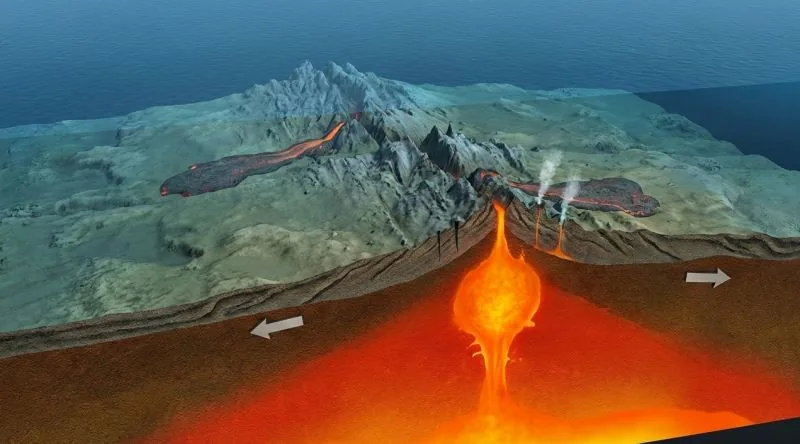
The mid-ocean ridge is Earth's longest mountain system, a nearly continuous 65,000-kilometer chain of underwater volcanoes that winds through every ocean basin, actively reshaping the planet's surface. This hidden backbone of the world, stretching from the Atlantic to the Pacific and Indian Oceans, is where new seafloor is born, and understanding it reveals why our planet's crust is in constant, slow-motion renewal. It is a place of immense darkness, crushing pressure, and surprising life, yet it quietly drives the movement of entire continents.
The mid-ocean ridge is a 65,000-kilometer underwater mountain chain formed at divergent plate boundaries, where magma rises from Earth's mantle to create new oceanic crust. This process, known as seafloor spreading, continuously renews the ocean floor and makes it significantly younger than the continents.
- The mid-ocean ridge system spans approximately 65,000 kilometers across the Atlantic, Pacific, and Indian Oceans, making it the longest mountain range on Earth.
- New oceanic crust is created at divergent plate boundaries, where tectonic plates pull apart and magma rises to fill the gap.
- Because of continuous seafloor spreading, the oldest oceanic crust is only about 200 million years old, far younger than continental rocks that can exceed 4 billion years.
- The Mid-Atlantic Ridge runs down the center of the Atlantic Ocean, while the East Pacific Rise is the fastest-spreading section of the global system.
- The ridge system is marked by volcanic activity, hydrothermal vents, and unique ecosystems that thrive without sunlight.
The Hidden Mountain System That Puts the Andes to Shame
Stretch a tape measure around Earth's middle, along the equator, and you'd cover roughly 40,076 kilometers. Now imagine a mountain range more than one and a half times that length, hiding beneath the waves. That's the mid-ocean ridge, a single interconnected system spanning about 65,000 kilometers across the planet's ocean floors.
To grasp that scale, consider the longest mountain system on dry land. The Alpine-Himalayan belt, which runs from the border of France and Spain eastward toward China, is typically cited at around 10,000 to 12,000 kilometers. Even at its most generous estimates, it barely reaches a fifth of the underwater system's length.
The mid-ocean ridge isn't one continuous spine, though it behaves as one. Its main components include the north-south running Atlantic ridge and the roughly east-west oriented ridges of the Indian and Pacific Oceans. Together, they form a global network that wraps around the planet like seams on a baseball.
What makes this system so remarkable isn't just its size, but how it works. Unlike continental ranges that rise from compression and folding, these ridges are born from tension. Where tectonic plates pull apart, the crust rips open, and magma from below surges up to fill the gap. This linear volcanic activity creates the ridge's distinctive shape, a process geologists call seafloor spreading.
The result is a constant cycle of renewal. New crust forms at the ridges, then slowly migrates away as plates continue their drift. At ocean margins, heavier oceanic plates slide beneath continental plates, sinking into the mantle and melting. This is why the ocean floor stays relatively young, while continents hold onto ancient rock.
How a Mid-Ocean Ridge Is Born: Tension, Not Compression
The birth of a mid-ocean ridge comes down to a simple but powerful force: tension. Where two tectonic plates pull away from each other, the crust tears open along a line, and magma rises from below to fill that gap. That continuous upwelling and accumulation of material builds the ridge.
Because the tearing follows a straight line, the volcanism here is linear. Magma doesn't erupt from scattered points; it oozes up along the entire rift, stacking layer upon layer. Over millions of years, this creates the long, linear bulges that run through the middle of the world's ocean floors. The result is a single connected system stretching roughly 65,000 km, a figure that puts it in a league of its own.
To appreciate that scale, consider Earth's equator, which measures about 40,076 km around. The ridge system is nearly two-thirds longer than the planet's own waistline. It snakes through the Atlantic Ocean on a north-south axis, then roughly east-west through the Indian and Pacific Oceans, all one continuous feature despite being divided into named sections.
This mechanism stands in stark contrast to how mountains form on land. Continental ranges like the Alps or the Himalayas are built by compression, where crustal masses fold and rise under immense pressure. The mid-ocean ridge works in reverse: the crust stretches, thins, and finally rips apart. Tension builds the longest mountain chain on Earth, while compression builds the ones we see from shore.
The Endless Conveyor Belt: Why the Ocean Floor Is Always Young
The ocean floor is on a constant cycle of birth and destruction, which is why the oldest oceanic crust on Earth is only about 180 to 200 million years old, while the oldest continental crust reaches roughly 4 billion years. This remarkable age gap exists because oceanic plates are denser than continental plates, so at ocean margins they sink beneath, melt, and return to the mantle. Meanwhile, new crust forms at the mid-ocean ridge, creating a self-sustaining loop that keeps the seafloor perpetually young.
Picture a slow-motion conveyor belt running beneath the waves. At the mid-ocean ridge, tectonic plates pull apart, cracking the crust open. Magma rises from below to fill the gap, cooling into fresh basalt that becomes brand-new seafloor. As plates keep drifting, that new crust moves away from the ridge, and the empty space gets filled again by more magma. This process, called seafloor spreading, runs continuously, recycling the ocean bottom like a planetary assembly line.
At the edges of the oceans, the opposite happens. The heavier oceanic plate dives under the lighter continental plate, sinks into the mantle, and melts away. This loss at the margins is perfectly balanced by the creation at the ridges. The crust lost at the coasts gets replaced at the mid-ocean ridge, keeping the system in equilibrium.
The contrast between land and sea crust is staggering. Continental crust can survive for billions of years, with the oldest known samples dating back about 4 billion years. The ocean floor, however, never gets that old. The oldest oceanic crust found anywhere on Earth is only around 180 to 200 million years old, a blink in geological time. Contrary to some accounts that claim 340 million years, the actual record shows the seafloor simply does not last that long before being subducted and recycled.
This constant renewal means the ocean floor we see today is geologically fresh, forever young compared to the ancient continents. The mid-ocean ridge system, stretching roughly 65,000 kilometers across the globe, drives this endless cycle, ensuring that the ocean bottom never grows old.
Frequently asked questions
What is a mid-ocean ridge?
A mid-ocean ridge is a submerged mountain system formed where magma wells up at divergent plate boundaries. These underwater ranges wrap around the globe like seams on a baseball, and they hold the title for the longest mountain chain on Earth. They are the places where our planet literally builds new ocean floor.
How long is the mid-ocean ridge system compared to continental mountains?
At roughly 65,000 kilometers, the global mid-ocean ridge system dwarfs anything on dry land. To put that in perspective, the Alpine-Himalayan belt, the longest mountain chain on the continents, stretches from the France-Spain border to China. The mid-ocean ridge system is several times longer than that entire continental chain. It even beats Earth's equator, which measures about 40,076 kilometers around.
How do mid-ocean ridges form?
The process is surprisingly straightforward. At divergent boundaries, the crust tears apart along a line, and magma from below rushes in to fill the gap. This molten rock cools and solidifies, creating brand-new oceanic crust. Because the volcanic activity happens along a crack rather than at a single point, it produces a long, linear ridge instead of a cone-shaped volcano.
Why is the oceanic crust younger than continental crust?
Seafloor spreading continuously renews the ocean floor. New crust forms at the ridges, then slowly moves away as fresh magma replaces it, while old crust gets pulled down into the mantle at ocean trenches. Continents, by contrast, survive for billions of years. The oldest continental crust ever found is about 4 billion years old, while the ocean floor is constantly recycled and never gets nearly as ancient.
What is the oldest oceanic crust on Earth?
The original account claims the oldest oceanic crust is 340 million years old, but that figure is off. Geologists place the true age of the oldest ocean floor at about 180 to 200 million years. Because seafloor spreading constantly recycles the crust, nothing older has survived. This is why the oceans hold no record of Earth's early history the way continents do.
Where are the main mid-ocean ridges located?
The Atlantic Ocean hosts a ridge running north-south down its center, while the Indian and Pacific Oceans have ridges that run roughly east-west. Though they have different names in different oceans, they are all part of one interconnected system. Together they form a single, continuous chain of underwater mountains encircling the globe.
Got a take on this? Add your voice to the conversation below →
No comments yet. Be the first.