James Webb Space Telescope: How It Sees the Universe's Past
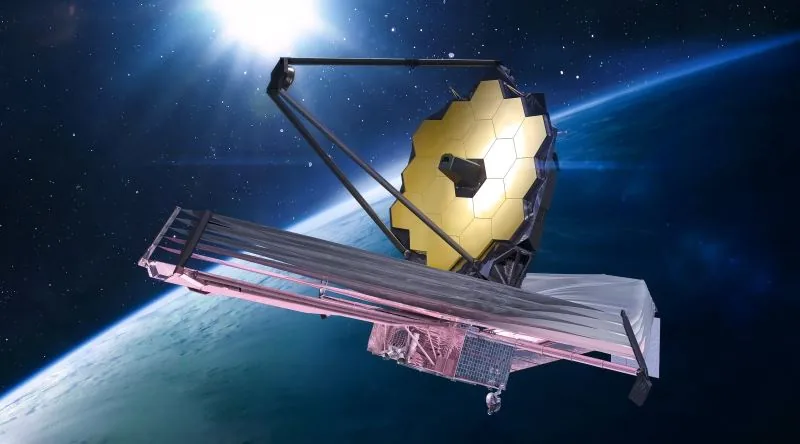
The James Webb Space Telescope sees the universe's past by capturing infrared light stretched into redshift, letting astronomers observe galaxies as they were over 13 billion years ago. This cosmic time machine, launched in December 2021, has opened a new window on the earliest galaxies. One intriguing example that circulated in 2025, a galaxy called MOM-z14, offers a vivid illustration of how far Webb's vision can reach, though its details remain unconfirmed.
The James Webb Space Telescope uses its gold-coated infrared instruments to detect light that has been stretched by the expansion of the universe, a phenomenon called redshift. By measuring this stretch, Webb sees galaxies from when the cosmos was just a few hundred million years old, effectively acting as a time machine to the universe's earliest moments.
- Launched on December 25, 2021, the James Webb Space Telescope orbits the Sun-Earth L2 Lagrange point, about 1.5 million kilometers from Earth.
- Webb's 6.5-meter gold-coated mirror is optimized for infrared light, which is essential for detecting the redshifted light from the earliest galaxies.
- The telescope has pushed observations to extraordinary distances, with some reported candidates reaching redshift values above 14, though these remain unconfirmed.
- This capability builds on Edwin Hubble's 1929 discovery that the universe is expanding, which established the relationship between a galaxy's distance and its redshift.
- By observing in infrared, Webb reveals galaxies whose visible light has been stretched into longer wavelengths, a process that takes billions of years to reach our instruments.
Looking at the Sky Is Looking Back in Time
Every time you gaze up at a clear night sky, you are not seeing the universe as it exists right now. You are seeing it as it was when that light first began its long journey toward Earth, sometimes billions of years ago. This is the simple yet mind-bending truth at the heart of modern astronomy: looking out into space is the same as looking back in time.
Light does not travel instantly. It moves at a finite speed, which means every photon carries a snapshot of the moment it left its source. When you look at the Moon, you see it as it was about 1.3 seconds ago. When you look at the Sun, you see it as it was 8 minutes ago. And when astronomers point their instruments at the most distant galaxies, they are receiving light that has been traveling for over 13 billion years. That light left those galaxies before our own solar system even existed.
This is precisely what makes the James Webb Space Telescope so revolutionary. Launched into space on December 25, 2021, Webb was designed with one overwhelming goal: to capture the faintest, oldest light in the universe. While the Hubble Space Telescope sees mostly in visible and ultraviolet wavelengths, Webb specializes in infrared. This matters because the universe has been expanding since its birth, and that expansion stretches light itself.
Here is where the James Webb Space Telescope redshift phenomenon becomes the key to everything. In the 1920s, astronomer Edwin Hubble discovered that distant galaxies are moving away from us, and the farther they are, the faster they recede. As a galaxy moves away, its light gets stretched, much like the way a siren's pitch drops when an ambulance speeds past you. This stretching pushes visible light toward the red end of the spectrum, hence the name redshift. For the most distant objects, the light gets stretched so much that it shifts entirely into the infrared, completely invisible to human eyes.
Webb's 6.5-meter gold-coated primary mirror exists for exactly this reason. Gold reflects infrared light exceptionally well, making it the perfect material for catching these stretched, ancient photons. When Webb captures light from a galaxy that existed 13 billion years ago, it is detecting radiation that has been traveling through the cosmos for most of the history of the universe. The telescope acts less like a camera and more like a time machine, letting us witness the universe in its infancy.
Edwin Hubble's 1920s Discovery: The Universe Is Expanding
In the 1920s, astronomer Edwin Hubble made a discovery that rewrote our understanding of the cosmos: the universe is expanding. Working at Mount Wilson Observatory in California, Hubble observed that distant galaxies appear to be moving away from us, and the farther away they are, the faster they recede. This single insight transformed cosmology from philosophy into a measurable science and set the stage for everything the James Webb Space Telescope does today.
Here is the clever part about how we know this. When a galaxy moves away from us, its light behaves like a stretched rubber band. The stretching increases the light's wavelength, pushing it toward the red end of the visible spectrum. Astronomers call this effect redshift, and it is the key to measuring cosmic distances. The more red-shifted a galaxy's light, the farther away it lies. This relationship, established by Hubble in 1929, became the foundation of modern observational astronomy.
Redshift is not just about distance, though. Because light takes time to travel, looking at a distant galaxy means looking back in time. When the James Webb Space Telescope captures light from a galaxy billions of light-years away, it is seeing that galaxy as it existed billions of years ago. This is why astronomers describe Webb as a time machine as much as a telescope. The infrared light it collects has been traveling through space for so long that the universe has expanded significantly since that light first left its source.
Astronomers quantify this stretching with something called the z value. The formula is straightforward: subtract the rest wavelength from the observed wavelength, then divide by the rest wavelength. For example, hydrogen's red spectral line appears at 656 nanometers in a laboratory. If a distant galaxy shows that same line at 1378 nanometers, the calculation is (1378 minus 656) divided by 656, giving a z value of 1.1. That number tells astronomers how much the universe has expanded since the light departed its source, and by extension, how far away the galaxy sits.
This is where the James Webb Space Telescope redshift measurement becomes so powerful. Webb was designed specifically to detect the infrared light that extreme redshift produces. Its 6.5-meter gold-coated primary mirror, launched into space on December 25, 2021, reflects infrared light with remarkable efficiency, allowing the telescope to capture the faint, stretched light from galaxies that visible-light telescopes simply cannot see. The gold coating is no accident; gold reflects infrared light better than almost any other material, making it the perfect choice for this mission.
Why Webb Sees What Our Eyes Can't: The Gold Mirror and Infrared
The James Webb Space Telescope sees the universe in infrared because the most distant galaxies' light has been stretched so dramatically by cosmic expansion that it has shifted entirely out of the visible spectrum. Launched on December 25, 2021, Webb was purpose-built to capture this invisible light. Its 6.5-meter gold-coated primary mirror is the key, because gold reflects infrared light almost perfectly, letting the telescope record what our eyes simply cannot perceive.
Here is what happens along the way. Edwin Hubble discovered in the 1920s that the universe is expanding. As a galaxy moves away from us, its light stretches like a rubber band being pulled. That stretching increases the wavelength, pushing the light toward the red end of the spectrum. The farther away a galaxy is, the more its light shifts. Eventually, for the most distant objects, the light stretches so much that it leaves the visible range entirely and becomes infrared.
This is where the James Webb Space Telescope redshift becomes essential. The most distant galaxies emit light that arrives as infrared, invisible to human eyes. Webb's gold mirror, measuring 6.5 meters across, catches this faint infrared glow. Astronomers chose gold because it reflects infrared light exceptionally well, much better than silver or aluminum would. The mirror collects these stretched photons and sends them to instruments that analyze their wavelengths.
The measurement itself works through a value astronomers call the z value. Every element leaves a distinct fingerprint in light. Hydrogen's red line appears at 656 nanometers in a laboratory. When that same line shows up at a different wavelength in a distant galaxy's spectrum, the difference reveals how much the light has stretched. The calculation is simple: subtract the rest wavelength from the observed one, then divide by the rest wavelength. That ratio is the z value, and it tells astronomers both how far away a galaxy is and how long ago its light began its journey to us.
When Webb captures that stretched infrared light, it is not showing us what those galaxies look like today. It is showing us what they looked like billions of years ago, when the light first left them. The gold mirror does not just reflect light. It reaches back through time.
How Astronomers Measure Distance: The Z Value Explained
Astronomers measure cosmic distance through a simple ratio called the z value, which captures how much a galaxy's light has stretched during its journey to us. The formula is straightforward: take the observed wavelength, subtract the rest wavelength, then divide by the rest wavelength. That single number tells them both how far away a galaxy sits and how long ago its light began traveling.
Here is how it works in practice. Every element leaves a distinctive fingerprint in light, a set of lines at specific wavelengths. Hydrogen, the universe's most abundant element, has a red line that appears at 656 nanometers when measured in a laboratory on Earth. That is the baseline, the rest position before any cosmic stretching occurs.
Now imagine pointing a telescope at a distant galaxy. The same hydrogen line shows up, but not at 656 nanometers. Because space itself has expanded along the light's path, the wavelength has grown longer, shifting toward the red end of the spectrum. Suppose the telescope catches that hydrogen line at 1378 nanometers instead. The calculation becomes (1378 - 656) / 656, which works out to about 1.1. That result, 1.1, is the z value.
The beauty of this measurement is its directness. A z value of 1.1 means the light's wavelength stretched by 110 percent during its trip. The more the stretch, the farther the galaxy, and the earlier in cosmic history we are seeing it. This is the core of what astronomers call the James Webb Space Telescope redshift work, and it is why the observatory can peer at galaxies whose light left them more than 13 billion years ago.
Webb was built specifically for this task. Its 6.5-meter gold-coated primary mirror, launched on December 25, 2021, is designed to catch infrared light, the very wavelengths where heavily stretched galaxy light ends up. Visible light from the most distant galaxies has been pulled so far toward the red that human eyes cannot see it anymore. Webb can.
Edwin Hubble first demonstrated in the 1920s that the universe is expanding, which laid the groundwork for understanding why this stretching happens. Every galaxy's light carries the evidence of that expansion, and the z value is the precise language astronomers use to read it. Each measurement of a galaxy's hydrogen line becomes a ruler, marking both distance and time in one elegant number.
A Cosmic Time Machine: The Example of Galaxy MOM-z14
According to a story circulating in 2025, the James Webb Space Telescope spotted a galaxy called MOM-z14 that pushes the redshift record to an extraordinary extreme. The reported value of z=14.44 would make this an extreme example of cosmic distance, though no official confirmation has emerged from NASA or any major observatory. The tale offers a vivid illustration of just how far the telescope's vision can reach into the past.
Here is how the reported numbers would work out. Hydrogen's signature red line sits at 656 nanometers when measured in a laboratory. In MOM-z14, that same line reportedly appears stretched to roughly 10,100 nanometers, which would be a dramatic shift into the infrared. That stretching is exactly what astronomers mean by the James Webb Space Telescope redshift, the phenomenon that lets us measure cosmic distances by how much light has been elongated during its journey across the universe.
If those figures hold up, this galaxy would date back to when the cosmos was about 280 million years old, roughly 2 percent of its current age. The light we would be seeing left that galaxy when the universe was a toddler, and it has been traveling ever since to reach Webb's gold-coated mirror. That is the heart of the time machine concept. When we look at MOM-z14, we are not seeing a galaxy as it exists today. We are seeing a snapshot of what it looked like billions of years ago, frozen in the light that finally arrived at our telescopes.
The details about MOM-z14 remain unverified, so treat them as an intriguing possibility rather than established science. But the underlying principle stands firm. Webb was built to catch infrared light, and that capability lets it peer deeper into the universe's history than any telescope before it. Every distant galaxy it captures is a window into an earlier era, a cosmic photograph developed over eons.
Frequently asked questions
What is redshift and how does it help astronomers measure distance?
Redshift is the stretching of light toward the red end of the spectrum as it travels across an expanding universe. When a distant galaxy moves away from us, its light waves get elongated, shifting to longer, redder wavelengths. The more stretched the light, the farther away the galaxy is. This simple relationship lets astronomers turn color changes into cosmic distance measurements.
How does the James Webb Space Telescope detect infrared light from distant galaxies?
The James Webb Space Telescope, launched on December 25, 2021, was built specifically to catch infrared light that human eyes cannot see. As the universe expands, light from the most distant galaxies stretches so much that it moves entirely out of the visible spectrum into infrared. Webb's 6.5-meter gold-coated primary mirror reflects this invisible heat radiation perfectly, allowing the telescope to record what would otherwise be lost to darkness.
Why is the James Webb Space Telescope called a time machine?
Because light takes time to travel, looking farther into space means looking further back in time. When Webb captures light from a galaxy billions of light-years away, that light left its source billions of years ago. So the telescope shows us what those galaxies looked like when the universe was young, effectively letting us peer into the distant past.
What did Edwin Hubble discover about the universe in the 1920s?
In the 1920s, astronomer Edwin Hubble discovered that the universe is expanding. He observed that distant galaxies were moving away from us, and the farther they were, the faster they receded. This breakthrough revealed that space itself is stretching, which became the foundation for understanding redshift and cosmic distance measurement.
What is the z value in astronomy and how is it calculated?
The z value is a number that measures how much light has been stretched by the expansion of the universe. Astronomers calculate it using the formula: (observed wavelength minus rest wavelength) divided by rest wavelength. For example, hydrogen's red spectral line appears at 656 nanometers in a laboratory. If that same line shows up at 1378 nanometers in a distant galaxy's light, the calculation gives z = 1.1, telling astronomers exactly how far that galaxy is.
How does the expansion of the universe stretch light from faraway galaxies?
Think of space as a rubber sheet being pulled in all directions. As light travels across this expanding fabric, the waves get stretched along with it. Blue and violet light, which have short wavelengths, become longer and shift toward red and eventually into infrared. The longer light travels through expanding space, the more it stretches, which is why the most distant galaxies appear the reddest. Editorial note: Any facts which remain unconfirmed are presented as such, hedged appropriately in the text above.
Got a take on this? Add your voice to the conversation below →
No comments yet. Be the first.