James Webb Pillars of Creation: Two 2022 Views Explained
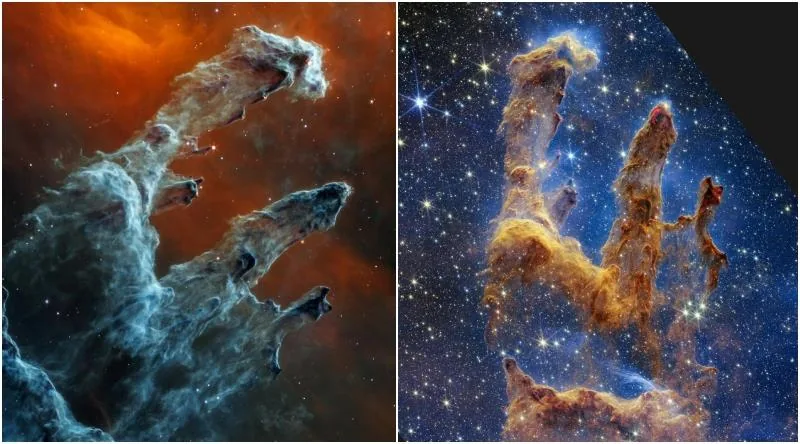
The James Webb Space Telescope released two distinct views of the Pillars of Creation in 2022, and comparing these James Webb Pillars of Creation images reveals what a single wavelength range cannot: one shows newborn stars piercing through obscuring dust, while the other traces the cooler dust itself. Captured in October 2022 within the Eagle Nebula, roughly 6,500 light-years away in the constellation Serpens, these twin portraits transform a familiar cosmic landmark into a layered story of stellar birth, inviting you to look past the iconic pillars and see the hidden mechanics of star formation.
In October 2022, the James Webb Space Telescope imaged the Pillars of Creation in the Eagle Nebula using two instruments. The NIRCam image highlights young stars glowing in near-infrared light, while the MIRI image reveals cooler dust and gas in mid-infrared. Together, they show where stars are actively forming.
- NASA released the first James Webb image of the Pillars of Creation on October 19, 2022, captured by the NIRCam instrument.
- A second James Webb image of the Pillars, taken with the MIRI instrument, followed on October 28, 2022, showing the region in mid-infrared light.
- The Pillars of Creation sit inside the Eagle Nebula, about 6,500 light-years from Earth in the constellation Serpens.
- The NIRCam view shows bright, newly formed stars emerging from the pillar tips, while the MIRI view reveals cooler dust and gas that obscures most background stars.
- Both 2022 images build on the earlier Hubble Space Telescope views of the same region, offering a sharper, deeper look at star formation.
Two Photos, One Cosmic Wonder: The James Webb Pillars of Creation Images, Explained
Why would one telescope produce two wildly different pictures of the same object? The answer comes down to the cameras themselves. In October 2022, the James Webb Space Telescope turned its instruments toward the Pillars of Creation, a star-forming region in the Eagle Nebula roughly 6,500 light-years from Earth, and captured two distinct views using its NIRCam and MIRI instruments. Each camera sees a different slice of the infrared spectrum, and that single difference transforms the entire scene.
The Pillars of Creation look like towering rock formations rising from a desert floor, but they are actually semi-transparent columns of gas and dust, constantly shifting and churning. This is where young stars are born, struggling to break free from the dusty cocoons that surround them. When you look at the two James Webb Pillars of Creation images side by side, you are essentially peeking through different windows into the same nursery.
The near-infrared camera, NIRCam, pierces through much of the obscuring dust. Its image sparkles with stars, many appearing as bright red spheres with eight diffraction spikes radiating outward. These spiky stars are the newborns, some estimated to be only a few hundred thousand years old. Along the edges of the pillars, you can spot wavy, lava-like lines. These are jets of material ejected by forming stars, creating shock waves that ripple through the dense clouds like a boat cutting through water.
The mid-infrared instrument, MIRI, tells a completely different story. Here, most stars seem to vanish. That is because young stars emit most of their energy in ultraviolet, visible, and near-infrared light, not in the mid-infrared range. The stars that do appear in this image are still wrapped in dusty shrouds, glowing faintly through their cocoons. The densest, coldest regions of gas and dust show up as the darkest gray patches, while a delicate red "V" shape near the top marks an area where the dust is more diffuse and cooler.
These two views are not just beautiful; they are complementary data sets. NIRCam reveals the stars themselves, while MIRI maps the dust that will fuel future generations of stars. Together, they give researchers a far more complete picture of how stars form and evolve within these massive clouds over millions of years.
The Hubble Legacy: How the 1995 and 2014 Images Set the Stage
Before the James Webb Space Telescope turned its gold-plated eye toward the Eagle Nebula, the Hubble Space Telescope had already made the Pillars of Creation famous, capturing the region in 1995 and again in 2014. Those earlier images, taken in visible light, painted a scene that looked like a desert sunrise, with yellows at the bottom melting into pale greens and deeper blues toward the top. That warm palette was doing more than looking pretty. It was highlighting just how thick the gas and dust around the pillars really were.
And that thickness came with a cost. The dense material that made the pillars so dramatic on camera was also hiding a huge number of stars behind it. The visible-light view simply could not see through the veil. Hubble showed us a magnificent wall of cosmic structure, but it left the stars themselves largely out of frame, obscured by the very clouds that were birthing them.
That is where the James Webb Pillars of Creation images change everything. Webb's infrared vision works differently. Instead of being blocked by the dust, the longer wavelengths slip through it, letting astronomers see the young stars that Hubble could only hint at. The familiar pillars are still there, but now they glow with a new kind of light, revealing a crowded stellar nursery that was always hiding in plain sight.
NIRCam's View: Young Stars Breaking Out of Dusty Cocoons
When the James Webb Space Telescope turned its Near-Infrared Camera, or NIRCam, toward the Pillars of Creation in October 2022, it didn't just take a prettier picture than Hubble. It revealed the region's true headline act: the stars themselves, blazing as bright red spheres crowned with eight diffraction spikes. These aren't ancient suns. Some are only a few hundred thousand years old, practically newborns in cosmic terms, and they'll keep gathering mass and brightening for millions of years to come.
The difference between Webb's view and Hubble's 1995 and 2014 portraits comes down to light. Hubble photographed the Pillars in visible light, which the thick clouds of gas and dust absorb and scatter, hiding countless stars behind a glowing, sunrise-colored haze. NIRCam, by contrast, works in near-infrared, a wavelength that slips through the dust like a hand through smoke. The result is a background awash in blue tones, a hue that highlights hydrogen atoms and pulls thousands of previously hidden stars into view.
Look closely at the edges of the pillars and you'll spot wavy lines, almost like lava flowing in slow motion. Those are jets of material blasted out by young stars still forming inside the columns. As these jets slam into the surrounding gas and dust, they create shock patterns, ripples that resemble the wake trailing behind a boat cutting through water. Each wave marks an episode of a star feeding, growing, and pushing back against the very cocoon that birthed it.
NIRCam's ability to pierce the dust lets astronomers spot stars that are either freshly formed or about to break free. Yet the image holds a curious absence. No distant galaxies pepper the background, despite the telescope's power to see across cosmic time. The reason is a translucent layer of gas hanging between us and the deeper universe, a veil that blocks the view. It's like standing in a brightly lit room and trying to see through a window at night; the light inside reflects back, hiding whatever lies beyond. That same scattered light, however, illuminates the region, making the pillars themselves glow with detail.
MIRI's View: The Dust That Builds Stars
When the James Webb Space Telescope turned its Mid-Infrared Instrument, or MIRI, toward the Pillars of Creation in October 2022, it captured something entirely different from its companion camera. The MIRI image is all about dust, the essential raw ingredient for star formation, and it reveals the pillars in shades of blue-gray that feel almost ghostly. This view strips away the familiar and shows us the cold, dense material that will one day become new stars.
At first glance, the MIRI image seems strangely empty compared to the NIRCam version. The stars appear to be missing, but they are not actually gone. Stars simply do not emit much mid-infrared light. They are easiest to detect in ultraviolet, visible, and near-infrared wavelengths, which is why the NIRCam image sparkles with them while the MIRI view looks quieter and more subdued.
Look closer at the MIRI image and two distinct types of stars emerge. At the tips of the thick, dusty pillars, you can spot stars that have recently carved away much of the surrounding material but still remain wrapped in dusty cocoons or cloaks. These are the newborns, still swaddled in the very matter that gave them life. In contrast, the stars appearing in blue tones are older, having shed most of their gas and dust long ago. They shine through the mid-infrared view as mature residents of this cosmic neighborhood.
The mid-infrared light also maps out the temperature and density of the dust itself. Near the top of the image, a delicate red "V" shape marks a region where the dust is both more diffuse and cooler. The darkest gray areas tell a different story entirely. These are the places where dust reaches its densest and coldest state, where far fewer stars appear and background galaxies remain completely hidden from view. The scenery seems to clear toward the lower left corner, but those deep gray patches hold the secrets of the pillars' structure.
The MIRI data will help researchers determine exactly how much dust exists in this region and what it is made of. These details will refine the James Webb Pillars of Creation images into far more precise models of star formation, offering a clearer understanding of how stars burst forth from these dusty clouds over millions of years.
What the James Webb Pillars of Creation Images Mean for Star Formation Research
These two views of the Pillars of Creation, captured in October 2022, give astronomers their clearest look yet at how stars are born. Together, the near-infrared and mid-infrared images let researchers count stars and measure gas and dust with far more precision than ever before. That combination is exactly what scientists need to test and refine their models of star formation.
The near-infrared camera (NIRCam) image shines a light on the young stars themselves. Some of those stars, visible as bright red spheres with eight diffraction spikes, are only a few hundred thousand years old. The mid-infrared instrument (MIRI) image tells a different part of the story: stars are largely invisible at these wavelengths because they emit most of their light in ultraviolet, visible, and near-infrared. Instead, MIRI reveals where the dust is thickest and coldest, the very places where new stars are still forming.
Put the two together and you get a fuller picture. NIRCam shows the stars that have already burst through their dusty cocoons. MIRI shows the dense, dark regions where future stars are still gathering mass. By matching star populations against the surrounding gas and dust, researchers can begin to understand how stars form and erupt from these clouds over millions of years.
This is exactly the kind of work the James Webb Space Telescope was built for. Its primary mirror spans 6.5 meters in diameter and is made of 18 hexagonal segments that work together as one giant eye. That mirror, combined with instruments sensitive to different infrared wavelengths, lets Webb peer through dust clouds that block visible light. The two Pillars of Creation images demonstrate what happens when that power is turned on a single, spectacular target.
Got a take on this? Add your voice to the conversation below →
Fantastic