IMDb Hidden Features: What Léon Reveals
IMDb hidden features are the tabs and sections most visitors scroll past, and the 1994 film Léon: The Professional is a perfect tour guide through them. You probably land on a movie page, check the star rating, maybe glance at the cast, and leave. But buried one click deeper sit trivia notes, soundtrack listings, filming locations, a parents guide, and alternate versions that change how you watch a film you thought you knew. Léon rewards that curiosity more than most titles, because its production history is full of small, strange, well-documented details.
IMDb pages hold far more than cast and ratings. Sections like trivia, goofs, soundtracks, filming locations, parents guide, and alternate versions sit one click below the surface. Léon: The Professional, released in 1994, shows how much detail these tabs can hold for a single film.
- Léon: The Professional was written and directed by Luc Besson and released in 1994.
- The film stars Jean Reno as Léon, a hitman, and a young Natalie Portman in her first major role as Mathilda.
- IMDb movie pages include separate sections for trivia, goofs, soundtracks, filming locations, parents guide, and alternate versions.
- A longer international cut of Léon exists, and IMDb's alternate versions section documents how it differs from the theatrical release.
- The parents guide section summarizes mature content so viewers can judge a film's suitability before watching.
IMDb Is More Than Cast Lists: The Hidden Features Most People Never Open
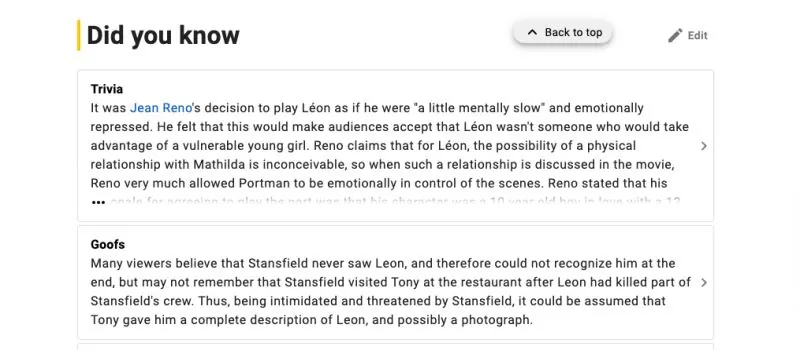
Most of us treat IMDb like a quick pit stop. You land on a title page, scan who directed it, check who's in it, glance at the runtime and the star rating, and you're gone. That habit hides the best part of the site. IMDb hidden features live one or two clicks below the surface, tucked behind buttons labeled "Did You Know" and "Details," and they turn a bare cast list into something closer to a small archive.
I'll use Léon, the 1994 film written and directed by Luc Besson, as the worked example here. Popular titles like this one pull in far more user-contributed material, so the buried sections are unusually rich. The same pages exist for quieter, less famous films too, though the pickings are thinner.
Picture the moment a song plays in a scene and you can't place it. On the film's main page you scroll down to the "Did You Know" heading and hit "see more." That drops you into the "trivia" area first, which is exactly what the name promises: loose scraps of information, some of it genuinely fascinating, some of it skippable. From there you look for "more from this title" and click "soundtracks." Now you have the full list of music used in the film.
The same "more from this title" block holds several other doors. "Goofs" collects the continuity mistakes and on-screen errors. "Crazy Credits" covers oddities buried in the opening or closing credits, and for this film the special thanks section carries a joking line of text. "Alternate Versions" describes different cuts, longer or shorter, when they exist. In the version that runs 26 minutes longer, Mathilda propositions Léon and he turns her down, and in another scene the two of them sleep side by side in a bed.
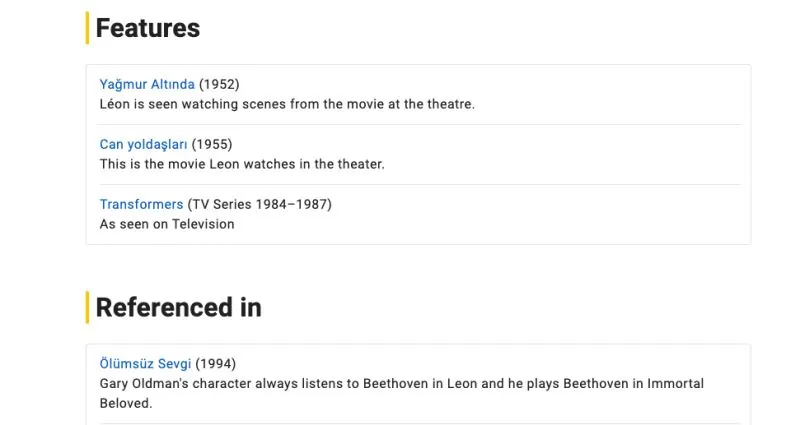
The section I care about most sits under "connections." It opens with "featured in," which lists other productions where part of the film shows up: other movies, documentaries, interviews, special reports. Then "features" flips the direction and lists the works shown inside our film. In one scene, Léon sits in a cinema watching Singin' in the Rain.
"Referenced in" gathers the nods other productions make toward this movie. One entry claims that a scene in The Fifth Element, another Besson film, where Leeloo asks for help, echoes Mathilda's doorstep moment, music included. That reading is widely repeated but hard to pin down as deliberate, so treat it as an interpretation rather than a documented fact. "References" goes the other way, collecting the films our movie points at. One such comparison: Léon putting on the clothes of a police officer he killed, then being carried by other officers, is said to recall Hannibal Lecter's famous maneuver in The Silence of the Lambs. That parallel is suggestive, not confirmed. "Remade as" lists remakes, and "spoofed in" collects the playful jabs, including a scene in Where the Heart Is where Natalie Portman is holding a plant pot.
One thing worth saying plainly: these entries are not handed down as absolute truth. Most of the connections and trivia come from IMDb users, the same crowd that fills in the cast lists, so the reference lists are never complete.
And none of this is exclusive to movies. The trivia, goofs, connections and related sections are maintained for TV series just as they are for films, so the next time a show leaves you with a question, the answer may already be sitting one click down.
Soundtracks, Goofs and Crazy Credits: The 'Did You Know' Rabbit Hole
Scroll to the "Did You Know" block on any IMDb title page, hit "See more," and you land in a small city of information most people never open. The area splits into Trivia, Soundtracks, Goofs, Crazy Credits, Alternate Versions, and Connections. That structure holds for films and for TV series alike, so the same path works whether you are chasing a movie or a show.
Say a song plays in a scene and you have to know what it is. From "Did You Know," look for the "More from this title" heading and click "Soundtracks." You get the full list of music used in the film. Fair warning on the stop before it: Trivia is often pure filler, the kind of stuff you skim or skip without guilt.
Two more links sit in the same cluster. "Goofs" collects the filming mistakes, the continuity slips and visible crew errors that fans love to catalog. "Crazy Credits" flags oddities buried in the opening or end credits, and Léon is a good example: its special thanks section carries a jokey line of text. "Alternate Versions" is the one that changes how you read the whole film. In the version running 26 minutes longer, Mathilda asks Léon to have sex with her and he refuses, and a separate scene shows the two of them sleeping together in bed.
What does the Connections section actually show?
Connections is where the cross-references live, sorted by type. "Featured in" lists other productions that show a piece of your film, whether that is another movie, a documentary, an interview, or a news segment. "Features" works in reverse and lists what your film shows on screen, such as the moment Léon sits in a cinema watching Singin' in the Rain. "Referenced in" gathers homages made elsewhere; one entry claims the scene in The Fifth Element where Leeloo asks for help echoes Mathilda's doorstep moment, music included. "References" points the other way, and one listed example likens Léon putting on a dead officer's clothes and being carried by other officers to Hannibal Lecter's famous move in The Silence of the Lambs. "Remade as" tracks new versions of the film, and "Spoofed in" collects the jokes at its expense, including a reported shot in Where the Heart Is where Natalie Portman stands holding a plant pot.
One caution worth carrying: these pages are not absolute truth. Much of the material, Connections included, is entered by IMDb users, so the lists are far from complete.
The 26-Minute Longer Léon: Alternate Versions and What Changes
Scroll down any film's page on IMDb, click "see more" under "Did You Know," and among the trivia and goofs you will find a link called "alternate versions." That is where a movie's other lives get catalogued: longer cuts, shorter cuts, regional edits, the versions that never played in your local theater.
Léon, Luc Besson's 1994 film about a hitman and the girl he shelters, has one of those alternate cuts. In the version that runs 26 minutes longer, Mathilda wants to have sex with Léon, and he refuses. In a separate added scene, the two of them sleep together in bed. Both scenes belong to the extended cut, and both are documented in that "alternate versions" section.
It is a small link with a strange power. You go in looking for runtimes and end up reading about a relationship the theatrical release never showed you.
Connections: How Léon Echoes Other Films (and Gets Echoed Back)
Scroll to the "Connections" link under a title's Did You Know section on IMDb and you get a map of a film's DNA: what it borrowed, what borrowed from it, what got remade, what got mocked. For Luc Besson's Léon (1994), that map runs from a Gene Kelly musical to a Natalie Portman plant pot. One caveat before we start: Connections entries are largely user-submitted, so they don't claim to be exhaustive. Treat them as leads, not verdicts.
Features: What Léon Watches
The "features" sub-section lists other works shown inside the film. In one scene, Léon sits in a cinema watching Singin' in the Rain. That's the whole entry, and it's a good one: the hitman who sleeps in a chair, alone in a dark theater, grinning at Gene Kelly.
Referenced In: The Fifth Element
Here's where it gets fun. One entry claims that another Besson film, The Fifth Element (1997), contains a scene where Leeloo asks for help that mirrors Mathilda's doorstep plea, music included. Both films share a director and a certain visual grammar, so the echo feels plausible. But a deliberate, note-for-note mirroring has never been confirmed, so file this one under "as the story goes."
References: Hannibal Lecter
Flip the direction and you get "references," the list of other films Léon nods to. One listed example: Léon disguises himself in the clothes of a policeman he's killed, and the sequence is likened to Hannibal Lecter's famous escape in The Silence of the Lambs (1991). He does put on a police-style uniform in the film. The specific "carried by officers" parallel, though, is unconfirmed.
Spoofed In: Where the Heart Is
"Spoofed in" collects the jokey homages. One entry points to Where the Heart Is (2000), where Natalie Portman's character tends a plant she keeps in a pot. Since Portman played Mathilda, and Mathilda carried Léon's beloved houseplant everywhere, the visual rhyme is real. Whether it was meant as a spoof is another matter, and the entry doesn't settle it.
Remade As
"Remade as" lists official reworkings of the film. If a title has them, they show up here with the year and country attached.
Why This Section Is Worth Your Time
Connections is the reason IMDb hidden features reward a slow read. A single link can hand you a 1994 film's whole afterlife: a musical it loves, a sci-fi film that may love it back, a horror classic it winks at, and a 2000 drama that may be teasing it. Just remember who wrote the entries.
Filming Locations, Tech Specs, and the Paris/New York Mix-Up
Here is the path that gets you there: open the title page, scroll to "Details," hit "See more," then look under "More from this title" for "Filming & production." That single link opens a page most people never see, and it is where the geography of a movie gets pinned down.
For Léon, the account on that page says the interiors of Léon's apartment were shot in Paris. Treat that one with a raised eyebrow. The film was made largely in and around Paris, so the interiors being Paris work is entirely plausible, but the specific claim about the apartment interiors has never been nailed down. The same page also names Tony's restaurant as Guido's Supreme Macaroni Restaurant, described as closed today. That, too, is unconfirmed. And it lists the shoot as running from June to October 1993, a window that fits the film's 1993 production but has not been independently verified.
Then there is the one that is simply wrong. If you read that Mathilda's hotel is the Chelsea Hotel in Manhattan, put it down. Léon was shot primarily in Paris, and the Chelsea Hotel is not where Mathilda's hotel scenes were filmed. The Paris/New York confusion is exactly the kind of thing that spreads when a detail gets repeated without a source.
Scroll a little further down the same area and you hit "Tech specs," which is where the camera, the film stock, the lens, and the aspect ratio live. It is the section for people who want to know what the movie was actually shot on, not just where.
The FAQ Page: Why Does Léon Drink So Much Milk?
On Léon's title page, the FAQ sits right at the top level. No "See more" button, no digging through sub-menus. You click it and the questions are already there, written and answered by IMDb users.
One of them asks the question that nags at half the people who finish the film: why does Léon keep drinking milk? He drinks it in his apartment, in the diner, in the middle of a job. The FAQ's answer stacks up in layers. It's irony, the answer says, a hitman whose whole life is violence, pouring himself a glass of milk like a kid at breakfast. It makes him more complex than a man with a gun. It hints that he's giving Mathilda something like a healthy environment, a routine, a table to sit at. And it suggests he's illiterate in the way a child is, that he enjoys simple pleasures, that he is asexual.
Those are the FAQ's words, not a verdict from a film scholar. Treat them the way you'd treat any neighbor leaning over the fence with a theory. IMDb's FAQ answers are user-written, and so are the connections listed elsewhere on the site. Nobody signs off on them. They're a crowd's best guess, collected over years, and the crowd is often sharp but never final.
Parents Guide: Reading the Sex, Violence and Profanity Ratings
Not every movie night is a solo one. Sometimes you have a younger sibling on the couch, or a friend who flinches at blood, and you want to know what you are walking into before the opening credits roll. IMDb answers that with the Parents Guide, and the path is short: open the film's main page, find the "Storyline" heading, and click the "Parents guide" link beneath it. No extra "see more" button required here.
Once you land on it, the page breaks the film down into categories, each tagged with a severity word like mild, moderate, or severe. For Léon, the "violence & gore" entry is rated severe, which tracks with a movie built around a hitman and a lot of gunfire. The other tags are murkier. According to the original account, "sex & nudity" sits at mild, and "profanity" is listed as moderate. Treat those two as reported rather than settled, since the exact wording shifts depending on when the page was last edited.
The guide does not stop at labels. Under each category it lists specific scenes, and for this film the bathroom scene involving Mathilda's parents is placed right at the top of the list. That ordering is a quiet signal: the editors want you to see the roughest moment first.
One number that circulates alongside the profanity tag is a tally of 31 uses of "fuck" and 19 of "shit." That count is reported, not verified, and profanity totals vary from one version of a film to another, so do not treat it as gospel. The same caution applies to the whole Parents Guide: it is assembled largely by IMDb users, not by a ratings board, so it reflects crowd knowledge rather than an official stamp. And this is not a films-only feature. IMDb keeps the same Parents Guide, trivia, and goofs sections running for TV series too, so you can check a show the same way you would check a movie.
Why IMDb's Hidden Features Are a Starting Point, Not a Verdict
Almost everything you just read on those IMDb pages was typed by an ordinary user, not a studio archivist. The trivia entries, the connection lists, the FAQ answers, the parents guide ratings: all of it is crowd-sourced, which is exactly why it is so rich and exactly why you should not treat it as gospel.
Take the milk question. The FAQ explanation for why Léon keeps drinking glass after glass, that it signals irony, complexity, a healthy home for Mathilda, a childlike illiteracy, a man removed from sex, is the version the site carries according to the account. It reads beautifully. It also may not be the filmmakers' own words. Something similar happens with the parents guide. The violence and gore rating of "severe" for Léon is a fair call for a film this bloody, but the "mild" tag on sex and nudity, and the "moderate" tag on profanity, are the kind of labels that shift depending on who last edited the page. The widely repeated claim that the film contains 31 uses of "fuck" and 19 of "shit" is just that, a claim, and profanity counts drift between cuts anyway.
None of this makes IMDb hidden features useless. It makes them a first draft of the truth, which is often the most interesting draft you will find.
The connections tab deserves the same skepticism. It does not capture every reference a film makes. It captures the references somebody bothered to log, which means the list is long but never complete. The rumored Fifth Element nod, where Leeloo's plea for help is said to echo Mathilda at the door, music included, is a lovely reading of two Luc Besson films. It is also unconfirmed. Same with the Silence of the Lambs parallel, the idea that Léon in a dead officer's uniform, carried by police, mirrors Hannibal Lecter's famous escape. The disguise is real. The deliberate homage is not something anyone has nailed down.
And then there are the plain errors. Contrary to the popular version, Mathilda's hotel is not the Chelsea Hotel in Manhattan. Léon was shot primarily in Paris, and the Chelsea was never the filming location. The claim that the apartment interiors were filmed in Paris is plausible but unconfirmed, and the June to October 1993 shooting window is the sort of precise-sounding detail that may or may not hold up. Tony's restaurant being the now-closed Guido's Supreme Macaroni is another one that resists verification.
So use the site the way it was meant to be used. Let the trivia spark the question, then go chase the answer somewhere that can actually back it up.
Frequently asked questions
What are the hidden features on IMDb that most people don't know about?
Most people open IMDb to check a cast list or a director's name and never scroll past the poster. Below the surface sits a "Did You Know" area packed with sub-sections: Trivia, Soundtracks, Goofs, Crazy Credits, Alternate Versions, and Connections. Each one opens a different door into how a film was actually made.
How can I find out what songs play in a movie using IMDb?
Scroll down the title page to the "Did You Know" heading and hit "See More." You land on Trivia first, but the real prize sits lower, under "More From This Title." Click the "Soundtracks" link and you get the full list of every piece of music used in the film, in order.
What does the connections section on IMDb show?
Connections is the deepest rabbit hole on the site. It splits into "Featured In" (other productions that show clips of your film), "Features" (films shown inside your film, like Léon watching Singin' in the Rain in a theater), "Referenced In," "References," "Remade As," and "Spoofed In." It maps how a movie borrows from and feeds into other work.
How do I find filming locations for a movie on IMDb?
Go back to the main title page, scroll to "Details," and click "See More." Find the "More From This Title" block and choose "Filming & Production." That page holds the location data, along with technical specs like camera, film stock, lens, and aspect ratio.
Was there a longer alternate version of Léon: The Professional?
Yes. IMDb's "Alternate Versions" page documents a cut that runs 26 minutes longer than the theatrical release. In that extended version, Mathilda propositions Léon and he turns her down, and a separate scene shows the two of them sleeping side by side in bed.
Why does Léon drink milk in the movie?
The FAQ page on IMDb's Léon entry takes up this exact question. According to the answers collected there, the milk works as irony, complicates the character, hints that Léon offers Mathilda a healthy environment, and suggests he is illiterate like a child, drawn to simple pleasures and uninterested in sex.
How does IMDb's parents guide rate sex, violence, and profanity?
The Parents Guide lives under the "Storyline" heading. For Léon, "Violence & Gore" is rated severe, which tracks with a film this bloody. The "Sex & Nudity" and "Profanity" ratings are harder to pin down, and the exact labels vary depending on which version of the page you're reading.
Are IMDb trivia and connections sections always accurate?
No, and it pays to remember that. Trivia, FAQ answers, and Connections entries are largely written by IMDb users, not studio archivists. They are a starting point for curiosity, not a final authority, and the Connections list in particular does not claim to capture every reference a film contains. Editorial note: Details that remain unconfirmed are presented as such, and readers should treat any hedged item as open to verification.
Got a take on this? Add your voice to the conversation below →
No comments yet. Be the first.