Espresso Brewing: The Math That Makes Shots Consistent
Espresso brewing got a scientific rethink when a team of researchers published a mathematical model showing that using less coffee and a coarser grind can make shots more consistent while trimming waste. Anyone who has pulled a shot at home knows the frustration. You dial in a dose, chase the perfect grind, and the next morning the same recipe tastes completely different. This model suggests the problem may not be your technique at all, but the physics of how water moves through a densely packed coffee bed.
A mathematical modeling study indicates that espresso brewing can become more consistent by using less coffee and a coarser grind. The approach may reduce coffee waste while smoothing out the shot-to-shot variation that frustrates baristas and home brewers alike.
- The research was published in the journal Matter in 2020.
- The model examines how water flows through a coffee bed during espresso brewing and why identical recipes can produce different results.
- It suggests that a smaller dose paired with a coarser grind can improve consistency rather than harm it.
- The original account reports that this approach could reduce coffee consumption by up to 25%, though that figure remains unconfirmed.
- The findings point to espresso brewing variables like dose, grind size, and pressure as a connected system rather than separate knobs to adjust.
Why Your Espresso Tastes Different Every Single Time
You order the same drink at the same café on Monday and again on Friday. Monday it's sweet, chocolatey, almost syrupy. Friday it's thin, sharp, a little burnt at the back of your throat. Same beans, same barista, same machine. So what changed?
Most of us reach for the easy explanation. The recipe must have shifted, or the barista was rushed, or the beans sat too long in the hopper. The research points somewhere less obvious: the inconsistency is baked into espresso brewing itself. It isn't a mistake anyone is making. It's the method.
Espresso sits at the far end of the sensitivity scale. Water is forced under high pressure through a compact bed of finely ground coffee, and because the window is so narrow, tiny shifts swing the flavor profile hard. A gram more coffee, a fraction finer on the grinder, a degree or two of water temperature, a second longer on the shot, and you're drinking a different beverage. The barista is juggling dose, grind fineness, water pressure, water temperature and brew time all at once, and every one of those dials moves the final cup.
Underneath all of it, the original account describes roughly 2,000 chemical compounds in coffee shifting in and out of balance with each shot. That exact figure is hard to pin down; coffee chemistry literature more often cites somewhere between 800 and 1,000 volatile compounds and over 1,000 in total. Whatever the true count, the point holds. You are tasting a balance, not a recipe.
And espresso isn't a niche drink you can ignore if it wobbles. It anchors the entire menu. The latte, the cappuccino, the flat white, the macchiato: all of them are built on a shot of espresso poured underneath. When the base is unstable, everything stacked on top of it inherits that instability. That's why a café can feel wildly inconsistent even when nothing on the menu board has changed.
So the mystery isn't really about your barista having a bad day. It's about a brewing method that leaves almost no room for error, and a drink that the rest of the menu depends on.
The Number That Decides Whether Your Shot Is Sour or Burnt
Extraction yield is the share of a coffee bean's dissolved solids that actually makes it into your cup. Coffee carries oils, acids, sugars and aromatic compounds, and hot water under pressure dissolves those compounds and carries them into the liquid. In espresso brewing, the industry expresses that transfer as a percentage, and the widely accepted target zone runs from 18% to 22%.
That single figure is what turns taste into something you can measure. Pull a shot where only a small fraction of the coffee dissolves and you get a thin, sharp, sour or watery drink. Push too far past the top of the range and the harsh, bitter compounds come along for the ride, leaving the cup overly intense, burnt and rough on the tongue. Same beans, same machine, two completely different drinks.
Here is the part that separates a good barista from a great one. The goal is not one beautiful shot on a lucky Tuesday. The goal is hitting that same flavor again tomorrow morning, and the morning after that. Consistency gets tracked by comparing extraction yields across shots, because a number you can write down is a number you can repeat.
Under 18%: sour, watery, hollow. Over 22%: burnt, harsh, overwhelming. Between the two: the sweet spot where sweetness, acidity and body sit in balance.
This is where the frustration of home espresso brewing usually starts. You dial in a recipe, you love the result, and the next shot tastes like a different coffee entirely. The variables are unforgiving: dose, grind size, water pressure, water temperature and brew time all nudge the extraction yield up or down, and even a barista who sets every one of them correctly can still watch two consecutive shots land in different places.
Coffee chemistry is famously crowded, and the story of espresso brewing often cites a figure of roughly 2,000 distinct chemical compounds swirling around in the cup. That specific number is hard to pin down, so treat it as the kind of detail that gets repeated more often than it gets verified. What is not in doubt is that the ratio in which those compounds dissolve is what you taste.
Once you accept that extraction yield is the dial that matters, the questions change. Not "did that taste good?" but "what percentage was that, and can I get back to it?"
What the 2020 Mathematical Model Found
In 2020, a team of researchers published a paper titled Systematically Improving Espresso: Insights from Mathematical Modeling and Experiment in the journal Matter. The author list runs Michael Cameron, Dechen Morisco, Daniel Hofstetter, Erol Uman, Justin Wilkinson, Zachary Kennedy, Sean Fontenot, William Lee, Christopher Hendon and Jamie Foster. Their question was blunt. Can espresso brewing ever be made consistent, or is the barista chasing a ghost every single morning?
To answer it, they built a mathematical model of the brewing process itself. The model's core measure was extraction yield, the percentage of a coffee bed's soluble material that actually ends up in the cup. In the coffee industry, that number is expressed as a percentage, and the widely accepted target range sits between 18% and 22%. Drop below 18% and the shot tastes sour or watery. Climb above 22% and the drink turns overly intense, burnt and harsh. The barista's real job is not just hitting that window once, but hitting it again and again.
That is where the trouble lives. Even with every variable dialed in, the path water takes through the coffee bed is unpredictable. One shot arrives fruity and chocolatey. The next one, same recipe, same machine, comes out burnt or bitter. The model captured this instability, then pointed at a fix that runs against barista instinct: cut the coffee dose and grind slightly coarser.
Why Less Coffee and a Coarser Grind Work
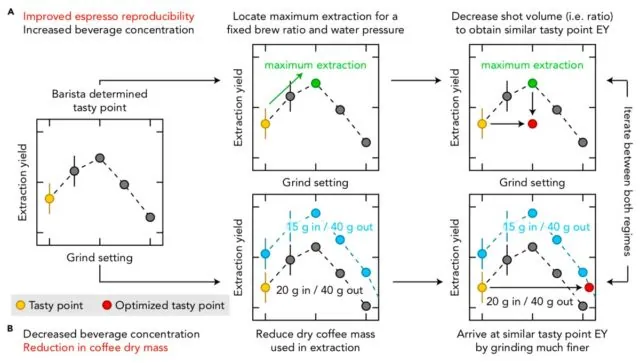
The mechanism is straightforward once you see it. A smaller dose of coffee means less resistance in the puck, so water flows faster and more predictably through the bed. A coarser grind raises the bed's permeability, which lets water distribute more evenly instead of carving unpredictable channels. Together, the two changes make shot-to-shot swings far smaller. The study found that reducing coffee dose and using a slightly coarser grind makes espresso shots much more stable.
The finding matters beyond the cup. As the original account notes, baristas could reportedly reduce coffee consumption by around 25% while maintaining the same quality and increasing annual profits. That figure and the profit claim remain unconfirmed, so treat them as the story goes rather than settled fact. What the model does show with confidence is that espresso brewing does not have to be a lottery. Tweak the dose down, loosen the grind a touch, and the same beans start behaving like they mean it.
Less Coffee, Less Waste, and a Question Mark Over 25%
There is a second payoff hiding inside the espresso modeling work, and it has nothing to do with taste. A smaller dose and a coarser grind mean a shop simply burns through fewer beans to pour the same number of drinks. The study by Michael Cameron and colleagues, published in the journal Matter in 2020, found that reducing coffee dose and grinding slightly coarser made shots far more reproducible. Fewer grams per basket, multiplied across a busy morning rush, adds up fast.
Then the numbers get slippery. According to the original account, baristas could cut coffee consumption by 25% while holding quality steady and lifting annual profits. Treat that figure with care. The study itself suggested meaningful savings without sacrificing the cup, but the precise 25% and the profit claim cannot be reliably confirmed from the published record. What is solid is the mechanism: a thinner coffee bed offers less resistance, water moves through it faster and more predictably, and a coarser grind raises the bed's permeability so water spreads more evenly instead of carving channels through the puck.
Why does using less matter beyond the register? Coffee production operates under real environmental strain, and every kilogram of green coffee carries a footprint from farm to roastery. Brewing with less of it, without giving up the flavor in the cup, points toward a lighter load on the supply chain. Sustainability here is not a slogan bolted onto the research. It falls out of the physics.
The closing idea from the original account is worth sitting with. Espresso-making stops being a craft you learn by feel and repetition, and becomes something closer to an art built on precise data.
It is a genuine shift in identity for the barista. The old skill was intuition, the palate, thousands of repetitions, the ability to taste a shot and adjust on instinct. The new skill is measurement: dose, grind, flow, extraction yield. The two are not enemies, and the best shops will likely blend them. But the direction of travel is clear. The puck is not a mystery. It is a system, and systems can be read.
For anyone chasing better espresso brewing at home, the practical takeaway is small and cheap. Try a touch less coffee in the basket. Nudge the grinder one step coarser. Watch what happens to consistency before you chase perfection. The savings, the stability, and the smaller footprint all arrive together, and none of them require a new machine.
Frequently asked questions
Why does the same espresso recipe taste different every time?
Because the recipe did not change, the path of the water did. Research on espresso brewing shows that water moving through a packed bed of ground coffee is genuinely unpredictable, so two shots pulled from identical settings can land in completely different places. One comes out fruity and chocolatey, the next burnt and bitter.
What is extraction yield and why does it matter?
Extraction yield is the percentage of dissolved coffee solids that actually make it from the coffee bed into your cup. In the coffee industry it is expressed as a percentage, and 18% to 22% is the accepted optimum. Below 18% the espresso tastes sour or watery; above 22% it turns overly intense, burnt and harsh.
How does using less coffee make shots more consistent?
A smaller dose lowers the resistance inside the puck, so water flows faster and more predictably through the bed. That is the core finding of the 2020 modeling study: pulling back on the amount of coffee, rather than pushing harder on the machine, smooths out the shot-to-shot swings that frustrate baristas.
What grind size helps?
Slightly coarser. Grinding a touch more coarsely raises the permeability of the coffee bed, which lets water spread more evenly instead of carving its own channels through the puck. Together with a reduced dose, it is the combination the researchers identified as the route to stable, repeatable espresso.
Was the model tested with real experiments?
Yes. The work combined mathematical modeling with physical experiment and was published in the journal Matter in 2020 under the title "Systematically Improving Espresso: Insights from Mathematical Modeling and Experiment." It was not a purely theoretical exercise; the predictions were checked against actual brewed shots.
Who developed it?
The author list runs Michael Cameron, Dechen Morisco, Daniel Hofstetter, Erol Uman, Justin Wilkinson, Zachary Kennedy, Sean Fontenot, William Lee, Christopher Hendon and Jamie Foster. The group spanned mathematicians and chemists, which is exactly why the project could treat a coffee puck as a problem in fluid dynamics.
Did researchers find a way to cut coffee waste?
The original account reports that baristas could reduce coffee consumption by as much as 25% while holding quality steady, which would also lift annual profits. That figure is reported rather than confirmed, so treat it as a promising estimate from the study rather than a settled number. Editorial note: Details that remain unconfirmed or reported without independent verification are presented here as such, and no figures have been invented beyond what the research describes.
Got a take on this? Add your voice to the conversation below →
No comments yet. Be the first.