Edgar Allan Poe Death Mystery: Cooping Theory Explained
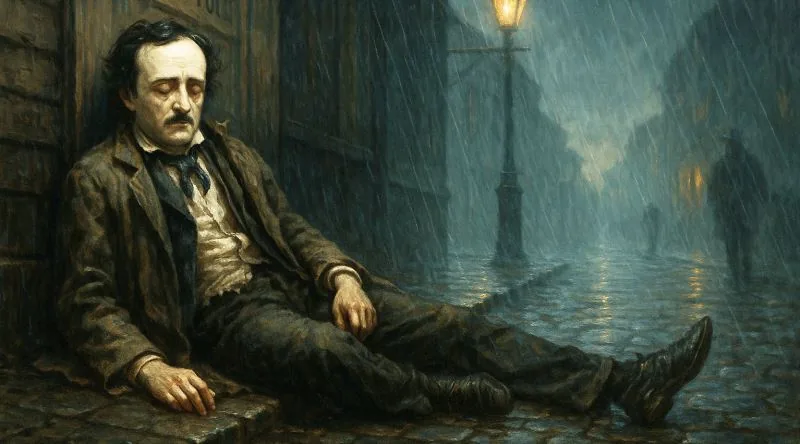
The Edgar Allan Poe death mystery centers on the author's final days in Baltimore in 1849, where he was found unconscious in strangers' clothes on election day, with the cooping theory offering the most plausible explanation for his demise. Poe's baffling final days have haunted literary historians for over 175 years, a puzzle made all the more tragic by the fact that the master of the macabre left behind more questions than answers when he died at just 40 years old. The image of the brilliant writer, delirious and wearing shabby garments that were not his own, is a scene straight out of one of his own stories.
Edgar Allan Poe was found delirious in front of a Baltimore bar on election day in 1849, wearing clothes that did not belong to him, and died a few days later. The cooping theory holds that he was drugged and forced to vote multiple times in the election, then beaten when he resisted, though no definitive proof has ever confirmed this account.
- Poe was discovered unconscious in front of Gunner's Hall, a tavern that served as a polling place in Baltimore's 4th Ward, on election day.
- The clothes Poe was wearing when found were not his own; his own garments were never recovered or identified.
- Poe was taken to a nearby hospital, where he never regained full consciousness and died a few days later.
- Cooping was a notorious practice in 19th-century Baltimore where gangs drugged and forced men to vote multiple times under false names on election day.
- Poe's deathbed murmurings reportedly included a call for "Reynolds," but no one has ever been able to identify who this person was.
A Death as Dark and Mysterious as Poe's Own Stories
Edgar Allan Poe died in Baltimore, Maryland, in 1849 at just 40 years old, and the circumstances surrounding his final days remain one of literature's most enduring puzzles. The man who wrote "The Raven" and pioneered the detective story left behind a real-life mystery that has frustrated historians for over 175 years. Poe had finally reached a point where his career and personal life seemed to be turning around.
By the autumn of 1849, Poe was engaged to Sarah Elmira Royster, his childhood sweetheart from Richmond, Virginia. He had plans to return to New York City, where an editing job awaited him, and then to marry Royster. But first, he told people he needed to make a brief stop in Baltimore "for a while" to handle some business matters. His health was already fragile; he had been complaining of various ailments for some time.
That short trip to Baltimore ended everything. Within days of arriving in the city, his life and all his future plans came to a halt. He would never leave Baltimore alive. The days between his arrival and his collapse remain a blank space in history, and what happened in that window has fueled speculation ever since. The Edgar Allan Poe death mystery begins right here, with a man at the peak of his promise walking into a city and never walking out.
Found Unconscious in Stranger's Clothes, Murmuring 'Reynolds'
Edgar Allan Poe arrived in Baltimore in late September 1849, and then vanished from the historical record for a few days. When he resurfaced, he was found unconscious in front of Gunner's Hall, a tavern that doubled as the 4th Ward's polling place for that day's election. The man who wrote "The Raven" was wearing shabby clothes that clearly did not belong to him.
The day Poe was found was Election Day in Baltimore, and the scene around Gunner's Hall would have been loud, crowded, and chaotic. Somehow, in the middle of it all, someone spotted the famous writer slumped in front of the bar. A doctor named Joseph Evans Snodgrass was called to the scene, and he recognized Poe immediately. Snodgrass helped transport him to a nearby hospital, where the poet would spend his final days.
Inside the hospital, Poe drifted in and out of consciousness. He never managed to string together a coherent explanation of what had happened to him. Instead, according to the attending physician Dr. John J. Moran, Poe repeatedly murmured a single name: "Reynolds." Nobody at his bedside could identify who Reynolds was, and Poe died at age 40 without ever clarifying the mystery.
The witnesses themselves complicate the story further. Snodgrass and Moran both gave accounts that shifted over time, and Moran later revised his report to replace "Reynolds" with "Herring," referring to Poe's uncle Henry Herring. The inconsistency between the two names, combined with the strange clothing and the election-day setting, left investigators and literary scholars with a puzzle that has never been fully solved. The Edgar Allan Poe death mystery only deepened with each contradictory testimony.
The Cooping Theory: A Grisly Election-Day Fraud
The cooping theory is the only explanation for the Edgar Allan Poe death mystery that accounts for his changed clothes, and the circumstances around his discovery support it. Poe was found unconscious in front of Gunner's Hall, a tavern in Baltimore that was serving as a polling place for the city's 4th Ward election. It remains a theory, not a proven fact, but it fits the evidence in ways no other explanation can match.
Cooping was a brutal, documented practice in 19th-century American cities. Gangs would snatch random people off the streets on election day and lock them in small rooms called "coops." Inside those cramped spaces, victims were forced to drink alcohol or take drugs, beaten into submission, then marched to polling places across town to cast votes for the gang's chosen candidate. Between each stop, the kidnappers changed the victims' clothes so poll workers would not recognize them as repeat voters. The ordeal could turn fatal, especially for someone in poor health.
That is exactly the kind of violence Poe was in no position to survive. He was already frail in 1849, and his sensitivity to alcohol was well known among his friends. Forced drinking and physical abuse would have hit him harder than it would hit a healthier man. After being released or escaping, he would have been left unconscious on the street, exposed to the cold in clothes that were not his own. The shabby garments he wore when found were a far cry from the black, well-tailored suits he always favored.
The timing and location add weight to the theory. Poe was found on election day itself, and newspapers at the time had warned that cooping was expected at that very bar. The stars seemed aligned for this grim scenario, even if no one can say for certain what happened inside those lost days between his arrival and his collapse.
Still, coincidence remains possible. The witnesses who tended to Poe in his final days gave accounts that shifted over time, muddying every attempt at certainty. The truth may have been something entirely different. We will never know for sure, and that unresolved question keeps the Edgar Allan Poe death mystery alive more than a century and a half later.
Why Other Theories Fall Short
The clothes are the clue that breaks every other explanation for the Edgar Allan Poe death mystery. Since 1849, people have blamed alcohol, a beating, robbery, a diabetic coma, even rabies. None of them account for one stubborn fact: Poe was found wearing clothes that were not his own.
Let's walk through the usual suspects. The alcohol theory has been around the longest, and it's easy to see why. Poe was known to be weak against alcohol. But alcohol poisoning doesn't explain why someone would strip him and dress him in shabby garments. The same problem sinks the robbery theory. A thief takes your coat, your watch, your money. A thief does not leave you in a different set of clothes. The beating theory? It explains bruises, maybe even unconsciousness, but not a wardrobe swap.
Diabetes and rabies are the more medical guesses. Both can cause confusion and delirium, and rabies in particular can make a person seem disoriented and agitated. Yet neither condition comes with a mechanism for changing clothes. No doctor has ever recorded a diabetic coma that dressed its patient in someone else's outfit.
Here is where the Edgar Allan Poe death mystery gets interesting. The one theory that actually accounts for the clothing is cooping, a brutal form of election fraud practiced in 1800s American cities. On election day, gangs would snatch people off the street and lock them in small rooms called "coops." They would force alcohol or drugs on their captives, beat them into submission, then march them from polling place to polling place to vote for the gang's preferred candidate. Between stops, they changed the victims' clothes to keep the trick from being spotted.
Poe was found on election day in Baltimore's 4th Ward. The tavern where he collapsed, Gunner's Hall, was being used as a polling place. Newspapers at the time had even warned that cooping was expected at that very location. A man already in poor health, already sensitive to alcohol, would not survive a night of forced drinking and beatings. It fits. Every other theory leaves the clothes unexplained. Cooping does not.
Frequently asked questions
What is the cooping theory?
The cooping theory suggests that Edgar Allan Poe was kidnapped by a gang on Election Day in Baltimore in 1849, forced to vote multiple times for their preferred candidates, and given alcohol and beaten to keep him compliant. This brutal practice was documented in 19th-century American cities and sometimes proved fatal for victims.
Who was Reynolds?
Reynolds was an unidentified person whose name Poe reportedly murmured repeatedly while delirious on his deathbed in 1849. Dr. John J. Moran, the physician who attended Poe at the hospital, first reported this detail. Years later, Moran changed the name to "Herring" in his written accounts, casting doubt on the reliability of either claim.
Why was Poe wearing clothes that weren't his?
Poe was found on election day in 1849 wearing shabby clothes that did not belong to him. The cooping theory explains this by suggesting his captors changed his clothing between polling places to avoid detection, a standard trick in the practice. Other theories about his death have never adequately explained this strange detail.
How did Poe die in Baltimore in 1849?
Edgar Allan Poe was found unconscious in front of a bar in Baltimore in 1849, just a few days after arriving in the city. He was taken to a nearby hospital, where his consciousness came and went for several days. He died at age 40 without ever explaining what had happened to him. The exact cause remains unknown.
Was his death related to election day?
Yes, Poe was found on Election Day in Baltimore's 4th Ward, in front of Gunner's Hall, a tavern that was being used as a polling place that very day. This timing is a key piece of evidence supporting the cooping theory, since the practice specifically targeted victims on election days when gangs needed bodies to cast fraudulent votes.
Did he die from alcohol poisoning?
Alcohol poisoning is one theory, but it has never been confirmed. Poe was known to be weak against alcohol, and the cooping theory suggests he may have been force-fed alcohol by his captors, which could have been fatal for him. However, no definitive evidence proves alcohol caused his death, and other possibilities like diabetes, rabies, or a beating remain unproven.
What inconsistencies exist in the accounts?
The witness accounts surrounding Poe's death shifted over time, especially those of Dr. John J. Moran, who attended him in the hospital. Moran initially reported Poe calling out "Reynolds," but in his later writings, he changed the name to "Herring," which was actually Poe's uncle, Henry Herring. Dr. J. E. Snodgrass, who helped transport Poe to the hospital, also gave varying versions of events in his writings, making it difficult to establish what truly happened. Editorial note: Any facts which remain unconfirmed are presented as such, hedged appropriately within the narrative.
Got a take on this? Add your voice to the conversation below →
No comments yet. Be the first.