Crows Can Count to Four—and They Do It Out Loud
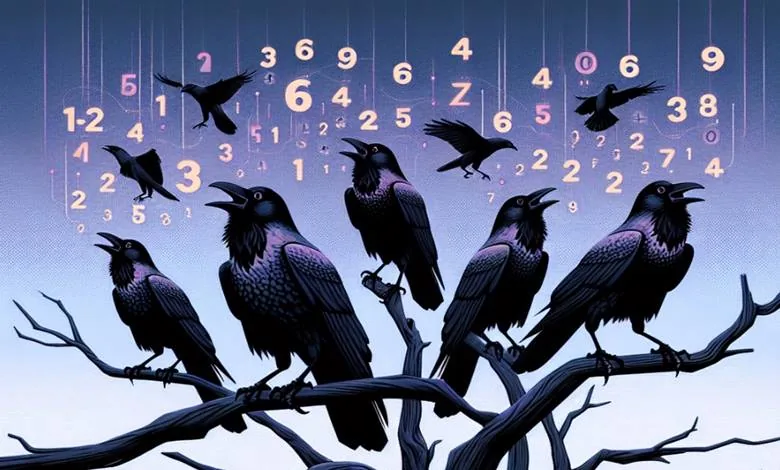
A new study from the University of Tübingen reveals that crows can count to four, and they do it out loud, producing a specific number of vocalizations to match a target quantity. This 2024 finding by researcher Diana Liao shows that carrion crows deliberately plan and control their calls, offering a rare glimpse into how animals grasp abstract numbers. It’s a discovery that makes you look at the bird on your windowsill a little differently, knowing that behind those sharp eyes lies a mind capable of deliberate, almost human-like counting.
In a study led by Diana Liao at the University of Tübingen, researchers trained carrion crows to produce one to four vocalizations in response to visual and auditory cues. The crows accurately matched the number of calls to the target, demonstrating that they can count out loud with intention. The findings were published in 2024.
- The study was conducted at the University of Tübingen in Germany, led by researcher Diana Liao.
- Carrion crows were trained to produce one to four calls in response to specific visual or auditory cues.
- The birds successfully matched the number of vocalizations to the target quantity, showing they can count out loud.
- The findings were published in 2024, adding to the growing body of research on crow intelligence.
- The crows planned their vocalizations in advance, taking longer to start calling when they needed to produce more sounds.
Crows Can Count to Four, and They Do It Out Loud
Yes, crows can count to four, and they do it by deliberately choosing how many times to call out. A 2024 study published in Science showed that these birds produce a specific number of vocalizations to match visual and auditory cues, much like human toddlers learning to count. The research team, led by Diana Liao at the University of Tübingen in Germany, found that crows mastered this skill after roughly 180 training trials.
Here is how the experiment worked. Researchers showed crows a series of cues: colorful numerals on a touchscreen for visual tests, and sounds like guitar chords or drumbeats for auditory ones. Each cue type came in four variations, and the birds had to respond by calling out the matching number of times. Get it right, and a reward waited. Get it wrong, and the game paused. After about 180 attempts, the crows figured out the pattern and began producing the correct number of calls on command.
What makes this remarkable is how the birds go about it. They do not think "three" and then say the word. Instead, they work through the count sequentially, one call at a time, the way a small child might say "one, one, one" while pointing at objects. The crows are essentially generating their own vocal sequences and keeping track of how many they have produced.
And four is not a hard ceiling. The researchers suspect these clever birds could count higher if given the chance. The study simply tested them up to four, but nothing in their performance suggested they had hit a mental wall.
This finding adds to a long list of crow talents that scientists have documented over the years. These birds craft hooks from twigs, bend wire into tools even when they have never encountered wire before, and remember human faces for years. They cache food for lean times, showing they plan for the future, and they can even make statistical inferences from limited information. A grudge against one crow, as the saying goes, can bring an entire neighborhood of them down on you, since they share warnings with each other.
The study also confirms that crows use both visual and auditory information together to solve problems, and that they can pair their own voice with numerical meaning. That combination, researchers say, places their counting ability squarely in the same territory as toddlers who are just learning to talk about quantities.
The Smartest Birds on the Planet: What We Already Knew
Long before scientists ever tested whether crows can count, these birds had already built a reputation as some of the sharpest minds in the animal kingdom. Crows and their cousins, the ravens, have been observed doing things that would make many mammals look slow by comparison. They reason abstractly, crack complex problems, and even make decisions as a group, skills that researchers have spent decades documenting.
Watch a crow at work and you will see what all the fuss is about. The bird scans the underbrush until it spots a twig with a nice curve at the end. It snaps the branch off with its beak, strips away the leaves, and peels back the bark. Then it pokes the stick into a hole in a tree trunk, wiggling it around until out come the insects hiding inside. Tasty caterpillars, spiders, and beetles suddenly become a meal, all thanks to a little ingenuity.
Tool use is just the beginning. Crows stash food away for leaner times, which means they are thinking about tomorrow, not just the present moment. They can also make statistical inferences from surprisingly limited information, drawing conclusions about their environment the way a detective might piece together a case from a few clues. And here is the part that really gets people talking: these birds can bend wire into hooks and other tools, even when they have never encountered wire in their lives.
Their memory is just as impressive, especially when it comes to faces. A crow does not forget someone who has wronged it, and it will hold a grudge for a long time. Worse, it will warn other crows about you. One angry bird can turn into a whole neighborhood of birds that know exactly who you are and what you did. That kind of social intelligence is rare in the animal world, and it is exactly what made researchers curious about whether crows can count in the first place.
How Do Crows Count? The Experiment
In a 2024 study published in Science, researchers at Germany's University of Tübingen proved that crows can count aloud, producing a specific number of vocalizations in response to visual and auditory cues. The birds learned to match each cue with the correct number of calls after roughly 180 training trials, demonstrating a skill previously thought to be uniquely human.
The setup was deceptively simple. Each crow sat before a touchscreen while researchers presented two kinds of cues. Visual cues appeared as colored numerals on the screen. Auditory cues came through as sounds like guitar chords or drumbeats. For each stimulus type, there were four distinct cues, and the bird's job was to respond with the matching number of vocalizations.
Success earned a reward. Failure meant a pause in the game, a small frustration that motivated the birds to pay closer attention. Trial after trial, the crows worked through the task. Then, at around 180 attempts, something clicked. The birds began producing the correct number of calls with consistency, matching each cue to its proper count.
Here's the remarkable part about how they did it. Crows don't think in abstract numbers the way humans do. When a crow sees three apples, it doesn't form a concept of "three." Instead, it behaves much like a toddler learning to count. The bird vocalizes sequentially, calling out "one, one, one" or "one, two, three," working through the sounds one at a time until it reaches the right total. This step-by-step vocal counting is exactly the strategy young children use before they grasp abstract numerical concepts.
Diana Liao, a postdoctoral neurobiology researcher at the University of Tübingen, led the study. Her team's findings add a new layer to what we already know about corvid intelligence. These are birds that craft hooks from wire, remember human faces for years, and even hold grudges that spread through their social networks. Now we know they can also count their own vocalizations, adjusting output to match what they see and hear.
The study proves that crows can count up to four, though that number isn't a hard ceiling. Researchers suspect the birds might manage higher counts with more training. For now, the evidence shows that crows can count, and they do it out loud, one deliberate call at a time, just like a small child learning their numbers for the first time.
Beyond Crows: Other Animals That Count
Counting is not a uniquely human talent, and crows can count as proof that sits in good company across the animal kingdom. The same cognitive toolkit that lets a crow match a cue to a number of calls shows up, in different forms, in bees, lions, and even clownfish.
Take honeybees. As they fly toward a nectar source, they track landmarks along the ground, effectively counting their way there. Their numerical sense goes further than simple tallying: bees reportedly grasp the concept of zero, understanding that an empty set is still a quantity, a distinction that even some human cultures took centuries to formalize.
Lions play a different numbers game. When a pride hears roars from a neighboring group, the cats estimate how many individuals are making all that noise. Based on that count, they decide whether to advance or back off, a life-or-death calculation made purely from sound.
Even clownfish, those orange reef dwellers made famous by animated movies, have demonstrated a basic counting ability. Their version is modest compared to a crow's, but it confirms the pattern: numerical thinking is scattered widely across the tree of life, not locked inside human brains.
What ties all these animals together is the same underlying skill that the 2024 study at the University of Tübingen highlighted in crows: the ability to link a quantity to a response. Whether a bee measures distance by landmarks, a lion sizes up a rival pride by roars, or a crow produces exactly four calls when shown the number four, each animal is doing arithmetic in its own way. That shared thread makes the crow's achievement feel less like an anomaly and more like one vivid example of a widespread, ancient capability.
Frequently asked questions
How do crows count to four?
Crows learn to match a specific number of sounds to a cue, whether they see something on a screen or hear a particular noise. After roughly 180 training trials, they reliably produced the correct number of vocalizations for each signal, working through the count one sound at a time, much like a toddler.
Can crows count more than four?
The 2024 study published in Science proved that crows can count up to four, which is the same range as human toddlers. Researchers suspect the birds might manage even higher numbers, but four is the verified limit from this particular experiment. The study simply didn't test beyond that point.
Who led the crow counting study?
Diana Liao, a postdoctoral researcher in neurobiology at the University of Tübingen in Germany, led the investigation. Her team's findings appeared in the journal Science in 2024, adding a remarkable new layer to what we know about corvid intelligence.
What other animals can count?
Honeybees track landmarks and can even grasp the concept of zero. Lions listen to roars from a nearby pride and estimate how many individuals they're dealing with before deciding whether to approach or retreat. Clownfish also demonstrate basic counting abilities, showing that numerical skills pop up across the animal kingdom.
Do crows have good memory?
Crows have exceptional memories, especially when it comes to faces. They remember people who have wronged them and can hold a grudge for years. Worse for you, they share that information with other crows, so one angry bird can turn an entire neighborhood of crows against you.
Got a take on this? Add your voice to the conversation below →
No comments yet. Be the first.