Conway's Game of Life: The 1970 Rules That Spawned a Universe
Conway's Game of Life is a zero-player cellular automaton that British mathematician John Conway published in Scientific American in October 1970, and it turned a simple grid of living and dead cells into one of the most influential toys in computing history. Four rules decide everything. A cell lives or dies based only on how many of its eight neighbors are alive. From that tiny seed, players discovered gliders that walk across the board, oscillators that pulse forever, and a pattern that fires new gliders like a machine gun. Half a century later, people are still exploring the universe those 1970 rules opened up.
Conway's Game of Life is a grid-based cellular automaton introduced by mathematician John Conway through Martin Gardner's Scientific American column in October 1970. Four simple rules govern how cells are born, survive, or die. Over time it was shown to be capable of universal computation, and it remains a favorite of programmers and hobbyists worldwide.
- John Conway, a British mathematician, devised the Game of Life rules around 1969.
- Martin Gardner popularized the game in his Mathematical Games column in Scientific American in October 1970.
- Conway offered a fifty-dollar prize for the first person to prove or disprove that no pattern could grow indefinitely, and Bill Gosper claimed it.
- The Game of Life was later shown to be Turing complete, meaning any Turing machine can be modeled with it.
- John Conway died on April 11, 2020, in New Brunswick, New Jersey, of COVID-19.
A Grid, Four Rules, and a Universe That Builds Itself
Picture a checkerboard stretching out in every direction. Some squares are black, meaning alive; the rest are white, meaning empty. You touch nothing after the first move. You just watch. That is Conway's Game of Life, a zero-player simulation where the entire future is decided by how the starting live and dead cells happen to be scattered. Nothing else steers it.
The man behind it was John Horton Conway, born in Liverpool on December 26, 1937. He was a British mathematician with a taste for puzzles and strange structures, the same mind that later built the mathematical objects he called surreal numbers. The Game of Life is usually dated to 1969, though some accounts place it in 1970, so treat the exact year as a matter of convention. What matters is the design: a universe of cells, each one either on or off, each one talking only to its neighbors.
Every square sits inside a little crowd of eight: the four touching it up, down, left and right, plus the four corners. That is the whole social world of a cell. From here, four rules do all the work.
| Situation | What happens |
|---|---|
| Fewer than two live neighbors | The cell dies of loneliness |
| Four or more live neighbors | The cell dies of overpopulation |
| Two or three live neighbors | The cell survives |
| An empty cell with exactly three live neighbors | A new cell is born |
Read them once and you can hold them in your head. That is the trap. Run them across a grid and the patterns that emerge stop looking like arithmetic. Some configurations freeze into still lifes and never move again. Others pulse back and forth like a heartbeat. Others crawl across the board, flipping themselves over and over in the same direction, drifting away from where they began. None of this is written into the rules. It grows out of them.
And here is the part that still feels a little uncanny: a cell never knows the shape it belongs to. It counts its eight neighbors, lives or dies, and that is all. There is no blueprint, no architect, no plan for a glider or a pulsar. Complexity, it turns out, does not need a complicated set of instructions. It needs a simple set of instructions applied relentlessly, square after square, step after step.
Four lines of arithmetic. No conductor. And yet the board fills with things that behave almost as if they want to stay alive.
The Rules of Conway's Game of Life, Written Out
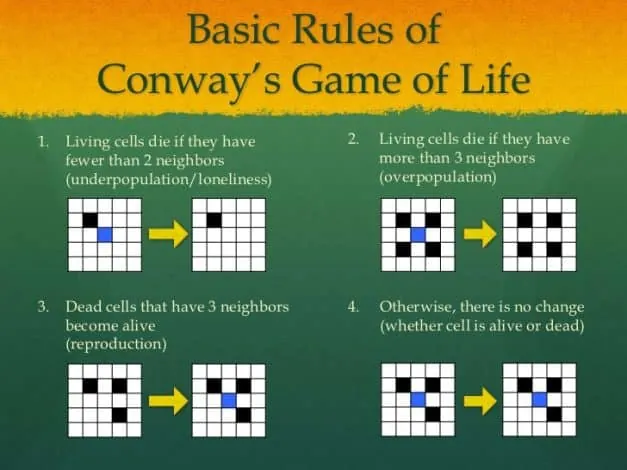
Conway's Game of Life runs on four rules, and they fit on a napkin. A live cell with fewer than two live neighbors dies. A live cell with four or more live neighbors dies. A live cell with two or three live neighbors survives. An empty cell with exactly three live neighbors becomes alive on the next step. That is the whole machine.
Picture the board first. It is a grid like a checkerboard, and every square holds one cell that is either alive or dead. Each square touches eight neighbors: one above, one below, one left, one right, and the four corners. No cell ever sees anything beyond that little ring of eight.
Now watch one tick of the clock. Count the live neighbors around a single cell. If it is alive and the count is zero or one, it dies, and the story calls that loneliness. If it is alive and the count climbs to four, five, six, seven or eight, it dies too, this time from crowding. With two or three around it, it stays exactly as it is. And if the cell is empty but precisely three of its neighbors are alive, it switches on. Three is the magic number for birth, no more and no less.
Here is the part that makes the machine tick: every cell on the board updates at the same instant. Nobody moves first. Each square looks at the previous configuration, decides its own fate, and the whole grid flips together. One step, one simultaneous breath, and the pattern you see next is built entirely from the arrangement you saw before.
| Rule | Cell state | Live neighbors | Result next step |
|---|---|---|---|
| Underpopulation | Alive | Fewer than two | Dies |
| Overpopulation | Alive | Four or more | Dies |
| Survival | Alive | Two or three | Survives |
| Birth | Empty | Exactly three | Becomes alive |
Read those four lines again and notice how modest they are. No rule mentions a shape, a plan, or a goal. Nothing tells a cluster of cells to build a glider or a blinking light. Yet out of these tiny local decisions come static patterns that sit still, oscillators that pulse back and forth, and spaceships that glide across the grid. The complexity is not written into the rules. It grows out of them.
Still Lifes, Oscillators, Spaceships, and a Game With No Players
Set a few cells on the grid and press play with nobody at the controls. That is the strange charm of Conway's Game of Life: the only thing that decides the outcome is the starting layout of live and dead cells. Once those cells are placed, the rules run themselves, step after step, and no hand steers what happens next.
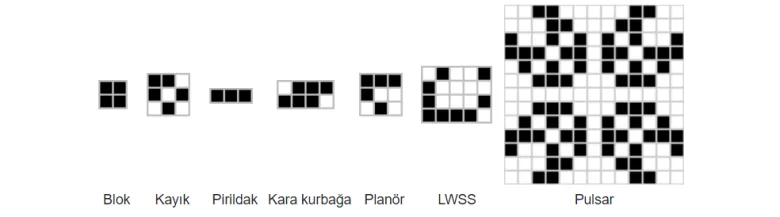
Watch that grid long enough and the patterns start sorting themselves into families. Some freeze on the spot: a cluster of live cells that never changes again, which players call a still life. Others pulse, blinking between shapes on a fixed rhythm, so they earn the name oscillator. And a third kind does something almost cheeky: it rebuilds itself a little to the side, again and again, gliding across the board like a tiny craft. Those are the spaceships, and they are the ones that make people lean closer to the screen.
Here is the twist that turns the whole thing on its head. Despite the name, this is a zero-player game. You do not take turns, you do not make moves, you do not react to what the board does. You arrange the opening scene and then you are a spectator. The rules, applied to every cell and its eight neighbors at once, carry the story forward on their own.
And you cannot cheat by peeking ahead. There is no clean algorithmic shortcut that tells you where a given starting arrangement will end up. You want to know? You run it. That is the only way. A configuration can drift for a long stretch and then settle, or flicker forever, and no formula hands you the answer in advance.
Which brings up the part most people get wrong. When John Conway built this system, he was not trying to simulate biology. He was not chasing a digital butterfly or a model brain. His aim was purely mathematical: he wanted a universal system, a kind of infinitely programmable computer, something that could in principle carry out any computation you fed it. The living, breathing look of the thing was a side effect, a happy accident that grabbed imaginations around the world.
So the still lifes, the oscillators, the drifting spaceships, none of them were the point. They were what fell out of a mathematician's search for a machine that could compute anything. The grid just happened to make that search beautiful.
The October 1970 Column That Launched a Cult
Martin Gardner's "Mathematical Games" column in the October 1970 issue of Scientific American is where the world met Conway's Game of Life. One magazine page, a grid of black and white squares, and a set of four rules were enough. Readers who had never touched a cellular automaton found themselves sketching gliders on napkins within days.
Conway had a hunch, and he put it in print. He believed no starting pattern could grow forever. Every configuration, he figured, would eventually settle into something stable, fizzle out, or fall into a repeating oscillation. It was a reasonable guess. It also turned out to be incorrect.
So Gardner's article carried a challenge with money attached. Conway offered $50 to the first person who could either prove that hunch or knock it down. Fifty dollars in 1970 was a decent sum, but the real draw was the puzzle itself.
It did not take long. Within weeks, the prize was claimed by Bill Gosper, a mathematician and programmer who went hunting for patterns and found one. His creation, the glider gun, does exactly what Conway doubted was possible: it keeps firing gliders across the grid, endlessly, without ever settling down. The bet was settled, and the game's reputation was sealed.
The glider gun turned a clever puzzle into a frontier. If a small arrangement of cells could produce endless motion, what else might be hiding in that grid?
That question built a subculture. Programmers started constructing patterns for the sheer joy of finding new ones, and they gave themselves a name: Lifenthusiasts. The term stuck, and it still describes the people who spend their evenings watching pixel grids come alive.
A Grid That Can Build a Computer
Yes, Conway's Game of Life is Turing complete. That means any Turing machine, the abstract device that defines what a computer can calculate, can be modeled inside the game's grid of live and dead cells. In plain terms, you can build a working computer out of those blinking squares. A parlor puzzle from 1970 turns out to be a universal machine in disguise.
That result lands harder once you remember what the game actually is. There is no player, no score, no controller. You set the starting pattern and walk away. Everything that follows is just the four rules grinding forward, cell by cell, on an endless checkerboard.
Conway wasn't chasing a toy. According to the original account, his aim was purely mathematical: he wanted a so-called universal system, a kind of infinitely programmable computer, something capable of arbitrary calculation. The Life grid was his attempt at that. The fact that it also looks alive, with static still lifes, repeating oscillators, and gliders that sail across the board, was a side effect.
But the side effect is what changed things. The biggest legacy of the Game of Life is that it pushed cellular automata into the mainstream. Since then, cellular automata have been used widely across physics, computer technology, and mathematics. The idea that enormous complexity can grow from a handful of local rules, each cell only ever talking to its eight neighbors, escaped the puzzle page and became a working tool.
It also built a culture. A community of programmers who call themselves Lifenthusiasts took up the game, constructing patterns in the hope of discovering new life forms, and the term refers specifically to people who contribute to the game by finding new and interesting configurations. The game also developed a software industry and led to the printing of thousands of books on the subject. Easy-to-use apps let anyone run the game online.
So the next time a grid of black and white squares flickers into a glider, remember what you're watching. It's not decoration. It's a machine that could, in principle, run any program you can write.
John Conway, 1937 to 2020
John Horton Conway was born on December 26, 1937, in Liverpool, and died on April 11, 2020, in New Brunswick, New Jersey, of complications from COVID-19. Between those two dates he built one of the strangest and most beloved legacies in modern mathematics, and Conway's Game of Life sits right at its center.
He was a British mathematician and game theorist, and his restless curiosity kept spilling into unexpected corners. He developed the mathematical structure he called surreal numbers, which brought a new perspective to game theory and number theory. He was the kind of thinker who treated a puzzle the way other people treat a conversation: something to poke, twist, and see where it goes.
That instinct is exactly what produced the grid so many of us have stared at on a screen. He devised it around 1969, though sources give both 1969 and 1970 for the precise year, so treat the earlier date as a matter of convention rather than a firm stamp. What is certain is the effect. A few lines of rules about neighbors and survival turned into a universe of gliders, oscillators, and still lifes, and a generation of programmers spent their evenings hunting for new patterns.
Then came the spring of 2020, and the man who had spent his life modeling how simple things live and die was gone. It is a strange symmetry to sit with. The cells on his grid keep flickering on and off in browsers and classrooms around the world, long after the hand that sketched the rules has stopped moving.
If you want to remember him, you do not need a monument. Open a blank grid, drop in a handful of live cells, and press play. Somewhere in that quiet churn of births and deaths is the mind that dreamed it up on a December day in Liverpool, all those decades ago.
Frequently asked questions
What is Conway's Game of Life and how does it work?
Conway's Game of Life is a zero-player cellular automaton played on a checkerboard-like grid. You don't take turns or make moves. You set a starting pattern of live and dead cells, press go, and watch the grid evolve step by step according to four simple rules. The initial configuration alone decides everything that follows.
What are the four rules of the Game of Life?
Each cell touches eight neighbors: up, down, left, right and the four corners. A live cell with fewer than two live neighbors dies of loneliness. A live cell with four or more dies of overpopulation. A live cell with two or three neighbors survives. And an empty cell with exactly three live neighbors becomes alive, a birth.
Why did Martin Gardner's October 1970 Scientific American column matter?
That column, in the October 1970 issue of Scientific American, is where the world first met Conway's Game of Life. Gardner's "Mathematical Games" piece turned a quiet mathematical curiosity into a sensation, and within weeks readers were sketching cell patterns on paper and watching them flicker to life.
How did Bill Gosper win Conway's $50 prize?
Conway doubted any pattern could grow forever, so in the 1970 article he offered $50 to whoever could prove or disprove it. Within weeks the prize was claimed by mathematician and programmer Bill Gosper, who found a pattern that kept growing without limit. That discovery became known as the glider gun.
Is the Game of Life Turing complete?
Yes. The Game of Life is Turing complete, which means any Turing machine can be modeled inside it. In plain terms, the grid is powerful enough to build a computer. That result helped push cellular automata into physics, computer science and mathematics, where they are used widely.
Who was John Conway and when did he die?
John Horton Conway was a British mathematician and game theorist, born December 26, 1937, in Liverpool. He also developed the mathematical structure he called surreal numbers. He died April 11, 2020, in New Brunswick, New Jersey, of COVID-19. He devised the Game of Life around 1969, though sources differ on the exact year.
What is the difference between a still life, an oscillator and a spaceship?
These are the three classic pattern families on the grid. A still life stays frozen in place, generation after generation. An oscillator repeats its shape in the same spot, cycling back to where it started. A spaceship translates itself across the board, arriving somewhere new each cycle while keeping its form.
Why is the Game of Life called a zero-player game?
Because nobody actually plays it. The starting arrangement of live and dead cells determines the entire outcome, and after that the rules run themselves. There is no strategy, no decision to make mid-game. You are a spectator to a small universe unfolding from a single setup. Editorial note: Any details that remain unconfirmed are presented as such, and readers should treat hedged claims accordingly.
Got a take on this? Add your voice to the conversation below →
No comments yet. Be the first.