Buried Alive Survival Time: The 5.5-Hour Coffin Truth
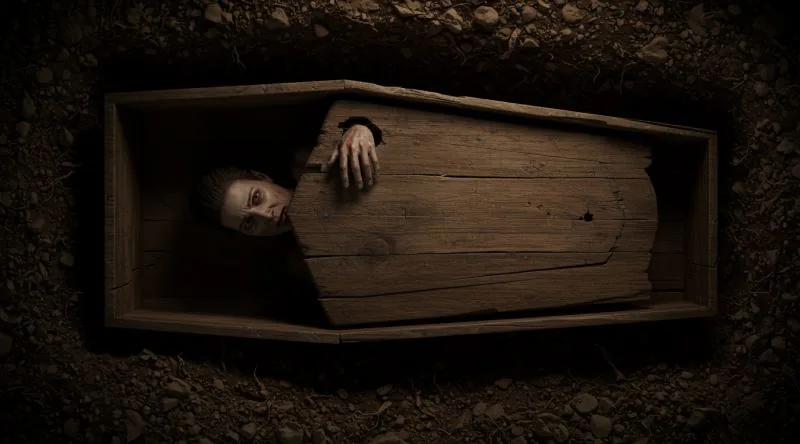
The average buried alive survival time inside a standard sealed coffin is roughly 5.5 hours, a figure rooted in the physics of oxygen depletion and carbon dioxide buildup that was starkly illustrated by pulmonologist Alan R. Leff in 1989. That clock starts the moment the lid closes, and for the estimated thousands of people who have been prematurely interred throughout history, it represents a terrifying, suffocating countdown that has haunted the human imagination for centuries. The fear is primal, the science is unforgiving, and the reality is that escape is almost never an option.
A person trapped in a standard, non-ventilated coffin has about 5.5 hours before oxygen runs out, based on the average adult lung capacity and the limited air volume inside the box. Carbon dioxide poisoning accelerates the loss of consciousness, making any struggle for survival brief and futile.
- The critical 5.5-hour estimate for buried alive survival time comes from a 1989 commentary by pulmonologist Alan R. Leff, who calculated oxygen depletion in a standard coffin.
- A standard coffin holds roughly 900 liters of air, but the average adult lung capacity of about 0.5 liters per breath quickly consumes the usable oxygen.
- Carbon dioxide buildup, not just oxygen loss, causes rapid unconsciousness, often within the first hour, well before the oxygen is fully gone.
- Historical "safety coffins" with bellows and signal flags were invented in the 19th century, but they rarely worked, and most victims remained trapped.
- The survival window is drastically shorter if the coffin is sealed tightly or if the victim panics, which increases breathing rate and accelerates oxygen use.
The 5.5-Hour Estimate: What the Numbers Actually Say
If you were sealed inside a coffin and lowered into the ground, the often-quoted answer for your buried alive survival time is roughly 5.5 hours. That figure comes from a simple calculation: a standard coffin holds a certain amount of air, and a resting person uses up oxygen at a predictable rate. But when you actually check the arithmetic, the numbers start to wobble, and the famous 5.5-hour estimate becomes more of a rough guess than a hard fact.
The story typically starts with coffin dimensions of 2 meters long, 70 centimeters wide, and 60 centimeters deep. Multiply those together and you get 840 liters of internal volume, not the 886 liters often cited in the popular version of this tale. From there, the claim shifts to oxygen making up about one-fifth of that space, which would be roughly 168 liters. The frequently repeated figure of 164 liters doesn't match either calculation, so the very foundation of the estimate is already shaky.
Then comes the consumption rate. The original account assumes a person burns through 0.5 liters of oxygen per minute, which yields that tidy 5.5-hour window. But physiologists typically put resting oxygen consumption closer to 0.25 to 0.35 liters per minute. If the lower, more realistic rate applies, the oxygen would last considerably longer than 5.5 hours, though carbon dioxide buildup would become a problem well before the oxygen ran out.
Professor Alan R. Leff of the University of Chicago weighed in on the grim scenario with a blunt assessment: once you are in that coffin, you are staying there, and there is nothing to be done about it. The dramatic version adds that about 2 meters of soil sits on top of the coffin, but standard burial depth usually falls between 1.2 and 1.5 meters. Some accounts also suggest that a person with exceptional lung capacity could hold their breath for about a minute to stretch their time, though that gesture would barely move the needle given the fixed supply of air in a sealed box.
Why the Coffin Is a Death Trap, Even With Air Left
Even if the oxygen inside a sealed coffin could stretch to 5.5 hours, the person inside would still have virtually no chance of survival. The reason has nothing to do with breathing and everything to do with physics. A coffin sits at the bottom of a grave with roughly 1.2 to 1.5 meters of packed earth pressing down on it, and that weight alone makes escape impossible.
The popular version of this story likes to say about 2 meters of soil sits on top of the coffin. That figure is exaggerated. Standard burial depth is typically 1.2 to 1.5 meters, which is still more than enough to seal someone's fate. At that depth, the soil above the coffin can weigh well over a ton. The lid is not designed to be pushed open from the inside, and no amount of desperate shoving will budge it.
This is the core reason why the concept of "buried alive survival time" remains theoretical rather than practical. The oxygen math might suggest a window of a few hours, but the physical reality closes that window almost immediately. A person wakes up in darkness, realizes where they are, and understands that the earth above them simply will not move.
Professor Alan R. Leff from the University of Chicago put it bluntly: "Once you get into the coffin, you're there, and there's nothing you can do about it." That quote captures the grim truth. The coffin is a sealed trap, and the weight of the grave is the lock.
Some accounts suggest that a person with exceptional lung capacity might theoretically hold their breath for about a minute to extend their time. But that trick does not meaningfully change the outcome. The total oxygen supply is fixed, and the buildup of carbon dioxide will trigger the urge to breathe long before breath-holding becomes a survival strategy. Even the most disciplined lungs cannot outlast a sealed wooden box buried under a meter and a half of earth.
What a University of Chicago Professor Says
Alan R. Leff, a professor at the University of Chicago, has studied this grim scenario, and his conclusion cuts through any lingering hope. According to the source, Leff reportedly said: "Once you're in the coffin, you stay there; there's nothing to be done."
The professor's words carry weight because they shift the conversation away from oxygen math and toward the brutal physical reality of the situation. Even if you could somehow stretch the buried alive survival time to its theoretical maximum, the coffin itself becomes your tomb the moment the lid closes. The soil pressing down from above, the sealed wooden box, the sheer weight of the earth surrounding you. None of it leaves room for escape.
Leff's point is simple and devastating. The oxygen levels inside the coffin are almost beside the point. Whether you have five minutes or five hours of air, the outcome remains identical. You cannot push the lid open. You cannot dig upward. You cannot signal anyone above ground. The mathematics of oxygen depletion matter only in theory, because in practice, the coffin has already made the decision for you.
Some have wondered whether extraordinary lung capacity might buy extra time. The source mentions that someone with exceptional breath-holding ability could theoretically extend their survival by about a minute. But Leff's assessment suggests this is little more than a footnote. A minute of held breath against hours of suffocation. The distinction feels almost cruel to consider.
What makes Leff's statement so haunting is its finality. He does not offer a strategy or a workaround. He does not suggest that panic might somehow change the physics. He simply states what anyone trapped in that position would eventually realize. There is nothing to be done. The professor's authority comes from years of studying respiratory medicine, and his verdict lands with the weight of someone who has seen exactly how the human body responds when its air supply runs out.
The hopelessness he describes is not about the numbers. It is about the absolute lack of agency. In a coffin, with earth above you and solid wood on every side, the buried alive survival time becomes an academic question with a fixed answer. The body will use what oxygen it has. The carbon dioxide will build. And eventually, the air will run out. Leff's quote reminds us that no amount of calculation changes the fundamental truth of being sealed inside a box underground.
Could Exceptional Lungs Buy You an Extra Minute?
Not really. The idea that a person with extraordinary lung capacity could hold their breath for about a minute to stretch their survival time in a coffin is theoretically possible, but it does not meaningfully change the outcome. The total oxygen supply in a sealed coffin is fixed, and the buildup of carbon dioxide forces you to breathe long before breath-holding becomes a useful strategy.
Here is where the story gets interesting, and a little morbid. According to the original account, someone with truly exceptional lungs might manage to hold their breath for roughly sixty seconds while buried alive. That sounds like a small victory, a tiny rebellion against the inevitable. But think about what a single minute actually buys you in that situation. Nothing changes about the oxygen left in the coffin. Nothing changes about the carbon dioxide accumulating around you. You are still waiting for the same end, just with slightly redder cheeks from the effort.
The physiology works against you in a sneaky way. When you hold your breath, carbon dioxide builds up in your bloodstream. That buildup triggers an overwhelming urge to breathe, a reflex so powerful it overrides conscious effort. Even trained free divers, people who spend years practicing breath control, eventually hit that wall. In a panic-filled coffin, with adrenaline pumping and your heart racing, that wall comes even sooner. The one minute you might gain is not a minute of comfort. It is a minute of pure struggle, followed by the same gasping intake of the same dwindling air.
Professor Alan R. Leff from the University of Chicago put it bluntly in his remarks on the subject. Once you are in that coffin, you stay there, and there is nothing to be done about it. His words cut through the hypotheticals. The math of oxygen depletion matters far more than any lung capacity trick. That fixed supply of air is the real clock, and no amount of breath-holding winds it back.
Frequently asked questions
How long can a person survive buried alive in a coffin?
According to the original account, a person might have roughly 5.5 hours before oxygen runs out inside a sealed coffin. However, survival for that full duration is extremely unlikely. The combination of a properly sealed coffin and the weight of the soil above makes escape practically impossible, so the theoretical oxygen timeline rarely matters in practice.
How much oxygen is inside an average coffin?
The story claims an average coffin holds about 164 liters of oxygen, based on dimensions of 2 meters by 70 cm by 60 cm. But the math behind that figure is disputed. Those dimensions actually give a volume closer to 840 liters, not the 886 liters stated, so the oxygen estimate doesn't hold up under scrutiny. The real number would depend on the actual coffin size and shape.
What happens to oxygen levels in a sealed coffin over time?
As you breathe inside a sealed coffin, the oxygen gradually depletes with each breath you take. But oxygen running out isn't the only problem. Carbon dioxide builds up at the same time, and that buildup can become dangerous even before the oxygen is completely gone. The combination of falling oxygen and rising CO₂ makes the air unbreathable well before the theoretical depletion point.
Can a person with exceptional lung capacity survive longer when buried alive?
The original account suggests that someone with extraordinary lung capacity might hold their breath for about a minute to stretch their survival time. Even if that's true, a single minute makes no meaningful difference when you're facing hours of entrapment. The total oxygen supply in the coffin is fixed, and eventually you have to breathe again, which only accelerates the CO₂ problem.
Why is survival unlikely even with oxygen left?
Even if oxygen remains in the coffin, survival is nearly impossible for practical reasons. The coffin lid is sealed shut from the outside, and the soil above it presses down with enormous weight. According to the source, about 2 meters of earth sits on top, though standard burial depth is typically 1.2 to 1.5 meters. Either way, pushing open a lid under that much dirt is beyond human strength.
What did Professor Alan R. Leff say?
Professor Alan R. Leff from the University of Chicago addressed this grim scenario directly. As the story goes, he said, "Once you're in the coffin, you stay there; there's nothing to be done." His point was blunt: the physical realities of being buried make escape impossible, regardless of how much oxygen remains or how calm you manage to stay.
How much soil is typically on top of a buried coffin?
The original account mentions 2 meters of soil covering the coffin, but that figure appears to be exaggerated. Standard burial practices typically place between 1.2 and 1.5 meters of earth above a coffin. Even at the shallower depth, the weight of the soil is still far too heavy for anyone inside to push against and escape.
What is the average breathing rate and oxygen consumption per minute?
The source claims a person consumes 0.5 liters of oxygen per minute, which would drain a coffin's supply in about 5.5 hours. But typical resting oxygen consumption is actually closer to 0.25 to 0.35 liters per minute. That discrepancy means the depletion timeline in the original account is uncertain and could be longer or shorter depending on the person's actual metabolic rate and the real volume of air inside the coffin.
Got a take on this? Add your voice to the conversation below →
No comments yet. Be the first.