Brocken Spectre: The Ghost of the Harz Mountains Explained
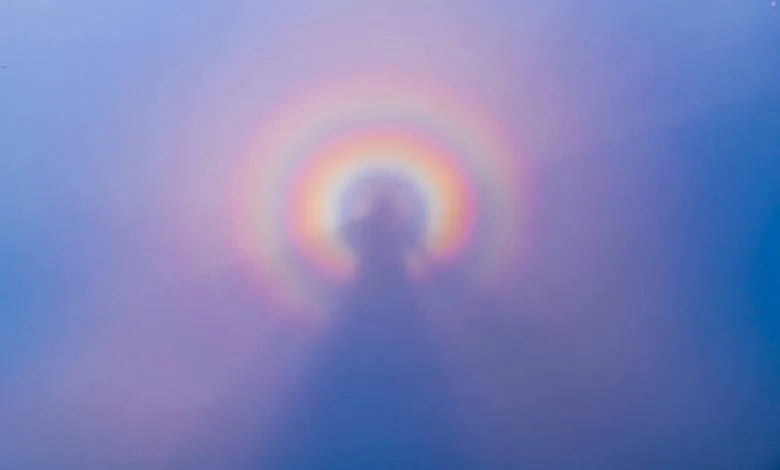
The Brocken spectre is a dramatic optical illusion of a giant, haloed shadow cast onto clouds or mist, first scientifically explained in 1780 on the Brocken peak in Germany's Harz Mountains. It is a moment that turns a simple hike into an encounter with what once seemed like a ghost, and understanding it only deepens the wonder of the experience. When you see your own colossal silhouette ringed by a rainbow-colored glow, it is easy to see why generations of mountaineers believed they were witnessing something supernatural.
A Brocken spectre occurs when a person stands above a cloud layer with the sun behind them, projecting their shadow onto the mist. This shadow appears enormous and is surrounded by a colored halo called a glory. Johann Silberschlag first described the phenomenon in 1780 from the Brocken summit in the Harz Mountains of Germany.
- The phenomenon takes its name from the Brocken, the highest peak in the Harz Mountains of central Germany.
- Johann Silberschlag, a German scientist, provided the first recorded scientific description of the Brocken spectre in 1780.
- The illusion is formed when sunlight casts a hiker's shadow onto a cloud or fog bank below, magnifying it to giant proportions.
- The colored rings surrounding the shadow are known as a glory, created by the diffraction of light through water droplets in the mist.
- The Brocken spectre can also be seen from airplanes, where the shadow of the aircraft is projected onto clouds below.
The Ghost That Walks the Harz Mountains
Picture this: you're standing on a misty peak in northern Germany, the air cold and damp against your face, when suddenly a colossal silhouette appears in the sky before you. Sometimes it seems to hover, and other times it wears glowing rings around its head like a spectral crown. That haunting figure has a name, the Brocken spectre, and for centuries it convinced hikers they were witnessing something supernatural.
The Brocken, the highest peak of the Harz Mountains in Germany, has long been wrapped in witch and demon legends. It's exactly the kind of place where your imagination starts playing tricks, especially when the fog rolls in thick and the world goes silent. Hikers reported seeing this giant shadow year after year, and the stories spread like wildfire through villages below. Poets and writers found endless inspiration in it, weaving the apparition into folklore that only deepened its mystery.
Then came 1780, when a man named Johann Silberschlag stepped forward with something revolutionary: a scientific description. He explained that this terrifying giant wasn't a ghost at all, but an optical phenomenon. The Brocken spectre happens when the sun sits low behind you while you stand above a layer of mist or cloud. Your shadow projects onto that fog, but it doesn't look like an ordinary shadow. The countless tiny water droplets at varying distances confuse your brain's depth perception, so the silhouette appears enormous and impossibly far away, like a being floating independently in the air.
The colored rings around the head are part of the same trick. Known as a glory, they form when sunlight scatters backward off those small water droplets in the fog. Unlike a regular rainbow, which needs larger raindrops, a glory emerges from droplets that are tiny and similar in size, producing narrow, nested rings of color. The halo centers exactly on the point opposite the sun from your perspective, which happens to be where your head's shadow falls. That's why the glow looks like a divine crown perched right on the spectre's head.
What makes this phenomenon even stranger is its intimate privacy. In 1736, Antonio de Ulloa and Pierre Bouguer observed it in South America during the French Geodesic Mission. Ulloa later wrote that six or seven people standing together each saw the glowing halo only around their own shadow. No one could see the rings around anyone else's. Each observer's eyes sit at a slightly different point, so each person receives light from the droplets at a unique angle. Your glory belongs to you alone, a personal ghost that follows only your shadow.
You don't need to climb a mountain to meet it, though. Pilots regularly spot the Brocken spectre from airplanes when the aircraft's shadow falls onto clouds below, complete with those same colorful rings. And the phenomenon isn't limited to Germany either. It's been documented at Haleakalā National Park on Maui in Hawaii, in Scotland's Cairngorms, and across the Ukrainian Carpathians.
So the next time you find yourself on a foggy ridge with the sun at your back, take a look down. That giant watching you from the mist isn't a demon or a witch. It's just you, projected larger than life by sunlight, fog, and the beautiful quirks of human perception.
What Is a Brocken Spectre?
Picture yourself standing on a mountaintop at sunrise, your back to the sun and a thick layer of cloud or fog spread out below. Your shadow suddenly appears on that cloud layer, but it's enormous, stretched to giant proportions. Around the shadow's head glows a halo of rainbow-colored rings, a phenomenon called a glory, and the whole figure seems to float in the distance like a separate, independent being.
The effect is haunting. The shadow looks so large and so far away that your brain insists something else is out there, hovering in the mist. On the Brocken, the highest peak of the Harz Mountains in Germany, the cold and humid air, the dense fog, the deep silence, and the lack of distinct peaks to help you judge distance all intensify the illusion. The conditions conspire to make a simple shadow feel like an encounter with another world.
This optical phenomenon, named after that German peak, doesn't limit itself to one mountain. You can witness it at Haleakalā National Park on Maui, Hawaii, where the massive volcanic crater provides perfect vantage points. The Cairngorms in the Scottish Highlands deliver the experience regularly, as do the Ukrainian Carpathians. In Spain, hikers have recorded the spectre at Peñalba peak in the Mena Valley. The common thread is simple: sun behind you, moisture below, and the right angle.
You don't even need a mountain. Airplane passengers see the Brocken spectre frequently when the plane's shadow falls onto clouds beneath. The shadow stretches across the cloud tops, ringed by its colored halo, and passengers who spot it often grab their cameras, unsure of what they're witnessing. It's the same physics, just viewed from a different altitude.
Why Does the Brocken Spectre Look So Big?
The Brocken spectre looks enormous because your brain cannot judge distance in a fog bank. Fog is not a solid surface but countless tiny water droplets scattered at different depths, so your shadow gets projected across a misty volume instead of a flat wall. Without a reliable distance cue, your mind guesses the shadow is far away and therefore gigantic.
Stand on a mountain peak with the sun at your back and a cloud layer below, and your own silhouette lands on that shifting white sea. But unlike a shadow on solid ground, this one has no anchor. The droplets catching your shape sit at varying distances, some close enough to touch, others dozens of meters down. Your visual system, built for solid surfaces, tries to make sense of the mess and settles on a simple explanation: the shadow must be huge and distant, not small and near.
Height adds another twist. Looking down from a summit, perspective stretches the silhouette into a triangular, elongated form, like a giant leaning away from you. The fog's lack of texture removes the usual clues, no rocks, no trees, no horizon to calibrate size. So the figure floats, disconnected from any reference point, appearing as a towering presence hovering in the air rather than a projection of your own body.
This perceptual trick is why the Brocken spectre has terrified hikers for centuries. Even knowing the physics, the brain refuses to shrink the image. The glory, those rainbow rings circling the head, only deepens the illusion, because the colored halo sits precisely where a supernatural being might wear a crown. Every observer sees the halo only around their own shadow, never around a companion's, which makes the experience feel intensely personal and eerily real.
The Glory: Why the Rainbow Rings Follow You
That halo of colored light circling your shadow is called a glory, and it is far more intricate than an ordinary rainbow. While a normal rainbow forms through larger raindrops, a glory emerges from very small, similarly sized water droplets that create narrow, concentric rings of color. The center of those rings aligns precisely with your antisolar point, the spot exactly opposite the sun, which is why the halo appears to crown the head of your shadow.
Here is the strangest part: every observer sees the glory only around their own shadow, never around anyone else's. In 1736, during the French Geodesic Mission in South America, Antonio de Ulloa and Pierre Bouguer climbed Mount Pambamarca and witnessed this firsthand. Ulloa later recorded that six or seven people standing together each saw the luminous ring exclusively around the shadow of their own head. Nobody could see the halo encircling another person's silhouette, even though they stood just steps apart.
The reason comes down to geometry. The glory depends on your exact line of sight. Because each person's eyes occupy a different point in space, light scatters back from the water droplets at a slightly different angle for each viewer. The droplets that send light toward your eyes are not the same ones that send light toward your companion's eyes. So the halo you see is genuinely yours alone, a private optical signature written in mist and sunlight.
That personal, viewpoint-dependent quality is what makes the Brocken spectre such a haunting experience. When you stand on a foggy peak with the sun at your back, your shadow stretches enormous across the cloud layer below, and that colored ring wraps around the head of your silhouette like a crown. It feels as though the atmosphere itself is acknowledging you, singling you out. But it is simply physics: tiny droplets, backscattered sunlight, and the precise angle of your gaze.
From Ghost Stories to Science
Today we understand the Brocken spectre as an optical illusion combining sun, shadow, fog, and perspective. The same effect that terrified hikers on Germany's Brocken mountain in the 1700s is now a well-documented atmospheric phenomenon. Knowing the science makes it easy to understand why people centuries ago told ghost stories.
The Brocken spectre is named after the Brocken, the highest peak of the Harz Mountains in Germany, a place long wrapped in legends of witches and demons. When Johann Silberschlag provided the first scientific description in 1780, the phenomenon shifted from folklore to physics. What once seemed like a supernatural giant hovering in the mist became a predictable play of light and water.
The same optical trick appears beyond Germany. Haleakalā National Park on Maui, Hawaii, the Cairngorms in Scotland, and the Ukrainian Carpathians all offer conditions where the spectre shows itself. You do not even need a mountain peak. Pilots regularly spot it from airplanes, and astronauts have observed similar effects from space. The shadow of an aircraft falling on clouds below can carry the same rainbow-tinted halo, though the plane's shadow is not causing the rings. They simply share the same line of sight.
What makes the experience so personal is that each observer sees the halo only around their own shadow. Antonio de Ulloa and Pierre Bouguer noted this during their 1736 expedition in South America. Ulloa recorded that six or seven people present each saw the glowing rings exclusively around their own head's shadow, never around anyone else's. The glory, as the colored rings are called, depends on each person's unique viewing angle, so every witness gets a private display.
Standing on a foggy summit with the sun low behind you, your shadow stretches across the cloud layer below, magnified by mist droplets at varying distances. The brain misjudges their depth, making the silhouette seem enormous and distant. Around its head, tiny water droplets scatter light back toward you, creating those tight, nested rainbow rings. It is a masterpiece of perspective, not a haunting.
If you enjoy these atmospheric illusions, you might also want to explore moon halos and parhelia, related phenomena that paint the sky with equally strange circles of light.
Frequently asked questions
What is a Brocken spectre?
A Brocken spectre is an optical phenomenon where a person standing on a high peak sees their own shadow cast onto fog or cloud below, surrounded by a glowing halo of colored rings called a glory. It happens when the sun sits directly behind the observer, throwing their silhouette onto the misty layer beneath them.
Why does it look so large?
The shadow appears enormous because fog is not a solid surface. It is made of countless water droplets scattered at varying distances, and the brain cannot correctly judge how far away they are. This confusion makes the silhouette seem far larger and more distant than it actually is, creating the illusion of a giant figure looming in the mist.
How is the glory formed?
The glory forms through backscattering, where sunlight bounces off tiny water droplets of similar size and returns toward the observer. Unlike a rainbow, which uses larger raindrops, a glory requires very small droplets, producing narrow, tightly packed colored rings. The effect centers exactly opposite the sun from the observer's position, which is why the halo appears around the shadow's head.
Who first explained it scientifically?
Johann Silberschlag, a German scientist, provided the first scientific description of the Brocken spectre in 1780. Before his work, the phenomenon was treated as a supernatural occurrence. Silberschlag's observations helped shift understanding of the spectre from folklore to optics, though two explorers, Antonio de Ulloa and Pierre Bouguer, had already witnessed the same effect in South America in 1736.
Where can you see it?
The Brocken spectre appears at several locations worldwide, including the Brocken peak in Germany's Harz Mountains, Haleakalā National Park on Maui in Hawaii, the Cairngorms in Scotland, and the Ukrainian Carpathians. It has also been recorded at Peñalba peak in Spain's Mena Valley. You do not even need a mountain, since the phenomenon is frequently spotted from airplanes looking down onto cloud layers.
Why did people believe it was a ghost?
The giant, haloed silhouette on misty peaks seemed genuinely supernatural to earlier generations, especially around the Brocken in Germany, where witch legends already saturated the region's folklore. A hiker alone on a foggy summit would see this towering figure with a rainbow ring around its head and reasonably conclude they had encountered something otherworldly.
Why does each person see their own glory?
Each observer sees only their own glory because the halo's center aligns with their personal antisolar point, the spot directly opposite the sun from their individual position. When Antonio de Ulloa stood with six or seven companions in South America in 1736, every person saw the colored rings exclusively around their own shadow's head, never around anyone else's silhouette.
Got a take on this? Add your voice to the conversation below →
No comments yet. Be the first.