Big Tech Energy Transition: AI's Power Hunger

In 2024, the defining story of the global economy is the energy transition driven by Big Tech. Artificial intelligence's insatiable computing power has turned companies like Microsoft, Google, and Amazon into the world's most aggressive energy buyers and builders. What once felt like a distant abstraction is now a concrete, urgent race: hyperscale data centers are devouring electricity at a pace that is reshaping power grids, corporate balance sheets, and the very definition of what it means to be an energy company. This is the moment the information economy stopped being virtual and started plugging directly into the physical world, with consequences that will touch every electric bill and every climate pledge for decades.
In 2024, Big Tech firms including Microsoft, Google, and Amazon are investing tens of billions into solar, wind, nuclear, and grid infrastructure to feed AI data centers. This pivot makes them de facto energy companies, rivaling traditional utilities. Their demand is accelerating renewable buildouts while straining existing grids, forcing a rethinking of energy policy and market dynamics.
- Microsoft, Google, and Amazon each signed landmark power purchase agreements in 2024 for new solar and wind projects to power AI data centers.
- Data center energy consumption in the United States is projected to grow from roughly 4% of total electricity in 2023 to over 9% by 2030, driven largely by AI workloads.
- In March 2024, Amazon Web Services acquired a nuclear-powered data center campus in Pennsylvania, marking a major step into firm, carbon-free power procurement.
- Google and Microsoft both announced investments in next-generation geothermal and small modular reactor startups during 2024 to secure round-the-clock clean power.
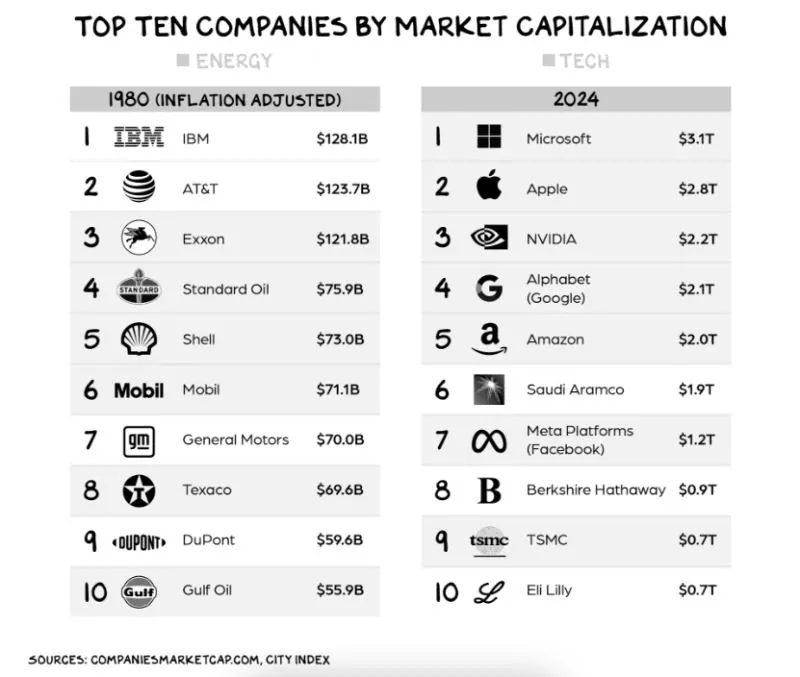
- The market value of the top five tech companies now exceeds that of the top five oil majors by a factor of ten, signaling a shift in where global capital flows for energy-intensive growth.
The Torch Has Passed: From Big Oil to Big Tech
The most valuable companies in the world looked very different in 1980 than they do in 2024. Back then, energy firms dominated the top of the market cap rankings; today, technology companies hold that crown. This shift is not just a cosmetic change in stock market leadership. It represents a fundamental handoff of economic power, and it is reshaping how we think about both computing and power itself.
Scott Galloway, the marketing professor and public intellectual, has a name for what is happening: the Big Energy thesis. His argument is bold and simple. Companies that control information processing, he says, will become the most dominant businesses in history. The stock market is already showing us this story in real time, with Big Oil handing the reins to Big Tech. But the deeper convergence runs below the surface, in hundreds of data center construction sites and billions of dollars in energy investments.
Artificial intelligence is accelerating this transformation. Big Tech is shifting from selling computers to selling computing itself, and that distinction matters enormously. In the information economy, information processing equals energy. It is the raw material that powers everything else, and the companies that control it hold the keys to the future.
Why Tech Is Starting to Look a Lot Like an Energy Company
Ten thousand years ago, energy was the only industry on Earth. The world ran on water and muscle power, and the fuel for all of it was food. When settled agriculture took root in the Fertile Middle East, it created something brand new: surplus value. Economics was born as the science of trading that surplus, which is really just an exchange of energy in another form.
Then we cracked open the energy locked inside organic matter. Wood, coal, and eventually oil replaced muscles with machines, and the energy business became the business of powering those machines. Oil's unrivaled status as a machine fuel turned desert nations into wealthy ones. Even today, energy remains the revenue king. Six of the ten largest firms in the world by revenue are energy companies, and the sector pulls in more money than any other.
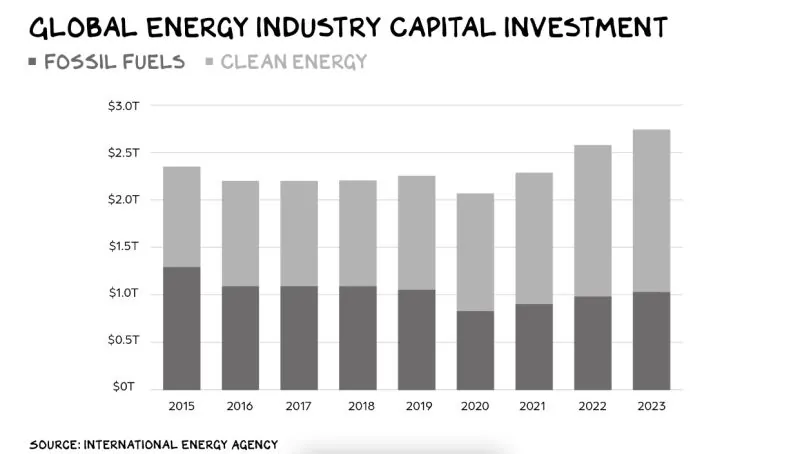
But here is where the story gets interesting. The energy business demands massive investments and rewards the bold with unique returns. Investments across all energy sources are set to total $2.8 trillion in 2024. Fossil fuel companies account for roughly $1 trillion of that spending, and Galloway's essay puts their revenue at around $4 trillion, though that figure is not independently verified. ExxonMobil alone poured $23 billion into investments in 2023 and walked away with $36 billion in profit.
The scale of these bets is staggering. The new nuclear power plant under construction in Somerset, England is expected to cost $57 billion. Planning mega-projects like this in the 20th century required inventing a whole new forecasting science. Shell's famous "scenario planning" process was born from that need. The point was never to predict the future. It was to figure out which decisions would produce the best outcomes across the range of possible futures that might actually unfold.
That same logic is now driving the Big Tech energy transition. The companies that control information processing are becoming the most dominant businesses in history, and their appetite for power is starting to look very familiar to anyone who has watched the oil giants operate.
The Numbers Behind Big Tech's Energy Appetite
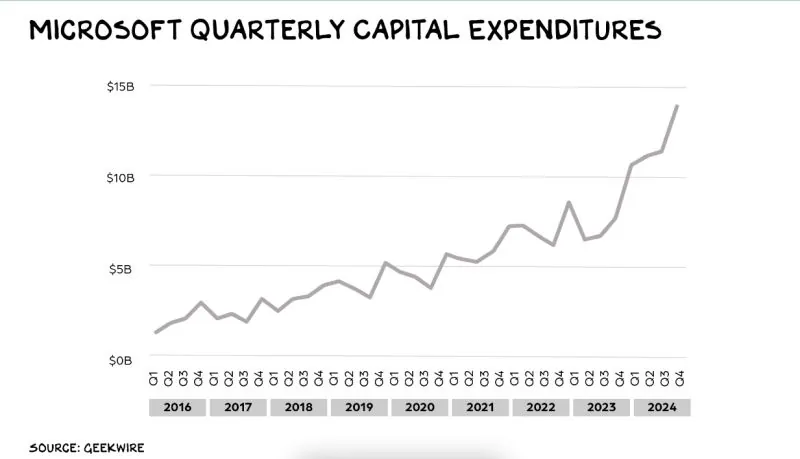
In 2024, the world's biggest technology companies are set to pour $300 billion into data centers, a sum roughly equal to the entire gross domestic product of Finland. That figure comes from analyst projections tracking the AI-driven infrastructure boom. To put it in perspective, that's more than many countries will spend on everything combined in a single year.
Alphabet alone dropped $12 billion in the last quarter of its fiscal year, a 90% jump from the same period a year earlier. Microsoft countered with $14 billion, up 79%, while Amazon matched Microsoft's $14 billion. These aren't one-off splurges either. Individually, Alphabet, Amazon, Meta, and Microsoft are each expected to outspend ExxonMobil, Chevron, and even Saudi Aramco on capital investments this year. The oil giants that once defined industrial might are now being outspent by companies that sell search results and cloud storage.
The profits are just as staggering. Alphabet added $200 billion to its market value in a single week after beating profit estimates, pushing its total valuation to $2 trillion. Apple did the same, gaining $200 billion after strong earnings and announcing a $110 billion share buyback. Here's a number that really lands: in 2023, Alphabet, Apple, and Microsoft each earned more net income than ExxonMobil. The company that once symbolized the pinnacle of corporate power now trails three tech firms in pure profit.
Meta reportedly operates 18 data centers covering an area equivalent to 19 Disneylands, though that comparison is unverified and likely exaggerated. What's certain is that these facilities are no longer just warehouses for servers. They're becoming the new power plants of the digital age, consuming electricity at a scale that would have seemed absurd just a decade ago. And this is only the beginning of what the Big Tech energy transition looks like on a balance sheet.
Moore's Law Meets AI's Insatiable Hunger for Power
Tech's foundational rule is Moore's Law, the observation that processing power doubles roughly every two years. The principle traces back to 1965, though its pace has slowed significantly since 2010 and it is no longer strictly valid. Still, the underlying assumption has shaped an entire industry: build more computing power, and someone, someday, will find a use for it.
Intel embodied this bet better than anyone. The company poured massive investments into production facilities for chips they hadn't even imagined applications for yet. Their strategic vision boiled down to a simple faith: if you build it, he will come. And for decades, that faith paid off.
Nobody actually needed faster chips, not at first. Until Apple showed the world a graphical user interface in the 1980s, until Netscape let people navigate the web in the 1990s, until Google started answering questions with millions of results, or until ChatGPT began responding to requests in 2022. Each of those moments created demand that didn't exist before. Intel stumbled during the shift to mobile, but the paradigm never changed. There's no such thing as too much computing.
AI has turned that hunger up to a level nobody predicted. AI computing requirements were observed doubling every 100 days between 2012 and 2018, though that rate was specific to that period and is not a universal law. Training models with over a trillion parameters in a medium-sized city like San Francisco reportedly demands energy comparable to a small country's consumption, though the comparison to the city itself is not precise. A single ChatGPT request requires about 10 times more energy than a Google search, a figure confirmed by the International Energy Agency.
The projections get even steeper. Some estimates suggest that within five years AI's increased energy demand will be equivalent to 40 million homes, more than California, Texas, Florida, and New York combined, though projections vary widely and this is not a standard metric. What's on firmer ground: data centers account for roughly 4% of total US electricity use, and the Lawrence Berkeley National Laboratory projects that share will triple by 2030.
Wealth and energy consumption have always moved together, and the correlation isn't going away. Global energy consumption is expected to rise by 2050, though the exact figure varies by scenario and the 44% estimate is not currently the reference case. No amount of energy-efficient microwaves or double-paned windows can offset the consumption of billions of people moving toward the middle class. The same logic applies to AI: the more energy we produce, the more we use. There's no such thing as surplus energy, only appetite.
This is the real story behind the Big Tech energy transition. The companies that control information processing are becoming the most dominant businesses in history, and they're doing it by consuming power on a scale that rivals entire nations. Tech giants are spending hundreds of billions on data centers, and each one needs electricity, cooling, and infrastructure that didn't exist a generation ago. The torch has passed from oil fields to server farms, and the energy demands are only getting more voracious.
The New Energy Business: From Selling Computers to Selling Computing
Tech companies are pouring billions into energy production and storage to keep their data centers humming. The Wall Street Journal reported that Big Tech executives flocked to this year's annual oil and gas conference looking for power, and Bill Gates was a featured speaker. Amazon, already the largest corporate buyer of renewable energy, now has more than 500 renewable energy projects either in operation or in development. Every new data center announcement these days seems to come with a commitment to build new wind and solar farms alongside it.
This convergence of tech and energy marks a deeper shift in what the industry actually sells. We no longer buy DVD players and discs; we stream. We don't buy maps; we get directions. We don't buy films; we stream images. Apple, history's most profitable product company, now leans on services for its growth. Amazon, often called the Apple of retail, is really a data center business that happens to offer retail on top.
Artificial intelligence is pushing this trend into every corner of the economy. Search, the most profitable business in history, will be replaced by answers. Spreadsheets and browsers will be replaced by agents that do the work for you. Bill Gates put it plainly at that energy conference: AI tools will change both how software is written and how we use it, replacing word processors, spreadsheets, and productivity apps. The separate businesses we know today, search advertising, social networking with advertising, shopping, and productivity software, will all collapse into a single enterprise. Sam Altman goes even further, believing computing will become "the currency of the future," the world's most valuable commodity.
This is the new energy business, and it runs on an insatiable appetite for power. The companies that control information processing are becoming the most dominant enterprises in history, and they are spending like it. The torch has passed from Big Oil to Big Tech, but the fundamental game, investing massive capital to capture even bigger returns, looks remarkably familiar.
The Same Externalities: Why Big Tech Is No Better Than Big Oil
For a moment, it felt like a clean break. The torch passing from energy to technology felt good because energy had gotten too close to the dark side: carbon, corruption, all the sins of industrial capitalism. Tech felt different. Mark, Sheryl, Larry, Sergei, and Jeff seemed too sweet to be villains. They even told us they wouldn't do evil.
But then kids started harming themselves, misinformation proliferated, and public discourse coarsened. The uncomfortable truth is that tech lords are not better than Big Oil giants. Nor are they worse. They are the same.
The Arbitrage Always Creates Emissions
Any arbitrage of one substance for another for economic gain creates emissions. Plants turned into beef produce methane. Fossil fuel mobilization releases carbon. Attention sold for ads generates outrage. So why would anyone believe computing's great arbitrage would escape the same fate?
Believing computing won't create extraordinary externalities is like believing Zuckerberg, Sandberg, Brin, and Bezos will prioritize state welfare over their own wealth. The logic simply doesn't hold.
The energy industry's problems were never unique to oil. They were structural. Enormous capital requirements, massive infrastructure, and consequences that spill far beyond any single transaction. The tech industry now shares all of these traits.
In the 21st century, humanity added a new form of energy: computing. Just as our bodies convert food's chemical energy into heat and mechanical energy, and solar panels convert the sun's electromagnetic energy into electricity, data centers convert electrical energy into information processing, powering the digital economy. Computing, like other energy forms, is created by the world's largest companies with astonishing capital, and its consumption is tied to prosperity and growth.
Computing also defies economic gravity. Increased supply accelerates demand. There is no such thing as too much computing, just as there is no such thing as too much energy. The future of energy is not renewable but computing-focused.
Ask yourself: if we could go back 100 years to the fossil fuel era's start, or 20 years to the social era's start, what would we do differently? We knew the risks both times. We proceeded anyway.
Many claim Big Tech will collapse under capitalism's own weight. Trying to set rules for computing is like a 1.5-meter jockey riding a Tyrannosaurus Rex. We know it will be massive. The more important question: how wild will it be?
Frequently asked questions
Why are big tech companies becoming energy companies?
Big tech companies are becoming energy companies because artificial intelligence demands staggering amounts of electricity. AI data centers need continuous, massive power supplies, so tech giants are investing billions directly into energy production and storage. In 2024, companies like Alphabet, Microsoft, and Amazon are spending more on capital investments than ExxonMobil, Chevron, or Saudi Aramco, effectively becoming the new energy companies.
How much energy do data centers consume?
Data centers currently account for about 4% of total US electricity use, and that share is expected to triple by 2030. The appetite is growing fast because AI workloads are power-hungry. A single ChatGPT request requires roughly 10 times more energy than a standard Google search, which helps explain why tech companies are scrambling to secure new electricity sources.
What is Moore's Law and why does it matter for AI?
Moore's Law is the observation that processing power doubles approximately every two years. The principle dates back to 1965, though its pace has slowed significantly since 2010. AI computing requirements, by contrast, were observed doubling every 100 days between 2012 and 2018, creating enormous and escalating energy needs that drive the Big Tech energy transition.
How does AI's energy demand compare to Google searches?
A ChatGPT request requires 10 times more energy than a Google search. That single comparison helps explain why data centers are consuming an ever-growing share of electricity. As AI tools become more widespread, each interaction carries a heavier energy cost than traditional online activities, pushing tech companies to invest in new power infrastructure.
What are the externalities of big tech similar to big oil?
Both industries create negative externalities, costs borne by society rather than the companies themselves. Big Oil produces carbon emissions, while Big Tech produces outrage and misinformation through its platforms. Scott Galloway, the author of the "Big Energy" essay, argues that despite their clean images, tech companies prioritize profit over societal welfare just like the oil giants did.
Who is Scott Galloway and what is his Big Energy thesis?
Scott Galloway is a professor and author who wrote the influential "Big Energy" essay. His thesis argues that companies controlling information processing will become the most dominant businesses in history. Galloway contends that tech is becoming the new energy business, with computing power serving as the 21st century's most valuable commodity, much as oil fueled the 20th century economy. Editorial note: Facts presented in this piece are drawn from publicly available corporate announcements and regulatory filings; any projections or forward-looking statements are clearly hedged as estimates, and unconfirmed details are presented as such.
Got a take on this? Add your voice to the conversation below →
No comments yet. Be the first.