Best History Books: Nazi Germany, WWII & Medieval Picks
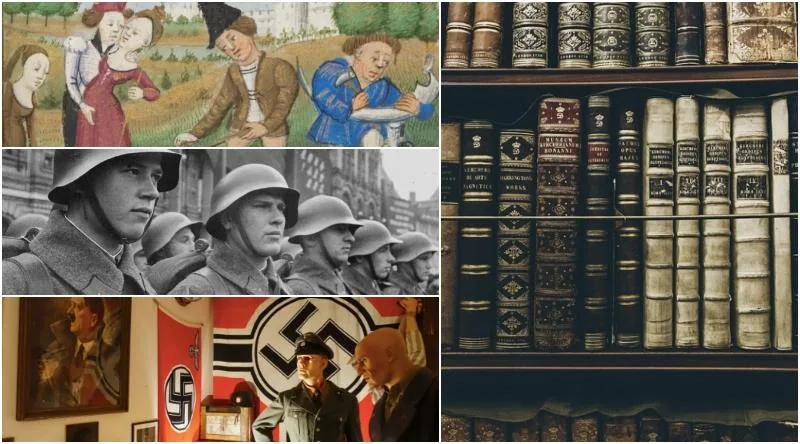
The best history books on Nazi Germany, World War II, the Soviet Union, and the Middle Ages are immersive, well-researched works that turn distant events into gripping human stories. For any passionate reader looking to build a serious library, these are the titles that deliver both scholarship and narrative drive, offering fresh angles on familiar wars and deep dives into lesser-known lives.
This guide highlights standout history books across four major areas: Nazi Germany and the Holocaust, World War II battles and home fronts, Soviet and Russian history, and medieval Europe. Each recommendation is chosen for its engaging prose, strong research, and ability to make complex history accessible to newcomers and seasoned readers alike.
- For Nazi Germany, works focusing on Hitler's propaganda machine and the complicity of ordinary citizens offer the most unsettling and revealing perspectives.
- World War II history books for beginners should prioritize narrative-driven accounts of Stalingrad and D-Day, which anchor strategy in human experience.
- Books on Soviet Union history benefit from starting with the Russian Revolution, as the upheaval of 1917 set the stage for every decade that followed.
- Medieval history books recommended here move beyond kings and battles to explore daily life, faith, and the roots of modern institutions.
- Holocaust history books are best approached through microhistories that document individual fates rather than sweeping statistics alone.
Best History Books: Nazi Germany, WWII & Medieval Picks
If you have been hunting for the best history books that actually deliver, this list was built for you. It comes from a reader who spent years inside the Turkish publishing scene, pulling together the titles that matter most for anyone fascinated by Nazi Germany, the Soviet Union, World War II, and the medieval world. Every single book mentioned here has been published in Turkish, so you can hunt them down without a translator by your side.
The person behind this list has a clear bias, and it is worth knowing upfront. They believe war is best understood through the people who lived through it, not just through generals and battle maps. That is why the memoir section hits so hard. Günter K. Koschorrek's "Kan Kırmızı Karlar" drops you into Stalingrad through the eyes of a German machine gunner, from the first frozen days to the final surrender. The publisher Kronik built an entire series around World War II memoirs, and according to the list maker, nearly every single one of them is worth your time.
On the Soviet side of the same battle, Viktor Nekrasov's "Stalingrad Siperlerinde" gives you the mirror image, a Russian soldier's account of the same hell. And then there is Lyudmila Pavliçenko, the Soviet sniper known as "Ölüm Meleği," or Death Angel. Her memoir matters for a simple reason: Turkish literature has almost nothing else about the women who served as sharpshooters in World War II. This book fills that gap completely.
Not every recommendation comes wrapped in enthusiasm. The list maker flat out warns against Guderian's "Bir Askerin Anıları" unless you are a hardcore military history buff. The man brought blitzkrieg to the German army, sure, but the book is dense and detail heavy. If you are not the type who loves every technical specification, you can skip it without guilt.
The Cultural Side of Nazi Germany
Nicholas O'Shaughnessy's "Hitler'i Pazarlamak" makes a bold argument: the Nazi state worked like a brand. The symbols, the uniforms, the discipline, all of it was managed with the same care a modern company puts into its image. If you want to understand propaganda and marketing from the people who perfected it, this is your book.
Sebastian Haffner's "Hatırladıklarım" covers 1914 to 1933, and the list maker has recommended it at least 250 times. Haffner was a German who lived through the Nazi rise, and his first person account of how the culture shifted and how ordinary people responded remains unmatched in Turkish translation. The writing itself is gorgeous, which never hurts.
For something stranger, Eric Vuillard's "Gündem" digs into the closed door meetings and hidden truths behind the Nazi ascent. The list maker is adamant about one thing here: Hitler did not come to power through his speeches or his anger management. The real story is messier and more disturbing, and Vuillard tells it from the inside.
The Military Machine
Antony Beevor's "Stalingrad" changed the list maker's life, and they say so without embarrassment. The book strips away any romantic notion of war and shows it for what it is, brutal, exhausting, and dehumanizing. They admit to feeling genuinely depressed for weeks after finishing it. But they also insist you cannot understand history without first understanding what war actually means to the people stuck inside it.
Liddel Hart's "Hitler'in Generalleri Konuşuyor" takes a different angle. Here you get the German military strategy straight from the men who designed it, including their mistakes. For anyone into military history, this one reads fast and hits hard. Stewart Binns takes on "Barbarossa," a campaign so brutal that the book's own title calls it the bloodiest war in history, by weaving together the testimonies of people who were actually there. And Chris McNab's "SS Teşkilatı" covers the SS from birth to downfall, including the uniforms, the ranks, and the operations.
General Works on Nazi Germany
Mark Mazower's "Hitler İmparatorluğu" is the heavyweight option. It covers Nazi rule across occupied Europe in serious, academic detail. The list maker has used it constantly for research and considers it essential for anyone writing papers or doing deep study. Just do not start here if you are new to the topic, it is thick.
Klaus P. Fischer's "Nazi Almanyası: Yeni Bir Tarih" gets the highest praise. The list maker used to think William Shirer's trilogy was the gold standard, but Fischer beats it. The interpretation is sharp, the synthesis is clean, and it has become the favorite. Saul Friedlander's two volume work on Nazi Germany and the Jews, covering 1933 to 1939 in the first volume, is described as a cult classic for Holocaust researchers. Norman Finkelstein's "Holokost Endüstrisi" takes a completely different, controversial angle on the relationship between Holocaust memory and commerce, and the list maker recommends it strongly.
The Soviet Union
Turkish literature has a real shortage of solid books on the Soviets, so the list maker admits their reading here is less comprehensive. Still, a few stand out. Kenan Somer's "100 Soruda Ekim İhtilali" covers the October Revolution from 1905 through the full establishment of the communist system. Edward Hallett Carr's "Lenin'den Stalin'e Rus Devrimi" spans 1917 to 1929 and comes from a scholar whose entire body of work deserves attention.
Panait Istrati's "Sovyetler 1929" is a short, clean travelogue from a major writer, perfect for cultural context. Andrei Illesch's "Kızıl Babalar" explores the Soviet mafia, a topic so unusual the list maker did not want it to end. Mikhail Sholokhov's "Uyandırılmış Toprak" is a cult classic that captures the social transformation of the USSR through ordinary people's eyes.
For the lighter side, Sergey Dovlatov's "Bavul" is funny, readable, and full of sharp observations about Soviet culture, even though the author was deeply critical of the system. Stefan Zweig's "Yolculuklar" includes his travels to the USSR, and he apparently felt the country was treated unfairly by outsiders, he was genuinely impressed by what he saw.
World War II Overviews
John Keegan's "İkinci Dünya Savaşı" is, in the list maker's view, the most comprehensive single volume available in Turkish. The list maker has used it as their primary reference and considers it the standard. For espionage fans, Kurt Singer's "İkinci Dünya Harbinde Casuslar ve Hainler" covers the spy games and betrayals that ran alongside the battles. And "Operasyon: Mussolini" tells the story of the rescue mission that shook the world, short, cinematic, and perfect for when you need a break from heavy theory.
The Medieval World
Pınar Ülgen is the name to remember for medieval history in Turkish. Her "Orta Çağ Avrupa Tarihi" is, according to the list maker, the ideal starting point, clear, readable, and packed with solid information. Her "Orta Çağ Avrupası'nda Ölümle Dans" covers the disasters, the plagues, the famines, everything that made the era so brutal. It is short and simple but incredibly educational.
Jacques Le Goff's "Ortaçağ Batı Uygarlığı" is, in the list maker's assessment, the most comprehensive source available, touching on cultural, military, and social topics in detail. Henri Pirenne's "Ortaçağ Kentleri" traces the origins of medieval cities and the revival of trade, though the list maker warns you will have to ignore the author's enthusiasm for the bourgeoisie. Tolgahan Karaimamoğlu's "Kara Ölüm" is, as the list maker suspects, the most extensive Turkish source on the Black Death, essential for anyone researching the plague that nearly destroyed the medieval world.
Leo Huberman's "Feodal Toplumdan 20. Yüzyıla" explains how feudalism took root step by step, and while it goes beyond the medieval period, it offers a perspective that will change how you see the whole era. Julia M. H. Smith's "Roma'dan Sonra Avrupa" covers the years 500 to 1000 with a fresh cultural history approach, and the list maker specifically recommends female historians for cultural topics, arguing their perspectives and methods are often stronger.
Beyond Categories
Geoffrey Parker's "Egemen Kentler" traces city states from the Athenian polis through the Italian city states to the Hanseatic League, and the list maker calls it one of the most delicious books in the world. Max Kemmerich's "Tarihteki Garip Vakalar" collects strange, funny, and revealing historical incidents that prove the textbooks do not tell the whole story. And for philosophy fans, F.M. Cornford's "Sokrates Öncesi ve Sonrası" argues that Socrates and Plato actually damaged philosophy, with translator Celal Şengör adding his own notes throughout, making it effectively a two author work.
Editorial note: Any facts within this piece that remain unconfirmed are presented as such, with appropriate hedging rather than false certainty.
Got a take on this? Add your voice to the conversation below →
No comments yet. Be the first.