Al-Battani: The Astronomer Who Measured the Year
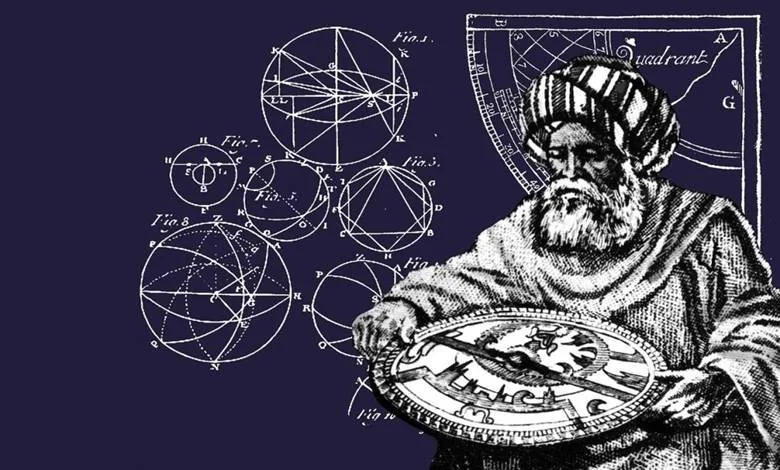
Al-Battani was a ninth-century astronomer who worked in Harran and Raqqa and measured the solar year at 365.24 days, a figure close to the modern value. He lived in an era when the night sky was read with the naked eye and instruments of wood and brass, and he still managed to refine numbers that later astronomers relied on. His tables of the Sun and Moon traveled across centuries and languages. When Copernicus looked up at the same stars, he found Al-Battani's work already waiting for him.
Al-Battani, also known as Albategnius, was a ninth-century astronomer from Harran who observed from Raqqa and Antioch. He calculated the solar year at 365.24 days, refined the obliquity of the ecliptic, and advanced trigonometry with sine ratios. His Kitab al-Zij influenced European astronomy, including Copernicus, for centuries.
- Al-Battani was born in the Harran region in the ninth century and died in 929, spending much of his working life around Raqqa on the Euphrates.
- His principal work, the Kitab al-Zij, contained astronomical tables and a star catalog that were used for centuries in both the Islamic world and Europe.
- He measured the length of the solar year as approximately 365.24 days, a value remarkably close to the modern measurement.
- He calculated the obliquity of the ecliptic more accurately than Ptolemy had, correcting earlier figures and influencing later astronomical tables.
- The lunar crater Albategnius carries his Latinized name, a lasting mark of his place in the history of astronomy.
Two Craters, Two Astronomers, One Long Conversation
Look up on a clear night and you can find two names written across the Moon's central highlands, close to the dark plain called Mare Nubium. One crater is Hipparchus, named for the Ancient Greek astronomer Hipparchus, who compiled a star catalog, discovered the precession of the equinoxes, and helped pioneer trigonometry. The other is Albategnius, named for the medieval Islamic astronomer Al-Battani. Two craters, two men, roughly fourteen centuries apart.
That pairing is the whole story in miniature. Hipparchus worked in the second century BC, measuring the sky with nothing but geometry and patience. Al-Battani worked in the ninth and tenth centuries CE, inheriting that Greek legacy, testing it, and quietly improving it. Between them sits a long conversation across time, carried on in numbers.
In the Latin-speaking world, Al-Battani was known as Albategnius, the standard Latinized form that medieval European texts used. That is why the crater carries that name rather than his Arabic one. It is a small linguistic fossil of how knowledge traveled: Greek into Arabic, Arabic into Latin, and finally into the printed books of Renaissance Europe.
Al-Battani is often described as the greatest and best-known astronomer of the medieval Islamic world. That is a widely repeated characterization rather than a settled, measurable fact, so treat it as reputation rather than record. What is not in dispute is the reach of his influence, which stretched from the observatories of the ninth century to the desks of European astronomers hundreds of years later.
Born in Harran: The Instrument-Maker's Son
Al-Battani was born in the Harran region in the ninth century, and his father was a master craftsman who built astronomical instruments. That single detail explains a lot. A boy growing up in a workshop full of astrolabes and sighting tools does not learn the sky from books first. He learns it from metal, from angles, from the feel of a graduated arc under his thumb.
His father's craft shaped his early interest in the sky, and the timing could hardly have been stranger or better. In the Abbasid era, the caliphs sponsored a systematic campaign to collect, translate and study ancient Greek scientific texts. Works that had survived through Syriac and Arabic copies were pulled together, rendered into Arabic, and picked apart by readers who were not content to simply admire them. Ptolemy's Almagest, the great second-century handbook of astronomy, stood at the center of that effort. It became the fundamental reference work for anyone studying the heavens.
Here is the part that matters. Islamic astronomers did not treat that inheritance as a finished thing to be passed along. They went back outside, re-observed, compared their own results against the old numbers, and corrected what did not hold up. Al-Battani grew into one of the strongest voices in that critical tradition, a scholar later known in the Latin world as Albategnius.
His own instruments came out of the same habit. While he studied astronomy and mathematics, he built his own observational tools rather than trusting someone else's. And the sky he watched was a working sky, not a philosophical one. In his world, astronomy was tied directly to measuring time, regulating calendars, fixing the hours of prayer, and navigating at sea. A mistake in a star table was not an abstraction. It was a missed prayer or a ship off course.
That is the hinge Al-Battani was born onto: a moment when Greek science was being rescued, translated, and then genuinely stress-tested by people who had the instruments to check it.
Watching the Sky from Raqqa and Antioch
Al-Battani did his most important work in the field, not in a library. He set up his observations around Raqqa, on the northern Syrian plain, and near Antioch, farther west toward the Mediterranean. These were his two home bases, and from them he watched the sky with a patience that few of his contemporaries matched.
What did he actually look at? Eclipses, mostly, both solar and lunar, tracked through their full passage. He followed the planets as they drifted against the stars. He marked the turning of the seasons, watching for the exact moments when winter gave way to spring and summer slid into autumn. Every one of those observations fed into a growing body of numbers.
Two of those numbers matter more than the rest.
The Tilt of the Ecliptic
The first concerns the angle between Earth's equator and the apparent yearly path the Sun traces across the sky. Astronomers call this the obliquity of the ecliptic, and in Al-Battani's time the accepted figure came from Ptolemy of Alexandria, the second-century Greek whose Almagest had become the fundamental reference work for astronomical studies across the Islamic world and later medieval Europe. Al-Battani, working from his own measurements, determined that tilt more accurately than Ptolemy had. His value sat closer to the truth than the master's did.
The Length of the Year
The second number is the solar year itself. Al-Battani did not guess at it. He timed the spring equinox and the autumn equinox, then measured the interval between them, and from those measurements he calculated the length of the year as approximately 365.24 days. It is a strikingly close match to the true tropical year, the span the Sun takes to return to the same point in its seasonal cycle.
Think about what that required. No clock in ninth-century Raqqa could simply be read off. The equinox had to be caught by watching the Sun's position and the length of shadows, then narrowed down through repeated observation across years. The precision came from accumulation, not from any single clever instrument.
A Discrepancy He Could Not Explain
There was something else Al-Battani noticed, and it troubled the tidy picture Ptolemy had drawn. According to the original account, he recorded that the Sun's apparent position did not fully match the fixed-star background that Ptolemy's system described. The point where the Sun's visible disc appeared smallest, its apogee, did not sit where the ancient Greek zodiac predicted it should. The framing of this particular finding is contested among historians, so it is best treated with care.
What we can say is that the discrepancy he flagged belongs to phenomena we now describe as precession and orbital irregularities. The slow wobble of Earth's axis, and the subtle shifts in its orbit, both push the Sun's apparent path out of alignment with the stars over long stretches of time. Al-Battani had no way to reach that explanation. Under the geocentric model, with Earth fixed at the center and everything wheeling around it, there was simply no physical mechanism available to account for the drift. He could measure it. He could record it. He could not explain it.
That is often how science moves. A careful observer writes down a number that does not fit, and the number waits, sometimes for centuries, until someone arrives with a model that can hold it.
From Chords to Ratios: Al-Battani and Trigonometry
Al-Battani, born in the Harran region in the ninth century, was among the pioneers who made trigonometry a fundamental tool of astronomy. He looked at the geometry the Greeks had handed down and found it clumsy for the job he actually needed done.
The older method worked with chords: lengths of straight lines drawn inside a circle. It was elegant on paper, but slow and awkward when you had to crank through hundreds of positions night after night. Al-Battani found that approach insufficient and pushed toward ratios instead, the sines and tangents that turn an angle directly into a number you can multiply. He did not just dabble in this. He systematized it, building the ratios into a working framework that could be applied again and again.
That shift mattered most because of how he used it. He deliberately applied spherical trigonometry to the problem of locating celestial bodies, treating the sky as a curved surface rather than a flat diagram. The payoff was practical: astronomical tables became easier to prepare, and the numbers that came out of them grew noticeably more accurate.
All of this fed into his comprehensive work, generally known as Kitab al-Zij. A zij was a handbook of tables, and his carried detailed listings of the positions and motions of celestial bodies alongside calculations tied to time itself. What set his tables apart was their foundation. They rested directly on observational data, gathered and then run through mathematical operations rather than copied from older authorities.
He also went back through the star catalogs that came before him. Al-Battani recorded the positions of many stars, corrected errors he found in the earlier lists, and improved them with new measurements of his own. His studies of the visibility conditions of the new moon carried the same care, and they mattered for calendar regulation and time calculations.
Read the whole arc and a pattern emerges. The observations were the raw material. The ratios were the engine. The tables were what you could hand to the next astronomer, who could check your work and push it further. Al-Battani did not simply inherit a tradition. He rebuilt its tools.
How Al-Battani Reached Copernicus
Al-Battani's great astronomical handbook traveled west long after his death. In the 12th century, his zij was rendered into Latin and circulated across Europe under the title De motu stellarum, "On the Motion of the Stars." That translation turned a ninth-century scholar from the Harran region into a name that medieval and Renaissance readers could actually consult.
Then came the printing press. Once movable type spread through Europe, copies of De motu stellarum multiplied far beyond the handful of hand-copied manuscripts that had served a small circle of scholars. The observations and tables reached a much wider readership, and they landed on the desks of the astronomers who were about to redraw the map of the heavens.
Nicolaus Copernicus was one of them. In his De revolutionibus, the work that set aside the geocentric model, Copernicus cited Al-Battani's observations and parameters directly. Here is the twist that makes the story worth telling: even as Copernicus pulled the Earth out of the center of the cosmos, some of the numerical data he relied on had been measured centuries earlier by an astronomer working within that very tradition. The framework changed. The measurements, in part, did not.
Al-Battani died in 929. What he left behind was never just a name attached to a lunar crater or a bundle of tables. He took the inherited knowledge of the ancient world and re-measured it with a critical eye, then bound mathematics directly to observation. That habit, patient correction and careful comparison rather than a single dramatic leap, is exactly what carried his work across languages, across centuries, and eventually into the hands of the man who moved the Sun to the center.
Frequently asked questions
Who was Al-Battani?
Al-Battani was a 9th-century astronomer and mathematician born in the Harran region, known in the Latin world as Albategnius. He carried out his observations around Raqqa and Antioch during the Abbasid Caliphate, and his father was a master craftsman who made astronomical instruments. He died in 929.
How did Al-Battani calculate the length of the solar year?
He measured the times of the spring and autumn equinoxes and worked from those observations to derive the length of the solar year as approximately 365.24 days. That figure sits remarkably close to the true tropical year, and it came out of patient watching of the sky rather than inherited tables.
What was the Kitab al-Zij?
The Kitab al-Zij was Al-Battani's comprehensive astronomical handbook, built from detailed tables and methods for locating celestial bodies, tracking their motions, and calculating time. Its tables rested directly on his own observational data combined with mathematical operations, and he corrected errors in earlier star catalogs and improved them with fresh measurements.
How did Al-Battani improve on Ptolemy?
Al-Battani determined the obliquity of the ecliptic more accurately than Ptolemy did. His measurement came closer to the true figure than Ptolemy's, a correction that shows how carefully he re-measured what earlier astronomers had taken for granted.
How did Al-Battani's work reach Europe?
His work was translated into Latin in the 12th century and became known in Europe as De motu stellarum. Printing later spread it to a far wider readership, and Renaissance astronomers including Nicolaus Copernicus consulted his observations and calculations directly.
Why are the lunar craters named Hipparchus and Albategnius?
The Hipparchus crater honors the Ancient Greek astronomer Hipparchus, a pioneer of trigonometry who prepared a star catalog and discovered the precession of the equinoxes. The Albategnius crater honors the medieval Islamic astronomer Al-Battani. According to the original account, both craters lie in the Moon's central highlands near Mare Nubium.
What was Al-Battani's role in trigonometry?
Al-Battani was among the pioneers who made trigonometry a fundamental tool of astronomy. He moved away from Greek chord-based geometric methods toward ratio-based sine and tangent approaches, then applied spherical trigonometry to the problem of computing celestial positions, which made astronomical tables easier to build and noticeably more accurate.
Where did Al-Battani live and work?
Al-Battani was born in the Harran region in the 9th century and centered his observational work on Raqqa and Antioch during the Abbasid Caliphate. In that setting, under caliphs who systematically collected, translated and studied ancient Greek scientific texts, he observed solar and lunar eclipses, planetary positions and seasonal changes with great care. Editorial note: Details that remain unconfirmed, including some dates and the exact circumstances of his observations, are presented here as uncertain rather than settled fact.
Got a take on this? Add your voice to the conversation below →
No comments yet. Be the first.