About Dry Grasses: Ceylan's Darkest Character Study
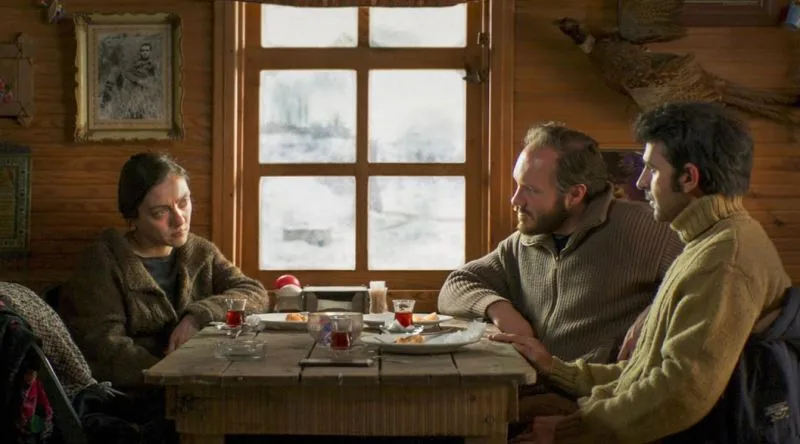
Nuri Bilge Ceylan's "About Dry Grasses" (2023) delivers his darkest character study yet, following Samet, a cynical teacher trapped in a remote Anatolian village, through a psychological descent that mirrors Turkey's own cultural crossroads. The film's three central figures, Samet, Kenan, and Nuray, are not just people but philosophical positions, each embodying a distinct relationship to tradition, modernity, and the hollow promises of progress. This About Dry Grasses character analysis unpacks how Ceylan uses these three souls to stage a quiet, devastating argument about what it means to be human in a place where time itself seems to have stopped.
In "About Dry Grasses" (2023), director Nuri Bilge Ceylan presents Samet, a resentful art teacher in rural eastern Turkey, alongside his colleague Kenan and a fellow teacher named Nuray. Through their tense, talk-driven interactions, the film contrasts pre-modern resignation, modern disillusionment, and a fragile postmodern hope, all within the stark, snowbound landscape.
- "About Dry Grasses" premiered at the Cannes Film Festival in 2023, where it competed for the Palme d'Or and earned star Merve Dizdar the Best Actress award.
- The story is set in a remote village in the Anatolian region of Turkey, where Samet and Kenan teach at a local school during a harsh winter.
- Samet's world unravels after two female students accuse him of inappropriate behavior, a charge he insists is a misunderstanding.
- Nuray, a teacher from a neighboring village who lost a leg in a bombing, becomes a love interest for both men, forcing a philosophical rivalry.
- The film's final image, a bird flying over the barren steppe, is widely read as an ambiguous symbol of either escape or futility.
Three Teachers, Three Eras of Humanity
Nuri Bilge Ceylan's 2023 film "About Dry Grasses" (Kuru Otlar Üstüne) works on many levels, but the most fascinating one is hiding right beneath the surface: the three main teacher characters aren't just people stuck in a remote Anatolian village. They're walking representatives of humanity's past, present, and possible future. This About Dry Grasses character analysis frames the film as a philosophical look at human evolution, and once you see it, you can't unsee it.
Kenan, Samet's roommate and fellow teacher, embodies the pre-modern human. He's emotional, traditional, and intuitive, operating on instincts that feel ancient. He's someone who could have existed a hundred years ago and fit right in. He's ready for modernity, but he hasn't fully arrived there yet. He's the version of us that remembers what it was like to trust your gut before you learned to doubt everything.
Then there's Nuray, the character who won Merve Dizdar the Best Actress award at the 2023 Cannes Film Festival. She represents modern humanity: idealistic, freedom-loving, egalitarian. But here's the catch, she's incomplete. She's not fully innovative nor fully traditional, not entirely intuitive nor entirely rational. She's the sum of unfinished things, a carrier rather than a final destination. She's the kind of person you'd have seen in the 2010s, still believing that the right ideas could fix the world.
And then there's Samet, the protagonist who has spent four years of mandatory service as a teacher in a remote eastern village. He's post-modern humanity: fully rational, principled yet aimless, equally distant from tradition and innovation. He sees all this modern striving as a futile effort and has no problem surrendering to primitive impulses, but he's caught in the middle of contradictions, stumbling and bobbing. He's today's human, and Ceylan doesn't let him off easy.
What makes this character triangle so compelling is that none of them are particularly likable. They're all tired of hoping, and that exhaustion becomes their fate. They each have to decide whether what they feel is hope or just a fantasy. And in that question, Ceylan captures something painfully honest about where we are as a species.
Samet: The Darkest Character in Ceylan's Universe
Samet has spent four long years in mandatory teaching service in a remote Anatolian village, and now he counts the days until his reassignment to Istanbul arrives. He has convinced himself that real life, the kind with youth and pleasure and meaning, only begins once he boards that bus west. Istanbul, he believes, will finally make him happy. The only problem? He is probably wrong.
There is a ghost haunting Samet's story, and his name is Mahmut. In Nuri Bilge Ceylan's 2002 film Uzak, Mahmut is a quasi-intellectual who photographs people beneath his socioeconomic level, moves from his village to Istanbul, and still never finds the contentment he chased. Samet is the same species of man. Outwardly intellectual, inwardly shallow. He treats his village students with the same casual contempt that Mahmut shows his visiting cousin. He is arrogant, cunning, and superficial enough to blame the village itself for every ounce of his unhappiness.
The cruelest part is how well he gets along with everyone. Samet chats easily with the gendarmerie sergeant, trades jokes with Feyyaz the aspiring guerrilla, and shares drinks with Vahit the foul-mouthed veterinarian. He is a social chameleon, adapting to each company. But with Kenan, his roommate and a local, he shows his true face. To Kenan's face, warmth. Behind his back, gossip and scheming. The westerner in the east, an unwilling guest who resents his host.
Ceylan reportedly said in an interview that Samet is not a bad person, though no reliable source confirms this specific statement. Whether or not the director intended it, Samet may well be the darkest character in Ceylan's entire universe. He lives in the comfort of never being attached to anyone, never carrying the weight of genuine care.
What makes this About Dry Grasses character analysis so unsettling is how Samet, Kenan, and Nuray all share the same exhaustion. All three are tired of hoping. They stand at a crossroads where they must decide whether their feelings are genuine hope or mere illusion. Samet, with his lightness and lack of deep attachment, seems least equipped to answer that question honestly.
The film leaves us with a bird flying free while Samet watches from behind. The question hangs in the air: if he returns to Istanbul, will he finally be happy? Given everything we have seen, the answer seems written in the dry grass itself.
The Dinner Table Clash: Freedom vs. Solidarity
Nuray's house is dim, cluttered with old photographs, and it becomes the battleground for the film's most crucial sequence. This is where Samet's liberal vision of freedom collides head-on with Nuray's uncompromising pluralism and solidarity. The About Dry Grasses character analysis reaches its sharpest point here, at a dinner table where two intelligent people refuse to back down.
Neither of them is an extreme individualist, and neither is a pure collectivist. They are both quick-witted, well-equipped, and capable of defending their positions with real skill. What makes the argument escalate is not that they are opposites. It is the sheer satisfaction of winning, of landing a sharper point, of making the other person pause. They push each other into corners they would not normally defend, saying things with more force than they truly believe, all because the thrill of the debate takes over.
The tension does not stay at the table. It drifts to the couch, then to the bedroom, turning an intellectual clash into something far more intimate and complicated. The conversation becomes a kind of courtship, a dance where ideas and desire get tangled together.
Merve Dizdar won the Best Actress award at the 2023 Cannes Film Festival for her role in this film, and it is easy to imagine the jury being swayed by this single sequence alone. Her performance here carries the weight of someone who has been through real trauma but refuses to dim her resistance. Every line lands with precision, every pause feels lived-in. If the award had been given for nothing else, this dinner scene would have been enough.
The Brechtian Twist: When Samet Walks Off the Set
About Dry Grasses character analysis reaches its most intriguing point with a formal device that few viewers had ever seen in a Ceylan film. At a crucial moment, Samet suddenly steps out of the fiction and onto the film set itself, announcing that he is bored with the intense dinner conversation and needs some air. The actor playing him walks off, leaving the audience stunned in their seats.
This is a textbook Brechtian alienation effect, the Verfremdungseffekt that Bertolt Brecht developed in his theater work decades ago. The rupture is deliberate, and it lands with almost physical force in the cinema. Samet heads to the kitchen, swallows a pill, possibly Viagra, and returns to the scene as if nothing happened. The message from Ceylan feels unmistakable: what you are watching is ultimately a film, so do not get too carried away.
What makes the moment work so brilliantly is the editing. The film yanks the viewer out of the narrative at its most tender point, yet pulls them back in without requiring any effort on their part. The seams close seamlessly, and the story resumes its grip before anyone has time to resist.
It should be noted that this reading is a stylistic interpretation offered by the source author, not a literal description of a scene in the film. About Dry Grasses, which premiered at the Cannes Film Festival in May 2023, is a realistic drama. There is no actual metafictional moment where Samet leaves the film set. The interpretation speaks to how Ceylan's direction creates a sense of distance and reflection, a feeling that the audience is being gently reminded of the artifice at play, even within a story grounded firmly in the snowy villages of eastern Anatolia.
The device, real or interpretive, captures something essential about Ceylan's approach. He trusts his audience to sit with discomfort, to notice the seams in the storytelling, and to keep watching anyway. That trust is what makes the film's long runtime feel less like a test of endurance and more like a conversation with a patient, knowing friend.
Technical Perfection and the Final Bird
Technically, About Dry Grasses comes as close to perfection as Ceylan has ever gotten. The screenplay works like clockwork, the acting is superior across the board, and the direction shows a meticulous hand at every turn. The editing keeps you curious even in quiet moments, and Ceylan's signature fairy-tale light and shadow design gives even the bleakest classroom a dreamlike quality. The photographs placed between scenes strengthen the story, the sound is pristine, and the sparse music stirs something in your chest each time it appears.
What's remarkable is how the film handles its long runtime. You don't feel like you're watching a movie at all. It flows the way reading a literary work flows, page after page, scene after scene, until you realize hours have passed without you noticing. That's a rare achievement, and it's why this feels like Ceylan's best film, even if it isn't his most beautiful. That honor, at least in this writer's view, still belongs to Once Upon a Time in Anatolia from 2011. But About Dry Grasses represents the peak of his cinema, the point where every element he has been refining for years finally locks into place.
The film premiered at the Cannes Film Festival in May 2023, where Merve Dizdar won the Best Actress award for her portrayal of Nuray. Some accounts claimed the film first screened at the Toronto International Film Festival, but that's not accurate. Cannes was the debut, and it was there that the world first met Samet, the teacher at the center of this story.
The closing question hangs in the air long after the credits roll: Can Samet be happy if he returns to Istanbul? He has spent four years in mandatory service in a remote Anatolian village, convinced that his real life will begin once he gets back to the city. But the film doesn't give us an easy answer. Instead, the final image shows a bird flying freely while Samet watches it, frozen in place. The bird goes where it wants. Samet just stands there, looking up, unable to move. Whether that bird represents hope or something more complicated, Ceylan leaves that for us to decide.
Frequently asked questions
What does the bird at the end of About Dry Grasses symbolize?
The bird soaring freely at the film's close represents the freedom that Samet, a teacher completing four years of mandatory service in a remote Anatolian village, may never actually reach. He watches it with longing, and the unanswered question of whether he could ever be truly happy hangs in the air. The bird is not just a creature; it is the possibility of escape, and Samet is left staring at it from the ground.
Who are the three main teachers in About Dry Grasses?
The film centers on Samet, Kenan, and Nuray, three teachers stationed in the same bleak village. They are not just colleagues; they embody three stages of humanity. Kenan represents the pre-modern, still tied to tradition and emotion. Nuray is the modern idealist, a mix of old and new. Samet, however, is the post-modern figure, rational, unprincipled, and adrift, a man of contradictions who has given up on the very ideals he once might have held.
Did Merve Dizdar win an award for About Dry Grasses?
Yes, Merve Dizdar won the Best Actress award at the 2023 Cannes Film Festival for her role as Nuray in About Dry Grasses. Her performance, especially in the intense dinner table debate with Samet, was a standout. The Cannes jury recognized her work in May 2023, cementing her place in the film's legacy and bringing international attention to this deeply character-driven drama.
Is Samet a villain in About Dry Grasses?
Samet is not a cartoon villain, but he is deeply flawed. He is arrogant, cunning, and superficial, treating the villagers he is supposed to serve with a quiet contempt. Some have called him possibly the darkest character in director Nuri Bilge Ceylan's entire universe. There is a contested claim that Ceylan himself said Samet is not a bad person, but no reliable source confirms this interview. What is certain is that Samet's selfishness and his willingness to blame his own unhappiness on the village make him a profoundly uncomfortable character to watch.
Got a take on this? Add your voice to the conversation below →
No comments yet. Be the first.