A Hard Day's Night Chord Mystery Solved by Math
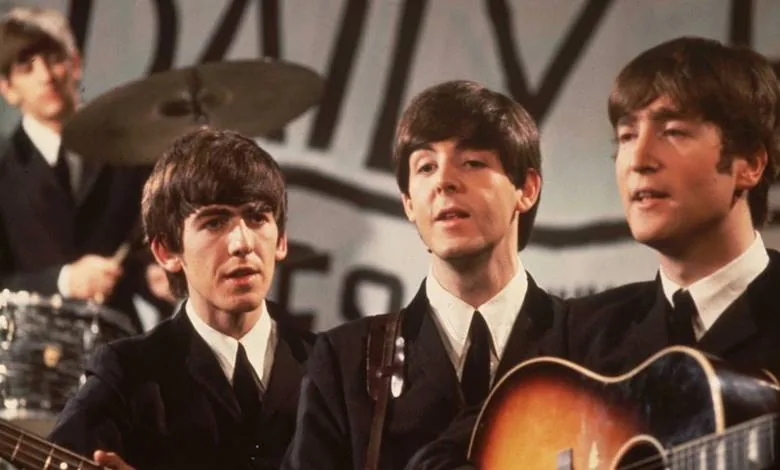
In 2004, mathematician Jason Brown cracked the A Hard Day's Night chord mystery, proving that The Beatles' iconic opening chord on the 1964 track was not just a guitar sound but a blend of instruments, including a hidden piano note. For 45 years, fans and musicians had been baffled by the chord's unique sound, unable to replicate it exactly, and Brown's Fourier transform analysis finally revealed the mathematical truth behind the musical magic. The discovery turned a casual listening puzzle into a celebrated moment of science meeting rock and roll, giving closure to a question that had haunted guitarists and producers for decades.
The Beatles' 1964 song "A Hard Day's Night" opens with a mysterious chord that stumped musicians for years. In 2004, mathematician Jason Brown used Fourier transform analysis to identify the exact frequencies, revealing that the sound combined three guitars and a piano note likely played by George Martin, finally solving the puzzle.
- The song "A Hard Day's Night" was released in 1964 as the title track for The Beatles' film and album.
- Jason Brown, a mathematician, published his findings in 2004.
- Brown used Fourier transform analysis to break the opening chord into its component frequencies.
- The analysis revealed a piano note, likely played by producer George Martin, that was previously undetected in the mix.
- The chord is a combination of three guitars and a piano, making it nearly impossible to replicate with a single instrument.
The Chord That Refused to Be Played Again
In 1964, The Beatles released "A Hard Day's Night," and with it came a musical puzzle that would stump experts for more than 45 years. The song's opening chord, a sound that lasted barely a second, became one of the most analyzed and debated moments in rock history. Guitarists, producers, and academics all took their best guesses, yet nobody could fully recreate that exact timbre.
Here is what we know for certain. George Harrison, John Lennon, and Paul McCartney all lightly touched their guitars at the same moment to produce the sound. A brief silence followed, and then the song kicked in. Simple enough on paper. But the result was something else entirely.
What made this chord so maddening? For one thing, a chord is just two or more notes played simultaneously. Music theory students learn to identify combinations all the time. Yet even the most trained ears disagreed about what was actually happening in those opening milliseconds. Some heard one cluster of notes, others heard something completely different.
As the years rolled on, the debate only grew. Studio engineers armed with the most advanced equipment of their time tried to replicate the sound note for note. They failed. Musicians in professional recording studios gave it their best shot, layering guitars and tweaking amplifiers, and still the original timbre eluded them. The mystery became a favorite argument among musicians, a barroom debate that never seemed to reach a verdict.
Part of the trouble was that the sound did not behave like an ordinary guitar chord. It seemed to contain frequencies that should not have been there, layers that did not match the three instruments everyone assumed were playing. Something was hiding inside that brief burst of noise, and it refused to come out.
Why the Chord Drove Musicians Crazy
The opening chord of "A Hard Day's Night" became one of music history's most stubborn puzzles, and for good reason: even the finest trained ears couldn't agree on what they were hearing. The Beatles released the song in 1964, and from that moment forward, the very first sound of the track sparked arguments that would last more than four decades.
What made this particular chord so maddening? Start with the fact that George Harrison, John Lennon, and Paul McCartney all touched their guitars almost simultaneously, brushing the strings in a way that produced something brief, shimmering, and strange. Then came a beat of silence before the song properly kicked in. As one famous group's recording, this was no ordinary sound. It was a puzzle wrapped in a pop song, and musicians couldn't leave it alone.
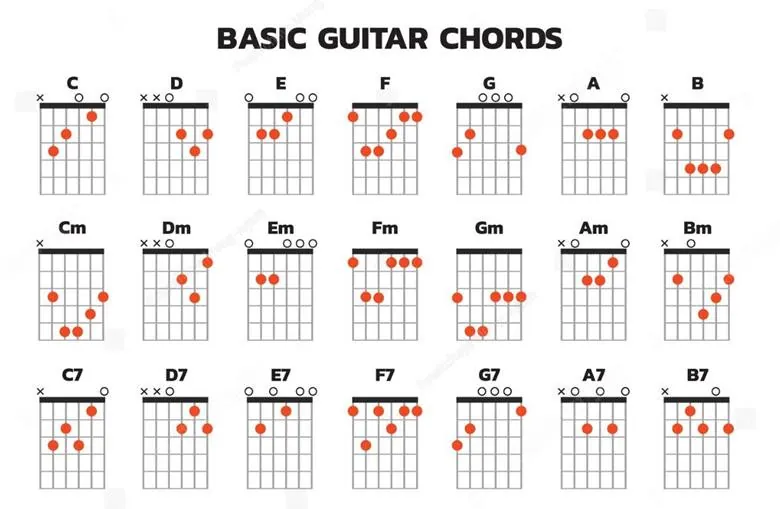
The debate turned into a favorite pastime. In studios, experts tried to recreate the exact tone using the most advanced equipment available. They failed. Again and again, the same result: close, but never quite right. Even the best-trained musicians disagreed on how to analyze it. Chord theory tells you which notes fit together to form a recognizable harmony, but this chord refused to behave by the usual rules. It was unusual, unconventional, and stubbornly resistant to reproduction.
Part of the difficulty was that the chord sat somewhere between a strum and a whisper. The three guitarists were not playing a clean, deliberate chord in the way a teacher might demonstrate in a lesson. They were brushing the strings, letting the notes ring out with a certain looseness. That made it harder to pin down. When you add the acoustics of the recording studio, the tape, and the mixing process, you get a sound that is nearly impossible to reverse-engineer by ear alone.
So the mystery persisted. For 45 years, nobody could say with certainty exactly which notes made up that opening blast. Musicians argued, theorists theorized, and the chord took on a life of its own. It became a test case, a talking point, a source of friendly (and not so friendly) disagreement. The more people tried to solve it, the more the chord seemed to slip away.
What nobody realized at first was that the answer required a different kind of listening, one that had nothing to do with the ear and everything to do with mathematics. But that breakthrough would not come until 2004, when a mathematician named Jason Brown decided to look at the problem from an angle no one had tried before.
A Mathematician Takes on the Beatles
In 2004, professor Jason Brown decided to approach the A Hard Day's Night chord mystery from a completely different angle. He was a mathematician, not a guitarist trying to replicate the sound by ear. While musicians had spent decades in studios attempting to recreate that elusive opening chord, Brown believed the answer lay not in fingers on strings, but in numbers on a page.
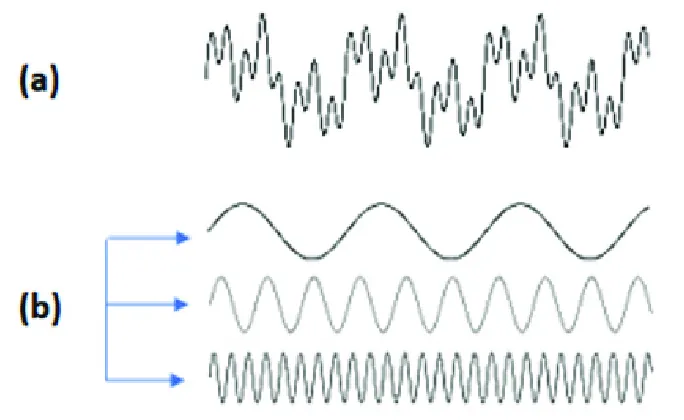
His tool of choice was the Fourier transform, a mathematical technique rooted in the work of Joseph Fourier, a French mathematician who lived in the 19th century. The concept sounds intimidating, but the core idea is surprisingly intuitive. The transform takes a complex wave, like the messy sound of a chord, and breaks it down into simple sine waves. Think of it like exchanging a large banknote: you get a handful of smaller coins that add up to the same value. The Fourier transform does this with sound, separating a dense, layered audio signal into its individual frequency components.
Brown fed the recording of the song's opening chord into his computer, letting the software apply the Fourier transform to dissect the sound into its building blocks. This allowed him to isolate the notes coming from the guitars played by George Harrison, John Lennon, and Paul McCartney. Yet something still didn't add up. No matter how he arranged the data, the reconstructed sound didn't perfectly match the original recording. There was an extra element, a low F note that the three guitars simply could not produce.
The missing piece, Brown concluded, was a piano. The note was likely played by George Martin, the Beatles' producer, who was in the studio during the recording session. It was a fourth instrument hiding in plain sight within the mix, and it was the key to finally explaining the chord that had puzzled musicians for so long.
The Hidden Piano Note That Solved It All
In 2004, mathematician Jason Brown cracked the A Hard Day's Night chord mystery using Fourier transform, the mathematical technique developed by 19th-century French mathematician Joseph Fourier that breaks complex sound waves into their simple sine wave components. Brown's breakthrough came when he realized the famous opening chord contained a note that no guitar could produce.
Brown didn't pick up a guitar and try to strum along like everyone else had for decades. Instead, he fed the recording into advanced computer software and let the Fourier transform do the heavy lifting. The math worked exactly as intended, splitting that dense, shimmering wall of sound into its individual building blocks. He could now isolate what George Harrison, John Lennon, and Paul McCartney each played on their guitars.
But here's where things got strange. No matter how Brown rearranged the data, the sound wouldn't match. The frequencies he recovered from the recording simply didn't add up to what three guitars should produce. Something was hiding in that chord, something that shouldn't have been there.
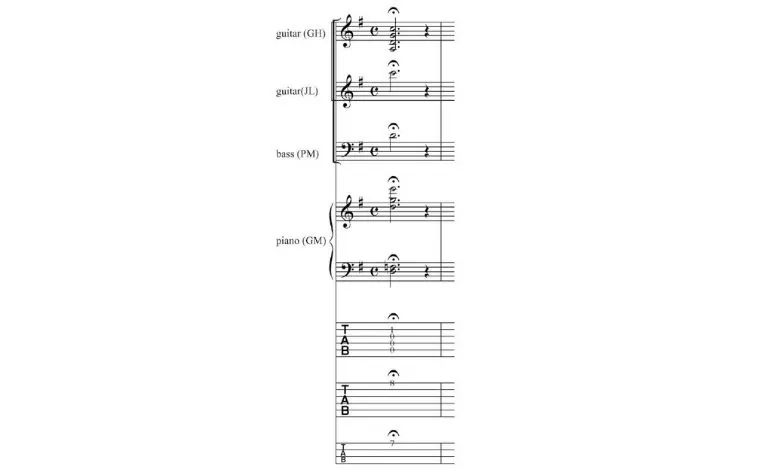
That something turned out to be a fourth instrument. A piano. Specifically, a piano playing an F note, almost certainly struck by producer George Martin, the man who shaped so much of the Beatles' signature sound. Martin had been in the studio that day, and his contribution had been sitting there in the recording all along, hidden in plain sight for more than four decades.
Once Brown accounted for that low F, everything clicked into place. The math finally matched the music, and the mystery that had stumped musicians, producers, and music theorists since 1964 was finally put to rest. The chord wasn't just three guitars ringing together. It was three guitars plus a piano note, a layered combination that no one had thought to look for because everyone assumed the Beatles had played the opening entirely on their signature instruments.
Frequently asked questions
What was the mystery behind the opening chord?
The opening chord of "A Hard Day's Night," released by The Beatles in 1964, was a single sound that no one could perfectly replicate for over 45 years. Musicians and producers tried everything to recreate it in studios, but the exact combination of notes stayed stubbornly hidden. The chord became one of music history's most famous unsolved puzzles.
Who solved it?
Mathematician Jason Brown solved the A Hard Day's Night chord mystery in 2004, during the album's 40th anniversary celebrations. Instead of picking up a guitar like everyone else had tried, Brown approached the problem from a completely different angle. He applied mathematics to music, a move that finally cracked the case wide open.
How did he solve it?
Brown used Fourier transform, a mathematical method based on the work of 19th-century French mathematician Joseph Fourier, along with advanced computer software to break the chord into its individual frequency components. The technique takes a complex wave and splits it into simple sine waves, much like exchanging a paper bill for a pocketful of coins.
What instruments were playing?
The analysis revealed that three guitars were playing, but there was also a fourth instrument hiding in the mix: a piano playing an F note, likely played by George Martin, The Beatles' producer. This piano note was the missing piece that had confused everyone for so long.
Why couldn't musicians replicate it?
Musicians couldn't replicate the chord because they didn't know about the piano note. They were trying to recreate the sound using only guitars, so the result never quite matched the original recording. The hidden piano was the secret ingredient all along. Editorial note: Any facts which remain unconfirmed are presented as such, hedged appropriately in the narrative above.
Got a take on this? Add your voice to the conversation below →
No comments yet. Be the first.