Why Turkish Calls Germany 'Alman': The Tribe Behind the Name
Ask a German what country they live in and they will not say Germany. They say Deutschland, and they call themselves Deutsche. So why does Turkish say Alman? The answer goes back to a group of tribes the Romans called the Alemanni, a name that stuck in Turkish and French while English went a completely different route. Every language around Germany picked a different neighbor to name the whole country after, and almost nobody uses the word Germans actually call themselves.
Turkish says "Alman" because the word came to it through French "allemand," which traces back to the Alemanni tribes. Germans themselves say "Deutsche," while English uses "German" from the Latin "Germanus." Different neighbors met different tribes, so each language named the same country after whoever stood closest.
- The Alemanni were a group of Germanic tribes the Romans recorded along the upper Rhine, and their name became the root of "Alman" in Turkish.
- Turkish and French both trace their word for Germany back to the Alemanni rather than to the Latin "Germanus."
- German speakers call their country "Deutschland" and themselves "Deutsche," a word tied to an old term for "the people."
- English and several other languages took "German" from the Latin "Germanus," a broad Roman label for peoples east of the Rhine.
- Finnish calls Germany "Saksa," borrowed from the Saxons, showing that yet another tribe gave the country its name in that region.
Germany Has No Germany: So Why Does Turkish Call It Alman?
Ask a German what country they live in and they will not say Germany. They say Deutschland, and they call themselves Deutsche, a word that essentially just means "the people." So the English name, the Turkish name, and the German name are three different words pointing at the same patch of land. That is the puzzle behind why Turkish calls Germany Alman, and the answer travels through French before it ever reaches Anatolia.
Start with the English word. "Germany" comes from the Latin Germani, a broad Roman label for several peoples east of the Rhine, not a single tribe confined to southern Germany. The Germanic-speaking Scandinavians never took that route at all. Swedish and Danish still say Tyskland, a form built on Proto-Germanic *þeudiskaz, the same root that gave German its own Deutsch. They kept the self-name.
Turkish did not. The word Alman arrived through French allemand, which traces back to the Alemanni, a Germanic tribe that lived around Alsace, near Strasbourg, and across Swabia, the region of Stuttgart, Ulm and Augsburg. Spanish alemán and Portuguese alemão share that same Alemanni root, which is why a Frenchman, a Spaniard and a Turk can all name the country without ever borrowing the German word for it.
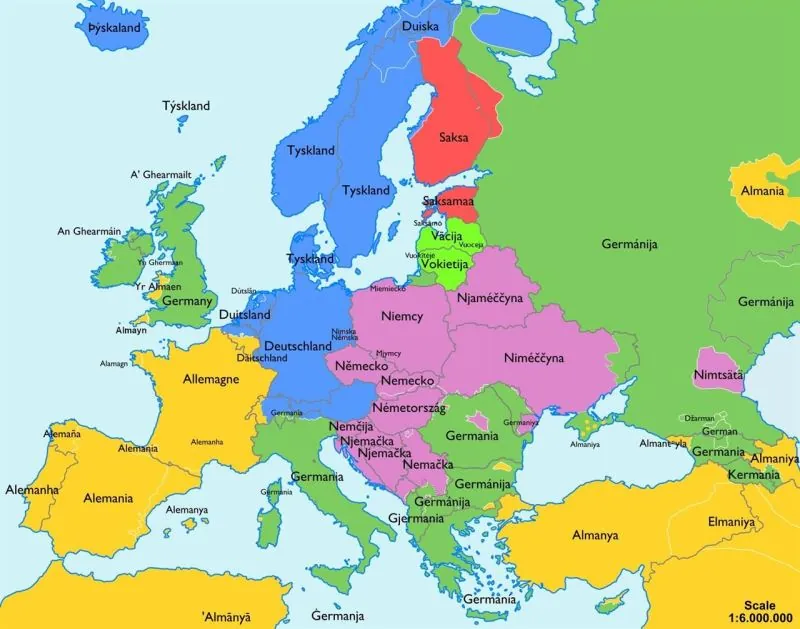
Once you notice the pattern, it becomes hard to unsee. Finnish and Estonian say Saksa and Saksamaa, a nod to the Saxons. Slavic languages went a stranger route: Polish Niemcy and Serbian Nemačka come from the old Slavic nemc, meaning "mute" or "unintelligible speaker." The Slavs called themselves slovne, the ones who speak, and everyone whose language they could not parse got filed under "the mute ones." One popular claim holds that Lithuanian and Estonian use a root meaning "loud speakers" or "shouters." That one does not hold up: Lithuanian is Vokietija, Estonian is Saksamaa, and no such "shouting" etymology is supported.
So the continent never agreed on a single name for the country at its center. Each language reached for whichever tribe it happened to meet first, and the Turks, arriving late to the party, simply picked up the French version and made it their own.
Who Were the Alemanni, the Tribe That Gave Turkish Its Word?
Somewhere along the upper Rhine, in the land we now call Alsace around the city of Strasbourg, a Germanic people settled who would end up naming an entire nation in three world languages. They were the Alemanni, and they also pushed east into Swabia, the region that today holds Stuttgart, Ulm and Augsburg. Their name traveled farther than they ever did.
Turkish did not borrow it straight from the Rhine. The route ran through Paris. French speakers called the people over the border allemand, and Turkish took that French word and trimmed it down to Alman. That single borrowing is the whole answer to why Turkish calls Germany Alman while Germans call themselves something else entirely.
The Alemanni root spreads across the Romance map. French has allemand, Spanish has alemán, Portuguese has alemão. Walk into Italy, though, and the pattern breaks: standard Italian uses tedesco, a word built on a completely different root. One peninsula, one exception, and a reminder that Europe never agreed on a single name for its neighbor.
So the Alemanni were not the only tribe drafted into naming duty. Finnish and Estonian went with Saksa and Saksamaa, borrowing the name of the Saxons instead. The Slavs took a stranger path. In old Slavic, nemc meant mute, or someone whose speech you cannot make out, and that is the seed of Serbian Nemačka and Polish Niemcy. Slavic speakers called themselves slovne, the ones who speak, and filed Latin and Germanic speakers under "the ones who cannot."
One popular version of this story goes further and claims Lithuanian and Estonian use terms like vačija or vokietija from a root meaning "loud speakers" or "shouters." That etymology does not hold up. Lithuanian Vokietija is real, but the shouting explanation is not supported, and Estonian is Saksamaa, the Saxon word again. It is a tidy little irony that has been repeated often enough to feel true.
What remains is a continent of mismatched labels. Germans say Deutsche for themselves and Deutschland for their country. English speakers say Germany, a name that traces back to the Latin Germani. Scandinavians kept a derivative of tysklan, still hanging onto the original Germanic root. Everyone picked a tribe, and the Alemanni happened to be the one that stuck in Turkish.
Why Do the Saxons and the Slavs Give Germany Different Names?
Head north and the map changes again. In Finnish, Germany is Saksa or Saksamaa; in Estonian, Saksamaa. Both point straight at the Saxons, one more Germanic tribe that gave its name to a whole country it never governed.
Then the Slavic languages do something else entirely, and it is where the story turns almost comic. Serbian says Nemačka. Polish says Niemcy. Croatian and Bosnian say Njemačka. All three trace back to the old Slavic word nemc, meaning "mute" or "unintelligible speaker." The logic is brutally simple: the Slavs called their own people slovne, the ones who could actually speak, and everyone whose words came out as noise got filed under "the mute ones." Germany, in this reading, is the land of people who cannot talk.
There is one claim worth flagging, because it floats around in retellings. Lithuanian and Estonian are said to use vačija or vokietija, from a root meaning "loud speakers" or "shouters." That etymology is not supported, and the Estonian form is in fact Saksamaa. So the "shouters" version, however charming, does not hold up.
Stand back and the whole continent looks like a room full of people who each picked a different neighbor to name the same country after. One tribe here, one tribe there, a shrug of "they can't talk" from the Slavs. Serious in some places, almost a joke in others. And this is exactly the pattern that explains why Turkish calls Germany Alman, a name borrowed from yet another tribe entirely.
Frequently asked questions
Why do Turkish people call Germany "Alman"?
Turkish borrowed "Alman" from the French "allemand," and French took it from the Alemanni, a Germanic tribe that once lived around Alsace and Swabia. So when a Turkish speaker says "Alman," they are echoing a tribal name that reached them through Paris, not a description of German character.
What does "Alman" mean in Turkish?
It simply means a German person. "Alman" is the ordinary Turkish noun for a German, and "Almanya" is the country. It carries no hidden insult or compliment. The word arrived through French "allemand," which itself traces back to the Alemanni tribe, so the meaning is purely a name, not a judgment.
Why do Germans call themselves "Deutsche" instead of German?
Because "Deutsch" comes from the Proto-Germanic *þeudiskaz , meaning "of the people." Germans call themselves "Deutsche" and their country "Deutschland," a self-description rather than a tribal label. Scandinavian languages kept the same root: Swedish and Danish say "Tyskland" for Germany, a direct cousin of "Deutsch."
Who were the Alemanni tribe?
The Alemanni were a Germanic people who lived in the Alsace region around Strasbourg and in Swabia, the area of Stuttgart, Ulm and Augsburg. Their name traveled west into French as "allemand," then into Spanish as "alemán" and Portuguese as "alemão." That is why so much of southern Europe calls Germany after a tribe.
Why does English say "Germany" but French says "Allemagne"?
English took "Germany" from the Latin "Germani," a broad Roman label for several peoples east of the Rhine. French, Spanish and Portuguese instead built their word on the Alemanni. So the split is old: one tradition reached for a Roman umbrella term, the other for a single tribe's name.
Why does Finnish call Germany "Saksa"?
Finnish "Saksa" and "Saksamaa," along with Estonian "Saksamaa," point to the Saxons, yet another Germanic tribe. Different neighbors simply grabbed whichever tribe they met first or heard about most. Finland picked the Saxons, France picked the Alemanni, and Rome's "Germani" stuck in English.
Why do Slavic languages call Germany "mute land"?
In old Slavic, "nemc" meant a mute or unintelligible speaker. Slavic peoples called themselves "slovne," the people of the word, and labeled Latin or Germanic speakers as those who could not speak their language. That root survives in Polish "Niemcy," Serbian "Nemačka," and Croatian and Bosnian "Njemačka." Editorial note: Details about how these names spread into Turkish rest on scholarly reconstruction, and any point that remains unconfirmed is presented here as such.
Got a take on this? Add your voice to the conversation below →
No comments yet. Be the first.