Social Facilitation: Why Crowds Change How We Perform

Social facilitation is the tendency for people to perform differently when others are watching, and it has been studied since 1898, when psychologist Norman Triplett noticed that cyclists rode faster in races than against the clock. More than a century later, the effect still shapes how we understand performance, from office desks to Olympic finals. It explains why a familiar task can feel effortless in front of a crowd, while a shaky new skill can fall apart under the same gaze. The story of how researchers pinned this down is as much about sport and spectacle as it is about psychology.
Social facilitation is the finding that the presence of other people can improve performance on well-practiced tasks and impair it on unfamiliar ones. It was first documented by Norman Triplett in 1898 through cycling records, and later refined by Robert Zajonc's arousal theory and large-scale studies of NBA games.
- In 1898, Norman Triplett published one of the first social psychology experiments, linking faster cycling times to the presence of competitors.
- Robert Zajonc proposed in 1965 that arousal from an audience boosts dominant, well-learned responses while hurting weaker ones.
- A study of 8,950 NBA games examined how crowd size related to home and away team performance.
- Social facilitation is often contrasted with social loafing, where people put in less effort when working in a group.
Why You Focus Better in a Crowded Café
You sit down at your own kitchen table with the whole afternoon free, and somehow forty minutes vanish into rearranging your pens. Then you carry the same laptop to a noisy café, wedge yourself between two strangers, and suddenly the words come out in a steady stream. If that sounds familiar, you are not lazy and you are not broken. Something about other people being nearby is quietly changing how your brain works.
Psychologists call it social facilitation: the real or perceived presence of others improves a person's performance. That is the whole idea in one line. The people around you do not have to help you, talk to you, or even know your name. Their mere presence is enough to nudge your behavior.
Here is the part that surprises most people. The others do not need to be doing the same task you are doing. Watching strangers work quietly in a library can sharpen your own concentration. Competing in front of spectators can pull a faster time out of your legs. Even simply knowing that someone is watching you can shift how carefully you move through a job.
That is why this effect has held psychologists' attention for well over a century. It reaches into open-plan offices, stadiums, theater stages, and ordinary weekday life. Understanding how company changes our output helps explain why some rooms make us sharper and others make us freeze.
There is one more wrinkle worth holding onto before we go further. A crowd is not a magic switch that turns everyone into a better version of themselves. What the audience does to you depends heavily on the task in front of you and on how well you already know it. Keep that in your pocket. It explains a lot of what comes next.
From Bicycle Races to the Laboratory: The Birth of Social Facilitation
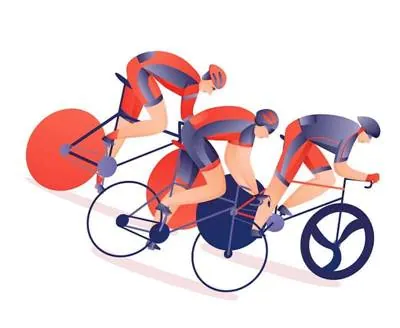
In 1898, the American psychologist Norman Triplett was looking over bicycle race results when he noticed an odd pattern. Cyclists generally performed better when they raced alongside other cyclists than when they were only trying to beat their own times. That observation opened the door to a new question in the history of psychology: why does the presence of other people change individual performance?
Triplett did not leave the question on the track. He carried it into the laboratory. He asked children to wind a fishing reel as fast as they could. Some children did the task alone, while others did it alongside another child. The results did not show the same effect in every participant. Even so, the experiment brought the idea that other people's presence can shift individual performance into psychology as a testable question. A small reel experiment laid the groundwork for a large field of research.
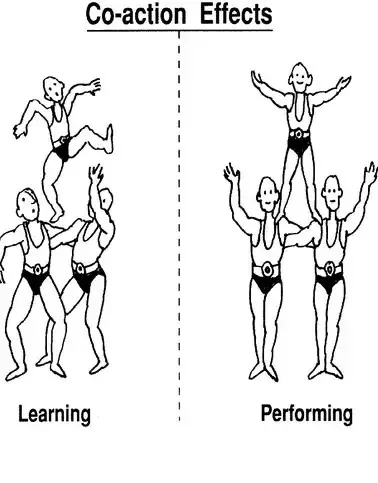
So when did this effect get a name? In 1924, the psychologist Floyd H. Allport used the term "social facilitation" to describe effects like these. Early researchers focused especially on how individuals doing the same job influenced one another. Psychologists later gave that situation its own name: the co-action effect.
Research did not stay limited to humans. In some experiments, ants were found to dig more sand when they worked alongside other ants. Findings like these strengthened the idea that other individuals changing your behavior might not be a human specialty at all.
Ants, Armadillos and the Audience Effect
The cyclists and the children with the fishing reels were not the whole story. Researchers pushed the question into stranger territory, and they kept finding the same pattern in places nobody expected. In 1937, the zoologist S. C. Chen reported that ants dug more sand when they were working alongside other ants than when they worked alone. The finding was real, and it landed hard. If an insect's output shifted just because other insects were nearby, then the whole thing could not be a quirk of human vanity.
From there the claim grew legs, and sometimes grew too many. As the story goes, armadillos were said to eat more food when other armadillos were around. That half of the pair has never been reliably confirmed, so treat it with a raised eyebrow. The ant result stands on its own. Together they strengthened the idea that other individuals changing your behavior might not be a human specialty at all, but something much older and much broader.
The Spectator Who Does Nothing
Then researchers noticed something that did not fit the co-action effect at all. In the earlier work, the people around you were doing the same job you were doing, winding reels or pedaling alongside. But a second phenomenon turned up: you did not need a competitor or a co-worker. A mere spectator, someone sitting there doing absolutely nothing, could still move your performance. No shared task, no race, just eyes.
John Dashiell ran experiments in the 1930s that put this to the test with adults working through math problems in front of an audience. He generally found that the watching crowd helped on tasks the participants had already practiced well. The audience effect joined the co-action effect as one of the two pillars of social facilitation research, and the field now had two separate ways that other people could bend what you do: they could work beside you, or they could simply watch.
Why the Crowd Sometimes Helps and Sometimes Hurts: Zajonc's Model
By the middle of the twentieth century, social facilitation research had a contradiction on its hands. In some experiments, the presence of other people sharpened performance. In others, it wrecked it. Robert Zajonc, an American psychologist, published a model in 1965 in the journal Science that finally made the mess make sense.
His explanation starts with arousal. When other people are around, our arousal level climbs. That rise in arousal does something specific: it raises the odds that we will produce our strongest, most habitual, best-learned response. Think of it as the brain reaching for its default setting.
Now follow that logic to its two very different outcomes. If the task is one you have mastered, the dominant response is the right one, so the crowd pushes you toward your best. If the task is new or genuinely complex, your dominant response is the clumsy, half-formed version, and arousal drags that to the surface instead.
An experienced footballer can pull off a movement practiced thousands of times faster and more decisively in front of a full stadium. The same player, under the same roar, struggles with a complex movement still being learned. Musicians, actors, presenters and public speakers live inside this same split every time they step in front of an audience.
That last detail is a useful reminder. Social facilitation is not one switch that flips performance up or down. Competition, motivation, the feeling of being evaluated, attention and sheer experience all feed into the same moment.
What 8,950 NBA Games Suggest About Crowds and Underdogs
Real games offer a messier test than any laboratory. According to one account, researchers examined 8,950 NBA games to see how crowd size lined up with team performance, and the results were not what anyone expected.
The starting hypothesis was tidy. Strong, favored teams would rise in front of big crowds. Underdogs, feeling the weight of all those eyes, would shrink. The first half held up: favored teams did play better as the arena filled. The second half fell apart. Underdog teams did not get worse as crowd size climbed. In some conditions they actually played better.
The sharpest pattern showed up at home. For underdog teams playing on their own floor, crowd size and performance moved together in a positive direction. The researchers suggested the pressure of the crowd may have pushed these players toward more effort rather than intimidating them. A hostile roar shrinks some athletes. A home crowd, apparently, can do the opposite.
That finding sits awkwardly beside any single-mechanism explanation of social facilitation. Competition, motivation, the feeling of being evaluated, attention, and experience level can all be active at once. The presence of others does not automatically make us more successful. What matters is how that presence interacts with the task, and how well we have already mastered it.
Frequently asked questions
What is social facilitation in psychology?
Social facilitation is the tendency for people to perform differently when others are present, whether that presence is real or only perceived. The company of other people can make someone faster, sharper or more motivated on a task. It does not require those others to be doing the same work, or even watching closely.
Who first studied social facilitation and when?
The American psychologist Norman Triplett opened the field in 1898. He examined bicycle race records and then ran a laboratory experiment in which children wound a fishing reel as fast as they could, some working alone and some competing against another child. His 1898 paper in the American Journal of Psychology is the founding study of social facilitation.
What did Triplett discover about cyclists in 1898?
Triplett found that cyclists generally rode faster when they raced alongside other cyclists than when they were only chasing their own best time. The presence of a rival, or even a pacemaker, seemed to pull more speed out of them. That observation launched the whole line of social facilitation research.
Why does the presence of others sometimes hurt performance?
Robert Zajonc's model from the 1960s answers this. The presence of other people raises arousal, and arousal strengthens whatever response is dominant, meaning the strongest or most habitual one. On a well-learned task that dominant response is the correct one, so performance improves. On a new or complex task the dominant response is often wrong, so performance drops.
How did Robert Zajonc explain social facilitation?
Zajonc proposed that being around others lifts our arousal level, and that this arousal favors our strongest, most practiced reaction. He published the drive-arousal model in Science in 1965, specifically to reconcile the contradictory results that had piled up. His framework explained why the same audience can help in one setting and hurt in another.
Was the NBA crowd study on underdogs surprising?
Reportedly, yes. According to that account, researchers looked at crowd size and team performance across thousands of NBA games, expecting favored teams to thrive before big crowds and underdogs to crumble under the pressure. The favored teams did play better. The underdogs, though, did not get worse, and in some conditions, especially at home, they played better. Those specific findings have not been independently confirmed.
Did Triplett's fishing reel experiment work on every child?
No. The results did not show the same effect in all participants. Some children sped up when another child was present, while others did not respond the same way. Even so, the experiment pushed the idea that other people's presence can shift individual performance into psychology as a testable question.
Why can't social facilitation be explained by one mechanism?
Because several forces can switch on at once. Competition, motivation, the feeling of being evaluated, attention and a person's level of experience may all be operating at the same time. That is why the presence of others does not automatically make anyone more successful. What matters is how their presence interacts with the task and with how well we have mastered it. Editorial note: Details that remain unconfirmed are presented as such, and no figures have been invented.
Got a take on this? Add your voice to the conversation below →
No comments yet. Be the first.