7-38-55 Rule: The Misunderstood Communication Myth
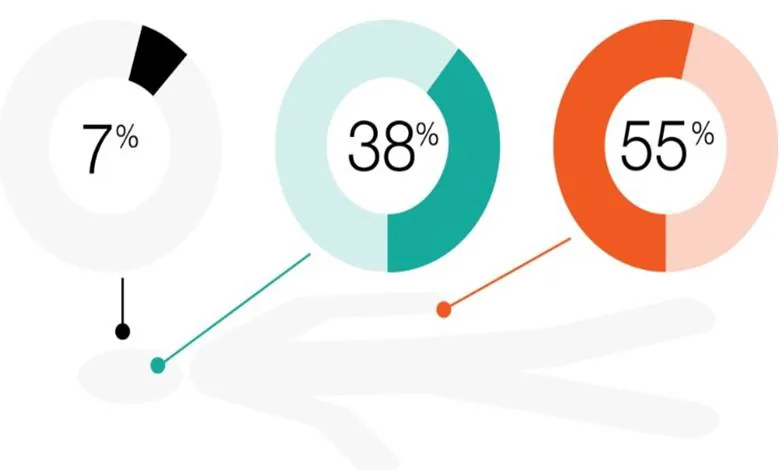
The 7-38-55 rule, the popular claim that words carry only 7 percent of meaning in communication, is a myth that misrepresents psychologist Albert Mehrabian's 1967 research findings. The rule took on a life of its own decades after Mehrabian published his studies on inconsistent messages, becoming a staple of corporate training and self-help advice. Understanding where this statistic actually came from, and what it was never meant to say, can change how you think about body language, tone of voice, and the words you choose every day.
The 7-38-55 rule comes from Albert Mehrabian's 1967 studies on inconsistent communication, where he found that when words contradicted tone and body language, listeners relied more on nonverbal cues. The rule applies only to that narrow scenario, not to all communication. Most popular uses of the rule misstate its scope and misrepresent the research.
- Albert Mehrabian conducted his communication studies in 1967.
- The 7-38-55 rule emerged from experiments on single spoken words, not full conversations or presentations.
- Mehrabian's findings apply to emotional communication under specific experimental conditions, not to all communication.
- The rule spread after appearing in Mehrabian's 1971 book, adopted by others over time.
- Mehrabian has repeatedly stated that his research was never meant to apply to general communication.
The 7-38-55 rule promises a shortcut to reading people, but it's built on shaky ground
The 7-38-55 rule is one of those tidy formulas that feels true the moment you hear it. It claims that only 7% of meaning in a conversation comes from the actual words, while 38% comes from tone of voice and a whopping 55% from body language. It sounds like a cheat code for human interaction, a way to see past what people say and into what they really mean. The only problem? The real story behind those numbers is far less neat, and far more interesting.
You have probably met its cousins before. The 10,000-hour rule says mastery of any skill demands exactly ten thousand hours of practice. The 21-day habit cycle insists that a new behavior becomes automatic after three weeks. The Myers-Briggs personality test sorts everyone into one of 16 tidy types. The 80-20 rule, borrowed from the Pareto principle, claims that 80% of results flow from just 20% of causes. And the 50-40-10 rule splits happiness into 50% genetics, with the rest explained by choices and life circumstances.
Notice the pattern. Each one takes a sliver of scientific research and dresses it up as a universal law. Yes, practice matters for learning skills, but there is nothing magical about the ten-thousand-hour mark. Yes, genetics influence happiness, but our choices and circumstances shape us too. Yes, personalities differ, but the evidence that everyone fits neatly into one of 16 boxes is thin at best. These formulas share a common DNA: a little bit of research, a memorable number, and a promise of certainty that reality never quite delivers.
That is exactly the trap the 7-38-55 rule springs on us. It arrives with the authority of a psychologist's name attached, a clean set of percentages, and a seductive promise. You could almost believe that words barely matter, that you could skip the dictionary and just read people's postures instead. But as with its formulaic siblings, the neatness hides a much messier truth. The experiments behind those numbers were narrow, artificial, and never involved an actual conversation. The rule became famous not because it held up under scrutiny, but because it spread so easily. And once you see how it was built, you start to wonder how many other beloved formulas are standing on the same shaky ground.
Albert Mehrabian's experiments: small samples, artificial conditions, no real conversations
The 7-38-55 rule traces back to psychologist Albert Mehrabian, who proposed the ratio in the late 1960s after running two tightly controlled experiments in 1967. Both studies were small, artificial, and involved only female participants listening to single words. No real conversation ever took place in either one.
Mehrabian's first experiment, conducted with Wiener, gathered 30 female participants who listened to individual words spoken with positive, neutral, or negative intonation. Sometimes the word and the tone matched, like a warm "thanks." Other times they clashed. The women consistently judged the emotion more from the tone of voice than from the actual word itself.
The second experiment, run with Ferris, took a similar approach but swapped tone for facial expression. This time 37 female participants looked at photographs showing liking, neutral, or disliking expressions while hearing a single word. Again, the face won out. Participants read the emotion more accurately from facial expression than from the words they heard.
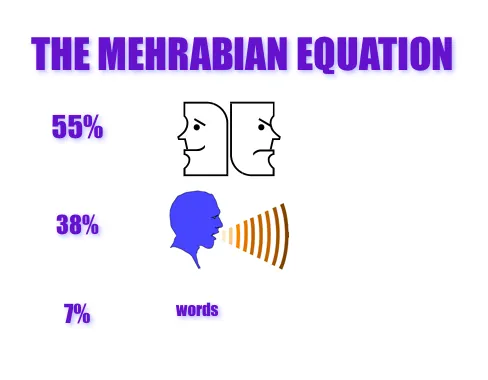
Mehrabian combined both findings and proposed that emotional communication breaks down as 7% words, 38% tone of voice, and 55% body language. He published the breakdown in his 1971 book Silent Messages, which is how the formula escaped the lab and reached a wide audience.
Here is what tends to get lost in retellings: neither experiment involved natural conversation, both used only women, and the samples were tiny. The participants heard single words, not sentences, and the "body language" component came entirely from posed photographs of facial expressions. Other elements of body language, like posture or gestures, were never examined at all. Mehrabian himself later pushed back against the way his ratio was being stretched into a universal rule for all communication.
How a narrow finding became an intellectual urban legend
Albert Mehrabian never claimed his ratio applied to all communication. The psychologist's 1967 experiments, conducted with just two small groups of women listening to single words and looking at posed photographs, only addressed one very specific situation: when a speaker's words, tone, and facial expression contradict each other while conveying feelings and attitudes. That narrow scope got lost somewhere along the way.
The 7-38-55 rule began its strange journey in 1971 when Mehrabian included the figures in his book Silent Messages. The book itself didn't cause much of a stir. But the tidy formula, 7 percent words, 38 percent tone, 55 percent body language, proved irresistible. It started appearing in self-help books, then business articles, then conference talks. Each retelling added a layer of confidence, as if the numbers had been carved in stone rather than derived from a handful of lab sessions with no real conversation involved.
The popular versions went far beyond what the data could support. "It's not what you say, it's how you say it," became a mantra. Some went further, urging people to ignore words entirely and watch for crossed arms or a cough as if those alone revealed hidden truths. Mehrabian himself spent years pushing back, repeatedly stating that his research had been misinterpreted and explaining the narrow conditions of his experiments. The clarifications never traveled as fast as the original claim.
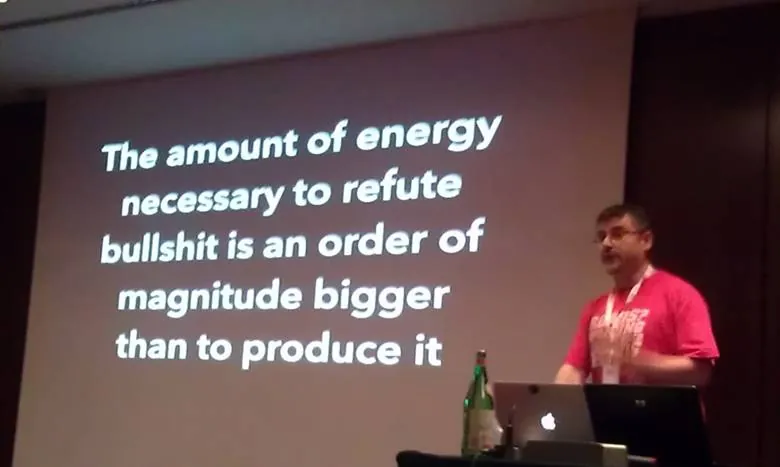
By the time the rule had been repeated in enough boardrooms and keynote speeches, it had become what researchers now call an intellectual urban legend. Debunking it takes disproportionate effort, a phenomenon Italian computer programmer Alberto Brandolini captured in 2013 with his Bullshit Asymmetry Principle: the energy needed to refute a false claim far exceeds the energy needed to create it. One tidy formula, born from two small experiments in 1967, still gets quoted as gospel decades later, even though its own creator spent his career trying to correct it.
The thought experiment that exposes the rule: if words were only 7%, why learn languages?
If words truly carried just 7% of meaning, the entire global language-learning industry would be a colossal waste of effort. A few nods, a sheepish smile, and the occasional pat on the shoulder would get you through any conversation in any country on Earth. Yet anyone who has ever traveled internationally knows this is nonsense. A good dictionary, even a phrasebook, does far more heavy lifting than 7% of the communicative load.
Think about what happens when you actually land in a foreign city. You need to ask for directions, order food, negotiate a price, or explain that you need a doctor. No amount of warm eye contact or expressive hand gestures will convey "I am allergic to peanuts" or "my train leaves at six." Words are not a garnish on the meal of communication; they are the main course. The 7-38-55 rule, for all its tidy appeal, collapses the moment you try to book a hotel room in a language you do not speak.
Communication does not happen in a vacuum. Every conversation unfolds within a context that shapes its meaning: the setting, the roles of the people speaking, their shared history, and their relationship to one another. A raised eyebrow means something very different in a job interview than it does at a family dinner. The same sentence can be a joke, a threat, or a confession depending entirely on who is saying it, to whom, and where they are standing. Context is not a minor variable; it is the very air that words breathe.
And here is where the popular readings of the rule really go off the rails. Cues do not arrive as isolated signals waiting to be decoded one by one. They come in clusters, tangled together, and they resist simple interpretation. A person with crossed arms might be hiding something, or the room might simply be cold. Someone avoiding eye contact might be lying, or they might be shy, distracted, or culturally conditioned to look away. The "body language experts" who claim otherwise are selling a fantasy that real conversation never matches.
Words, tone, facial expressions, and posture all work together as a single, indivisible whole. You cannot quantify the mix, because the mix changes with every speaker, every listener, and every moment. The 7-38-55 rule tries to turn a living, breathing exchange into a static pie chart. Real communication refuses to be sliced that neatly.
Why we crave neat formulas, and what real communication actually demands
There is a reason the 7-38-55 rule feels so satisfying to repeat. It promises that a messy, unpredictable thing like human conversation can be reduced to three tidy percentages, and that feels like control. But the comfort is counterfeit. Mastering a skill, building a habit, or finding happiness has never obeyed a magic number, and neither has connecting with another person.
Think about the other formulas that circulate in the same circles. The 10,000-hour rule claims mastery requires exactly that many hours of practice. The 21-day habit cycle promises a new behavior will stick in three weeks. The 80-20 rule says 80 percent of results come from 20 percent of causes. The 50-40-10 rule assigns 50 percent of happiness to genetics. Each one carries a whiff of scientific authority, yet each one crumbles under a closer look. Research on habit formation, for instance, shows it takes anywhere from 18 to 254 days, with an average of 66 days. The 21-day figure is simply a myth.
These formulas share a common trick. A bit of genuine research gets dressed up in everyday observations, and suddenly a rough heuristic looks like a law of nature. The percentages in such rules often reflect the researcher's method, not real conversation. Mehrabian's experiments, after all, involved single words and posed photographs, not actual dialogue. The numbers describe a narrow laboratory condition, yet they got repackaged as a universal truth about how humans communicate.
The deeper problem is what these formulas do to our expectations. They suggest that if we just learn the right ratio, we can decode anyone. But meaningful relationships do not work that way. They demand curiosity about the person in front of you, empathy for what they might be feeling, attention to the full context of the moment, and emotional intelligence to navigate the gaps between what is said and what is meant. None of that fits into a percentage.
And here is the strange relief hiding inside that truth. Because there is no simple number to measure or manage your conversations, you are free to shape them yourself. You are not bound to a formula. You get to listen, adjust, ask questions, and respond to the actual human being rather than to a rule about how humans supposedly work. The absence of a magic number is not a loss. It is an invitation.

Frequently asked questions
What is the 7-38-55 rule in communication?
The 7-38-55 rule claims that only 7% of meaning in a conversation comes from the actual words spoken, while 38% comes from tone of voice and 55% from body language. It sounds like a neat formula for decoding hidden messages. The reality, however, is far more complicated than those tidy percentages suggest.
Who created the 7-38-55 rule?
Psychologist Albert Mehrabian developed the 7-38-55 ratio in the late 1960s and published it in his 1971 book Silent Messages . He based it on two small laboratory experiments, both involving only female participants. Neither experiment involved a real, natural conversation between people. Mehrabian later spent years trying to correct how his work was being used.
Why is the 7-38-55 rule considered a myth?
The rule is considered a myth because it was built on artificial conditions that don't reflect how people actually communicate. Mehrabian's experiments used single spoken words and posed photographs, not genuine back-and-forth dialogue. The ratio was never tested across different settings, groups, or real-world situations. Despite this, the formula took on a life of its own as a universal truth about communication.
How did Albert Mehrabian conduct his experiments?
Mehrabian ran two separate studies in 1967. In the first, 30 women listened to single words spoken with different emotional tones, sometimes matching and sometimes contradicting the word's meaning. In the second, 37 women looked at facial expressions while hearing recorded words. In both cases, participants judged emotions more from tone and facial cues than from the words themselves.
Did Albert Mehrabian ever disavow the 7-38-55 rule?
Yes, Mehrabian repeatedly stated that his research had been misinterpreted. He emphasized that the percentages only applied to situations where a speaker's words and nonverbal cues were in conflict, and only when discussing feelings or attitudes. He never claimed the ratio applied to communication in general. His clarifications, unfortunately, never spread as widely as the original formula.
What does body language actually contribute to communication?
Body language matters, but it works together with words and tone within a specific context. Isolated cues don't reliably reveal hidden truths. Someone crossing their arms might be cold, not defensive. Avoiding eye contact could mean shyness or distraction, not deception. The meaning emerges from the whole cluster of signals, plus the situation and relationship between the people talking.
Is the 7-38-55 rule applicable to all conversations?
No, the rule only applied to the narrow conditions of Mehrabian's experiments. Those studies involved contradictory cues about feelings and attitudes, measured in a lab with a small group of women. The ratio was never shown to hold for regular conversations, factual discussions, or any everyday exchange. Applying it broadly goes far beyond what the research actually demonstrated.
What is the Brandolini law and how does it relate to this myth?
The Brandolini law, also called the Bullshit Asymmetry Principle, was formulated by Italian computer programmer Alberto Brandolini in 2013. It states that debunking a false claim requires far more effort than making the claim in the first place. The 7-38-55 rule fits this pattern perfectly. A catchy formula spread effortlessly, while correcting the record takes careful explanation and repeated effort. Editorial note: Some details about how the rule spread through corporate training materials remain unconfirmed and are presented as such.
Got a take on this? Add your voice to the conversation below →
No comments yet. Be the first.