Hamnet Film: Chloé Zhao's Grief Masterpiece
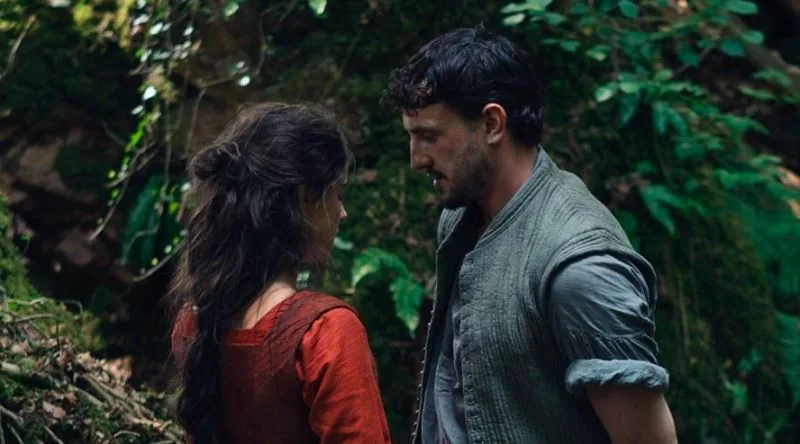
The Hamnet film, Chloé Zhao's adaptation of Maggie O'Farrell's novel, follows Agnes Shakespeare as she grieves the death of her young son Hamnet. It is a quiet, devastating story about a family living in Stratford-upon-Avon in the 1580s, and about what a mother loses when a child is taken. Jessie Buckley plays Agnes with a fierce, wordless intensity. The film asks how grief turns into art, and whether the man who wrote Hamlet ever truly understood the boy he buried.
Chloé Zhao directs the Hamnet film, an adaptation of Maggie O'Farrell's novel starring Jessie Buckley as Agnes Shakespeare. Set in the 1580s in Stratford-upon-Avon, it follows a family through the death of young Hamnet and the grief that shapes Shakespeare's later work.
- The Hamnet film is directed by Chloé Zhao and adapted from Maggie O'Farrell's novel of the same name.
- Jessie Buckley stars as Agnes Shakespeare, the mother of Hamnet, in a cast that centers the family rather than the playwright.
- The story is set in the 1580s in Stratford-upon-Avon, where Shakespeare's son Hamnet died at a young age.
- The film explores the speculative idea that the death of Hamnet influenced the writing of Hamlet, though historians debate the connection.
- Chloé Zhao's direction emphasizes quiet domestic grief over spectacle, continuing her interest in intimate human stories.
The Hamnet Film Opens With a Myth About Looking Back
The Hamnet film is Chloé Zhao's adaptation of Maggie O'Farrell's 2020 novel Hamnet, and it begins not in Stratford-upon-Avon but in ancient Greece. Before we ever meet the twins, before the plague, before the theatre, a young William Shakespeare sits with Agnes, the woman he will marry, and tells her the story of Orpheus and Eurydice.
You probably know how that one ends. Orpheus walks into the land of the dead to bring his wife back. He persuades Hades himself to let her go, and there is one condition: don't look behind you. He looks. She vanishes, this time for good.
According to the film's account, William is the one telling this story, with Agnes listening. Treat that as the movie's invention rather than a documented evening in the Shakespeare household. What matters is the seed it plants.
Because the reviewer notices something that runs underneath the whole film. Agnes is forever standing behind William. At their wedding, she is at his back. Later, in the theatre, she is behind him again, watching him watch a stage. And in both places, the same silent cry rises in her: look at me!
It is a strange thing to beg for, when looking back is exactly what destroyed Eurydice. So the question the film keeps asking is what Agnes actually wants. To disappear? Or to become immortal the way the myth became immortal, told and retold until the lovers inside it stopped being people and turned into story?
They never became immortal themselves. But their love has been passed down as if it were.
Hold onto that image. A woman behind a man, asking to be seen, while he stares straight ahead into a story. The Hamnet film will spend its whole runtime answering her.
A Grief Foretold: Agnes, the Twins, and the Plague
Agnes knows the shape of her own loss before it arrives. In Maggie O'Farrell's telling, she is "the daughter of the forest," a woman whose intuition runs deeper than reason, and that gift comes with a cruel bill attached: she understands that only two of her children will be beside her when she dies. She learns the rest in the same breath. When she takes her second child into her arms, a moment that should be pure joy, the knowledge settles over her that one of the twins will plant their pain inside her heart and leave it there.
The twins are Hamnet and Judith, baptized on 2 February 1585 in Stratford-upon-Avon, as the parish records show. Susanna came first, in 1583, so this is Agnes's second childbirth, and the novel leans into that doubling: two children who adore swapping places, who trade identities for the sheer fun of it, who seem to believe a good trick can fool anyone, including death. In some countries, the novel was reportedly published under the title Hamnet and Judith, as if the publisher could not bear to let the boy stand alone in the title.
Then the fever comes. Judith shakes with the plague's fire, and Hamnet crawls in beside her. He goes because his father told him to watch over the family while he was away, and because a boy who has spent his life trading places with his sister knows exactly how to do it. The swap that once felt like a game becomes something else entirely, and it plants a theme Shakespeare would return to again and again in the plays he wrote afterward.
Hamnet was buried in 1596, and the parish records of Holy Trinity hold that with plain certainty. Plague as the cause of his death is the commonly inferred explanation rather than a documented one, so it stays an inference, however likely. The popular version of this story often adds that Shakespeare created Prince Hamlet as a direct act of mourning, but that is a speculative biographical theory with no documentary backing. It is a beautiful idea. It is not a fact.
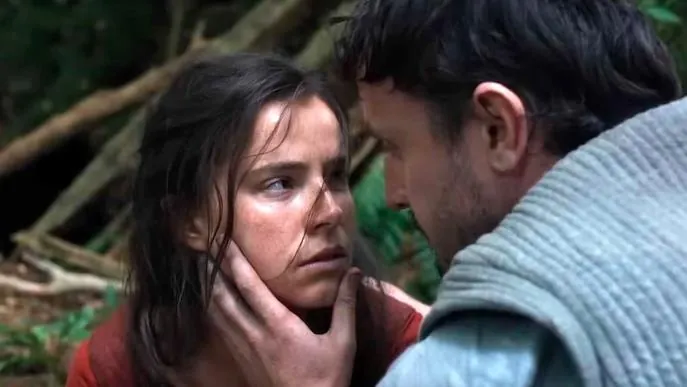
Chloé Zhao directs the film adaptation, with Jessie Buckley as Agnes, and the material gives her plenty to carry. The reviewer singles out a moment when Agnes holds the second twin, believing the child is dead, while the camera shudders in a way that traps you inside the instant. The same tremor is said to return later, when William hugs himself and weeps. Grief, in Zhao's hands, is something the frame itself cannot hold steady.
Chloé Zhao's Camera and Jessie Buckley's Agnes
Chloé Zhao directed the film adaptation of Hamnet, and Jessie Buckley plays Agnes, William Shakespeare's wife. Together they carry the emotional weight of the story, and one small camera choice by Zhao does more than any speech could.
Watch the moment Agnes cradles the second of her twins, convinced the child has died in her arms. Zhao does not hold the frame steady. She lets the camera shake, and the tremor does something strange to your body: you are no longer watching from a seat, you are inside that room with a mother bracing for the worst. The reviewer singles out this exact technique, and notes that Zhao repeats the trick later, when William wraps his arms around himself and weeps. Same shiver, same trap. The audience is pinned to the instant instead of being allowed to observe it from a safe distance. For that alone, the reviewer argues, Zhao earns the praise.
Then there is Buckley. The reviewer says the performance left them speechless, and puts it plainly: Agnes is no longer a figure on a page. She lives. She is among us. We see her in every state, in every mood, and we witness all of it beside her. That is a rare thing to say about acting on screen, and the reviewer says they had not seen such acting in cinema for a long time.
What makes the pairing work is the contrast Zhao builds. William's head is full of stories, and Agnes belongs to the forest, a woman with an intuition all her own. She simply knows things, including that only two of her children will be at her deathbed. When she takes the twins in her arms after that second birth, the knowledge lands: one of these two will settle into her heart as a wound. The camera and the actress make that dread physical before a single word explains it.
Why Shakespeare Wrote Hamlet After His Son Died
The house at Stratford is quiet in a way that has nothing to do with silence. William must return to London to write plays, and the family stays behind. That is the arrangement, and it holds.
Agnes does not let it pass without a question, and her question lands like a stone in still water. What is a play against her son's death? What are these plays, anyway, if not entertainment for people? You can almost hear the room change temperature. William, who thinks in stories the way other men think in numbers, answers with a promise. In paraphrase: I will find where he has gone and bring him back. Am I not Orpheus?
There it is. A husband reaching for a myth because the plain words are too small. And the myth he reaches for is the one where Orpheus descends into the land of the dead, persuades its ruler Hades to give Eurydice back, and then loses her forever by looking behind him.
The reviewer's reading of the film turns on a single, unprovable idea: that Shakespeare could not have written Prince Hamlet's attitude toward death with such precision if he had never buried a child.
That is the thesis, and it is worth being honest about what it is. Hamnet's death and Prince Hamlet's brooding on mortality are linked in the film's imagination, not in any document. No parish record, no letter, no contract ties the two together. As the story goes, the grief came first and the play came after, and the reviewer finds that reading impossible to shake. Fair enough. It is a beautiful guess, and O'Farrell's novel, the source the Hamnet film was adapted from, builds its whole architecture on that guess.
What the argument does give you is a way to watch the rest of the movie. Every scene where William is absent from Stratford, every page he fills in London, carries the weight of a man trying to negotiate with death on his own terms. Agnes sees it plainly. He is not writing to escape the loss. He is writing to argue with it.
The Ending: Agnes Reaches Toward Hamlet and Breaks the Fourth Wall
Agnes walks into the theatre and spots it almost at once: the gap in the back that the players slip through. That dark opening is not just a stage door to her. It is the same dark forest her mother came from, and her grandmother before that.
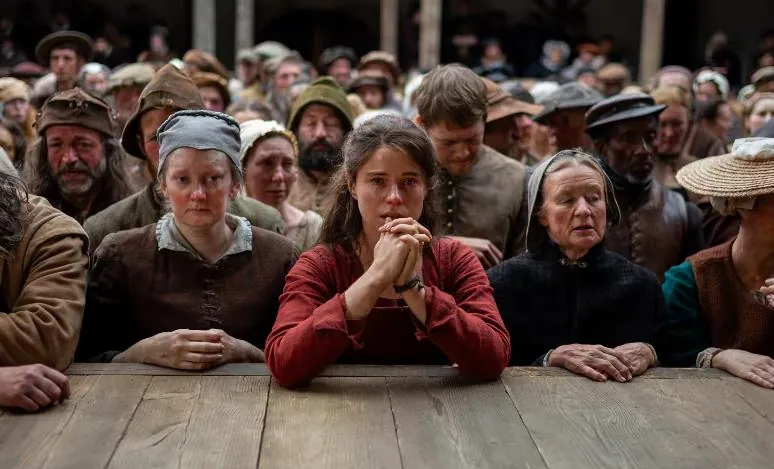
Then Hamlet takes the stage, and her face clouds over. She stares at the prince as if someone has read her private grief out loud. Why are you saying my son's name, her look seems to ask. She is new to this world of double meanings, of words that carry a second life underneath the first. She has not yet learned how we take our plainest sorrow and spin it into stories.
What happens in the closing moments is the image the reviewer could not shake. As the play ends and Hamlet dies on stage, the reviewer describes Agnes reaching her hand out toward him. A mother's grieving hand, pushed straight through the fourth wall. The reviewer describes the gesture as building a bridge between the fiction and the life beside it, and as carrying us, the people in the seats, up onto that stage with her.
And something clicks for her in that reach. She understands that William found "that place where the dead go." He bargained with Hades, the way Orpheus once did in the old myth, and he made Hamnet immortal.
A magnificent film. Nothing missing, nothing extra.
That is the reviewer's verdict. The reviewer describes grief and triumph, death and life, all trading places until immortality is born from the dance.
Frequently asked questions
What is the Hamnet film about?
The Hamnet film adapts Maggie O'Farrell's 2020 novel of the same name, a story built around William Shakespeare's son Hamnet, who was buried in 1596. It follows a family through plague, grief and the strange bargain art makes with loss, tracing how the writing of Hamlet grew out of a father's mourning.
How does Chloé Zhao direct the Hamnet movie?
Chloé Zhao, who directed the adaptation, works with a restless, shaking camera that traps you inside the moment. When Agnes holds one twin believing the child is dead, the frame trembles with her. Zhao repeats the trick later, and the effect is a viewer pinned to the scene rather than watching it from a safe distance.
Why did Shakespeare write Hamlet after his son's death?
That reading belongs to the reviewer, not to any document. Shakespeare's twins Hamnet and Judith were baptized on 2 February 1585, and Hamnet was buried in 1596. The idea that Prince Hamlet's grief flowed from a father's real loss is a speculative biographical theory, with no documentary evidence behind it.
What is the significance of Orpheus and Eurydice in Hamnet?
The myth of Orpheus and Eurydice opens the story. In the classical telling, Orpheus descends to the land of the dead and persuades its ruler Hades to give Eurydice back, on one condition: do not look behind you. He looks, and loses her forever. In the film, the descent and the backward glance mirror a father trying to bring his son home.
How does Jessie Buckley portray Agnes in Hamnet?
Jessie Buckley plays Agnes, and the reviewer's praise is unreserved. She reads as a person who lives among us, a forest daughter with a fierce intuition, and the performance is described as the kind of acting the reviewer had not seen on screen in a long while. Every version of her, the review argues, feels witnessed.
Was Hamnet Shakespeare a real person?
Yes. Hamnet Shakespeare was the twin of Judith, and the two were baptized on 2 February 1585, as recorded in the parish register of Holy Trinity in Stratford-upon-Avon. Hamnet was buried in 1596. Plague is the commonly inferred cause of death, though the parish record does not state it.
What happens in the ending of the Hamnet film?
According to the original account, Agnes arrives at the theatre and reaches her hand toward the dying Hamlet on stage. That staging detail could not be reliably confirmed, so treat it as the story goes rather than as documented fact. What the ending clearly tries to do is bind grief and triumph, death and life, into a single dance.
How does the film Hamnet break the fourth wall?
Reportedly, Agnes's outstretched hand toward the stage shatters the boundary between fiction and life, pulling the audience into the scene alongside her. The gesture is described as a mother's grieving heart overriding the frame. It is a striking reading of the finale, though not a detail confirmed by available sources. Editorial note: Details about the film's release, casting, and historical connections that remain unconfirmed are presented as such, and readers should treat them as provisional.
Got a take on this? Add your voice to the conversation below →
No comments yet. Be the first.