Frida Kahlo: Pain, Passion, and Iconic Self-Portraits
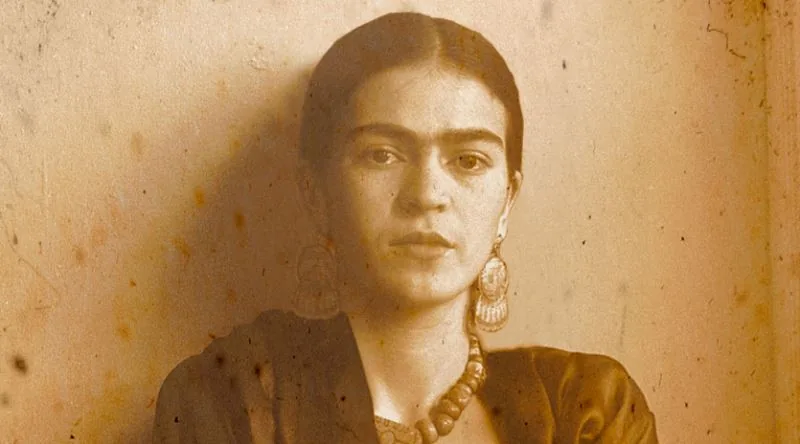
The Frida Kahlo life story is one of profound transformation, where a near-fatal bus accident in 1925 Mexico City and a turbulent marriage to Diego Rivera fueled the creation of the 20th century's most arresting self-portraits. Her art turned unrelenting physical pain and emotional heartbreak into bold, unflinching visual statements that continue to resonate today. You can almost feel the raw honesty in every brushstroke, every tear, and every shattered symbol she placed on her canvas.
Frida Kahlo, a Mexican artist born in 1907, channeled a lifetime of physical suffering from a devastating bus accident and a volatile marriage to muralist Diego Rivera into powerful self-portraits. Her work, created primarily in her home in Coyoacán, Mexico City, explored identity, pain, and politics, cementing her as an enduring global icon.
- In September 1925, Kahlo was gravely injured when a bus collided with a streetcar in Mexico City, leading to a lifetime of surgeries and chronic pain.
- Kahlo married the famed muralist Diego Rivera in 1929, a passionate and turbulent union that profoundly influenced her personal and artistic life.
- Her 1944 painting "The Broken Column" depicts her torso split open to reveal a shattered spinal column, a stark visual metaphor for her chronic suffering.
- The 1939 canvas "The Two Fridas" portrays two versions of herself, one loved by Rivera and one rejected, reflecting her anguish during their divorce.
- Kahlo created her most significant works from her home and studio in Coyoacán, often while confined to bed, turning her personal reality into universal art.
Born into the Flames of Revolution
Frida Kahlo entered the world on July 6, 1907, in Coyoacán, Mexico, but she spent her whole life insisting she was born in 1910. That year mattered because it marked the beginning of the Mexican Revolution, the uprising led by Emiliano Zapata that would reshape her country. She wanted her personal story welded to that national fire, and she made sure history recorded it her way.
Her father was German, a man who had crossed the Atlantic to build a new life. Her mother was Mexican, a woman rooted in the traditions of their homeland. Together they gave their daughter a name that carried a quiet irony given the turmoil around her: Frida, which in German means "peace."
The Mexican Revolution was not just another political upheaval. It stood apart because it birthed an entire artistic movement, a flowering of modern Mexican art unlike anything the world had seen. In its wake came muralists and painters who would define an era, names like Diego Rivera and Tina Modotti, artists who marched alongside revolutionaries and told their country's story through color and form.
Kahlo placed herself at the very center of that creative explosion. In her own words, she described being born into the revolution's embrace, filled with its rebellious spirit before she even saw daylight. "My history is 1910," she wrote, claiming that year as her true origin. She painted herself as a spark in childhood who grew into a blaze, a daughter of revolution and of the old gods her ancestors worshipped. When she spoke of Emiliano Zapata, the great insurgent who would soon rise up in the south, she called him part of her own story.
That deliberate rewriting of her birth date tells you everything about how Kahlo understood herself. She was not merely an observer of history. She was its creation, its product, its living embodiment. The girl born in 1907 chose to be born again in 1910, in the year her nation caught fire.
Polio, the Accident, and the Mirror Above the Bed
Frida Kahlo's body began betraying her when she was just six years old, in 1913, when polio confined her to a single room for nine long months. The disease left her right leg permanently weaker and thinner than her left, a difference that cruel schoolmates would latch onto with the nickname "Frida, pata de palo," or "Frida, wooden leg." She spent her youth hiding that leg beneath long skirts and thick stockings, but she refused to let it define what she could do with the rest of her body.
The girl who was told she would never run properly became a swimming champion. She boxed. She played football. She pushed her recovering body harder than anyone expected, as if sheer will could erase what polio had taken. By 1922, she entered the National Preparatory School in Mexico City. There she joined a socialist student group and met Alejandro Gomez Arias, a charismatic older student who became her first great love. Their romance was passionate, intellectual, and full of the revolutionary idealism that pulsed through Mexico in those years.
Then came September 17, 1925. Frida and Alejandro were riding a bus home from school when it collided with a tram. The accident killed dozens of people. Frida survived, but barely. A metal handrail from the vehicle impaled her abdomen, entering through her left side and exiting through her genitals. Her spine was broken, her pelvis shattered, her collarbone and several ribs fractured. Her right leg and shoulder were dislocated. Doctors at the Red Cross Hospital did not expect her to live.
She spent a month in the hospital undergoing thirty-two surgeries. When she was finally released, the hospital stay had lasted a month. What matters is that she did not walk out healed. She went home to a bed where she would remain for months, her body encased in casts and her spirit hovering somewhere between defiance and despair.
It was her family who helped her begin her artistic journey. They had a special wooden bed frame made for her so she could paint while lying down. And her mother hung a mirror on the ceiling of the bed, angled so Frida could see her own reflection. At first, Frida hated it. She did not want to look at her broken, scarred body. But the mirror stayed, and slowly she began to study her face, her posture, the way her dark eyes held both pain and pride.
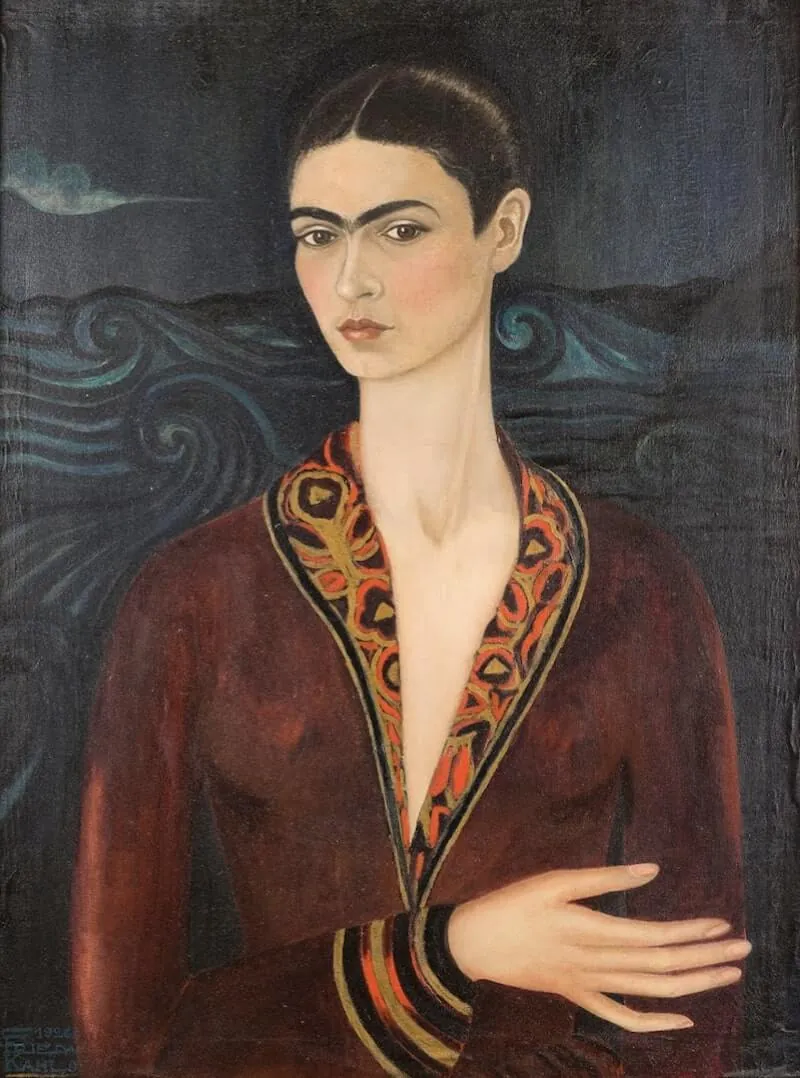
That mirror led directly to her first self-portrait, painted when she was nineteen years old. She titled it "Self-Portrait in a Velvet Dress," and she made it for Alejandro. In the painting, she wears a deep red velvet gown with an elegant neckline, her hair swept up, her gaze steady and searching. She looks nothing like a girl recovering from a catastrophic accident. She looks desirable, composed, almost regal. But in the background, the brushstrokes grow dark and turbulent, hinting at the storm inside her. The bed frame she painted with honest detail stands behind her, a quiet admission that she was still not well.
The painting was an offering. Her extended hand in the portrait reaches toward Alejandro, begging him to take it, to stay with her, to find her beautiful despite everything. He did not. When she finally left her bed and reached for him in real life, Alejandro rejected her. The relationship ended, adding emotional ruin to her already shattered physical state. She had lost her health, her mobility, and now the boy she loved. All she had left was the mirror, the paintbrush, and the strange new language she was beginning to speak on canvas.
That first self-portrait was dismissed by Frida herself as a trivial whim, a distraction from her misery. But it was the beginning of the artistic voice that would eventually make her one of the most recognizable figures in modern art. The girl who could not walk was learning to paint the truth of her own face, and the world would never be quite the same.
The Elephant and the Dove: Marriage to Diego Rivera
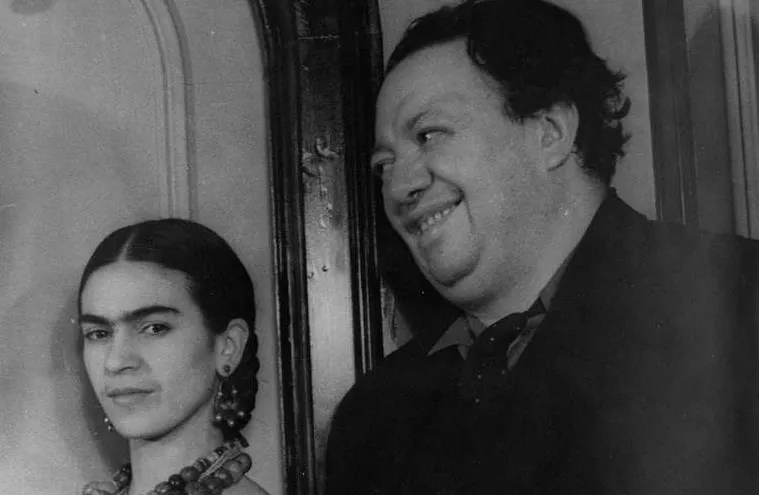
Frida Kahlo married Diego Rivera on August 21, 1929, in a civil ceremony that united two of Mexico's most formidable artistic spirits. The union stunned her family, delighted her friends, and set the stage for one of the most turbulent love stories in modern art history. Her own mother compared the match to a marriage between a white dove and an elephant.
The path to that wedding day began in 1928, when Frida struck up a friendship with Julio Antonio Mella, a Cuban communist revolutionary living in Mexico City. Through him, she joined the Communist Party and found herself in rooms buzzing with political energy and creative fire. It was there that she crossed paths with Diego Rivera, the muralist whose monumental public works had already made him a national legend.
Diego was not a handsome man. He was heavyset, with bulging eyes and a tendency toward grand gestures that could tip into grandiosity. None of that seemed to matter. Women flocked to him, drawn by a charm that had little to do with conventional good looks. But what captivated Diego about Frida was something deeper. Here was a woman who had survived a catastrophic bus accident in 1925, endured dozens of surgeries, and emerged with a fierce intelligence and a will of iron. She painted with raw honesty. She argued about politics with passion. She refused to be anyone other than herself.
Diego began visiting her regularly, and soon their conversations about art and revolution turned into something more tender. He was already famous across Mexico for murals depicting the struggles of miners, peasants, and the working class under Spanish colonial rule. She was a young woman still finding her artistic voice. The pull between them proved impossible to resist.
When they announced their engagement, Frida's family was devastated. Her mother saw the pairing as absurd, a delicate bird yoked to a lumbering beast. Only Frida's father attended the wedding ceremony. None of that dimmed her joy. In those early days, she wrote ecstatically about her husband, stringing together words that read like a prayer: "Diego, beginning. Diego, child. Diego, painter. Diego, father. Diego, lover. Diego, husband. Diego, friend. Diego, mother. Diego, me. Diego, universe."
The marriage soon carried them north. In 1931, Diego received commissions in the United States, and the couple moved to San Francisco. Frida hated the country from the moment she set foot in it. The culture felt foreign, the people seemed cold, and she missed the colors and textures of Mexico with an ache that never quite subsided. She coped the only way she knew how: she painted.
That year, she completed "Frida and Diego Rivera," a double portrait that captures the strange physics of their partnership. In the painting, Diego stands massive and confident, holding a palette and brushes, his feet planted wide. Frida stands beside him, smaller, her head tilted slightly toward his, her hand resting delicately in his grip. She wears a traditional Mexican dress even in California, clinging to her roots as a form of resistance. Above them, a dove carries a banner that reads: "Here you see us, me Frida Kahlo, with my dear husband Diego Rivera. I painted these portraits in the beautiful city of San Francisco, California, for our friend Albert Bender, in the year 1931." The contrast between her delicate frame and his powerful stance tells you everything about how she saw their dynamic in those early years, and how much she was willing to give to keep him close.
Miscarriage and the Birth of a New Artistic Language
In 1932, Frida Kahlo found herself trapped in Detroit, a city whose gray, gloomy atmosphere she openly despised, and it was there on July 4, 1932, that she lost the baby she had so desperately wanted. The tragedy did something profound to her art. It gave birth to her first explicitly bloody and unsettling painting, a canvas that would mark a permanent shift toward the raw, unfiltered honesty that defines her most famous work.
The painting, titled "Henry Ford Hospital," shows Frida lying naked on a blood-stained bed. She floats in a barren industrial landscape rather than a hospital room, as if the city itself felt as cold and sterile as any ward. The sheet beneath her is soaked crimson, and from her body stretch thin, cord-like lines that connect to floating symbols around her. A fetus hovers nearby, the child she would never hold. A snail represents the slow, fragmented delivery of the dead baby, a detail so haunting it stays with you long after you look away. An orchid, the flowers Diego had brought to her bedside, dangles from another cord. A pelvic bone references the damage from her 1925 accident, the same injury that made carrying a pregnancy so dangerous. And a metal machine part ties the scene to the industrial Detroit she hated so much.
Her earlier works had been tender, even romantic in their longing. This one was different. The source describes this moment as the point when her work gained a much more dominant and raw character, and you can feel it in every brushstroke. The vulnerability is no longer quiet. It is loud, graphic, and unapologetic. Frida lay alone in that massive hospital room, sobbing, her spirit and body both broken, and from that wreckage she forged a new visual language that would carry her through every hardship still to come.
Betrayal, Divorce, and the Two Fridas
Diego Rivera's affair with Frida's younger sister, Cristina Kahlo, in the mid-1930s shattered something fundamental in their marriage. The betrayal cut deeper than any of Diego's previous infidelities, because this time he had reached into Frida's own family. The wound would eventually lead to their divorce in 1939, but not before Frida transformed her anguish into some of the most searing self-portraits of the twentieth century.
Frida's response to the affair was immediate and visceral. She chopped off her long, dark hair, the very feature Diego adored most, and painted "Self-Portrait with Curly Hair" in 1937. The short, curly crop was a deliberate rebuke, a visual scream aimed directly at her husband's preferences. The painting sold in 2003 for nearly one and a half million dollars, though it did not set a record for a female artist at that time. What remains undisputed is the painting's raw emotional power, a woman reshaping her own image in defiance of the man who hurt her.
The couple separated after the affair but did not divorce immediately. They drifted through a strange limbo for a while, still legally bound but emotionally fractured. Then, in 1939, they made it official. The divorce was final, and Frida, who had once written poetry declaring "Diego is my universe," found herself utterly alone. She poured everything into her art during 1939 and 1940, producing an extraordinary volume of work in that brief, painful window.
The most famous piece from this period is "The Two Fridas," completed between 1939 and 1940. The painting shows two versions of Frida sitting side by side, their hearts exposed and connected by a single thin artery. On the right sits the Mexican Frida, dressed in traditional Tehuana attire, her heart whole and healthy. In her hand she holds a small portrait of Diego as a child. On the left sits the American Frida, wearing a white European-style dress, her heart split open and incomplete. She holds a pair of scissors, and the artery that once connected the two women has been cut, dripping blood onto her lap.
The symbolism is devastating. Frida seems to be blaming herself for Diego's wandering eye, convinced that her time in America had changed her, made her less interesting, less desirable to the man she loved. The Mexican Frida still clings to Diego's image, while the American Frida, the version of herself that lived in the United States during their years in Detroit and San Francisco, has severed the lifeline. The painting captures a woman torn between who she was and who she became, unable to reconcile the two.
Her loneliness deepened in the years that followed the divorce, and she kept painting her pain. In 1940, she completed "Self-Portrait with Cropped Hair," showing herself in an oversized man's suit, seated in a chair with scissors still in hand. Her shorn hair lies scattered across the floor around her. Above her head, musical notes carry the lyrics of a popular Mexican song: "Look, if I loved you it was because of your hair. Now that you're bald, I don't love you anymore." The words are a bitter mockery of Diego's affection, a man who loved her for her appearance rather than her essence. She dressed as a man in the painting, as if trying on a new identity, one that might protect her from ever being hurt again.
The wounded deer came later, in 1946, when Frida's physical pain had begun to rival her emotional scars. "The Wounded Deer" shows her as a stag with her own face, pierced by arrows, running through a barren, lifeless forest. The trees are dead, the ground is cracked and dry, and no green shoot of hope appears anywhere. In the background, a body of blue water stretches out, but the deer does not look toward it. She stares directly at the viewer, eyes wide with suffering, as if to say there is no escape, no path to safety, no way to outrun the arrows that have already found their mark.
What makes these paintings so haunting is how openly they document a woman falling apart in real time. The Frida who painted herself in a velvet dress at nineteen, reaching out hopefully toward her first love, had become someone who painted herself as a dying animal in an empty landscape. The thread running through all of it is Diego, always Diego, the man she called both her worst accident and her greatest love. In one of her most quoted reflections, she wrote that she had suffered two accidents in her life: the tram crash in 1925 and Diego Rivera. The tram, she said, was the lesser of the two.
The Broken Column and the Final Years
By 1944, Frida Kahlo's spine had become a battlefield. The pain that had shadowed her since the 1925 bus accident now sharpened into something relentless, forcing her into a steel corset that held her torso rigid. That year, she poured her agony into one of her most devastating works: "The Broken Column." In it, she stands alone in a cracked, barren landscape, tears streaming down her face. Her body is split open down the middle, and where her spine should be, she painted a crumbling Ionic column, fractured into segments. Nails pierce her skin across her face and torso, each one a pinpoint of suffering. The steel corset she actually wore appears in the painting as the straps holding her broken body together. It remains one of the rare canvases where we see Frida weeping, her usual defiant mask stripped away.
Five years later, in 1949, her obsession with Diego Rivera had not loosened its grip. "Diego and I" shows Frida crying again, but this time the source of her tears is painted directly onto her forehead: Diego's face, complete with his signature third eye, hovers between her brows. Her long black hair coils around her neck like a rope, and art historians have long read that detail as a quiet admission that thoughts of death never left her. She loved him with a ferocity that bordered on sickness, and she could not stop painting that truth.
In 1950, her body finally forced a surrender. Frida was hospitalized, and she would never truly recover her strength. Diego stayed by her side through those long months, visiting faithfully, but something fundamental had shifted. His presence now carried the warmth of an old friend rather than the fire of a great love. The romance she had dreamed of, the consuming passion of their early years, had cooled into something quieter and sadder.
The losses kept mounting. In 1953, gangrene spread through her right leg, the same leg that polio had weakened when she was six years old. Doctors recommended amputation below the knee. Frida fought the idea at first, refusing to accept what it meant. Eventually, though, she gave in. According to the original account, she reportedly told those close to her, "What do I need feet for when I have wings to fly?" The bravado in those words feels heartbreaking coming from a woman who had spent decades painting herself as rooted, earthbound, and in pain.
By 1954, her diary entries had become farewell notes. Every line circled around death. On April 27, she suffered a crisis, and afterward she wrote what would be among her final words: "I hope the exit is joyful and I hope never to return." The woman who had once declared herself a child of the Mexican Revolution was now asking only for a clean departure.
Frida Kahlo died on July 13, 1954. The official cause was a pulmonary embolism. She was 47 years old.
Even in death, though, she refused the labels others tried to pin on her. André Breton, the French poet who founded Surrealism, had spent years trying to claim her as one of his own. She never accepted the designation. "I never painted dreams," she insisted. "I painted my own reality." And she reserved her sharpest honesty for Diego. "I suffered two grave accidents in my life," she told him, "the trolley and you. You were the worst of all." Then, with the same breath, she added that if she could live her life over, she would love him again, even knowing she would rot alive. That contradiction, the fury and the devotion tangled together, was Frida Kahlo to her core. Her paintings, her unflinching self-portraits, and her refusal to look away from her own suffering have made her Frida Kahlo life story one that still resonates with anyone who has ever loved too hard or hurt too much.
Frequently asked questions
What happened to Frida Kahlo in the bus accident?
On September 17, 1925, the bus Frida Kahlo was riding collided with a tram in Mexico City. A metal handrail impaled her abdomen, piercing through her uterus, and she suffered a fractured spine, a broken pelvis, and numerous other severe injuries. The accident left her bedridden and in chronic pain for the rest of her life. The young woman was returning home from school with her boyfriend Alejandro Gomez Arias when the crash happened. The impact was so violent that a steel handrail went straight through her body, entering at her hip and exiting through her genitals. She survived, but her body would never be the same. Doctors did not expect her to live. She spent a month in the hospital and underwent 32 surgeries over the course of her lifetime to address the damage. Her spine was broken, her collarbone was shattered, and her right leg and shoulder were dislocated. The recovery process was agonizing, and she was fitted with a series of plaster corsets and steel braces to hold her body together.
Why did Frida Kahlo start painting self-portraits?
Frida Kahlo began painting self-portraits while recovering in bed after her 1925 bus accident. Her mother hung a mirror on the ceiling of her bed so she could see herself, and she started with a portrait of herself in a velvet dress intended for her boyfriend Alejandro. Painting became her way of coping with isolation and physical pain. Confined to a wooden bed frame her family had made for her, Kahlo had little to do but stare at her own reflection. The mirror was installed on the ceiling of her bed, and she initially hated the idea. But she needed to become familiar with her own body, which had been so violently changed. What she called a "passing whim" turned into the foundation of her entire artistic career. Her first self-portrait, completed when she was 19, shows her in a dark red velvet dress with a deep neckline. She painted it for Alejandro, who was drifting away from her after the accident. The painting is both an offering and a plea, her hand extended toward him in the background, hoping he would still find her desirable despite her injuries.
How did Frida Kahlo's marriage to Diego Rivera affect her art?
Frida Kahlo's marriage to muralist Diego Rivera profoundly shaped her art, inspiring masterpieces like "The Two Fridas" and "Diego and I." His affair with her sister Cristina led to their divorce in 1939, which triggered an intense burst of creative output as Kahlo channeled her heartbreak onto canvas. The couple married on August 21, 1929. Her mother compared the union to a marriage between a white dove and an elephant. Rivera was already Mexico's most famous artist, and his influence on Kahlo's work was immediate. He encouraged her to embrace Mexican folk traditions and indigenous dress, elements that became central to her visual identity. When Rivera began an affair with Cristina in the mid-1930s, Kahlo was devastated. She cut off her long hair, which Rivera adored, and poured her anguish into paintings. "The Two Fridas," completed in 1939, shows two versions of herself sitting side by side, one with a whole heart and one with a broken heart, connected by a shared artery. The painting captures her sense of being split between the woman Diego loved and the woman he had abandoned. The divorce in 1939 unleashed a remarkably productive period. Between 1939 and 1940, she completed numerous works, each one more raw and confessional than the last. Her art became her primary language for expressing emotions too painful to speak aloud.
What does the painting Henry Ford Hospital symbolize?
"Henry Ford Hospital" depicts Frida Kahlo's miscarriage on July 4, 1932, while she was living in Detroit with Diego Rivera. The painting shows her naked and bleeding on a hospital bed, connected by red cord-like veins to floating symbols: a fetus, a snail, an orchid, and a pelvic bone, each representing an aspect of her loss and physical trauma. Kahlo was pregnant and desperate to have the child, despite Diego's fears that her body, already weakened by the 1925 accident, could not handle a pregnancy. Her condition deteriorated as the pregnancy progressed, and she was rushed to the hospital with severe abdominal pain. The miscarriage was slow and agonizing, and the baby was delivered in pieces. In the painting, the industrial city of Detroit looms in the background, cold and indifferent. The snail represents the slow, drawn-out nature of the stillbirth. The orchid was a reference to the flowers Diego had brought her in the hospital. The pelvic bone points to the damage from the original accident that made carrying a child so dangerous. The metal object in the lower left references the industrial city itself, which Kahlo hated. She painted the scene from her hospital bed, depicting herself utterly alone, crying in a vast room. It was the first of her paintings to use the visceral, symbolic language that would define her mature style.
Was Frida Kahlo a surrealist?
No, Frida Kahlo was not a surrealist, even though the movement's founder Andre Breton tried hard to claim her. She insisted she did not paint dreams or the subconscious; she painted her own reality. Her response to being labeled a surrealist was famously sharp: she said she painted her own reality, not surrealism. Breton visited Mexico in 1938 and was captivated by Kahlo's work. He organized an exhibition for her in Paris and wrote an essay presenting her as a surrealist discovery. But Kahlo never accepted the label. Her paintings were not exercises in automatic writing or dream logic. They were direct, unflinching records of her actual experiences: her pain, her miscarriages, her surgeries, her turbulent marriage. The distinction mattered deeply to her. Surrealism, in her view, was an escape from reality into the imagination. She was doing the opposite, confronting reality head-on, no matter how brutal it was. Her art was autobiographical to its core, a visual diary of a life marked by suffering and passion.
How did Frida Kahlo die?
Frida Kahlo died on July 13, 1954, officially from a pulmonary embolism. Her health had been declining for years, and her right leg was amputated below the knee in August 1953 due to gangrene. She was 47 years old. The last years of her life were marked by escalating medical crises. In 1950, she was hospitalized, and her health never fully recovered. She was confined to bed for long stretches and relied on increasing amounts of pain medication. Despite her suffering, she continued to paint whenever she could. When the gangrene spread to her right leg, the leg weakened by polio in childhood, doctors recommended amputation. She initially resisted fiercely, but when she understood the severity, she accepted it. She told those close to her, "What do I need feet for when I have wings to fly?" In her final months, she wrote constantly about death in her diary. On April 27, 1954, she noted that she had suffered a crisis. Her last known diary entry expressed a hope that her exit would be joyful and that she would never return. She died at her beloved Blue House in Coyoacan, the same house where she had been born and where she had lived through so much of her pain and creativity. Editorial note: Any facts which remain unconfirmed are presented as such, clearly hedged within the narrative.
Got a take on this? Add your voice to the conversation below →
No comments yet. Be the first.