Flow Psychology: The 1992 Jordan Shrug Explained
Flow psychology is the study of those absorbed moments when challenge and skill line up so perfectly that self-consciousness disappears. The concept became famous through Mihaly Csikszentmihalyi, the psychologist who began mapping the state back in the 1960s. Then in 1992, during the NBA Finals, Michael Jordan gave the world a wordless demonstration. He hit a string of three-pointers against Portland and offered a shrug that seemed to say he was as surprised as anyone. That gesture is what pure flow looks like from the outside.
Flow psychology describes full absorption in a task where challenge and skill are balanced. Mihaly Csikszentmihalyi developed the theory from research he began in the 1960s. In 1992, Michael Jordan's shrug during the NBA Finals became a famous public example of the state in action.
- Mihaly Csikszentmihalyi, a Hungarian-American psychologist, developed flow theory through research he began in the 1960s.
- Flow occurs when a person's skill level matches the difficulty of the task, producing deep focus and a lost sense of time.
- During the 1992 NBA Finals against the Portland Trail Blazers, Michael Jordan reacted to his own hot shooting with a now-famous shrug.
- Csikszentmihalyi's model places anxiety above the challenge-skill balance and boredom below it, with flow in between.
The Shrug That Explained Everything
It was Game 1 of the 1992 NBA Finals, and Michael Jordan did something that left even him speechless. Within 18 minutes of play, he drained six three-pointers, then turned toward the crowd and gave a slow, almost puzzled shrug, palms turned up, as if to ask the air itself what had just happened. That small gesture became one of the most replayed images in basketball history, and it opens a door onto something psychologists call flow psychology: the study of what happens when a person is so completely absorbed in an activity that everything else falls away.
Jordan later expressed genuine astonishment at the outburst. According to the original account, he said something close to not even knowing how he had done it. Whether or not those exact words left his mouth, the sentiment is the point. Here was arguably the best basketball player alive, and even he couldn't reconstruct the mechanics of what his body had just done. The performance had run through him rather than being consciously assembled by him.
That gap between doing and explaining is where flow psychology begins. The term describes a mental state in which attention narrows to a single task, time seems to dissolve, and the outside world goes quiet. People tend to hit their highest performance in this state, and it shows up in very different arenas, from sports to science to medicine. You may have felt a flicker of it yourself, buried in a book's pages, lost in a video game, or mid-workout when suddenly an hour has vanished.
What makes Jordan's shrug such a good entry point is the honesty of it. He wasn't performing modesty. He was standing at the far edge of his own skill, baffled by the result. That is the strange signature of flow: the peak moment is often the one you can least explain afterward.
What Is Flow Psychology? Csikszentmihalyi's 1960s Discovery
Flow psychology is the study of complete absorption in an activity, the state where time disappears and every scrap of attention locks onto the task in front of you. The American psychologist Mihaly Csikszentmihalyi built the concept in the 1960s, and his starting point was surprisingly simple: he watched painters work, and he watched them lose track of everything else.
Picture the studio. An artist bent over a canvas, brush moving, hours sliding past without a glance at the clock. Csikszentmihalyi noticed that some of these artists forgot to eat. Some forgot to sleep. The finished painting was almost beside the point. What pulled them back to the easel, again and again, was the act of creating itself, not the result hanging on a wall afterward.
That observation became the seed of a whole field of inquiry. If a painter could vanish into the work like that, what exactly was happening inside the mind? Csikszentmihalyi pushed the question beyond the studio, and his research showed the same state surfacing far from art: in sports, in science, in medicine. A surgeon deep in an operation and a painter deep in a canvas are, in this sense, doing the same thing.
He put a name to it. Flow. You know the feeling when it hits you: a book whose pages stop existing as pages, a game that swallows an afternoon, a run where your legs move without instruction. The outside world goes quiet. The task fills the whole frame.
The Balance That Makes It Happen
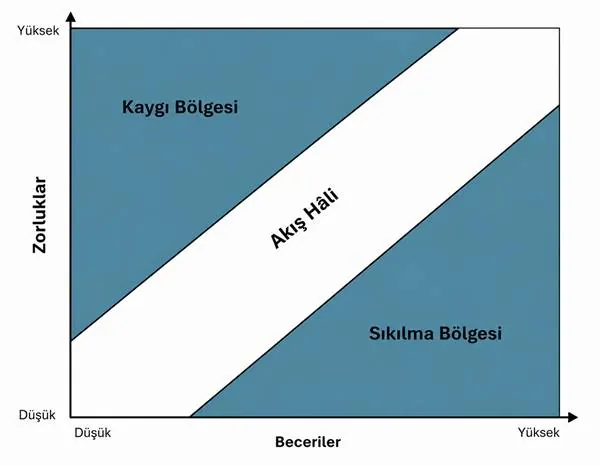
Flow does not strike at random. It lives on a balance point between two forces: how hard the challenge is and how capable you are of meeting it. When the challenge outruns your skill, you slide into what Csikszentmihalyi called the anxiety zone, and the work turns into stress, pressure, and frustration. When your skill outruns the challenge, you drop into the boredom zone, and the work goes flat, indifferent, easy to walk away from.
Line the two up, challenge and skill in step, and the flow state opens. Focus sharpens, the bond between you and the task tightens, and you are simply inside the process. Think of a new office job. The first assignments match your abilities, so you stay engaged. Then a demanding project lands with a deadline close behind, and you feel the anxiety zone closing in. Master those tasks and the routine turns dull, and boredom creeps back. The fix is to reach for something a little harder, which rebalances skill against challenge and pulls you back toward flow.
The Flow Chart: Challenge, Skill, Anxiety, and Boredom
Flow psychology rests on a single balance beam: the match between what a task demands and what you can actually do. When challenges exceed skills, you land in the anxiety zone, where stress, pressure and frustration take over. When skills exceed challenges, you slide into the boredom zone, and disinterest, disconnection and apathy creep in. Flow state appears only when the two lines cross and match.
Picture the diagram as a channel running between two cliffs. On the left cliff sits anxiety, all tight shoulders and racing thoughts. On the right sits boredom, all glazed eyes and clock-watching. The sweet spot is the narrow river between them. In that channel, focus sharpens, your sense of self fades into the task, and the work feels less like effort and more like being carried along.
The office makes this easy to feel. Say you start a new job. The first assignments sit right at your skill level, so you sink in, stay productive, and lose track of the morning. That is flow doing quiet work.
Then a project arrives with a deadline breathing down your neck. The challenge jumps above your current skills, and you feel the shift in your chest: pressure, stress, the sense that you are behind before you begin. You have crossed into the anxiety zone.
Give it a few months. You master the tasks. The routine stops testing you, and the same work that once absorbed you now feels flat. Interest drains out, you drift toward disconnection, and the boredom zone opens up beneath your chair.
The fix is rarely dramatic. You take on slightly harder responsibilities, a new project that stretches you just past your comfort. Skills and challenge rebalance, and the intense focus and strong connection to the task come back. Csikszentmihalyi's model is not a one-time achievement but a moving target you keep adjusting.
The Math Equation Researchers Proposed to Explain Flow
What if flow psychology could be boiled down to a single relationship between what you do and what comes back? A research team set out to test exactly that. According to the source, they ran five separate experiments in which participants played digital tile-based games, and the results led them to a deceptively simple idea: the tighter the connection between your actions and their outcome, the more likely you are to slip into flow.
The setup, as the original account describes it, was designed to measure immersion rather than just performance. Successful participants reportedly earned monetary rewards, extra time to finish the game, and additional chances to improve their results. Throughout, the researchers watched which small tweaks to the tasks pushed flow up or pulled it down, and they asked players how absorbing, gripping, and worth-continuing each game felt. Those questionnaires were the measuring stick.
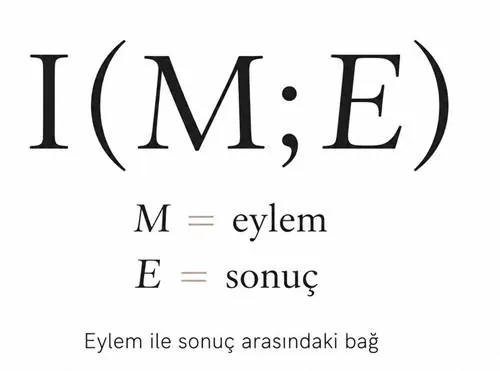
Out of that came the equation. The source describes a simple mathematical relationship in which M stands for the actions you take toward a goal, E for the outcome of those actions, and I for the shared information between the two. The exact variable definitions are reported rather than independently confirmed, but the underlying claim is clear enough: the stronger the link between what you do and what results, the higher the flow probability.
The three pieces, as proposed
- MActions taken toward a goal
- EThe outcome those actions produce
- IThe information the two share
You can feel the logic in everyday play. A game that only offers win or lose resolves fast, uncertainty stays low, and the pull fades. Apps that keep you hooked often stretch the outcome across days, so each small action visibly shifts the result. That sense of "my move mattered" is where the equation says flow lives. Reportedly, the work behind this appeared as "A computational theory of the subjective experience of flow" by Melnikoff, Carlson, and Stillman, published in Nature Communications in 2022 (volume 13, article 2252).
Treat the formula as a lens, not a law. It says the mental state we call flow has a measurable spine: clear actions, visible outcomes, and a strong thread of information tying them together. When that thread is thick, attention locks in almost on its own.
Streaks, Apps, and Why Uncertainty Keeps You Hooked
Think about the last time an app kept you coming back for just one more day. A win-or-lose game settles fast: you know the outcome, the uncertainty drains away, and so does the pull. A language-learning app works the opposite way. There is no single answer to "how many days in a row will I study?" The streak stretches out step by step, and every small daily action visibly changes where it lands. That is flow psychology hiding inside a notification.
Csikszentmihalyi's core insight was that flow strengthens when you clearly feel your actions affect the result. The streak system is a machine built on exactly that feeling. Each tap, each completed lesson, nudges a number that belongs to you alone. You are not waiting for a verdict at the end. You are watching the outcome take shape through your own hands, day after day.
A game with only two endings resolves in minutes. A streak with no fixed ending keeps the question open, and an open question is what holds your attention.
That gap between "I did something" and "here is what it changed" is the whole trick. Close the gap too tightly and the result is instant and forgettable. Leave it wide open and the outcome feels random, so you drift toward the anxiety zone. The sweet spot sits in between, where your next action still matters and you can still feel it mattering. Small, visible, gradual feedback loops turn a routine into something closer to play.
How to Find Flow in Daily Life
You can find flow in daily life by picking challenges that sit just above your current skill level and by checking in on your mood as you work. Too easy and boredom creeps in. Too hard and anxiety takes over. The sweet spot between the two is where flow psychology says deep focus lives, and it is something you can deliberately steer toward.
Think about the office job example. At first the tasks match your abilities, so you stay sharp and engaged. Then a tight-deadline project lands and the challenge jumps past your skills, which is the anxiety zone. Later, once you have mastered the routine, the same work stops stretching you and you drift into the boredom zone, indifferent and disconnected. The fix is not to wait for the perfect assignment. It is to reach for new responsibilities and projects that push you slightly beyond where you are right now, so your skills rebalance against a fresh challenge.
That requires a little self-monitoring. While you work, ask yourself a plain question: am I anxious, bored, or focused? The answer is your signal. Anxious means ease the difficulty down a notch. Bored means raise it. Focused means stay exactly where you are. This small act of noticing is what turns flow from a lucky accident into a condition you can recreate on purpose.
Then learn your own flow signs. If you lose track of time, disconnect from the world outside, and pour all your attention into the task, you are likely close to that state. Catching those moments when they happen is the whole trick. Once you know what the conditions felt like, you can build them again the next time you sit down to work.
Frequently asked questions
What is flow psychology and who developed it?
Flow psychology describes the state of complete absorption in an activity, where time slips away and attention locks onto the task at hand. American psychologist Mihaly Csikszentmihalyi developed the concept in the 1960s after watching painters who forgot to eat and sleep while working, driven by the act of creating rather than the finished product.
What happened to Michael Jordan in the 1992 NBA Finals?
In Game 1 of the 1992 NBA Finals, Michael Jordan hit six three-pointers within 18 minutes and then turned to the crowd and shrugged. He later expressed astonishment at the outburst, though the exact wording of his quote is contested. The moment became a famous snapshot of an athlete performing at the peak of flow.
How do challenge and skill levels create flow, anxiety, or boredom?
When challenges outrun your skills, you land in the anxiety zone, full of stress and pressure. When your skills outrun the challenge, you slide into the boredom zone, marked by disinterest and detachment. Flow sits at the balance point, where challenge and skill match and deep focus takes over.
What is the mathematical equation behind flow?
As the original account goes, researchers proposed a simple relationship in which M stands for the actions you take toward a goal, E for the outcome of those actions, and I for the shared information linking them. The stronger the connection between what you do and what results, reportedly the greater the chance of flow.
What did the digital tile game experiments reveal?
According to the reported account, a research team ran five separate experiments in which participants played digital tile-based games. Successful players reportedly earned monetary rewards, extra time to finish, and additional chances to improve. Surveys then asked players how immersive and engaging they found each game.
How can I use flow to improve productivity?
Pick tasks just slightly above your current skill level. Too easy and you drift into boredom, too hard and anxiety takes over. Check in on your mood as you work: anxious, bored, or focused? That awareness tells you when to ease a task off or push it a notch harder.
What are the signs of flow?
The clearest signals are losing track of time, feeling cut off from the outside world, and pouring all your attention into the work in front of you. Notice those moments when they happen. Recognizing them helps you rebuild the same conditions on purpose. Editorial note: Details that remain unconfirmed are presented as such, and the psychological concepts described reflect the published work of Mihaly Csikszentmihalyi.
Got a take on this? Add your voice to the conversation below →
No comments yet. Be the first.