Effective Learning Techniques: 5 That Work, 5 That Don't

Effective learning techniques are not all created equal, and a landmark 2013 study by Dunlosky et al. identified which methods truly boost retention and which common habits quietly waste your study time. This research, published in the journal Psychological Science in the Public Interest, evaluated ten popular strategies and found that only five stand up to scientific scrutiny, while the other five, including highlighting and rereading, consistently underperform for most students. If you have ever felt like you worked hard but still forgot everything on exam day, this breakdown will explain why and show you a better path forward.
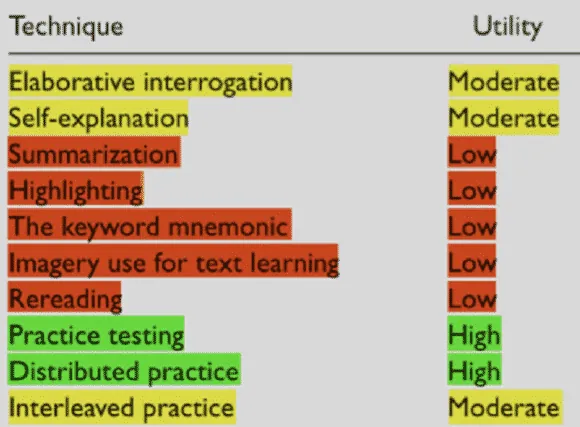
A 2013 research review by cognitive scientists scored ten common study techniques. Five strategies, including practice testing and spaced practice, earned high marks for boosting learning. The other five, such as highlighting and rereading, proved largely ineffective. Students who swap the weak methods for the strong ones typically remember more with less total study time.
- The 2013 review by Dunlosky and colleagues evaluated ten learning techniques used by students of all ages.
- Practice testing and distributed practice were rated as having high utility for lasting learning.
- Highlighting, rereading, and summarization were judged to have low utility for most learners.
- The findings apply broadly across subjects, from math and science to humanities and language study.
- Students who adopt the five evidence-based methods typically see better exam performance and long-term retention.
Why Your Study Habits Might Be Working Against You
You highlight passages in neon yellow, rewrite your notes into tidy summaries, and read the same chapter three times before an exam. It feels productive. It feels like studying. But a landmark 2013 review by cognitive psychologist John Dunlosky and his colleagues examined ten learning techniques students rely on, and the five they rated as least effective are among the ones most of us reach for first.
The researchers weren't guessing. They combed through decades of studies and graded each technique on how well it actually supports long-term learning. Highlighting came out near the bottom. So did summarizing, mnemonics, visual imagery, and rereading. These are the methods that fill our study sessions, the ones we learned from older siblings and well-meaning teachers, the ones that feel like work. And according to the review, they barely move the needle on genuine understanding.
Here's the uncomfortable part. The story that emerged from that 2013 review suggests these five low-utility techniques are also widely used by students. Whether they are literally the most popular is hard to pin down precisely, but anyone who has watched a friend color-code a textbook knows they are everywhere. Meanwhile, the techniques that actually work, like retrieval practice and spaced studying, are the ones most of us avoid because they feel harder and slower.
Think about what highlighting really does. You drag a bright marker across a sentence, and the physical act tricks your brain into thinking the information has been processed. But the research shows it doesn't help you derive additional meaning or make new inferences. It is passive. The same goes for rereading. Reading a passage again feels like reinforcement, yet the evidence is thin that it improves deep comprehension. Unless the rereading is spaced out over time, you are mostly just looking at familiar words without wrestling with their meaning.
The real problem is that these habits are comfortable. They require no struggle. And that comfort is exactly why so many of us never question them.
The 5 Study Techniques That Quietly Fail You
If you have ever cracked open a textbook with a bright yellow highlighter in hand, you are not alone. In fact, researchers who examined 10 different learning techniques in a 2013 review led by John Dunlosky found something uncomfortable: the five methods students lean on heavily are the very ones rated weakest for long-term learning. Here is what those quietly failing techniques look like, and why they keep letting us down.
Highlighting
There is something satisfying about dragging a marker across a sentence that feels important. The problem? Highlighting only helps a little, and only when you are wrestling with genuinely difficult material. It does nothing to help you derive additional meaning or inferences from what you read. You are marking text, not processing it. The page gets colorful while your understanding stays flat.
Summarizing
Teachers love assigning summaries, and for good reason in theory. The catch is that summarizing only works if you already know how to identify key points. If you lack prior knowledge about a subject, you cannot tell what matters and what does not. You end up summarizing everything, which is just rewriting. For most students, this technique quietly fails before it ever gets a chance to work.
Mnemonics
Turkish students of a certain generation remember "Fıstıkçı Şahap," the mnemonic for consonant mutation in grammar. The trick can pull information back quickly, sure. But the original review rated mnemonics as low utility for lasting learning, and that rating is worth taking seriously. More recent work suggests mnemonics can actually aid long-term retention for certain kinds of material, especially when the content is well suited to the memory device. Still, if you can recall the phrase but not the grammar rule it stands for, the technique has not done its job.
Visual Imagery
Creating mental pictures of what you read sounds promising, and it is more promising than the other low-utility techniques. The honest limitation is that imagery mainly helps with memory test prep, not durable learning. It might carry you through a quiz tomorrow, but it will not build the kind of understanding that sticks around for next month or next year.
Rereading
Reading a chapter once, then again, then a third time feels productive. The evidence says otherwise. Rereading only shows effectiveness when the repetitions are spaced out over time. Even then, researchers found no convincing proof that rereading improves deep understanding of a topic. You finish the chapter familiar with the words, but the concepts remain shallow.
The uncomfortable truth is that these five techniques share a common flaw: they keep you busy without making you think. According to the original account, we tend to lose a significant portion of new information within the first 24 hours of hearing or reading it. That figure is debated in memory research, but the direction is clear. Passive exposure fades fast. What actually protects learning is active engagement, the kind that forces your brain to work, retrieve, and connect. The techniques above rarely ask that of you, which is exactly why they fail so quietly.
The 5 Evidence-Based Study Techniques That Actually Work
In 2013, a team of cognitive psychologists led by John Dunlosky published a landmark review in Psychological Science in the Public Interest that examined 10 different learning techniques and rated them for effectiveness. The results turned conventional study habits upside down. The five techniques that scored worst, including highlighting and rereading, turned out to be among the ones students reach for frequently. But buried in that same review were five methods that genuinely move the needle.
These effective learning techniques are not flashy or complicated. They require more effort than passively running a highlighter across a page, and that effort is exactly the point. Here is what the research actually supports.
Elaborative Interrogation
Ask yourself why a fact is true while you study it. That simple habit, called elaborative interrogation, forces your brain to connect new information to what you already know. It works best when you have some prior knowledge of the topic to build those connections. If you are learning about photosynthesis, pause and ask why plants need sunlight. The act of generating an explanation, even an imperfect one, locks the material in far better than reading it again.
Retrieval Practice
Close the book and force yourself to recall what you just learned. That is retrieval practice, and it is one of the most powerful tools in the cognitive scientist's toolkit. The counterintuitive part: it works best when you have forgotten a little first. This "desirable difficulty" means you should wait a bit before testing yourself. Try solving the practice questions at the end of a chapter without looking back at the notes. Draw a concept map from memory. Then check your work and fill the gaps. The struggle to retrieve is what builds durable memory.
Self-Explanation
Talk yourself through a problem out loud. Describe each step as you solve it, explain what a concept means in your own words. This technique, called self-explanation, does double duty. It strengthens your understanding, and it reveals when you are fooling yourself. If your explanations come out rambling, vague, or contradictory, that is a reliable signal that you do not understand the topic as well as you think you do. Treat those messy explanations as a warning flag, not a failure.
Interleaving
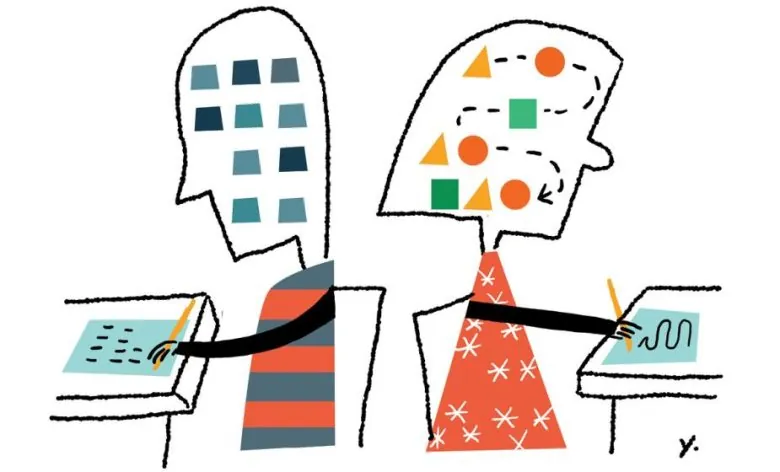
Most students practice one type of problem at a time, a habit researchers call blocked practice. It feels productive because each new problem is similar to the last, so you get the satisfaction of solving them quickly. But that comfort is deceptive. Interleaving, mixing different problem types in a single study session, forces your brain to distinguish between categories and choose the right approach each time. In math, for example, if you need to learn graphs and roots, study them together rather than in separate blocks. It feels harder in the moment, and that difficulty is precisely what improves your ability to apply the correct solution later.
Spaced Practice
Distribute your studying across time instead of cramming the night before an exam. Spaced practice has more than 200 research studies behind it, spanning over a century of psychological research. The evidence is remarkably consistent. You will retain more information and hold onto it longer if you revisit material across multiple sessions, letting some forgetting happen between each one. Cramming might get you through tomorrow, but spaced practice is what actually builds lasting knowledge.
One more habit deserves mention. Effective note-taking helps recall information later, and the research backs this up. The act of writing things down in your own words, especially in a structured way, creates a record you can return to during retrieval practice and spaced review sessions.
How to Put These Techniques Into Practice Today
The most practical shift you can make starts with a simple confession: most of us study in blocks because that's how textbooks are built. Chapter one covers graphs, chapter two covers roots, and so you sit down and drill graphs until they feel automatic, then move on to roots. Researchers call this blocked practice, and while it feels productive, it is consistently less effective for long-term retention than mixing things up.
Interleaving, the alternative, asks you to do something that feels almost wrong at first. If you need to study graphs and roots in math, mix them together rather than tackling them sequentially. Each problem you attempt is different from the last, so your brain has to keep searching for the right approach instead of coasting on repetition. That struggle is exactly the point. It trains you to distinguish between problem types and recognize which solution applies, which is precisely what you need during an exam or in real life.
Retrieval practice is where the real magic happens, and it is refreshingly concrete. After you finish a chapter, close the book. Solve the end-of-chapter questions from memory, draw what you remember on a blank sheet of paper, or build a concept map linking the ideas together. Then, and only then, check your notes to see what you missed. Fill those gaps deliberately. This cycle of recalling, checking, and correcting is what moves information from your short-term memory into something lasting.
The key shift is moving from passive absorption to active engagement. Reading and highlighting feel like studying, but they are mostly just exposure. Recalling, explaining, mixing, and spacing are the actions that actually build durable knowledge. None of these techniques require special tools or apps. They just require you to close the textbook a little sooner and trust that the struggle of remembering is what makes the learning stick.

Frequently asked questions
What study techniques are proven ineffective by research?
In 2013, cognitive psychologists including John Dunlosky published a landmark review in Psychological Science in the Public Interest that examined 10 different learning techniques. Five of them were rated as having low utility: highlighting, summarizing, mnemonics, imagery, and rereading. Interestingly, these low-rated techniques are widely used by students, even though the research consistently shows they do little to promote lasting understanding.
Why is highlighting not an effective learning technique?
Highlighting fails because it is a passive activity. When you mark text with a bright marker, you are simply selecting information that already stands out to you, not deriving additional meaning or making inferences from the material. The 2013 Dunlosky review rated highlighting as low utility precisely because it does not push your brain to process the content more deeply.
How does retrieval practice improve memory retention?
Retrieval practice works because it is an active process. Instead of passively rereading notes, you force yourself to recall information after a bit of forgetting has set in. That effort to pull knowledge back up strengthens the memory trace. The Dunlosky research team rated retrieval practice as one of the most effective learning techniques available, noting that the slight struggle of remembering is exactly what makes the memory stick.
What is spaced practice and why does it work?
Spaced practice means distributing your study sessions over time rather than cramming everything into one sitting. The method has been supported by more than 200 research studies over the past century. When you revisit material after a gap, your brain has to work harder to retrieve it, and that effort consolidates the learning. It is a simple concept that most of us know but rarely put into practice.
How can interleaving improve my study results?
Interleaving means mixing different problem types during a single study session rather than practicing one type at a time. This approach improves your ability to distinguish between problem categories and apply the right solution to each. Most textbooks are organized in blocks, so students naturally study one topic, then move to the next. But research shows that shuffling the problems forces your brain to constantly identify which strategy fits, which builds stronger discrimination skills.
Does rereading help with deep understanding?
There is no convincing evidence that rereading improves deep comprehension. The Dunlosky review rated rereading as low utility, noting that it mainly creates a false sense of fluency. The only exception is when rereading is spaced out over time, which at least gives your memory a chance to fade and recover. But even then, it does not promote the kind of active processing that real learning requires.
What is self-explanation and how do I use it?
Self-explanation is simply thinking aloud while you work through a problem. You narrate each step, explain what a concept means, and articulate why you are making certain choices. This technique reveals whether you truly understand the material. If your explanations come out long, rambling, or inconsistent, that is a clear signal you have not grasped the topic as well as you thought. The Dunlosky team rated self-explanation as having moderate utility with consistent benefits.
How much information do we forget within 24 hours?
According to the original account, people tend to lose a significant portion of newly learned information within the first 24 hours of hearing or reading it. That figure is not a standard, universally cited number in memory research, so treat it as a rough illustration rather than a precise scientific constant. What is well established is that forgetting happens quickly without reinforcement, which is why effective note-taking and retrieval practice matter so much for recall later. Editorial note: Any facts which remain unconfirmed are presented as such, and the effectiveness ratings reflect the original research conditions described in the study.
Got a take on this? Add your voice to the conversation below →
No comments yet. Be the first.