Curse of the Ninth: Classical Music's Strangest Superstition
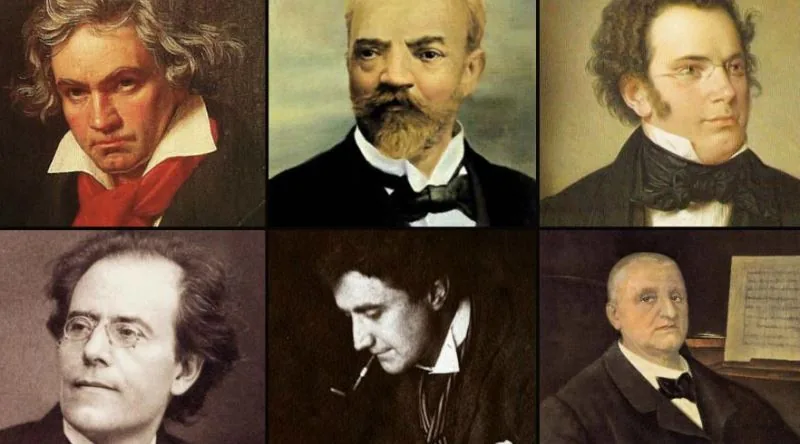
The Curse of the Ninth is a superstition that claims a composer's ninth symphony will be their last, and it has haunted classical music since Beethoven completed his Ninth Symphony in 1824. It's a legend that has weighed on the minds of Gustav Mahler, Anton Bruckner, and countless others, turning the act of writing a ninth symphony into a terrifying game of musical Russian roulette. There is something deeply unsettling about the idea that an artistic milestone could carry a hidden death sentence, and that fear is precisely what makes this story so enduring.
The Curse of the Ninth is a superstition that holds that a composer's ninth symphony will be their last, and it has been a source of dread for composers like Mahler and Bruckner ever since.
- Ludwig van Beethoven completed his Ninth Symphony, making him the origin of the curse.
- Gustav Mahler was so afraid of the curse that he tried to trick it by numbering his next symphonic work as "Das Lied von der Erde" instead of calling it his ninth.
- Anton Bruckner died in 1896 while still working on his Ninth Symphony, leaving the final movement unfinished.
- Arnold Schoenberg famously wrote about the curse, and he died in 1951 before completing his ninth symphony.
The superstition that haunted classical music's greatest minds
The Curse of the Ninth is a superstition claiming that a composer's ninth symphony will be their last, either dying after completing it or never finishing a tenth. The belief emerged in the late 19th and early 20th centuries, near the end of the Romantic period, and it genuinely rattled some of history's most celebrated composers.
Here is the core idea that spooked so many musicians: once a composer delivers a ninth symphony, they have reached a decisive turning point. Starting a tenth, according to believers, means defying fate itself. The number nine became a kind of invisible wall, one that several giants of classical music never managed to climb over.
The pattern seemed real enough to those who watched it unfold. Anton Bruckner died in 1896 with his Ninth Symphony unfinished, a fact that only deepened the unease. Gustav Mahler, who wrote some of the most magnificent symphonies of the 19th and 20th centuries, was among the first composers to take the superstition seriously. He died while sketching his Tenth Symphony, though records suggest the illness was a streptococcal infection.
Arnold Schoenberg, the composer known for revolutionizing modern music, wrote an essay on the curse. According to the account, he described it with striking words: those who write a ninth "stand very close to the hereafter," and anyone who tries to push beyond it "must pass away." The exact quotation is hard to verify, but the sentiment captures the dread perfectly.
What makes this superstition so haunting is not whether it holds any logical weight. It is the fact that brilliant, rational minds looked at the pattern and wondered if something cosmic was at play. For composers staring at a blank page, knowing the number of their next symphony, that kind of doubt could be paralyzing.
The composers who seemed to prove the curse real
Ludwig van Beethoven finished his Ninth Symphony, and he died three years later. That single fact became the seed of an entire superstition, because Beethoven never wrote a tenth symphony, and the pattern seemed to repeat itself with alarming frequency in the generations that followed.
The names most often cited as victims of the so-called Curse of the Ninth form an impressive list: Beethoven, Franz Schubert, Antonín Dvořák, and Ralph Vaughan Williams. Each of them, the story goes, completed their ninth symphony and then died before finishing a tenth. But the list needs a careful second look, because it does not hold up as cleanly as the legend suggests.
Take Schubert, for instance. He left behind a body of work that includes symphonies numbered up to nine. Yet music historians point out that Schubert never actually completed a ninth symphony. The numbering of his symphonies is messy, and what some catalogs call his ninth was left unfinished at his death. So the claim that he "completed his ninth and died" is a convenient distortion, not a verified fact.
Dvořák, on the other hand, did finish his Ninth Symphony, the famous "From the New World," and he lived for another eleven years. Vaughan Williams completed his Ninth Symphony and died just a few months later, which feels eerily on-pattern. But the strongest confirmed case belongs to Anton Bruckner, who died in 1896 with his Ninth Symphony unfinished, the final movement never realized.
Then there is Gustav Mahler, the composer who arguably took the superstition most seriously. Mahler was terrified of the curse and tried to dodge it by not numbering his next symphony, calling it a song cycle instead. According to the original account, he died while writing his Tenth. The facts, however, are slightly different: Mahler died of a streptococcal infection, while sketching his Tenth Symphony. The fear was real, and so was the death, but the details got blurred somewhere along the way.
Mahler, the composer who believed the curse was real
Gustav Mahler, the late-Romantic Austrian composer who wrote some of the most magnificent symphonies of the 19th and 20th centuries, was among the first major composers to take the Curse of the Ninth seriously. He knew the pattern all too well: Beethoven had died after completing his Ninth, and Anton Bruckner had died in 1896 with his own Ninth Symphony unfinished. Mahler looked at that trail of bodies and saw his name written at the end of it.
The fear wasn't abstract for him. Mahler watched the composers he revered meet their ends around the number nine, and he couldn't shake the feeling that he would be next. Beethoven's Ninth had become a towering monument in the classical canon, and Schubert's own symphonic output had stopped before he ever reached a completed ninth. As the story goes, Mahler believed the number itself carried a kind of gravitational pull toward death.
So he tried to outsmart it. After finishing his Eighth Symphony, Mahler skipped ahead and wrote a piece he called Das Lied von der Erde, or "The Song of the Earth," a symphonic song cycle that he deliberately did not number as a symphony. It was his way of cheating fate, of slipping past the curse without triggering it. Then he wrote his actual Ninth Symphony anyway, and the dread returned.
According to the original account, Mahler was so convinced the curse would claim him that he reportedly feared even starting a Tenth Symphony. He died in 1911 while sketching his Tenth, though the cause was a streptococcal infection rather than pneumonia as some versions of the story claim. The composer Arnold Schoenberg later wrote an essay describing the curse, framing it as if those who write a ninth symphony stand dangerously close to the afterlife. Whether the exact words attributed to him are accurate remains unverified, but the sentiment captured something Mahler himself had felt for years.
## Schoenberg's Chilling Description of the Curse The composer Arnold Schoenberg, a man who spent his career wrestling with the boundaries of musical form, put the fear into words. In an essay he wrote about Gustav Mahler, Schoenberg gave the Curse of the Ninth its most haunting articulation, reportedly saying: "Those who wish to go beyond it must pass away. It seems as if something might be given to us in the Tenth which we ought not yet to know, for which we are not yet ready. Those who have written a Ninth stood too close to the hereafter." Now, a small confession about those exact words. Fact-checkers who have dug into Schoenberg's writings confirm that he did compose an essay on the curse, and that he was deeply preoccupied with the idea. But the precise quote as it circulates today, the one that gets passed around with such gravity, is not something anyone has been able to verify word-for-word in his surviving texts. It may be a paraphrase, or a translation that took on a life of its own. According to the original account, the sentiment is genuinely his, even if the exact phrasing remains a bit fuzzy around the edges. What makes Schoenberg's words land with such force is that he was not just theorizing from a safe distance. He was watching his friend Mahler walk right into the danger zone. The essay was written in the shadow of Mahler's own brush with the curse, a story that had already begun to solidify into legend. Schoenberg, a composer who would himself live in constant awareness of the number nine, was giving voice to something that felt less like superstition and more like a law of nature. The image he conjures, of standing "too close to the hereafter," is the kind of phrase that sticks in the bones. It suggests that a ninth symphony is not merely a work of art, but a threshold, a place where the composer peers through a curtain that was never meant to be pulled back. Those who write a ninth, in Schoenberg's telling, have already touched something vast and final. The tenth, then, is not just another piece of music. It is a request for knowledge that humanity, perhaps, was never meant to receive. Whether Schoenberg spoke those exact words or not, the essay captured a mood that had been building among composers for decades. It gave the superstition a voice, a shape, and a terrible kind of poetry. And for anyone who has ever sat in a concert hall and felt the weight of a ninth symphony settle over the room, the words still land with an unsettling accuracy.Is the Curse of the Ninth real?
No, the Curse of the Ninth is not real. It is a superstition and a statistical coincidence that has been romanticized by classical music culture. The pattern only appears when you cherry-pick a handful of famous composers while ignoring the many who wrote far more than nine symphonies.
The math simply does not hold up. Joseph Haydn, the Austrian composer who helped define the symphony as a form, wrote many of them. Wolfgang Amadeus Mozart, the Salzburg prodigy, managed dozens. Dmitri Shostakovich, the Soviet composer whose career stretched from the 1920s into the 1970s, completed many more than nine. None of them hit a mysterious wall at number nine.
The legend leans on a very selective reading of history. Anton Bruckner did die in 1896 with his Ninth Symphony unfinished, and that part is true. Gustav Mahler, the Austrian composer who wrote some of the most towering symphonies of the late 19th and early 20th centuries, reportedly believed the superstition himself. According to the original account, he died while sketching his Tenth Symphony, though the details of his illness and exact age at death are disputed. Arnold Schoenberg, the composer who pioneered atonal music, is said to have written an essay describing the curse, but the exact words attributed to him cannot be verified.
Here is where the story gets wobbly. The popular version claims Beethoven, Schubert, Dvořák, and Vaughan Williams all died after completing their ninth symphonies. That is not accurate. Schubert never finished a ninth symphony at all, so he cannot be counted in that group. The curse only works when you ignore composers like Haydn and Mozart, who sailed past nine without issue, and when you overlook the fact that most of the so-called victims died of natural causes unrelated to any symphony.
The belief persists because it is a good story. It gives the number nine a dramatic weight, turning a simple ordinal into something fateful. But when you look at the full roster of composers who wrote nine, ten, or even a hundred symphonies, the curse evaporates. It is a romantic myth, not a pattern. The real lesson is that confirmation bias loves a good anecdote, and classical music history has plenty of those to spare.

Frequently asked questions
What is the Curse of the Ninth?
The Curse of the Ninth is a superstition claiming that a composer's ninth symphony will be their last. The belief holds that after finishing a ninth symphony, a composer will either die or never complete a tenth. It emerged in classical music circles during the late Romantic period, roughly the late 19th and early 20th centuries.
Which composers are cited as examples?
Beethoven, Dvořák, Vaughan Williams, Bruckner, and Mahler are the names most often mentioned. Anton Bruckner died in 1896 before finishing his Ninth Symphony, which is a documented fact. Gustav Mahler died while sketching his Tenth Symphony. However, some of the other examples are disputed, so the list is not as clean as believers like to present it.
Why did Mahler believe in it?
Gustav Mahler, the Austrian composer who wrote some of the grandest symphonies of the late 19th and early 20th centuries, took the superstition seriously. He watched Beethoven, Schubert, and Bruckner die around their ninth symphonies, and he feared he would be next. That anxiety reportedly weighed on him as he approached his own ninth symphony.
Did Bruckner finish his ninth?
No, Anton Bruckner died in 1896 with his Ninth Symphony unfinished. He had dedicated much of his later life to the work, but he never put the final touches on it. His death left the symphony incomplete, which became one of the strongest pieces of evidence for the superstition's believers.
Is it real?
No, the Curse of the Ninth is widely regarded as a superstition and a statistical coincidence. Music historians and statisticians point out that plenty of composers wrote nine or more symphonies and lived perfectly normal lives. The pattern only holds when you cherry-pick the famous examples and ignore everyone who broke the supposed curse. Editorial note: Any facts which remain unconfirmed are presented as such, hedged clearly in the text above.
Got a take on this? Add your voice to the conversation below →
No comments yet. Be the first.