Cognitive Tests: 5 Brain Challenges to Understand Your Mind

Cognitive tests like the Cognitive Reflection Test, the Stroop Test, and the Iowa Gambling Task are the most famous ways scientists measure how your brain thinks, decides, and pays attention. These five challenges, developed over the past century in labs from Stanford to Iowa, reveal hidden quirks in your mental processing that you likely never notice in daily life. Whether you are curious about why you make snap judgments or how quickly your brain filters distractions, these simple tasks offer a fascinating window into your own mind.
Five well-known cognitive tests, including the Cognitive Reflection Test, the Stroop Test, the Iowa Gambling Task, the Wonderlic Test, and the PASAT, each measure a different mental skill. They range from quick puzzles that reveal intuitive thinking to longer tasks that assess decision making, attention, and processing speed. Each test is used by researchers and employers to understand how the brain works.
- The Cognitive Reflection Test, created in 2005, uses three short puzzles to measure whether you rely on intuition or deliberate reasoning.
- The Stroop Test, developed in the 1930s, measures how well you can ignore automatic reading and focus on naming ink colors instead.
- The Iowa Gambling Task, introduced in 1994, assesses decision making by having participants choose cards from decks with hidden reward patterns.
- The Wonderlic Test is a timed 50-question exam that measures general cognitive ability and problem solving speed.
- The PASAT, the Paced Auditory Serial Addition Test, gauges attention and processing speed by asking you to add numbers heard aloud in sequence.
Your Brain Is the Stranger You Spend the Most Time With
You live inside your own head every waking moment, yet the inner workings of your mind remain surprisingly opaque. Your thoughts, your instincts, your split-second decisions all happen in a place you can never fully see. That is where cognitive tests come in, offering a rare window into the machinery of your own mind. These five tools, each designed to expose a different layer of mental processing, can show you things about yourself that you never knew were hiding there.
Think about it this way. You have spent decades with yourself, but how much do you actually know about why you make the choices you make? Why does one person pause before answering while another blurts out the first thing that comes to mind? Why do some people learn from their mistakes while others repeat them endlessly? The answers live in the wiring between your ears, and psychologists have spent years building clever little experiments to pull those answers into the light.
The five tests you are about to meet each probe a different corner of your mental landscape. The Cognitive Reflection Test, created by psychologist Shane Frederick in 2005, asks whether you trust your gut or stop to think. The Stroop Test, born from research first demonstrated by John Ridley Stroop in 1935, reveals how your brain handles conflicting information. The Iowa Gambling Task, designed by Antoine Bechara, exposes how you weigh short-term gains against long-term consequences. The Wonderlic Test, named after its creator Eldon F. Wonderlic, measures how you solve problems under pressure. And the Paced Auditory Serial Addition Test, known simply as PASAT, tests your working memory and attention when your brain is working at full speed.
Each one is deceptively simple on the surface. Each one has the power to surprise you with what it reveals. By the time you finish, you may find yourself looking at that familiar stranger in the mirror with fresh eyes.
The Cognitive Reflection Test: Are You Relying on Gut Instinct?
Psychologist Shane Frederick created the Cognitive Reflection Test in 2005, and it is one of the most revealing cognitive tests you will ever take. It is a three-question quiz that exposes whether you trust your first impulse or pause to reason things through. Most people get at least one answer wrong, and the results often say more about how we think than what we know.
The test is deceptively simple. Each question has an answer that pops into your head almost instantly, and that instant answer is almost always wrong. You have to fight your own intuition to get it right.
Here are the three questions. Write down the first answer that comes to mind before you overthink anything:
- A bat and a ball cost 1.10 lira together. The bat costs 1 lira more than the ball. How much does the ball cost?
- If 5 machines take 5 minutes to make 5 products, how long would 100 machines take to make 100 products?
- There is a lily pad on a lake that doubles in size every day. If it takes 48 days to cover the entire lake, how many days does it take to cover half of it?
The bat and ball question tempts you to say 10 kuruş. The machine question makes you want to answer 100 minutes. The lily pad question pulls you toward 24 days. All three are wrong, and that is exactly the point. The questions are built to trigger a fast, intuitive response that feels right until you actually do the math.
Frederick's research showed just how common these missteps are. According to his findings, 83 percent of people miss at least one question. Some reports also suggest that a large portion of people get all three wrong, though the exact figure varies across studies and has not been consistently replicated. Still, the pattern holds: our brains prefer the easy answer.
The real lesson here is about how we think, not just whether we pass. A few minutes of careful analysis reveals that the intuitive answers are misleading. The correct responses require slowing down, questioning your first instinct, and working through the logic step by step. The answers appear at the end of this article, so you can check how well you resisted your gut.
The Stroop Test: Why Your Brain Stumbles on Colorful Words
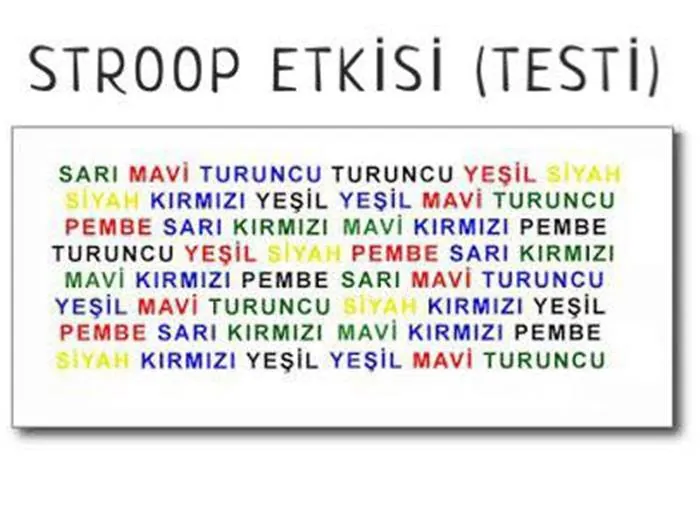
Try a quick experiment. Look at these words and say the color of the ink out loud as fast as you can: the word "blue" printed in red ink, "green" printed in yellow, "red" printed in green. You will almost certainly stumble. That hesitation, that tiny mental hiccup, is the Stroop Effect, a phenomenon where conflicting color and word information slows your reaction time. It was first demonstrated by John Ridley Stroop in 1935, and it remains one of the most revealing windows into how your brain handles competing information.
The reason your brain trips up is surprisingly simple. Reading is so deeply automatic that your mind processes the word before you can consciously override it and focus on the color. When the ink color and the word meaning clash, your brain creates a cognitive conflict that demands extra effort to resolve. This extra effort shows up as a measurable delay in your response time.
The most common version of this cognitive test is the Color/Word Test, where participants must name the ink color while ignoring the printed word. There is also a version designed for children that uses pictures of animals instead of color words, making it more accessible for younger minds. The test has become a standard tool for measuring cognitive control, attention, and processing speed, and it is used widely in both clinical and research settings.
Several theories attempt to explain why the Stroop Effect happens, but the most widely accepted one centers on speed. The brain processes linguistic information much faster than it processes color information. When both arrive at once, the faster linguistic signal wins the race and interferes with the slower color signal. Your eyes perceive both the word and the ink simultaneously, but your brain instinctively prioritizes the word because reading is more practiced and automatic than color naming. Forcing yourself to say the color instead requires deliberate, conscious effort that your brain does not enjoy making.
The Iowa Gambling Task: Can You Spot the Losing Deck?
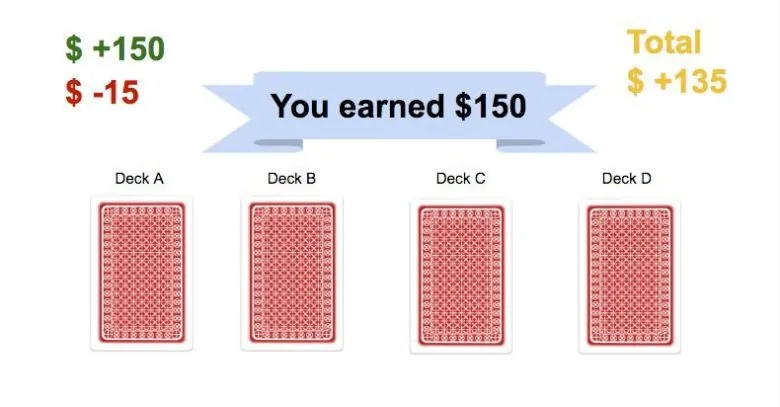
Picture yourself sitting at a table with four decks of cards spread out in front of you. Your job is simple: pick cards, win money, and try to walk away with as much as possible. What you don't know is that two of those decks are quietly bleeding you dry, and the whole game is designed to reveal something profound about how your brain makes decisions. This is the Iowa Gambling Task, a cognitive test created by Antoine Bechara.
The rules feel almost too easy at first. You see four decks labeled A, B, C, and D, and with every card you flip, you win some cash. But here's the catch: as the game moves along, some decks also hit you with losses. Your goal is to maximize your winnings while minimizing what you lose, all without knowing when the test will end. It's a strange position to be in, making choices in the dark, never sure if your next pick will be a win or a financial gut punch.
Here's what makes the task so revealing. The decks aren't equal. A couple of them offer tempting, frequent rewards, but they carry heavy penalties that stack up over time. Others give smaller, steadier payoffs that leave you better off in the long run. Most people, after taking a few hits, start gravitating toward the safer decks. Their brains quietly learn which choices pay off and which ones are traps.
But not everyone figures it out. Bechara found that people with damage to the prefrontal cortex, the brain region tied to planning and foresight, keep reaching for the losing decks even after suffering repeated losses. They simply can't anticipate future consequences. Their decisions stay stuck in the moment, chasing short-term wins while ignoring the mounting damage. It's a striking demonstration that good decision-making isn't just about intelligence, it's about having the right wiring upstairs.
The task also captured something else. People struggling with gambling addiction show a similar pattern, repeatedly choosing risky decks despite the losses. That's why the Iowa Gambling Task has become a valuable tool for studying brain injuries, addiction, and impulse control disorders. It simulates a very real dilemma: the pull of immediate reward versus the wisdom of long-term thinking. Every day, we face versions of this choice, and this deceptively simple card game reveals just how well we handle it.
The Wonderlic Test: The 12-Minute Test That Decides Your Job Interview
Some cognitive tests live in psychology labs, but the Wonderlic Test grew up in the hiring office. Named after its creator, Eldon F. Wonderlic, this exam was built for one very practical purpose: figuring out, fast, whether a job candidate has the mental firepower to handle the work.
The setup is deceptively simple. You get a sheet of questions and a strict time limit of 12 minutes. That clock is the whole point. The test measures quick thinking, analytical skills, and how well you solve problems while the pressure is on. It is not about deep, leisurely reflection. It is about whether your brain can perform on demand, the way it would need to on a busy shift or during a chaotic deadline.
Unlike standard IQ tests, which aim for a broad picture of intellectual capacity, the Wonderlic is specifically designed to assess general cognitive ability and problem-solving skills in a workplace context. Public institutions and private companies alike have leaned on it for years to quickly evaluate candidates without running them through lengthy assessment batteries.
Here is where the details get a bit murky. The original account describes the test as having 50 questions and claims the scoring runs on a 20-point scale. That second part is incorrect. The standard Wonderlic Personnel Test is scored on a 0 to 50 scale, with each correct answer adding a point to your total. If you hear someone mention a 20-point Wonderlic score, treat that number with skepticism.
What is not in dispute is the 12-minute limit, which is short enough to force candidates into rapid-fire decision-making. The questions range from math and logic to vocabulary and spatial reasoning, all mixed together to keep you off balance. Employers love it because it is fast, standardized, and gives them a rough snapshot of how a person thinks under the gun.
For the candidate sitting in that chair, the experience can feel like a sprint. You do not have time to second-guess yourself. You have to trust your instincts, move quickly, and accept that some questions will trip you up. That is exactly what the test is designed to reveal: how well you think when the clock is ticking and the stakes are real.
The PASAT: A Mental Marathon for Your Working Memory
Picture this: you are sitting in a quiet room, and a voice starts reading numbers out loud. Three seconds later, another number. Then another. Your job is to add each new number to the one that came right before it, out loud, before the next number arrives. No paper, no calculator, no pause. That is the Paced Auditory Serial Addition Test, better known by its acronym PASAT, and it was designed to measure the effects of traumatic brain injury.
The original goal was straightforward. Doctors needed a way to see how a concussion or a blow to the head affected a person's ability to think quickly and stay focused. What Gronwall created turned out to be useful far beyond that. Today, the PASAT is used to measure working memory, attention, and arithmetic ability in all kinds of settings, from clinical evaluations to research on aging.
Here is how it works. A participant hears a single-digit number at set intervals, usually every 3 seconds, though some versions speed things up to 2 or 2.4 seconds. After hearing each new number, the person must add it to the number they heard just before, not the running total. So if you hear 4, then 7, you say 11. Then if you hear 3, you say 10, because you are adding 3 to 7, not to 11. The pace keeps pushing, and there is no time to second-guess yourself.
The mental load is heavier than it sounds. You are holding the previous number in your short-term memory while simultaneously performing a quick calculation and preparing to speak. Slip for even a moment, and you fall behind. This is why the test is such an effective measure of fast information processing, short-term memory, and attention level. It forces all three systems to work together under pressure.
One of the most striking findings from years of PASAT research is that scores drop with age. Older adults consistently show slower processing and more frequent errors, which reveals the effects of cognitive decline in a very concrete way. The test captures age-related distractibility and the gradual slowing of mental speed better than many other cognitive tests. It is not just about whether you can add numbers. It is about whether your brain can keep up when the world keeps moving.
The Cognitive Reflection Test Answers: Did You Outsmart Your Gut?
The ball costs 5 kuruş. The 100 machines finish their work in 5 minutes. And the lily pad covers half the lake on day 47. Those are the three correct answers, and if you landed on all of them, you beat the odds in a meaningful way.
Psychologist Shane Frederick designed these three questions in 2005 as part of his Cognitive Reflection Test, a tool that measures whether people override their first instinct and actually think things through. The test is short, but it reveals something surprisingly deep about how your mind operates.
Let's walk through each one, because the math is genuinely elegant once you see it.
Question 1: The bat and the ball
If a racket and a ball together cost 1.10 lira, and the racket costs 1 lira more than the ball, what does the ball cost? Your gut probably shouted "10 kuruş!" That is the most common wrong answer, and here is why it fails. If the ball cost 10 kuruş, the racket would cost 1.10 lira, and together they would add up to 1.20 lira, not 1.10.
The correct approach starts by calling the ball's price x. The racket costs x + 1. Add them together and you get 2x + 1 = 1.1. Solve for x and you find x = 0.05, meaning the ball costs 5 kuruş and the racket costs 1.05 lira. The trap is that your brain wants to subtract 1 from 1.10 and call it done, but that shortcut skips a step.
Question 2: The machines
Five machines produce five products in five minutes. How long would 100 machines take to produce 100 products? The reflexive answer is 100 minutes, but that assumes the machines get slower as you add more of them, which makes no sense.
Think about it this way. If five machines make five products in five minutes, then each machine makes one product in five minutes. Add 95 more machines and they all work in parallel. So 100 machines still produce 100 products in exactly 5 minutes. The number of machines and products both scale together, which means the time stays put.
Question 3: The lily pad
A lily pad doubles in size every day. If it covers the entire lake at the end of day 48, when did it cover half? The tempting answer is 24 days, because half of 48 sounds right. But the lily pad does not grow linearly. It doubles, which means it was half the lake's size one day before it covered everything.
So the answer is day 47. On day 48 it doubles from half to full. The question is designed to punish anyone who treats exponential growth like simple division.
Here is the uncomfortable part. According to Frederick's research, roughly 83% of people get at least one of these three questions wrong. The commonly cited figure is that about one-third miss all three, though the exact proportion varies across studies and is not consistently replicated. But the pattern holds: most people trust their gut, and their gut leads them astray.
These cognitive tests are not about intelligence in the traditional sense. They measure something closer to intellectual humility, the willingness to pause, question your first answer, and check your work. The people who ace the Cognitive Reflection Test are not necessarily smarter. They are just more comfortable with the discomfort of not knowing immediately.
Frequently asked questions
What is the Cognitive Reflection Test and what does it measure?
The Cognitive Reflection Test, created by psychologist Shane Frederick in 2005, measures whether you rely on intuition or pause to analyze before acting. It presents three seemingly simple questions that each have an obvious but incorrect answer. The test reveals how willing you are to override your gut reaction and think more carefully, a skill that connects to broader decision-making patterns. Frederick designed the test to expose the gap between fast, automatic thinking and slower, deliberate reasoning. The questions look easy at first glance, yet they trip up plenty of people. According to the original research, a large portion of respondents get at least one question wrong, which says a lot about how quickly we jump to conclusions.
Why is the Stroop test difficult and what does it reveal about the brain?
The Stroop test is difficult because your brain automatically reads words faster than it processes color, creating a cognitive conflict that slows your reaction time. When you see the word "red" written in blue ink, your brain wants to say "red" even though the correct answer is "blue." This clash reveals how automatic reading has become and measures your cognitive control and attention. First demonstrated by John Ridley Stroop in 1935, the effect shows that reading is so deeply ingrained that it happens whether you want it to or not. Naming the color requires conscious effort to override an automatic process. The delay you experience is not a failure on your part, it is your brain doing exactly what years of reading practice have trained it to do.
How does the Iowa Gambling Task assess decision making?
The Iowa Gambling Task simulates real-world decisions where short-term gains can become long-term losses. Players choose cards from four decks labeled A, B, C, and D, earning money with each pick but also facing occasional penalties. The task reveals how well you anticipate long-term consequences rather than chasing immediate rewards. Designed by Antoine Bechara in the 1990s, the test mirrors everyday situations where quick wins look attractive but lead to bigger losses down the road. Most people start avoiding the risky decks after taking a few hits. However, individuals with damage to the prefrontal cortex reportedly struggle to learn this pattern and keep choosing disadvantageous decks even after repeated losses. The test has become a valuable tool for studying addiction and impulse control disorders.
What is the Wonderlic test and how is it used in hiring?
The Wonderlic test is a 12-minute, 50-question cognitive ability assessment that employers use to quickly evaluate a candidate's problem-solving and analytical skills under pressure. Named after its creator Eldon F. Wonderlic, the test measures how well someone thinks on their feet when time is limited. It is scored out of 50 points, not 20 as some sources claim. Public agencies and private companies alike use the Wonderlic to screen applicants efficiently. The tight time limit forces test-takers to work fast, which gives employers a sense of how candidates perform when stakes are high. The questions cover verbal reasoning, math, and logic, offering a broad snapshot of general mental ability in a very short window.
What does the PASAT test measure and why is it used?
The Paced Auditory Serial Addition Test measures working memory, attention, and arithmetic ability by having participants add the last two numbers they hear at set intervals. Originally designed to assess the effects of traumatic brain injury, the test requires you to hold a number in mind while simultaneously adding a new one. This dual demand makes it a sensitive measure of cognitive processing speed. During the test, you hear a single-digit number every few seconds, sometimes every 2 or 2.4 seconds depending on the version, and you must add it to the number you heard just before. The task sounds simple but becomes mentally exhausting quickly. Scores tend to decline with age, which makes the PASAT useful for tracking cognitive changes over time and for evaluating patients recovering from head injuries.
How can I test my own cognitive abilities at home?
You can test your own cognitive abilities at home using the Cognitive Reflection Test questions from this article. Grab a piece of paper, write down your first answers, then check them against the correct responses at the end of this section. You can also try the Stroop test by writing color words in mismatched ink colors and naming the ink color out loud as fast as you can. For the Cognitive Reflection Test, the correct answers are 5 kuruş for the ball, 5 minutes for 100 machines, and 47 days for the lily pad. If you got all three right, you are in a minority. If you got some wrong, do not worry, the questions are designed to trick you. The point is not to grade yourself harshly but to notice how your mind works when faced with a tempting but incorrect answer. Editorial note: Any facts within this article that remain unconfirmed are presented as such, with hedged language, so readers can distinguish verified findings from ongoing research.
Got a take on this? Add your voice to the conversation below →
No comments yet. Be the first.