Trajan's Market: Rome's Ancient Shopping Mall
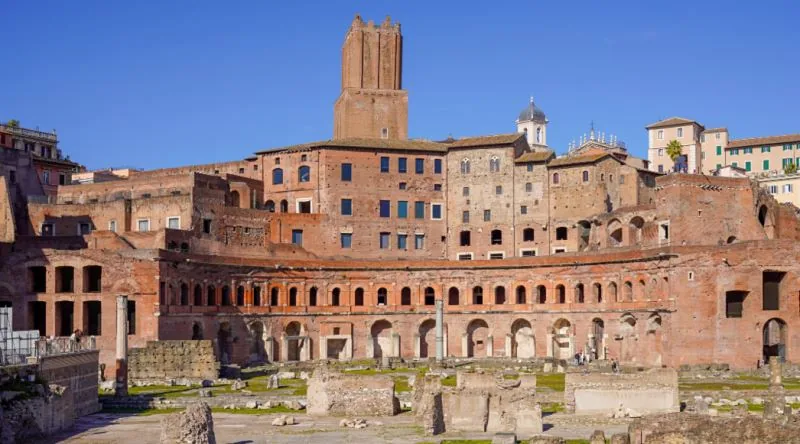
Trajan's Market in Rome, built in AD 113 by Emperor Trajan, is often called the world's first shopping mall, and this ancient complex of shops and offices still stands today near the Roman Forum. Standing before its weathered brick facades, you can almost hear the bustle of Roman merchants hawking wine, olive oil, and spices, a vibrant commercial heartbeat that has echoed through nearly two millennia. Trajan's Market remains one of the most extraordinary testaments to Roman engineering, a multi-level marvel that transformed how we understand ancient urban life.
Trajan's Market is a massive ancient Roman commercial complex built in AD 113 under Emperor Trajan in central Rome. It featured six terraced levels with shops and offices. Today it houses the Museum of the Imperial Forums and remains open to visitors.
- Emperor Trajan commissioned Trajan's Market in AD 113 as part of his grand Forum complex in central Rome.
- The market's six terraced levels were carved into the Quirinal Hill, creating a striking semi-circular structure that still dominates the neighborhood.
- Dozens of individual shop units lined the market's corridors and main hall, selling everything from fresh produce to luxury goods.
- In the medieval period, the complex was repurposed as a fortress, with the Torre delle Milizie tower added to its defensive structure.
- Today, the site houses the Museum of the Imperial Forums, displaying architectural fragments and sculptures from Rome's imperial era.
A Shopping Center Built by an Emperor
Before the escalators, the food courts, and the endless corridors of glass and steel, there was Trajan's Market, a sprawling complex of shops and offices carved into the slopes of Rome's Quirinal Hill in AD 113. It wasn't a modern mall with anchor stores and parking garages, but it was something the ancient world had never seen before. The man behind it was Emperor Trajan, who ruled Rome from AD 98 to 117.
Trajan wasn't content with just being another emperor. He wanted to leave a mark that would outlast him, a monument that would make people whisper his name for centuries. So he dreamed big, commissioning a structure that would do double duty: a place where the city's traders could sell their goods to the masses, and a grand public forum that would cement his legacy. The result, dedicated in AD 113 as part of the larger Forum of Trajan, was a marvel of Roman engineering and ambition.
Think of it this way: when you walk through a mall today, you're stepping into a world of curated experiences and climate-controlled comfort. In Trajan's time, the market was a living, breathing organism, a terraced complex of six different levels that climbed the hillside, connected by streets and stairways that let Romans move with ease. It was a bold statement, a declaration that Rome was the center of the world, and its emperor was the one who could make such wonders real.
Six Levels of Ancient Retail and Administration
Trajan's Market was organized into two main sections, upper and lower, that together created six distinct terraced levels carved into the Quirinal Hill in Rome. The complex, dedicated in AD 113 during the reign of Emperor Trajan (who ruled from AD 98 to 117), was engineered so that bureaucracy sat above while commerce thrived below.
The upper levels carried the administrative weight of the operation. Offices where the market was managed occupied these spaces, along with warehouses for storing goods and even apartment complexes where people lived. These upper terraces sat close to a street called Via Biberatica, a name that comes from the Latin word "bibere," meaning "to drink." The location hints that shops along that road may have served refreshments to shoppers passing through.
The lower levels belonged to trade. Here, merchants sold products brought from the farthest corners of the Roman Empire, goods that had traveled hundreds of miles to reach these stone shelves. The complex was laced with streets and staircases that connected every level, so Romans could move from the busy retail floors below to the administrative offices above without trouble.
According to the original account, the market reportedly served for about two centuries as a shopping center, office space, apartment complex, and social meeting place, though the precise duration of each use is not firmly documented. What is certain is that the six levels were built to handle many functions at once, a layered solution to the needs of a bustling imperial capital.
The Street of Drinks and Daily Life
High above the busiest trading floors of Trajan's Market ran a cobbled lane with a name that tells its own story: Via Biberatica. The name comes straight from the Latin bibere, meaning "to drink," and the street almost certainly hosted shops where shoppers could pause for a cup of something refreshing between purchases. The very stones beneath your feet would have been worn smooth by sandals heading toward that promise of a cool drink.
You can picture the scene: a Roman housewife emerging from a spice shop, a merchant wiping dust from his tunic, both drawn by the scent of watered wine or a herbal infusion. The placement was no accident. The upper levels of the complex housed the offices where the market was managed, along with storage warehouses and even apartment blocks. A drinking street positioned right there meant that business and pleasure could share the same few steps.
Trajan's Market was never just one thing. According to the original account, for roughly two centuries it served as a shopping center, office space, apartment complex, and social meeting place all at once. That mix of uses is part of what makes the site feel so alive even now, nearly two thousand years after Emperor Trajan, who ruled Rome from AD 98 to 117, dedicated the complex in AD 113. The six terraced levels were connected by streets and stairways, so a shopper could move from a ground-floor stall selling goods from the far corners of the empire up to an administrative office without ever stepping outside.
From Medieval Fortress to Modern Museum
By the 12th and 13th centuries, the great market complex had taken on a very different role, when the Torre delle Milizie tower was added and the whole site became part of a medieval fortress. The centuries of commerce and administration had come to an end, and the ancient stonework found itself wrapped into the defensive architecture of a very different Rome.
The tower, which still leans slightly today, was built in the late 1100s and became a key piece of the fortified neighborhood that grew up around the old imperial structures. For centuries after that, the site sat largely forgotten, its layers of history buried under rubble and later construction.
The first proper excavation of the complex finally came in the 1920s and 1930s, when archaeologists began peeling back the centuries of dirt to reveal what had been hiding underneath. What emerged was so impressive that the site quickly took on the name Trajan's Market, and it became clear just how monumental the original design had been.
Today, the complex has found yet another purpose. Since 2007, it has been home to the Museum of the Imperial Forums, where visitors can walk through the ancient halls and see artifacts from the other imperial forums of Rome. The old market now draws tourists from around the world who come to marvel at Roman engineering and stand in the same spaces where merchants once sold their goods.
Frequently asked questions
What was Trajan's Market used for?
Trajan's Market was a bustling multi-purpose complex in ancient Rome, functioning as offices, shops, and even apartments. It served as a social and commercial hub where Romans could shop, conduct business, and gather. The lower levels were dedicated to trade, while the upper floors housed administrative offices and storage spaces.
Who built Trajan's Market and when?
Emperor Trajan, who ruled Rome from AD 98 to 117, commissioned the complex, and it was completed in AD 113. He envisioned a grand structure that would serve both as a social forum and a marketplace. The project was part of his larger Forum of Trajan, a monumental architectural achievement in the heart of the city.
How many levels did Trajan's Market have?
Trajan's Market consisted of six distinct terraced levels, arranged in two main sections. The upper portion was designed for administrative functions, while the lower part was set aside for commerce. Streets and staircases connected each level, allowing Romans to move easily through the entire complex.
Why is Trajan's Market considered the first shopping mall?
The label "first shopping mall" is a popular modern comparison, though scholars do not universally endorse it. The multi-level retail layout, combined with administrative offices and social spaces, does resemble today's malls. But according to the original account, it was more accurately a versatile urban center than a mall in the contemporary sense.
What is the Museum of the Imperial Forums?
The Museum of the Imperial Forums is a museum housed within Trajan's Market since 2007. It showcases artifacts and architectural fragments from the Imperial Forums, offering visitors a closer look at ancient Rome's civic grandeur. The museum occupies the very spaces where merchants and officials once conducted their daily business.
Did Trajan's Market become a fortress?
Yes, in the 12th and 13th centuries, the complex was incorporated into a medieval fortress with the addition of the Torre delle Milizie, a large tower. This transformation repurposed the ancient market for defensive purposes. The tower still stands today as a striking reminder of the site's layered history.
Where is Trajan's Market located?
Trajan's Market sits in the heart of ancient Rome, as part of the Forum of Trajan. It is nestled between the Quirinal and Capitoline hills, near the modern Via dei Fori Imperiali. The location placed it at the center of imperial power and public life.
What is the Via Biberatica?
The Via Biberatica is a street within the Trajan's Market complex, named after the Latin word "bibere," meaning "to drink." The name suggests that beverage shops once lined this thoroughfare. It likely served thirsty shoppers with drinks as they navigated the bustling market levels.
Got a take on this? Add your voice to the conversation below →
No comments yet. Be the first.