Roman Sumptuary Laws: Rome's Failed War on Luxury
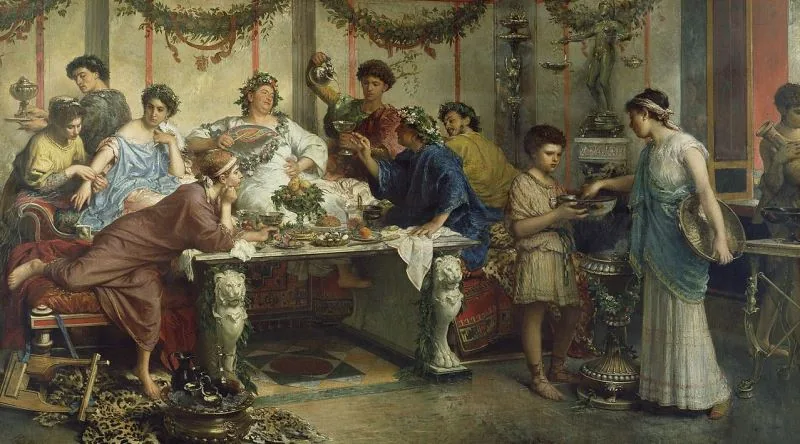
The Roman sumptuary laws were a centuries-long attempt by the Roman state, beginning in earnest around 215 BCE, to cap private luxury, defend traditional morals, and slow the flow of gold and silver to the East. Senators argued over dinner tables and dyed cloth while the empire's richest citizens quietly ignored the rules. The real story is not one of successful restraint. It is about how hard it is to make people stop wanting what they want, and how often the lawmakers were the first to break their own rules.
Roman sumptuary laws were a series of restrictions, from the Lex Oppia of 215 BCE through Diocletian's price edict of 301 CE, that limited spending on banquets, clothing, and luxury goods. They aimed to protect morals and the treasury, but enforcement was weak, loopholes were common, and emperors often violated their own rules.
- The Lex Oppia, passed in 215 BCE during the Second Punic War, restricted women's gold, purple garments, and public display of wealth.
- The Lex Fannia of roughly 161 BCE set spending ceilings on banquets and limited the number of guests at private dinners.
- Purple dye from the murex snail was so costly that it became a symbol of imperial status and was eventually reserved for the emperor's use.
- Diocletian's price edict of 301 CE fixed maximum prices for goods and services across the empire, including luxury textiles and spices.
- Roman authors such as Cato the Elder and Pliny the Elder complained that luxury imports drained Rome's wealth toward the East.
Rome's War on Luxury: Why Roman Sumptuary Laws Existed
Picture a government office with a scale and a ledger, and a citizen standing in front of it while an inspector weighs the gold on her arm. That image is not a modern fantasy. It is roughly how Rome tried to police excess, and it is why these luxury laws existed in the first place.
These rules began in the Republic and carried on through the Empire. Their stated aims were straightforward: protect public morals, keep the class order intact, and guard the state's economic resources. The trigger was conquest. As Rome's armies swept across the Mediterranean, gold, silver, silk, pearls and exotic goods poured into the city, and the old frugal habits of the early Republic could not keep pace with the flood of wealth. The laws were an attempt to rein in the extravagance that arrived with the spoils.
Underneath all of it sat a moral theory. Luxury was believed to breed greed, and greed was believed to breed corruption. Spend too freely on oysters and purple cloth, the thinking went, and soon you would be spending freely on votes and officials. The state was not just worried about your wallet. It was worried about your character.
So the laws piled up, one after another, each trying to patch the hole the last one left. And they were broken constantly. The people who broke them most often were the very people who wrote them: Rome's ruling class, and on occasion the emperor himself. A law that forbids everyone else's banquet looks very different when you are the one hosting it.
That tension runs through the whole story. A state tried to legislate what people could eat, wear and spend, and a ruling elite kept finding reasons why the rules did not apply to them.
The Lex Oppia of 215 BCE: When Rome Told Women What They Could Wear
The Lex Oppia was a Roman sumptuary law passed in 215 BCE, in the middle of the Second Punic War, when Rome's treasury was running on fumes. It capped how much gold a woman could wear, banned colored clothing, and kept her off carriages inside the city. The logic was simple and cold: pull gold toward the war effort and push everyone toward plainer living.
Picture the Rome that wrote this law. Hannibal is still loose in Italy, the legions are bleeding men and money, and the state is hunting for every last coin it can find. So the Senate turns to the jewelry boxes. Under the Lex Oppia, a woman could display no more than half an ounce of gold on her person. Colored garments were out, and the target was blunt: purple above all, the *purpura* that had become the loudest badge of wealth a household could flaunt. Carriages were forbidden within the city walls too, which meant the wealthy matron who once rolled through the streets now walked them like everyone else.
The moral packaging came free with the economics. Luxury was treated as a gateway to greed, and greed as the door to corruption, so dressing plainly was framed as a civic virtue. Restraint, in other words, was sold as patriotism.
Then the war ended, and Carthage's wealth began draining into Rome. The law stayed. That was the problem. What had felt like shared sacrifice in a crisis now looked like a leash, and the women it bound felt it tighten every time a fortune arrived from abroad and they were still told to keep their gold in the chest.
In 195 BCE the resentment broke into the open. Roman women massed in the streets to demand the Lex Oppia's repeal, a rare recorded instance of a mass protest led by women in the ancient world. Livy follows the whole fight in his history of Rome, and the law was ultimately repealed. The earliest and most contested of these luxury laws ended not in a courtroom but in the street, under the weight of women who had decided they were done being told what to wear.
Banquet Laws: Lex Orchia, Lex Fannia and Lex Didia
Picture a Roman election season and the smell of roast boar drifting out of a senator's courtyard. Votes were not won with speeches alone. Lavish feasts did the work, and so did plain bribery, the handing over of wine, oil or money to voters, a practice the Romans called ambitus. The first banquet law tried to cut off the food supply of that corruption.
Around 182 BCE, a measure given as the Lex Orchia banned giving banquets to more than a certain number of guests, and the link to curbing ambitus is an inference from fragmentary sources rather than a settled fact.
Then came the loophole. The earlier rule exempted family members, so a host simply declared his hundred closest friends his family and carried on. The Lex Fannia of 161 BCE closed that door by abandoning headcounts altogether and capping spending instead. Ordinary days were limited to 10 asses, holidays to 30 asses, and weddings to 100 asses, the as being a small Roman coin. Certain luxury foods were banned outright: oysters, imported fish and birds' tongues. Whether the Lex Fannia applied only within Rome is uncertain.
Rome's newly rich did not sit still. Oysters in Capua, musicians and entertainers in Pompeii, and in 143 BCE the Lex Didia reportedly extended the Fannia rules to all of Italy. According to the original account, it also paid informers, the delatores, a quarter of the confiscated goods, though the exact date and that reward figure rest on fragmentary testimony. What followed was a surveillance network: slaves walked the markets, seized any expensive fish they spotted, and the owner was reported to the Senate.
Purple, Silk and the Price of Status
Two luxuries carried the heaviest weight under the old statutes: purple dye and silk. Purple was the color of rank itself. Only the emperor could wear full purple, senators wore a narrow purple stripe, and equestrians a narrower one still. Silk, meanwhile, came from China, and Rome's silver and gold reserves were draining at alarming speed to pay for it.
Tyrian purple, also called Phoenician purple, was staggeringly expensive to make. According to the original account, a single gram demanded roughly 12,000 snails, which is why the dye often cost far more than gold. That snail figure is a modern estimate, and the gold comparison is loose, so treat both as colorful approximations rather than hard prices. What is certain is the class-coding: the color itself became a badge of who you were.
The Lex Aemilia of 115 BCE reportedly went after sweets, incense and imported wine, and set a maximum pretium, a ceiling price, on some goods. As the story goes, it even capped the price of asparagus. The specific provisions survive only in fragmentary and late testimony, so the details are contested. What the source frames as the harshest targets were purple dye and silk.
Under Tiberius, men were reportedly banned from wearing silk as "effeminate and immoral." The decree is reported in moralizing terms, and its precise legal form is uncertain. Still, the panic behind it was economic: silk flowed in from China, and the outflow of Roman silver and gold was the real worry.
A color and a fabric, and suddenly the whole social order was stitched into what you could legally wear.
The Lex Julia and the Emperors Who Broke Their Own Rules
Julius Caesar pushed through his Lex Julia on luxury spending in 46 BCE, and the provisions usually attached to it, a ban on expensive furniture, pearls and perfume, are reported by Suetonius but not securely attested. What the record does make clear is the irony: the man who signed the law was the first to walk past it.
Here is the pattern that makes these rules so human. They were written in Rome, but the man who wrote them was not always in Rome. According to the original account, while Caesar was away from the city, everyone simply broke the law. No inspectors, no fines, no shame. You can almost picture the dining rooms: citrus-wood tables polished to a mirror, pearls on every throat, scent hanging in the air, and a law sitting somewhere back in the capital gathering dust.
The pearl story, handled with care
Legend has it that Caesar, while dallying with Cleopatra in Egypt, was handed a pearl valued at 6 million sesterces. Treat that number gently. The famous pearl anecdote is usually tied to Mark Antony rather than Caesar, and the value is not reliably fixed. The story travels; the receipt does not.
One correction worth making, because a garbled version of it circulates widely: a Roman soldier did not earn about 1 sestertius a day. Under Augustus, a legionary's annual stipend came to roughly 900 sesterces, which works out to about 2.5 per day. So a single pearl at the legendary 6 million would have represented a fortune beyond any soldier's lifetime of pay, which is precisely why the anecdote kept being told.
The first century CE brought more of the same theater. Augustus and Tiberius both presided over measures touching silk and purple, though a clean paired policy on the two is a loose summary rather than one securely attested law. The pattern held: stern pronouncement, then quiet indulgence. These laws were never really about cloth or perfume. They were about who got to decide how a Roman should live, and whether the person deciding intended to obey.
Diocletian's Price Edict of 301 CE and the End of the Experiment
In 301 CE, the emperor Diocletian issued the Edictum de Pretiis Rerum Venalium, a sweeping decree that fixed maximum prices on goods across the Roman world. It was the boldest attempt yet to command the economy by decree, and it did not work. The edict is the last great chapter in the long story of Rome's luxury laws.
By the turn of the fourth century, the economy had come badly unstuck. Coins were losing their silver, prices were climbing, and the old moral machinery of restraint no longer had much grip on daily life. Diocletian's answer was the same instinct that had driven the lawmakers before him, only now scaled to the whole empire: put a ceiling on what things could cost and trust the ceiling to hold.
The edict set maximum prices for a vast range of goods and services. It failed, much as the earlier caps on luxury had failed, and the Roman economy kept sliding.
Here is where the story needs a careful hand. It is tempting to draw a straight line from the price edict to Rome's collapse and division, and that line is often drawn. Historians generally treat the edict, and the sumptuary laws that came before it, as symptoms of fiscal stress rather than the primary cause of Rome's decline. The laws are a fever chart, not the disease.
What the edict shares with everything that came before is the same stubborn faith: that a decree can talk people out of wanting what they want. The Lex Oppia tried it with gold and purple. The banquet laws tried it with oysters and birds' tongues. Diocletian tried it with the entire price list. Each time, the market found a way around the rule.
And so the experiment ends where it began, with a law and a loophole. For all the statutes and all the ceilings, purple remained a great deal of trouble in ancient Rome.
Frequently asked questions
What were the Roman sumptuary laws and why were they created?
Roman sumptuary laws were a long series of spending and dress restrictions that began in the Republic and continued under the emperors. Lawmakers aimed them at three targets: public morals, the social hierarchy, and the state's economic resources. The trigger was conquest. Gold, silver, silk, pearls and exotic goods poured into Rome, and the ruling class wanted to rein in the showy excess that came with it.
Why did Roman women protest the Lex Oppia in 195 BCE?
The Lex Oppia, passed in 215 BCE during the Second Punic War, had banned women from wearing more than half an ounce of gold, from colored clothing (especially purple), and from riding carriages inside the city. Once the war ended and Carthage's wealth began flowing into Rome, women resented the restrictions. In 195 BCE they massed in the streets to demand repeal, and the law was struck down.
How did the Lex Fannia try to limit banquet spending?
The Lex Fannia of 161 BCE capped banquet outlay at 10 asses on ordinary days, 30 on holidays, and 100 at weddings. It also banned luxury foods outright, including oysters, imported fish and birds' tongues. The earlier Lex Orchia had limited guest numbers, and hosts simply claimed everyone at the table was family, so the Fannia shifted the target from headcount to the bill.
Why was Tyrian purple so expensive?
Tyrian purple, the dye tied to the Phoenician city of Tyre, was extracted from sea snails in tiny quantities. A modern estimate puts the requirement at roughly 12,000 snails per gram of dye, and the common claim that it cost more than gold is an imprecise generalization rather than a fixed price. The cost is why full purple became reserved for the emperor, with senators wearing a broad stripe and equestrians a narrower one.
Did Julius Caesar ban pearls and perfume?
Caesar did pass sumptuary legislation, the Lex Julia of 46 BCE, and it is reportedly the measure that targeted expensive furniture, pearls and perfume. The precise provisions are not securely attested, and the story that Romans ignored the ban while Caesar was away in Egypt rests on later anecdote rather than firm record.
How did Diocletian's price edict of 301 CE try to fix the Roman economy?
In 301 CE Emperor Diocletian issued the Edictum de Pretiis Rerum Venalium, which set maximum prices and wages across a vast range of goods and services. It was a last-resort attempt to steady a badly strained economy, and it failed. Historians generally read the edict, like the sumptuary laws before it, as a symptom of fiscal stress rather than a cause of Rome's decline.
Why did Roman sumptuary laws repeatedly fail?
The pattern is consistent: elites found ways around every rule. Hosts reclassified guests as family to dodge the Lex Orchia, and later laws leaned on informers, the delatores, who were reportedly rewarded with a quarter of confiscated goods under the Lex Didia of 143 BCE. Emperors themselves broke the spirit of their own rules, and a lawgiver who preaches restraint while indulging privately is a hard sell. Editorial note: Details that remain unconfirmed, including exact dates of some laws and the full scope of their enforcement, are presented here as uncertain rather than settled fact.
Got a take on this? Add your voice to the conversation below →
No comments yet. Be the first.