Roman Republic Social Classes: The Hidden Hierarchy of Power
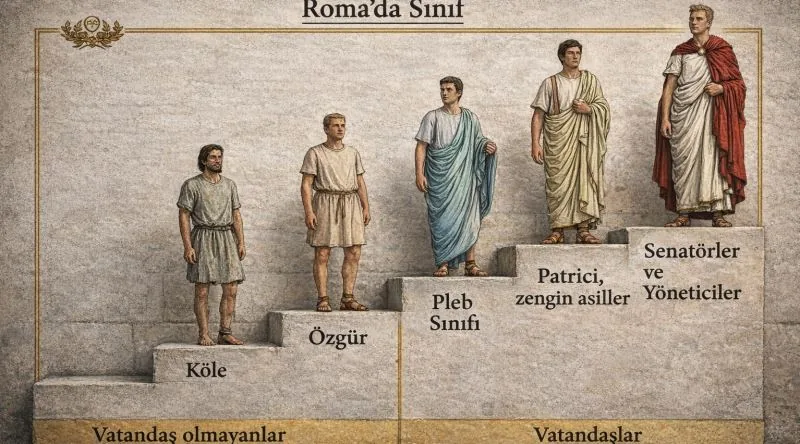
The Roman Republic social classes, from the patrician elite to the enslaved masses, formed a rigid hierarchy that determined political power and economic survival in ancient Rome between 509 BC and 27 BC. Beneath the proud facade of citizen equality and republican voting, a hidden ladder of birth, wealth, and legal status quietly decided who could rule, who could profit, and who could be bought or sold. This is the story of that ladder, and of the men and women who climbed it, clung to it, or were crushed beneath it.
The Roman Republic social classes were a layered system of birth, wealth, and legal status. Patricians held early political monopoly, plebeians fought for and won representation, the equites built commercial empires, and slaves, with no rights at all, fueled the economy until revolts like Spartacus shook the state.
- Patricians, the hereditary aristocracy, dominated the early Republic's magistracies and priesthoods from 509 BC onward.
- Plebeians, the common citizen majority, secured the Tribunate and written laws through the Conflict of the Orders, which concluded around 287 BC.
- The equites, or Roman knights, amassed wealth through tax farming and trade, becoming a distinct economic class by the second century BC.
- The nobilitas, a ruling elite of former consuls and their descendants, controlled the Senate and high office throughout the middle Republic.
- Slaves, with no legal personhood, formed a vast labor force, and Spartacus led a major uprising against their condition in 73 BC.
The Illusion of Equality: How the Roman Republic Really Worked
The Roman Republic talked a beautiful game about shared civic life and legal equality, but the reality on the ground was something else entirely. The Roman Republic social classes formed a steep pyramid, with political power, wealth, and social prestige concentrated in the hands of a few hereditary families. This hierarchy didn't just exist; it was passed down from generation to generation, shaping everything from who could run for office to who got to eat.
Walk through the Roman Forum in 300 BC and you'd see the machinery of a republic humming along. Assemblies met, magistrates gave speeches, and citizens cast votes. It all looked remarkably fair on paper. But scratch that surface and you'd find a system engineered to keep the same elite families in charge, decade after decade, century after century.
The founding story sets the stage. According to the traditional account, which modern historians treat with caution, in 509 BC the last king of Rome, Tarquinius Superbus, was driven from the city, and the monarchy came to an end. You might think that would open things up, but the opposite happened. The power that once belonged to a single king simply shifted to a circle of aristocratic families who controlled the new republic's highest offices. The patricians, who claimed noble ancestry, treated political and religious positions as their birthright. The plebeians, the vast majority of the population, found themselves locked out of most of these roles from the start.
This wasn't just a status squabble. It was a fight over the very boundaries of political participation, and it defined the republic's first century. The tension between these two groups produced some of Rome's most important institutions, including the office of the tribune of the plebs, created after the plebeians literally walked out of the city in 494 BC and refused to serve in the army. The patricians had no choice but to negotiate.
Over time, the old patrician-plebeian divide softened, at least legally. The Twelve Tables, Rome's first written law code, appeared between 451 and 450 BC, though the surviving text is a later reconstruction. The Licinio-Sextian laws, traditionally dated to 367 BC, opened the consulship to plebeians. And in 287 BC, the Lex Hortensia made decisions of the plebeian assembly binding on all Roman citizens, though scholars debate the exact date and scope. On paper, the gap had closed.
But here's where the story gets interesting. What actually emerged from this long struggle wasn't equality. It was a new kind of elite. The old patrician families merged with wealthy plebeian families who had climbed the political ladder, creating a new ruling class called the nobilitas. The labels changed, but the machinery of power kept grinding in the same old grooves. Power remained concentrated among a small circle of families who passed their advantages down through the generations, and the republic's famous institutions kept functioning while a handful of interconnected clans pulled the strings.
From Kings to Conflict: The Birth of Class Struggle (509, 287 BC)
The Roman Republic didn't begin as a democracy, and it didn't begin peacefully. According to the traditional account, in 509 BC the last king of Rome, Tarquinius Superbus, was driven from the city, and in the power vacuum that followed, a bitter struggle erupted between two groups that would shape Roman politics for the next two centuries: the patricians and the plebeians.
Tarquinius Superbus was the seventh and final king of Rome, a tyrant whose expulsion marked the traditional founding date of the Republic. But the patricians, the aristocratic families who claimed descent from Rome's earliest founders, didn't intend to share their newly won power. They controlled the consulship, the highest office in the land, and they controlled it exclusively. The plebeians, the common citizens who made up the bulk of the population and the army, found themselves locked out of political life entirely, while also bearing the heaviest burdens of debt and military service.
The tension finally boiled over in 494 BC with the First Secessio Plebis. The plebeians walked out of Rome entirely, withdrawing to the Mons Sacer, the Sacred Mountain, and refusing to serve in the army. This was a genuine crisis; Rome's military depended on plebeian soldiers. The patricians had no choice but to negotiate. The result was the creation of the tribune of the plebs, a new office that gave plebeians a champion with the power to veto senatorial decisions and protect ordinary citizens from the abuses of magistrates.
The struggle didn't end there. Between 451 and 450 BC, the Twelve Tables were compiled, Rome's first written law code, though the surviving text is a later reconstruction. Before this, law was unwritten and could be interpreted arbitrarily by patrician judges. Putting the laws in writing was a genuine victory for the plebeians, a check on the capricious exercise of power. Yet it was only a step, not a destination.
The next major milestone came in 367 BC with the Licinio-Sextian laws, though details are debated. These reforms opened the consulship to plebeians, meaning a commoner could theoretically reach the highest office in the Republic. It was a dramatic shift in the political structure. But here's where the story gets complicated: in practice, these new opportunities didn't spread power widely. They simply changed who held it.
The final chapter of this early struggle came in 287 BC with the Lex Hortensia, though the exact date and scope are debated. This law made plebiscites, decisions made by the plebeian assembly, binding on all Roman citizens, patricians included. On paper, the patrician-plebeian distinction had been largely erased. Legal equality had been achieved.
But look closer at what actually happened, and a different picture emerges. The old aristocratic privileges weakened, yes, but political power didn't flow to the masses. Instead, a new elite formed from the fusion of patrician and plebeian noble families. This was the nobilitas, a ruling class defined not by birth alone but by having ancestors who had held high office. The legal victories of the plebeians didn't produce equality; they produced a transformation. The aristocracy simply changed its face, and the Roman Republic social classes rearranged themselves into a new hierarchy that would dominate the centuries to come.
Gentes and Patronage: The Clan Machinery Behind Roman Elections
Long before the Forum echoed with the speeches of Cicero, Roman society was organized around something far more intimate than political parties: the gens, or clan. These extended kinship groups, including the Cornelii, Claudii, Aemilii, Fabii, Valerii, and Julii, were not merely family trees but concentrated centers of political power. And the way they wielded that power, through a system of patronage and weighted voting, made a mockery of the idea that Roman elections were a genuine contest of ideas or individual merit.
The machinery of this rigged system was traditionally attributed to King Servius Tullius in the 6th century BC, though his historicity is debated. He reorganized Roman citizens not by birth but by wealth, tying military service and political rights directly to property. This created the Comitia Centuriata, the assembly responsible for electing the highest officials: consuls, praetors, and censors. But here was the twist: citizens were divided into groups called centuriae, and each group cast a single vote. The wealthiest classes had the most centuriae, so they controlled the majority of votes. To make matters worse, the rich voted first, and voting often stopped as soon as a majority was reached, meaning the poorer classes frequently never even got to cast their ballots.
Two other assemblies existed, though they dealt with lesser offices. The Comitia Tributa elected lower magistrates like quaestors, while the Concilium Plebis, the plebeian council, chose tribunes and plebeian aediles. But even these were not simple democratic exercises. The real lever of power was patronage. An aristocrat did not stand alone; he stood at the center of a web of clientes, dependents who owed him loyalty and support in exchange for protection, legal help, and financial assistance. On election day, a candidate's clients would flood the Forum, creating an imposing show of strength that could intimidate rivals and sway undecided voters.
The Cornelii Scipiones, a family that produced some of Rome's greatest generals, exemplified this strategy. Their military victories were certainly impressive, but their sustained dominance in politics owed as much to their extensive client networks as to their battlefield prowess. Later, in the 1st century BC, figures like Pompey and Julius Caesar would expand this model dramatically. Pompey cultivated relationships in the eastern provinces, building a power base far beyond the city walls. Caesar, ever the innovator, blended his aristocratic lineage with direct appeals to the urban masses, creating a more flexible and volatile form of political power. The old clan system, once a closed circle of blood relatives, had evolved into a sprawling machine of influence that could make or break any political career.
Nobilitas: The New Aristocracy That Replaced the Old
By the middle of the third century BC, the old battle lines between patricians and plebeians had blurred into something far more subtle and, in its own way, more powerful. The winner was not the Roman people, but a new kind of elite known as the nobilitas, a flexible yet tightly guarded circle defined by one simple question: had your ancestors been consuls?
This was the quiet revolution of the Roman Republic social classes. The Licinio-Sextian laws of 367 BC had formally opened the consulship to plebeians, and the Lex Hortensia of 287 BC had made plebiscites binding on all citizens. But these legal victories did not spread power across the Forum. Instead, they allowed ambitious plebeian families to merge with the old patrician clans, creating a new aristocracy that was technically open to talent yet practically closed to almost everyone else.
The great patrician houses, the gentes maiores, kept their place at the center of this system. The Aemilii, Claudii, Cornelii, Fabii, Manlii, and Valerii had been powerful since the early Republic, and they remained so through the centuries of expansion. But alongside them rose plebeian families who had climbed the political ladder and earned their place in the elite: the Caecilii, the Metelli, the Sempronii, the Licinii, the Domitii, and, at times, the Livii. These families intermarried with the patricians, traded favors, and built the dense web of alliances that would dominate Roman politics for generations.
Perhaps no family embodied this new aristocracy better than the Cornelii Scipiones. Publius Cornelius Scipio Africanus, the man who defeated Hannibal in the late third century BC, became the brightest star of this system. His success was not just military; it was deeply political, rooted in the prestige his family had accumulated over decades. The Scipios understood something crucial: in Rome, reputation was a currency that could be inherited, invested, and spent.
This is where the tradition of the imagines becomes so telling. Wealthy aristocratic families kept wax masks of their ancestors who had held high office, displaying them in the family home and carrying them in funeral processions. Actors would wear these masks, parading the dead through the streets while orators recited their deeds. This was not mere ancestor worship; it was living political propaganda. When a young aristocrat launched his campaign for quaestor, he did not walk into the Forum alone. He carried with him the faces and memories of every consul his family had ever produced.
The cursus honorum, the career path from quaestor to praetor to consul, was theoretically open to any citizen who could win election. In practice, the ladder was greased by money, networks, speaking ability, and military glory, all of which were concentrated within the nobilitas. A young man from a consular family started with advantages that no newcomer could match: name recognition, client networks, marriage alliances, and the financial resources to campaign effectively.
The results spoke for themselves. The second century BC produced a remarkable string of commanders and statesmen from the same families. Quintus Fabius Maximus, the cautious general who wore down Hannibal, came from one of the oldest patrician clans. Marcus Claudius Marcellus, the conqueror of Syracuse, carried the Claudian name. Lucius Aemilius Paullus, who defeated the Macedonian king Perseus, belonged to the Aemilii. And Scipio Aemilianus, the adopted grandson of Africanus, destroyed Carthage, cementing the Scipionic legend even further.
The Caecilii Metelli took this dynastic strategy to an almost industrial level. Over several generations, this one plebeian family produced multiple consuls, censors, and military commanders, operating less like a family and more like a political machine. They understood that the nobilitas was not about individual brilliance but about the sustained accumulation of office, memory, and influence across generations.
It is tempting to translate nobilitas simply as "nobility" or "aristocracy," but that misses the point. This was not a legally defined caste with written privileges. The nobilitas held power through an unwritten regime of precedence, reputation, and institutional control. They did not need laws to exclude outsiders; they simply made it nearly impossible for outsiders to compete on equal terms. The Republic's institutions remained functional, but their control remained firmly in the hands of a few dozen families who had turned the state into their private arena of glory.
This system delivered remarkable stability during the second century BC, the era of Rome's greatest expansion. But it also planted the seeds of the crises to come. When the highest offices of state become the hereditary playground of a few clans, politics ceases to be about public service and becomes a struggle to preserve inherited status and destroy rivals. The nobilitas, in other words, built the machine that would eventually tear the Republic apart.
Equites: The Economic Elite Between Senators and the Masses
By the 3rd and 2nd centuries BC, a new kind of power had taken shape in Rome, one that did not depend on holding a single political office. The equites, the equestrian class, had grown wealthy through trade, tax farming, and finance as Rome pushed across the Mediterranean, and they were about to change the Republic's balance of power forever. Their origins and evolution are complex and debated, but they are generally understood to have emerged as an economic elite.
The equites started out as a military category, plain and simple. These were the citizens who could afford to equip their own horse and ride into battle. But as Rome's conquests multiplied, so did the fortunes available to those with capital and connections. War spoils, provincial revenues, and expanding trade networks turned the equites from cavalrymen into financiers. They became, in a very real sense, the closest thing the ancient world had to a bourgeoisie.
The real engine of their rise was Rome's provincial system. When territories like Anatolia, Sicily, Hispania, and Africa came under Roman control, the business of collecting taxes became extraordinarily profitable. The Senate, true to its habits, preferred not to manage these operations directly. Instead, it contracted the work out to private entrepreneurs called publicani, and these tax collectors were almost always equites. They would promise the state a fixed sum, then go into the provinces and squeeze out as much as they possibly could. In rich provinces like Asia, the abuses became notorious. Local populations groaned under the pressure, and resentment toward Roman rule deepened. It is no coincidence that when Mithradates stirred up rebellion in Anatolia, he found ready support among people who had been bled dry by the publicani.
What made the equites truly dangerous to the old order, though, was not their money alone. It was the moment they got their hands on the courts. During his tribunate, traditionally dated to 123 to 122 BC, Gaius Gracchus transferred jury courts from the senators to the equites, though the exact scope is debated. This was a seismic shift. The Senate had long used its control of the courts to protect its own members from prosecution, especially in cases involving provincial mismanagement. Now, the equites could sit in judgment over the very aristocrats who had once looked down on them. For the first time, an economic elite held formal power that checked the political elite, and the two groups were locked in a tense, unstable equilibrium.
The equestrian class was never as closed as the nobilitas. Entry was theoretically based on wealth, not birth, which made it a kind of stepping stone for ambitious Romans who lacked noble ancestors. But that openness had limits. Accumulating a great fortune still required opportunities and connections, and those tended to circulate among people who already had some standing. The equites were not a class of self-made men rising from the masses. They were an upper tier, positioned awkwardly between the senatorial aristocracy and the broad population, with one foot in each world.
By the late Republic, the equites had become indispensable to the political game. Cicero, who came from an equestrian family, embodied their role as a balance between the Senate and the people. He could speak to both sides, because he belonged to neither camp entirely. But the equites' economic power also made them a target. When Publius Clodius Pulcher mobilized the urban plebs during his tribunate in 58 BC, he was not just stirring up street violence for its own sake. He was aiming at the equites' financial interests, using the crowd as a weapon against the men who controlled Rome's money flows.
The result was a Republic where power no longer belonged to a single class. The nobilitas, the equites, and the urban masses each held a piece of the whole, and none of them could dominate the others for long. That fragile arrangement kept the system moving, but it also meant that every major conflict became a three-way struggle. Economic interests pulled against political ambitions, the courts became a battleground, and provincial abuses eroded the Republic's legitimacy. The equites had risen by exploiting Rome's expansion, and in doing so, they helped tear apart the very order that had made them rich.
The Crushing Weight on the Lower Classes: Peasants, Urban Plebs, and Slaves
The backbone of the early Republic was the small landowning citizen, the assiduus, who farmed his plot and shouldered his military duty. But the Second Punic War, when Hannibal marched his army through Italy, and the endless campaigns that followed, slowly crushed this class. By the 130s BC, these independent farmers were disappearing, replaced by vast slave-worked estates that would tear the Republic apart.
The numbers tell a brutal story. When Hannibal's invasion ravaged the Italian countryside in the late 3rd century BC, smallholders lost their fields, their livestock, and their tools. Then came the long overseas wars, which kept citizen-soldiers away from home for years at a time. A man could return from campaign to find his farm in ruin, his family in debt, and no way to recover. Meanwhile, wealthy aristocrats and investors were buying up public land and consolidating it into latifundia, enormous estates worked by enslaved people that produced goods for the market. The small farmer simply could not compete with this system, and one by one, they lost their land.
The crisis exploded in 133 BC, when Tiberius Gracchus, a tribune of the plebs, proposed a land reform law to redistribute public land to landless citizens. His plan was not merely about fairness; it was about survival. The Roman army recruited from property owners, and with the smallholder class vanishing, the military's manpower was shrinking. Tiberius pushed his law through the popular assembly, but the Senate saw his reforms as a direct attack on their wealth. During the voting, a riot broke out, and Tiberius was killed, reportedly struck with a stool, though ancient accounts differ on the details. His body was thrown into the Tiber River, and his followers were hunted down and executed.
Ten years later, his younger brother Gaius Gracchus took up the cause with an even broader program. As tribune in 123 and 122 BC, Gaius pushed through a grain law that provided subsidized grain to Roman citizens, institutionalizing the practice of feeding the urban poor. He also transferred jury courts from the senators to the equites, the business class, and proposed colonies for the landless. But he too met a violent end, and the reforms died with him.
The city of Rome was filling with displaced peasants who could no longer make a living on the land. This new class, the plebs urbana, or urban plebs, was poor, restless, and increasingly politically active. They packed the Forum, attended assemblies, and could be mobilized by any politician who promised them relief. In 58 BC, the populist tribune Publius Clodius Pulcher made grain distributions completely free, though details and impact are debated, cementing the urban poor as a permanent force in Roman politics. These were not idle loafers; they were voters, and their support could make or break a political career.
The peasant crisis also transformed the army. Gaius Marius, traditionally credited with opening recruitment to landless citizens around 107 BC, though modern historians debate the extent and novelty of this change, faced a manpower shortage during the Jugurthine War. Previously, soldiers had to own property to serve; now, any citizen could enlist. The result was a professional army of volunteers who looked to their general, not the state, for their rewards, typically land grants upon discharge. This shift created armies loyal to their commanders, a development that would fuel the civil wars that eventually destroyed the Republic.
Below the free poor stood the enslaved, the most numerous and most oppressed class of all. The conquests of the Mediterranean flooded Italy with captives. Sicily and southern Italy, in particular, became home to massive slave-worked estates. The enslaved worked the fields, mined the ore, and served in households, and their labor undercut free workers at every turn. Their suffering produced two major uprisings in Sicily: the First Servile War, traditionally dated to 135 to 132 BC, and the Second Servile War, traditionally dated to 104 to 100 BC. Both were brutally suppressed.
The most famous revolt came in 73 BC, when Spartacus, a gladiator, escaped from a training school in Capua with a small band of followers. Within months, his army swelled to tens of thousands of enslaved people and dispossessed poor. For two years, Spartacus's forces raided across Italy, defeating several Roman armies before being crushed in 71 BC. The revolt failed, but it exposed the seething anger beneath the Republic's glittering surface. The enslaved had no political rights, yet their presence shaped everything: the economy, the land system, and the lives of every free person who struggled to compete with their labor.
Echoes in Modernity: What Rome's Class Divide Teaches Us Today
The Roman Republic's social structure, with its hereditary advantages, moneyed elites, and politically restless urban poor, offers a striking mirror for our own time. These are analytical parallels, not direct equivalences, but the patterns are hard to miss. When you look at how the equites wielded influence without holding office, or how the urban plebs shaped policy through their sheer numbers, you start to see the same dynamics playing out in contemporary societies.
Consider the equites, that class of financiers and tax farmers who amassed fortunes through trade and state contracts. They never sat in the Senate as a matter of right, yet their money talked loudly in the corridors of power. Sound familiar? Modern financiers and corporate leaders rarely hold political office either, but their campaign contributions, lobbying efforts, and ability to shape public discourse give them an outsized say in how things get run. The mechanism differs, but the core dynamic remains: economic might finds a way to translate itself into political influence.
Then there's the urban plebs, that vast population of Rome's poor who crowded into tenements and depended on grain distributions to survive. Politicians courted them, feared them, and built careers on their support. In modern terms, think of how working-class voters in many countries have become a decisive bloc, courted by competing parties with promises of jobs, housing, and social programs. The specific issues have changed, but the political weight of economically vulnerable populations is a constant. When Publius Clodius Pulcher made grain free in 58 BC, he was doing something not so different from a modern politician promising healthcare reform or tuition relief.
Hereditary advantage is another thread that runs straight through. The nobilitas of Rome was supposedly open to talent, but in practice, it was a tight circle of families who passed down political know-how, name recognition, and connections. The wax masks of ancestors carried in funeral processions were, in effect, a family brand that gave young aristocrats a head start in every election. Today, we don't have wax masks, but we do have legacy admissions, family connections, and the quiet transmission of social capital from one generation to the next. The packaging is different; the underlying reality of accumulated privilege is not.
Even the language of political conflict echoes. The optimates who defended traditional aristocratic privilege and the populares who championed the common people have their modern counterparts in every debate between establishment insiders and populist outsiders. When Tiberius Gracchus pushed for land reform in 133 BC and was beaten to death with a stool by senators, it wasn't just a personal tragedy. It was a sign that when the gap between the haves and have-nots grows too wide, the political system itself starts to crack.
None of this is to say that Rome's experience maps neatly onto our own. The Roman economy ran on slavery, a horror that has no true parallel in modern democratic societies. The political institutions were fundamentally different, with assemblies and offices that have no direct equivalent today. But the underlying questions, about who gets to shape the rules, who benefits from them, and what happens when too many people feel left out, remain as urgent now as they were two thousand years ago.
What makes the Roman case so valuable is that it shows these dynamics playing out over centuries, with a clarity that contemporary events rarely offer. We can watch the slow erosion of the small farmer class, the rise of a moneyed elite, the growing dependence of politicians on popular favor, and the eventual breakdown of the republican system into civil war. It's a cautionary tale, but also a clarifying one. The Roman Republic's social classes were not a distant curiosity but a laboratory for understanding how power and inequality interact, a lesson that still speaks to us across the millennia.
Frequently asked questions
What were the main social classes in the Roman Republic?
The Roman Republic's social pyramid had several distinct layers. At the top stood the patricians, the old aristocratic families who claimed descent from Rome's founders. Below them were the plebeians, the common citizens who made up the bulk of the population. Over time, a new elite called the nobilitas emerged from successful political families, while the equites built their status on wealth rather than birth. The bottom rungs held peasants, the urban poor, and enslaved people. This structure shifted constantly. The patrician-plebeian divide that defined the early Republic softened after the Lex Hortensia of 287 BC made plebiscites binding on all citizens. But legal equality did not mean social equality. A new aristocracy, the nobilitas, formed when wealthy plebeian families intermarried with patrician lines, creating a ruling class based on ancestral consulships rather than pure bloodline. The equites, originally citizens wealthy enough to serve as cavalry, evolved into an economic powerhouse. They dominated tax farming, trade, and finance, growing rich on Rome's overseas expansion. Meanwhile, small farmers struggled to compete with slave-staffed latifundia estates, pushing many into the cities. At the very bottom, enslaved people from Rome's conquests underpinned the entire economy while having no rights at all.
How did the patrician and plebeian conflict shape Roman politics?
The struggle between patricians and plebeians fundamentally reshaped Rome's political institutions over two centuries. This conflict produced the tribunes of the plebs, the Twelve Tables law code, the Licinio-Sextian laws, and ultimately the Lex Hortensia, each expanding plebeian rights. What began as a rigid aristocratic monopoly slowly transformed into a more inclusive, though still hierarchical, system. The first major breakthrough came in 494 BC. Plebeian soldiers, burdened by debt and excluded from power, marched out of Rome to the Mons Sacer and refused military service. This first secessio plebis forced the patricians to create the office of tribune of the plebs, giving commoners officials who could veto Senate decisions and protect their interests. Written law followed between 451 and 450 BC. The Twelve Tables, Rome's first legal code, limited the arbitrary judgments that had favored patricians in court. Then in 367 BC, the Licinio-Sextian laws opened the consulship, Rome's highest office, to plebeians for the first time. The final piece came with the Lex Hortensia of 287 BC, which made plebiscite decisions binding on all citizens, patricians included.
Who were the nobilitas and how did they maintain power?
The nobilitas were a new aristocracy that emerged after the patrician-plebeian conflict, defined not by birth but by whether a family could claim ancestral consulships. They maintained their grip on power through a combination of imagines, patronage networks, and control of the cursus honorum, the sequential ladder of political offices. These families, including the Cornelii, Claudii, and Aemilii, turned public memory into political capital. The imagines tradition involved displaying wax death masks of ancestors who had held high office, carried in funeral processions and exhibited in family homes. This was not mere decoration; it was living propaganda that gave young aristocrats centuries of public prestige before they even entered politics. Patronage formed another pillar. Wealthy nobiles protected large networks of clientes who supported them at elections and in public assemblies. Meanwhile, the cursus honorum, though theoretically open to competition, required the money, connections, and military reputation that mostly circulated within these select families. The result was a system where power stayed concentrated among a few interconnected clans.
What role did the equites play in the Roman economy?
The equites drove Rome's commercial expansion, dominating tax farming, long-distance trade, and financial services across the Mediterranean. Their economic power translated into political influence, especially after Gaius Gracchus transferred jury courts from senators to equites during his tribunate of 123-122 BC. These businessmen, known as publicani, bid for contracts to collect taxes in Rome's provinces. The system proved lucrative but brutal. In wealthy provinces like Asia, tax collectors squeezed local populations hard, fueling resentment that leaders like Mithridates would later exploit. The equites grew rich on these operations while senators, barred from such activities, watched their economic rivals gain ground. Unlike the nobilitas, the equites were theoretically open to anyone who accumulated enough wealth. This made them a middle tier between the aristocracy and the masses, a social escalator for ambitious men. Their growing power created a new dynamic in Roman politics, where economic elites could challenge the traditional ruling class without holding political office themselves.
Why did the Gracchi brothers attempt land reforms?
The Gracchi brothers tried to reform land distribution to address a crisis that threatened Rome's military and social fabric. Small farmers, the backbone of the Roman army, were losing their land to wealthy elites who built massive slave-run estates. This decline meant fewer eligible soldiers and growing instability, problems Tiberius Gracchus tackled head-on in 133 BC. Tiberius proposed redistributing public land that had been concentrated in elite hands, giving plots to landless citizens. His motivation was not purely idealistic; Rome's manpower shortage had become a national security issue. The Senate responded with fury, and Tiberius was killed during a riot, reportedly struck with a stool, though ancient accounts differ on the details. His death marked a turning point in Roman politics, showing that social reform could now provoke lethal violence. His brother Gaius Gracchus continued the fight a decade later, from 123 to 122 BC. Gaius expanded the reform program to include subsidized grain for urban citizens, new colonies, and the jury reform that empowered the equites. His grain law institutionalized state support for the poor, changing Roman politics permanently. He too met a violent end, but the issues he raised would not go away.
How did Marius's army reforms change Roman society?
Gaius Marius transformed the Roman army after 107 BC by recruiting landless citizens, creating professional soldiers whose loyalty belonged to their commanders rather than the state, though modern historians debate the extent and novelty of this change. This shift dissolved the ancient link between property ownership and military service, with profound consequences for the Republic. Previously, soldiers had to own land to serve, tying military duty to a stake in Roman society. But as small farms disappeared, so did eligible recruits. Marius opened the ranks to the capite censi, the propertyless poor, offering them steady pay, loot, and the promise of land grants upon discharge. These men became career soldiers, dependent on their generals for rewards and advancement. The results reshaped Roman politics. Ambitious commanders like Marius, Sulla, and later Caesar could now build personal armies loyal to them, not the Senate. This created the conditions for the civil wars that would eventually destroy the Republic. The army became a political instrument, and the soldier's loyalty to his general often outweighed his loyalty to Rome itself.
What was the impact of slavery on the Roman Republic?
Slavery underpinned the Roman economy while simultaneously creating deep social tensions that erupted in repeated revolts. Rome's conquests flooded Italy with enslaved captives who worked the latifundia estates, replacing free labor and squeezing small farmers out of existence. The system enriched the elite but destabilized everything beneath them. The island of Sicily saw two massive slave uprisings, the First Servile War, traditionally dated to 135 to 132 BC, and the Second from 104 to 100 BC. Both exposed how fragile the plantation system had become. But the most famous revolt came later, from 73 to 71 BC, when Spartacus escaped from a gladiator school in Capua and built an army of tens of thousands of enslaved people that terrorized Italy for years. Spartacus's rebellion ultimately failed, but it revealed the scale of Rome's slave population and the depth of their desperation. Enslaved people had no political rights, yet their presence shaped the entire social order. Their labor made the rich richer, pushed free workers out of the economy, and kept the threat of violent uprising perpetually simmering beneath the surface of Roman life.
How does Roman class structure compare to modern societies?
Roman class structure mirrors modern societies in how elites reproduce their advantages across generations, even when legal equality exists. The nobilitas passed down political connections and public prestige just as wealthy families today pass down educational opportunities and social networks. The mechanisms differ, but the pattern remains recognizable. The equites offer another parallel. These businessmen influenced politics without holding formal office, much like modern economic elites who shape policy through lobbying and campaign contributions. Their wealth bought access and power that rivaled the traditional aristocracy. The same dynamic plays out today, where economic strength often translates into political influence. Even the urban plebs have modern counterparts. Rome's poor citizens, dependent on grain distributions and vulnerable to political manipulation, resemble contemporary populations affected by economic insecurity. The Roman experience shows how class divisions persist despite formal equality, a lesson that remains relevant. The names and institutions change, but the fundamental tensions between wealth, power, and opportunity continue to shape societies. Editorial note: Any facts which remain unconfirmed are presented as such, hedged with appropriate qualifiers so the reader can distinguish verified history from plausible interpretation.
Got a take on this? Add your voice to the conversation below →
No comments yet. Be the first.