Mussolini Biography: Rise, Rule, and 1945 Execution
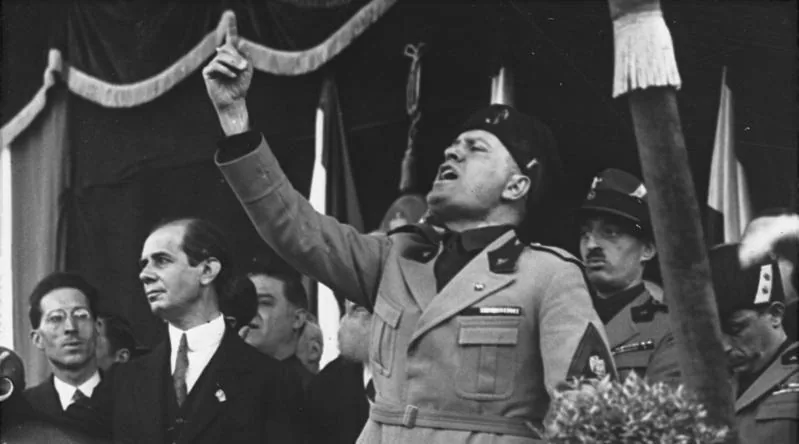
Benito Mussolini, the founder of Italian Fascism and dictator of Italy from 1922 until his downfall in 1943, was executed by partisan firing squad on April 28, 1945, near Lake Como. His extraordinary arc from socialist journalist to brutal dictator, and his fatal alliance with Adolf Hitler, remains one of the most instructive cautionary tales of the 20th century. This biography traces the man who gave the world the word "fascism" and led his nation into ruin, capturing both the magnetic charisma that seduced millions and the violent paranoia that ultimately destroyed him.
Benito Mussolini rose from socialist agitator to found Italian Fascism, seizing power in the 1922 March on Rome. He ruled Italy for over two decades, allied with Hitler during World War II, and was captured and executed by Italian partisans in April 1945, ending his brutal regime in ignominy.
- Mussolini was born in Dovia, Romagna, Italy, on July 29, 1883, to a socialist blacksmith father and a devout Catholic mother.
- He founded the Fascist movement in 1919 and led his Blackshirts in the March on Rome in October 1922, where King Victor Emmanuel III appointed him Prime Minister.
- Mussolini signed the Lateran Treaty with the Catholic Church in 1929, formally resolving the "Roman Question" and gaining crucial legitimacy.
- He forged the Pact of Steel with Hitler in 1939, committing Italy to the Axis alliance that would prove catastrophic in World War II.
- After being deposed in July 1943 and rescued by German commandos, Mussolini was captured by partisans while fleeing to Switzerland and executed on April 28, 1945.
The Making of a Dictator: From Socialist Roots to Fascist Fire
Benito Mussolini was born on 29 July 1883 in Dovia, a small town in the Romagna region of Italy. His father, Alessandro, was a socialist blacksmith with strong revolutionary ideas, and his mother, Rosa Maltoni, was a devout Catholic. That unlikely pairing shaped the boy who would one day reshape Italy. Alessandro gave his son a name loaded with meaning: Benito Amilcare Andrea. Each name honored a left-wing hero. Benito came from Benito Juárez, the Mexican revolutionary. Amilcare honored Amilcare Cipriani, an anarchist. Andrea paid tribute to Andrea Costa, a fellow Romagnese socialist. The blacksmith father, who spent time in prison for his beliefs, also filled his son's head with radical writers, from Mikhail Bakunin to Eugène Sue. The young Mussolini grew into an excitable, combative personality, drawn to confrontation. At 18, he took a job as a substitute elementary school teacher. But the classroom couldn't hold him for long. He soon headed to Switzerland, where he met Angelica Balabanoff, an Italian socialist who played a major role in shaping his political ideas. That Swiss chapter ended abruptly in 1904 when authorities expelled him for carrying a fake passport and engaging in subversive activities. Back in Italy, Mussolini climbed the socialist ranks. In 1910, he became general secretary of the Forlì Socialist Federation. He ran a newspaper called *La Lotta di Classe* (The Class Struggle) and used its pages to attack the church and the state. When Italy went to war with the Ottoman Empire over Libya in 1911, Mussolini opposed it fiercely. He called for a general strike and ended up spending five months in jail. The prison stint made him famous. By December 1912, he had become editor of *Avanti!*, the official newspaper of the Italian Socialist Party. When World War I broke out in 1914, he initially opposed it with the slogan "neither a man nor a single penny." But his stance began to shift. He praised Gustave Hervé, an anti-militarist who had volunteered for the army, in a surprising column. The party leadership pushed him out of *Avanti!*, and he soon launched his own paper, *Il Popolo d'Italia* (The People of Italy). In his first issue, he wrote that the state must be destroyed through revolution to prevent war. The Socialist Party expelled him. That expulsion marked the beginning of a long transformation. The firebrand who once rallied workers against war was about to build something far darker.Birth of Fascism: From Unrest to the March on Rome
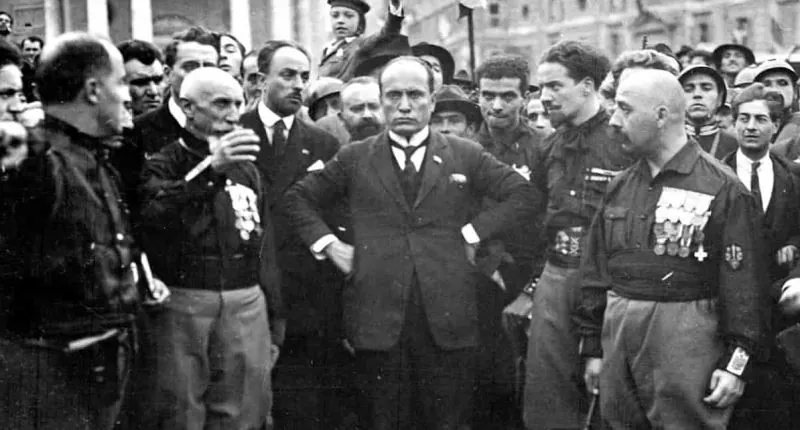
When World War I ended in 1918, Benito Mussolini was a forgotten man. The man who would become Italy's dictator had been expelled from the Socialist Party and his name carried little weight. But on 23 March 1919, in Milan, he gathered 53 people, mostly former soldiers, in a meeting that would change Italian history forever. That meeting birthed the Fasci di Combattimento, the movement that became fascism. The timing was no accident. Italy was simmering with rage. Veterans returned from the trenches to find unemployment and chaos. Factory workers were occupying plants across the industrial north. The Socialist Party, which had opposed the war, emerged from the 1919 elections as the strongest political force in the country. That terrified the wealthy landowners, industrialists, and middle classes who feared a Bolshevik-style revolution on Italian soil. Mussolini, ever the opportunist, positioned himself as the answer to that fear. He had no fixed ideology, no consistent doctrine. He simply read the mood of the streets and adjusted his stance daily. One day he spoke of revolution, the next he courted the establishment. His movement was a contradiction wrapped in black shirts. In the 1919 elections, the Fascists fielded just 2 candidates, one of them Mussolini himself. Both lost badly. The movement seemed destined for obscurity. But then came the factory occupations of 1920, and with them, money. Industrialists, frightened by the red tide, began funding Mussolini's squads. In 1920, Prime Minister Giovanni Giolitti made a calculated decision: he would use Mussolini's blackshirts to crush the worker movements that his own government could not contain. The state gave fascism legitimacy, and fascism gave the state a weapon. By the 1921 elections, the strategy paid off. Mussolini entered parliament as one of 35 Fascist deputies. The man who could not win a single seat two years earlier was now a legitimate political force. That same year, at the Fascist Congress in Rome, the decision was made to formalize the movement into a political party. Fascism was no longer a street gang with pretensions. It was an institution. The violence did not stop. Squadristi, armed fascist militias, roamed the countryside beating socialists, burning union halls, and intimidating voters. Italy was tearing itself apart, and the establishment watched with growing alarm. Something had to give. On 26 October 1922, Mussolini announced a nationwide Fascist mobilization. His blackshirts marched into public offices, post offices, and municipal buildings across Italy. The March on Rome had begun, though Mussolini himself stayed safely in Milan, waiting to see how the cards would fall. The weak government of Luigi Facta wanted to declare martial law and disperse the marchers. King Victor Emmanuel III refused to sign the order, fearing it would trigger a civil war, or worse, cost him his throne. On 29 October 1922, the King summoned Mussolini to Rome and appointed him Prime Minister. He was 39 years old. The march had been a bluff, a display of force that never actually needed to fight. But it worked. Fascism had seized power through a combination of violence, political maneuvering, and the cowardice of those who should have stopped it. The road to dictatorship was now wide open.The Duce's Grip: Totalitarian Rule, War, and Alliances
By 1924, Benito Mussolini had turned Italy into a one-man state, and the murder of socialist politician Giacomo Matteotti that year gave him the excuse to crush all opposition. The King had already appointed him Prime Minister in October 1922 after the March on Rome, but it took a violent crime to complete his takeover. After that, there was no turning back.
Mussolini called himself "Duce," the Italian word for leader or commander, a title that carried the weight of absolute authority. He had spent three years consolidating power after being handed the government, and Matteotti's killing triggered the social upheaval he needed to tighten his grip completely. Anyone who stood in his way learned quickly that dissent meant danger.
His foreign policy matched his domestic brutality. The city of Fiume, which had been a point of contention with Yugoslavia, came under Italian control through the Treaty of Rome in 1924, though the popular version often gives Mussolini personal credit for seizing it directly. Albania became an Italian protectorate in 1939 following an invasion, not through peaceful arrangement in the twenties as some accounts claim. In 1929, he did sign the Lateran Treaty with the Vatican, a genuine achievement that recognized the Pope's sovereignty over Vatican City and settled decades of tension between the Italian state and the Catholic Church.
The regime demanded absolute loyalty. In 1931, university professors across Italy were forced to swear an oath of allegiance to Mussolini, a requirement that silenced academic dissent and brought the intellectual world under fascist control. Fascism had embedded itself into every corner of Italian life.
Then came the alliance that would seal his fate. In 1938, Adolf Hitler visited Rome and met with Mussolini, a meeting that pushed the Duce toward adopting racist policies modeled on Nazi ideology. The Italy-Germany Pact, known as the Pact of Steel, was signed on 22 May 1939, a mutual assistance treaty that bound the two dictatorships together in what would become a catastrophic partnership.
Mussolini invaded Albania and then made a disastrous move against Greece, suffering a major defeat that exposed the weakness of his military machine. The German army had to step in to handle the Greek campaign, wasting precious time and resources. The tide was turning.
The Allied invasion of Sicily began on 10 July 1943, with primarily American and British forces landing on the island. The Fascist Grand Council voted no confidence in Mussolini, and King Victor Emmanuel III ordered his arrest. Marshal Pietro Badoglio took over as Prime Minister and negotiated peace with the Allies, ending Italy's participation in the war on the Axis side.
The Fall and the Final Act: Capture and Execution
Mussolini's final chapter began on 12 September 1943. German paratroopers snatched him from a mountain hotel at Gran Sasso, where he was being held prisoner after the King had him arrested in July of that year. The rescue was daring, the kind of operation that would later become the stuff of war movies. But it bought him less than two years of borrowed time, and those months were spent running a shadow state that existed only because German bayonets kept it alive. On 23 September 1943, Mussolini announced the creation of the Italian Social Republic, a puppet government headquartered in the north under German protection. The Allies had already landed in Sicily in July 1943, and Italy's new prime minister, Marshal Badoglio, had signed an armistice with them. The country was split in two, with Mussolini ruling a rump state that most Italians had stopped believing in. By April 1945, the German war machine was collapsing. On 27 April, partisans stopped a German convoy near the village of Dongo, near Lake Como, and found Mussolini hiding among the soldiers. He was dressed in a German greatcoat and helmet, trying to slip across the border into Switzerland. With him was his mistress, Clara Petacci, a woman who refused to abandon him even as everything fell apart. The partisans knew they had a problem. Fascist loyalists might try to free their Duce, and the Allies might demand he be handed over for a show trial. So they moved Mussolini and Petacci to a farmhouse owned by a peasant family named De Maria, a place they thought would be safe from rescue attempts. Socialist leader Sandro Pertini, who would later become president of Italy, made his position clear. He called for swift execution, saying Mussolini deserved to die "like a mangy dog" rather than be given the honor of a formal firing squad. On 28 April 1945, the partisans took matters into their own hands. Mussolini and Petacci were executed by firing squad near the farmhouse, their bodies loaded into a truck and driven to Milan. There, in Piazzale Loreto, the same square where partisans had been executed months earlier, the corpses were hung upside down by the feet from a steel girder at a gas station. A crowd gathered, some spitting, some cheering, some just staring at the man who had once ruled Italy with an iron fist. The public display was brutal, but it served its purpose. It showed the world, and especially any remaining fascist sympathizers, that the regime was truly finished. The image of that body hanging in Milan is the final, unshakable punctuation mark on twenty years of dictatorship. The man who had marched on Rome in 1922, who had signed the Lateran Treaty with the Vatican in 1929, who had stood beside Hitler in 1938, ended his days swinging from a girder in a city square.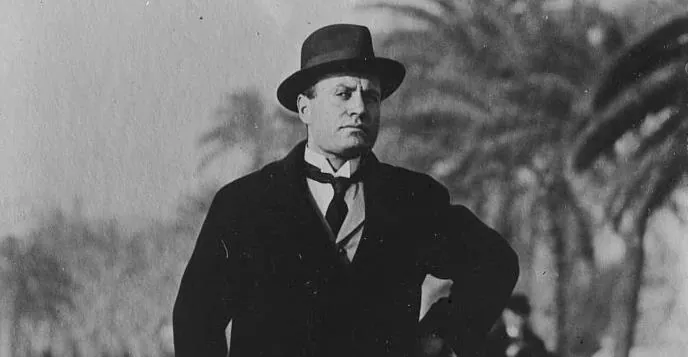
Frequently asked questions
What were the key events in Mussolini's rise to power?
Benito Mussolini's path to power began when he founded the Fasci di Combattimento in Milan on 23 March 1919 with 53 followers, mostly former soldiers. He entered parliament in 1921 as one of 35 Fascist deputies, and after the March on Rome in October 1922, King Victor Emmanuel III appointed him Prime Minister on 29 October 1922.
Why did Mussolini align with Nazi Germany?
Mussolini met Adolf Hitler in Rome in 1938, a meeting that pushed the Italian leader toward adopting racist policies. The following year, on 22 May 1939, Italy and Germany signed the Pact of Steel, a military alliance that formally bound the two regimes together. This alignment drew Italy into World War II on Germany's side.
How did Mussolini die in 1945?
Mussolini was captured by Italian partisans on 27 April 1945 while trying to flee toward Switzerland with his mistress Clara Petacci. The next day, 28 April 1945, partisans executed both of them by firing squad near Lake Como. Their bodies were then hung by the feet in Milan's Piazzale Loreto for public display.
Who was Clara Petacci and what happened to her?
Clara Petacci was Mussolini's longtime mistress, a young woman from a well-off Roman family who stayed with the dictator until the very end. She was captured alongside him on 27 April 1945 and executed with him by firing squad on 28 April 1945. Their bodies were displayed together, hung by the feet in Milan.
What was the March on Rome and why was it significant?
The March on Rome was a Fascist mobilization in October 1922, announced by Mussolini on 26 October, when thousands of Blackshirts occupied public buildings across Italy. The show of force led King Victor Emmanuel III to appoint Mussolini as Prime Minister on 29 October 1922, marking the beginning of Fascist rule in Italy.
How did Mussolini's early socialist influences shape his politics?
Mussolini's father Alessandro, an atheist blacksmith with socialist convictions, named his son born on 29 July 1883 after Benito Juarez, Amilcare Cipriani, and Andrea Costa, all left-wing figures. Young Benito became a socialist activist and editor of Avanti!, the Socialist Party newspaper, before his expulsion in 1914 for supporting Italian entry into World War I.
What was the Lateran Treaty and what did it establish?
The Lateran Treaty, signed in 1929, was an agreement between Mussolini's government and the Vatican that settled the long-standing "Roman Question" over papal territories. The pact recognized Vatican City as an independent sovereign state and gave the Church financial compensation. This agreement significantly strengthened Fascism's domestic support among Catholic Italians.
Did Mussolini support World War I initially or oppose it?
Mussolini initially opposed World War I, greeting its outbreak with the slogan "neither a man, nor a single penny" against the war effort. However, he soon shifted his position and began advocating for Italian intervention. This reversal led to his expulsion from the Italian Socialist Party and the loss of his position as editor of Avanti!. Editorial note: Any facts which remain unconfirmed are presented as such, hedged appropriately within the narrative above.
Got a take on this? Add your voice to the conversation below →
No comments yet. Be the first.