Marcus Agrippa: Rome's Silent Hero of Actium
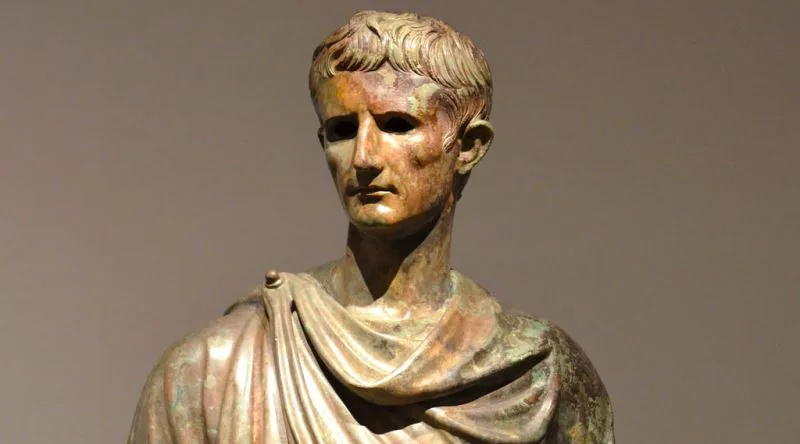
Marcus Vipsanius Agrippa was the Roman general and engineer who turned Octavian's fragile claim to power into the Roman Empire, most decisively at the Battle of Actium in 31 BC. He never held the title of emperor, and he never seemed to want it. He built the fleets, the roads, the aqueducts, and the concrete dome that still stands in Rome today. When people picture the glory of Augustus, they are often picturing the work of Agrippa.
Marcus Vipsanius Agrippa was a Roman general, admiral, and engineer who served Octavian, later Augustus, from the 40s BC onward. He commanded the fleet at Actium in 31 BC, built aqueducts and the original Pantheon, and married Augustus's daughter Julia.
- Agrippa was born around 63 BC and came from a noble but politically minor Roman family.
- He commanded Octavian's fleet at the Battle of Actium in 31 BC, defeating the forces of Mark Antony and Cleopatra.
- He oversaw major public works in Rome, including the Aqua Julia and Aqua Virgo aqueducts and improvements to the city's water supply.
- He restored the original Pantheon in Rome, which was later rebuilt under Hadrian and still bears Agrippa's name on its facade.
- He married Julia, the daughter of Augustus, and their sons were adopted into the imperial family as potential heirs.
The Boy Who Had to Prove It
Marcus Vipsanius Agrippa was born around 63 BC, into a Rome tearing itself apart with civil strife. His family carried a noble name but no real political weight, an equestrian, non-senatorial line that never sat in the Senate's front rows. In a city where your father's connections opened doors, Agrippa's door was barely a crack. He would have to push it open with his own two hands.
And he started early. The moment he put on the toga virilis, the plain white garment that marked a Roman boy's passage into manhood, his education turned serious. Military drills, rhetoric, strategy, he absorbed everything the Republic could teach him. He learned fast. Ancient sources describe a young man with unusual courage and an almost unsettling speed at picking things up, someone who could read a battlefield the way other people read a scroll.
By the 40s BC, with Rome still bleeding from one civil war after another, Agrippa was already in the field. Small campaigns. Senate-backed operations. Nothing that would make the history books on its own. But his performance in those forgettable engagements did something more important than any single victory could: it revealed a mind that could organize, lead, and improvise under pressure.
Then the rumors started. As the story goes, Agrippa's early successes built a legendary image among the Roman people. Some whispered that the gods had chosen him to save Rome, that his rise was not merely the work of an ambitious young man but of fate itself. Those whispers would follow him for the rest of his life, growing louder with every victory.
What made Agrippa different was not just talent. It was discipline. From his earliest years he showed a loyalty and self-control that set him apart from the usual Roman aristocrat, hungry for personal glory. Those two qualities, more than any sword stroke, would eventually make him the most trusted man in Octavian's inner circle, the future Augustus's right hand.
His youth, in other words, was not simply a training ground. It was the foundation of a myth.
The Man Augustus Could Not Rule Without
Marcus Vipsanius Agrippa was the one man Octavian, the future Augustus, could not govern Rome without. Born around 63 BC, he came from a noble but politically obscure family, and he spent his whole career making himself indispensable to a single man rather than chasing his own spotlight. That choice, made again and again across three decades, is what turned a republic in freefall into an empire.
Picture Rome in the 40s BC. The Republic is tearing itself apart. Octavian is young, untested, and surrounded by rivals who would happily bury him. Agrippa becomes his most trusted right-hand man, and his usefulness reaches far past battlefield planning. He handled the boring but essential work: supplies, diplomacy, the quiet deals that kept an army fed and a faction together. While other Roman nobles angled for personal glory, Agrippa kept pushing his own ambitions to the side and put Rome and Octavian first. In a political culture built on cutthroat self-promotion, that was almost strange.
That loyalty paid off in the vacuum left by the dying Republic. As the old order crumbled, Agrippa's strategic and logistical support let Octavian fill the gaps, and the transition to the new imperial order held together because of it. He also helped give the coming regime a face. Public projects, military victories, and ceremonies all worked to make imperial ideology something people could actually see and touch.
One detail worth flagging: the story goes that Agrippa took an active role in the post-war reconstruction of cities, and that reported involvement is where his influence stretched beyond the battlefield into political life. Treat that claim as tradition rather than settled record.
Actium: The Battle That Decided Rome's Fate
On 2 September 31 BC, the naval Battle of Actium settled the question of who would rule Rome. Marcus Vipsanius Agrippa, the admiral Octavian trusted above every other man, arranged his fleet so that the ships of Mark Antony and Cleopatra could not use their size to break free. Antony and Cleopatra fled the battle, and their political power was gone.
Everything Agrippa did that day was preparation before a single arrow flew. He chose where the Roman ships would sit. He read the wind and the sea currents and timed the engagement around them. He drilled his captains until the whole line could turn and strike as one body. Ancient accounts suggest that Agrippa's maneuvers boxed Antony's ships in so tightly that they lost coordination with one another, and that this loss helped decide the battle. That specific tactical reading is contested, so hold it loosely. What is not in doubt is that Antony's heavy ships never fought the way they were built to fight.
There was more than tactics in the air that day. It is said that a popular rumor among Romans held the victory at Actium had the backing of Apollo and the gods of the sea. Again, that is what people said, not what anyone could prove. It tells us something about how Rome wanted to remember the battle: not as two fleets grinding against each other, but as a moment when the divine order tilted toward Octavian.
The consequences landed fast. Antony and Cleopatra fled the field, and in 30 BC, the following year, both took their own lives. With them went the last serious rival to Octavian's authority. Actium did not merely win a war. It ended the long era of Roman civil war and handed Octavian the legitimacy he needed to rebuild the state as an imperial order, with himself at its head. The man who made that possible from the water was Agrippa, and the rest of his career would be spent making the new order look permanent.
The Builder of Rome's Bones
When the naval battle at Actium ended on 2 September 31 BC, Marcus Vipsanius Agrippa did not retire to a country estate to enjoy the triumph. He went to work on Rome itself. The man who had just helped eliminate the political power of Mark Antony and Cleopatra now turned his attention to aqueducts, roads, ports, and public buildings. It was a second act that would prove just as consequential as the first.
Agrippa became the chief executor of the infrastructure and urban projects that gave physical form to Augustus's ideology. His aqueducts are the clearest example. The Aqua Julia, completed in 33 BC, and the Aqua Virgo, finished in 19 BC, are both attested by Frontinus in his treatise on Rome's water supply and confirmed by the Oxford Classical Dictionary. These were not mere pipes and channels. They were statements carved in stone and flowing water, improving daily life for ordinary Romans while making the central government's power visible in every fountain and every bathhouse they fed.
The distribution networks that Agrippa designed turned water supply into something closer to a civic ritual. The socio-political order of the new regime became something you could drink from, wash in, and walk past on your way to the forum. His building program, as the Oxford Classical Dictionary notes, strengthened both the functional and aesthetic aspects of Rome. The city did not just work better. It looked like an empire.
Between 27 and 25 BC, Agrippa restored the Pantheon. The original inscription on the building preserves his name, and Cassius Dio records the project in his Roman History. That structure, rebuilt later under Hadrian but still carrying Agrippa's name across its facade, remains one of the most recognizable buildings in the world. It is also a reminder that Agrippa's fingerprints are on Rome's skyline in ways most visitors never realize.
Here is where the record needs correcting. The Forum of Augustus, often lumped into lists of Agrippa's achievements, was not his project at all. Augustus built it himself. The Oxford Classical Dictionary is clear on this point. Attributing it to Agrippa is a mistake that has circulated in popular retellings, and it does a disservice to both men. Augustus had his own architectural ambitions, and the Forum Augustum was squarely among them.
Agrippa's portfolio was broad enough without borrowing from his emperor. Roads, ports, forums, baths, and public buildings all bore his organizational stamp. These projects served overlapping purposes. They moved troops and goods more efficiently. They created spaces where Roman citizens could gather, trade, and feel connected to the state. And they projected an image of order and prosperity that the regime desperately needed after decades of civil war.
One phrase that gets attached to Agrippa deserves scrutiny. The Roman people did not call him the "silent architect of cities." No ancient source uses that epithet. It is a modern descriptive phrase, useful for capturing his behind-the-scenes style, but it should not be presented as something Romans actually said. What the ancient record does show is a man whose contributions were so woven into the fabric of the city that separating his work from Augustus's would be nearly impossible.
The infrastructure Agrippa built outlasted him. Some of it outlasted the empire. Aqueducts he commissioned still carried water into Rome centuries after his death, and the Pantheon still stands. That is a different kind of monument than a triumphal arch, quieter and more useful. Maybe that is why the phrase, even if invented, has stuck.
The Silent Hero Who Became a Myth
Roman historians generally remember Marcus Vipsanius Agrippa as Augustus's right-hand man and most trusted strategic advisor, the man who did the quiet work while his friend took the credit. That much is settled. But in popular memory, his legend swelled well past the man himself, tied to Actium and to the buildings that still stand in Rome. His story sits right on the seam between history and legend, which is exactly why he is often called the silent hero of Rome's transition from Republic to Empire.
Here is where the record gets slippery. It is said that Plutarch and Cassius Dio reported that Romans came to see Agrippa as a manifestation of Apollo on earth. That claim is contested and cannot be reliably confirmed, so it belongs in the realm of tradition rather than documented fact. The same caution applies to the idea that Agrippa's maneuvers were the single decisive factor at Actium; Dio credits him with significant actions, but the specific framing of a battle-winning tactical stroke is not cleanly attested. What we can say with confidence is that his projects strengthened both the functional and aesthetic fabric of Rome, and that his story became immortalized in the city's collective memory. The man built aqueducts and monuments; the myth built something larger.
Frequently asked questions
Who was Marcus Vipsanius Agrippa?
Marcus Vipsanius Agrippa was a Roman statesman and general born around 63 BC into a noble but politically minor family. Through sheer ability he became the most trusted lieutenant of Octavian, the future emperor Augustus, serving as his general, admiral, engineer, and closest advisor.
What role did Agrippa play in the Battle of Actium?
At the Battle of Actium in 31 BC, Agrippa commanded Octavian's fleet against Mark Antony and Cleopatra. Ancient accounts suggest his careful positioning may have contributed to Antony's larger ships losing coordination, a turning point that helped decide the engagement. The precise tactical claim is contested, so hold it loosely.
How did Agrippa help Augustus become emperor?
Agrippa advanced Augustus's rise through military victories, logistics, political strategy, and public building projects. His campaigns and his ability to fill power vacuums during Rome's civil wars cemented Augustus's legitimacy, helping transform the unstable Republic into the stable imperial order that followed.
What aqueducts did Agrippa build in Rome?
Agrippa oversaw construction of two major aqueducts for Rome: the Aqua Julia, completed in 33 BC, and the Aqua Virgo, completed in 19 BC. These projects improved the city's water supply and stood as lasting symbols of Rome's centralized power and improved public life.
Why did Agrippa restore the Pantheon?
Agrippa restored the Pantheon in 27 to 25 BC as part of a broader urban program that embodied Augustus's imperial ideology. The original dedicatory inscription from his restoration survives, marking his role in reshaping Rome's monumental and cultural landscape during the transition from Republic to Empire.
Was Agrippa the real military genius behind Augustus?
Ancient sources and modern scholarship credit Agrippa as Augustus's most indispensable lieutenant, the man whose victories and organizational skill made the emperor's success possible. The framing of him as the singular "real genius" oversimplifies a partnership in which both men depended on each other.
How did ancient historians like Plutarch and Cassius Dio describe Agrippa?
It is said these historians credit Agrippa's maneuvers at Actium and relay rumors of divine favor surrounding him. These specific claims, including the idea that Romans saw him as a manifestation of Apollo, are reported and contested rather than firmly established, so they are best treated as tradition rather than settled fact.
Why is Agrippa called the silent hero of Rome?
Agrippa is called the silent hero because he consistently subordinated his own ambition to Augustus and to Rome, never seeking the spotlight for himself. His achievements in war, politics, and city-building were often overshadowed by Augustus, yet they were essential to the empire's foundation. Editorial note: Details that remain unconfirmed by the surviving record are presented here as uncertain rather than as settled fact.
Got a take on this? Add your voice to the conversation below →
No comments yet. Be the first.