Magna Carta and Charter Flights: The 1215 Link
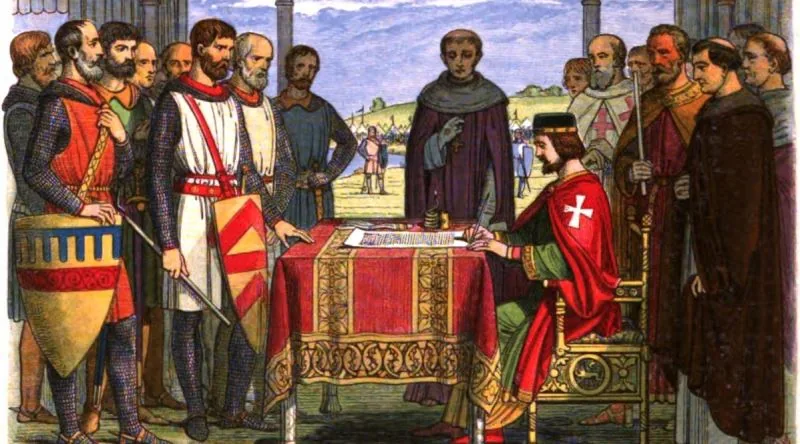
The Magna Carta, sealed by King John in 1215 at Runnymede, England, shares a surprising linguistic bond with modern charter flights: both trace their names to the Latin "carta," meaning a written document that grants rights or privileges. This Magna Carta charter connection reveals how a medieval peace treaty shaped not only constitutional law but also the everyday vocabulary of air travel. It is a story of how a single word traveled from a meadow on the Thames to the runways of the world, linking the fight against tyranny to the freedom of the skies.
In 1215, King John of England sealed the Magna Carta at Runnymede, a document that limited royal power and established legal rights. The word "charter" comes from this same Latin root, meaning a formal grant. Today, a charter flight is a plane hired for a specific purpose, echoing that original sense of a special written authorization.
- The Magna Carta was sealed by King John on June 15, 1215, at Runnymede, a meadow beside the River Thames in England.
- The word "charter" derives from the Latin "carta," which means a document that grants or confirms rights, privileges, or freedoms.
- A charter flight, in modern usage, is an aircraft hired for a specific journey or purpose, rather than a scheduled public service.
- The Magna Carta's legacy includes its influence on later legal documents, including aspects of the United States Constitution.
The Surprising Link Between a 1215 King and Your Next Vacation Flight
That "charter" on your flight booking shares a surprising lineage with the Magna Carta, the document King John of England sealed in 1215. The Magna Carta charter connection runs through a simple Latin word: carta, meaning a piece of paper or document. When you book a charter flight, you are riding on centuries of legal history.
Here is how it works. The word "charter" comes straight from that Latin carta, and for good reason. In medieval Europe, monarchs handed out charters as written grants of rights and privileges. Towns received them. Universities received them. Even trading companies received them. The East India Company, established by royal charter in 1600, is a classic example of a commercial venture built on this kind of document.
The Magna Carta itself is simply the most famous charter ever issued. Its name literally means "Great Charter," a title chosen to distinguish it from the Charter of the Forest, a separate document dealing with royal hunting grounds. King John did not invent the idea; he was following a tradition of Saxon and Norman rulers who had long distributed these written grants to their subjects.
So how did a medieval legal document become the name for a vacation flight? The path runs through maritime law. In Anglo-Saxon legal tradition, a charterparty agreement was a contract between parties, with the term derived from the Latin carta partita, meaning "divided document." Over time, chartering came to mean leasing a vessel for a specific voyage or period. When aviation arrived, the same logic applied: an airline leases an aircraft for a specific trip, and the flight becomes a charter. The Magna Carta charter connection is not just etymological trivia; it is the same legal concept of granting exclusive rights, applied to airplanes instead of barons.
From Royal Grants to Legal Contracts: How 'Charter' Evolved
The word "charter" traveled a long road from medieval royal handouts to the paperwork behind your vacation flight. It starts with the Latin carta, meaning a piece of paper or document, and winds through kings, shipping deals, and colonial ventures before landing in modern legal language.
In medieval Europe, monarchs handed out charters like favors. Cities, towns, individuals, communities, even universities received them as written proof of specific rights and privileges. These weren't casual notes; they were binding documents that shaped how places governed themselves and how institutions operated.
The East India Company got its start this way, receiving a royal charter in 1600 that granted it privileges during the age of exploration and colonialism. That single piece of paper gave a trading company extraordinary power, setting a pattern for how charters would fuel commercial expansion.
Maritime law added another layer. The term "charterparty agreement" comes from the Latin carta partita, meaning "divided document." In practice, this was a contract where the document was written twice on one sheet, then cut in half, with each party keeping one piece as proof of the agreement. It was a clever medieval security system for shipping deals.
In modern law, a charter remains what it always was: a written document that confirms or proves rights or ownership. That's why charter flights carry the name. An airline leases an aircraft for a specific period or voyage, operating under a form of concession contract. The plane, like the medieval town or the trading company, operates under a grant of specific privileges for a defined purpose.
So the next time you board a charter flight, you're participating in a tradition that stretches back centuries. The legal DNA of that journey traces directly to the same concept that gave us the Magna Carta charter connection, a thread linking royal concessions to modern commerce.
Magna Carta: The "Great Charter" That Wasn't Signed
Magna Carta, meaning "Great Charter," was issued by King John of England on 15 June 1215 at Runnymede, a water meadow by the River Thames. And despite what nearly every schoolbook picture suggests, the king never put pen to parchment. The document was sealed, not signed, because that was the custom of the time.
The king's royal seal, pressed into wax and affixed to the document, carried all the legal weight anyone needed. A signature was simply not how medieval English monarchs did business. So when you picture King John hunched over a table with a quill, scratch that image. He approved the charter, yes, but the physical proof of his approval was that blob of wax, not ink.
What exactly was this document? It was a charter granted by the king to his barons, spelling out their privileges and, crucially, putting limits on royal power. The name "Magna Carta" itself came about to distinguish it from another document, the Charter of the Forest, which dealt with the royal hunting grounds and their harsh laws. One charter for liberties, one for deer and timber.
Here is where the popular story gets fuzzy. Contrary to what you might have heard, there is no single Magna Carta. The charter was reissued multiple times, with versions from 1216, 1217, 1225, 1297, and 1300, each issued by different kings under different pressures. Each time, hundreds of handwritten copies were made and sent out to towns and cities across the kingdom.
Today, four original 1215 copies survive, along with nearly twenty later copies, displayed in various museums and cathedrals. The most famous one, the 1297 version bearing the seal of King Edward I, sits in the National Archives Museum in Washington, D.C. That copy was donated in 2007 by David Rubenstein, an American businessman, who paid a handsome sum to bring it to the American public.
That 1297 version is considered the definitive text. The rights it laid out, including recognition of church independence, preservation of city customs (especially London's), and the right to a fair trial, are still on the UK statute book today. Most of the other clauses have been repealed, but those few remain, quietly still in force.
The connection to the modern word "charter" runs straight through this medieval document. The word derives from the Latin "carta," meaning a piece of paper or document. And that same root gave us charter flights, charter schools, and the charterparty agreements used in shipping. The Magna Carta charter connection is not a coincidence; it is the original use of the term, a royal grant of privileges that later evolved into everything from corporate charters to leased aircraft.
One thing Magna Carta was not, however, was a decree or ferman. A decree comes from an absolute sovereign, an order that cannot be questioned or changed. King John, facing armed rebel barons on that marshy meadow in 1215, had no such unlimited authority. He was negotiating from a position of weakness, and everyone at that table knew it.
The barons had chosen Runnymede carefully, a boggy floodplain unsuitable for cavalry charges, so they would not be ambushed. And the decisions made there were later copied out by scribes, meaning the document we call Magna Carta technically did not physically exist at the moment of its formal acceptance. The agreements were made; the paperwork came after.
A Charter, Not a Decree: The Legal Nature of Magna Carta
Magna Carta was never a decree, because King John of England was not acting as an absolute sovereign when he accepted it in 1215. He was a cornered monarch, surrounded by armed and rebellious barons who had forced him to the negotiating table. The document that emerged from that confrontation was a negotiated settlement, not a unilateral command from a throne.
Calling it a contract also misses the mark, at least in the technical sense. There was no wet-ink signature pressed onto a single master document at Runnymede on 15 June 1215. What actually happened is that the decisions made in that marshy meadow were later copied by scribes, producing multiple handwritten versions that were then distributed across the kingdom. The physical document, as we might imagine it, did not exist at the moment of formal acceptance.
So what exactly is it? In Anglo-Saxon law, a charter is a grant that flows from sovereign power, conferring specific privileges upon a class, an organ, or an entity. That is precisely what Magna Carta was: a royal grant of liberties, the largest and most consequential of its kind. The name itself, meaning "Great Charter," was coined to distinguish it from the Charter of the Forest, a separate document dealing with hunting rights in royal woodlands.
This is where the Magna Carta charter connection to modern legal thinking becomes clear. The charter tradition in Britain stretches back to the Saxon kings, who issued these grants to towns, individuals, and even universities. William the Conqueror, after landing on the island in 1066, distributed charters freely to consolidate his Norman settlement. Most were limited grants of land to barons. Magna Carta was different in scale and scope, but it belonged to the same family of documents.
In Turkish legal terminology, the closest equivalent to "charter" is not "tüzük" (bylaw). A tüzük in the Turkish system sits below the constitution and basic laws like the civil code, serving as implementing regulation rather than foundational law. Charters of the Magna Carta variety operate on an entirely different level. They are constitutional in nature, not mere regulations. The 1297 version, sealed by King Edward I and now displayed in Washington, D.C. at the National Archives Museum, remains partly in force in the United Kingdom today, including clauses on church independence, the customs of London, and the right to a fair trial.
The distinction matters because it reveals how power was understood in 1215. A decree assumes a sovereign whose will is absolute, unquestionable, and unchangeable. King John enjoyed none of those luxuries that summer. The barons had chosen Runnymede deliberately, a boggy meadow unsuitable for cavalry charges, precisely to avoid being ambushed. They came armed, and they left with a written promise. That promise, copied and recopied by scribes, became the foundation of a legal tradition where even kings had to answer to the terms of a charter.
The Legacy: From Runnymede to the U.S. Constitution and Beyond
The 1297 version of Magna Carta, sealed by King Edward I and now displayed in the National Archives Museum in Washington, D.C., still carries three clauses that remain law in the United Kingdom today. Those surviving provisions protect the independence of the Church, preserve the ancient customs of cities including London, and guarantee the right to a fair trial. Everything else in that medieval document has faded into history, yet its shadow stretches across the modern legal world.
The influence traveled through a chain of English statutes. The Petition of Right of 1628, the Habeas Corpus Act of 1679, and the Bill of Rights of 1689 each explicitly referenced Magna Carta as their foundation. The story that kings who broke these covenants lost their heads or were driven into exile makes for dramatic reading, but records simply do not support it. No English monarch was ever executed or banished specifically for violating Magna Carta's terms.
Across the Atlantic, those same liberties found new expression in the American Declaration of Independence of 4 July 1776. The document's insistence that governments derive their power from the consent of the governed echoes the bargain struck on that marshy meadow at Runnymede in 1215. The direct line between King John's reluctant concession and Thomas Jefferson's sweeping words remains one of the great through-lines in constitutional history.
The Ottoman parallel, the Sened-i İttifak of 1808, took a different path. Although it aimed to restrain the sultan's authority, historians do not classify it as a fundamental rights document. The privileges it granted to the ayan, the provincial notables, never extended to ordinary people. Where Magna Carta's protections eventually reached all citizens, the Sened-i İttifak remained a bargain among elites.
This brings us to a curious linguistic echo. The Turkish word "berat," meaning an official document granting rights or a diploma, reportedly traces to the Arabic root for "acquittal" or "innocence." According to the etymologist Nişanyan, the word appears twice in the Quran with the sense of "written contract" or "permission document," possibly borrowed from Aramaic or Hebrew scribal culture. That etymology remains plausible rather than proven, but the resonance is striking: a berat, like a charter, is a piece of paper that transforms a promise into a binding reality.
The Magna Carta charter connection to modern life runs deeper than dusty archives. Every time a plane takes off as a charter flight, it carries the DNA of that 1215 agreement. The word "charter" itself descends from the Latin "carta," meaning a piece of paper or document, and the legal concept of chartering a vessel or aircraft derives from the same root as the royal charters that once granted privileges to towns and trading companies. The East India Company received its charter in 1600, setting the pattern for colonial enterprise. Even the maritime charterparty agreement takes its name from "carta partita," the "divided document" that was torn in half so each party could keep proof of the deal.
What makes Magna Carta different from a ferman, an imperial decree, is the nature of the authority behind it. A ferman flows from an absolute sovereign whose will cannot be questioned. King John in 1215 had no such luxury. He faced armed barons on a floodplain they had chosen specifically to avoid ambush, and he approved their demands because he had no other option. That negotiated quality, the fact that power had to bend to law, is precisely what transformed a medieval privilege into a modern principle.
Frequently asked questions
What exactly is the Magna Carta charter connection?
The Magna Carta charter connection comes down to a single Latin word: "carta," meaning a piece of paper or document. When King John sealed Magna Carta in 1215 at Runnymede, he was issuing a charter, a written grant of privileges. Modern charter flights borrow that same word because they operate under a charter agreement, where an airline leases an aircraft for a specific period or voyage.
Was Magna Carta actually signed by King John?
King John sealed Magna Carta on 15 June 1215 at Runnymede, a water meadow beside the River Thames in England. He did not sign it in the modern sense, he pressed his royal seal into wax to authenticate the document. The seal carried the same legal weight as a signature would today, marking the king's formal acceptance of the barons' demands.
How many versions of Magna Carta exist?
There is no single Magna Carta, contrary to popular belief. The document was reissued multiple times, with versions dating from 1216, 1217, 1225, 1297, and 1300, each issued by different kings. Four original copies from 1215 survive today, along with nearly twenty later copies, scattered across museums and cathedrals in England.
Where can I see a Magna Carta in the United States?
The 1297 version of Magna Carta, bearing the seal of King Edward I, is displayed at the National Archives Museum in Washington, D.C. Businessman David Rubenstein donated this copy to the museum, making it the only version of Magna Carta permanently located in the United States. It remains one of the most visited documents in the archive's collection.
Is Magna Carta a decree, a contract, or something else entirely?
Magna Carta is best understood as a negotiated grant of privileges, not a decree from an absolute sovereign. King John faced armed rebel barons in 1215, so his authority was limited when he approved the document. It was also not a contract in the modern legal sense, since no wet signatures were exchanged at Runnymede, the decisions were later copied by scribes.
Does Magna Carta still have legal force today?
Three clauses from the 1297 version remain on the UK statute book today. These include recognition of church independence, preservation of city customs especially those of London, and the right to a fair trial. All other clauses have been repealed over the centuries, but these three endure as living law rather than mere historical artifacts.
How did Magna Carta influence the U.S. Declaration of Independence?
The liberties granted in Magna Carta found their way into the American Declaration of Independence of 4 July 1776. The document's principles, including protection against arbitrary arrest and unlawful seizure of property, shaped the founding generation's understanding of rights. The Declaration reflects these inherited freedoms, though it extends them far beyond the medieval barons who originally demanded them.
Why is the word "charter" used for both a medieval document and a flight?
The word "charter" traces back to the Latin "carta," meaning a paper or document granting rights. In medieval Europe, monarchs issued charters to towns, universities, and trading companies, conferring specific privileges. In maritime law, the term evolved through "carta partita," meaning "divided document," which referred to charterparty agreements. Modern charter flights simply apply this ancient concept of leasing rights to aircraft, where an airline charters a plane for a specific period or journey.
Got a take on this? Add your voice to the conversation below →
No comments yet. Be the first.