Language and Thought: MIT's Fedorenko on Thinking Without Words
Evelina Fedorenko, a neuroscientist at MIT's McGovern Institute, has spent years testing whether language and thought are the same thing, and her answer is no. Her experiments with aphasia patients and brain imaging suggest that people can reason through complex problems even when their language networks are damaged or silent. That finding pushes back on a view Bertrand Russell popularized, that language is essential for any thought worth the name. It also raises a quieter, more personal question: what is happening in your head when the words fall away?
Research by Evelina Fedorenko at MIT's McGovern Institute indicates that language and thought rely on separate brain networks. Studies of aphasia patients and brain imaging suggest complex reasoning can occur without intact language, challenging the long-held idea that language is required for thought.
- Evelina Fedorenko is a neuroscientist at MIT's McGovern Institute who studies the relationship between language and thought.
- Her work examines people with aphasia, a condition in which language abilities are impaired after brain damage.
- Brain imaging research points to distinct networks for language processing and for reasoning and problem-solving.
- The findings challenge Bertrand Russell's view that language is essential for complex thought.
- The research suggests that some forms of thinking can proceed even when language is disrupted.
Can You Think Without a Single Word?
Try this: strip away every word you know. No speech, no reading, not even the quiet voice that narrates your day. Now solve a math problem in that silence. Now read a tense room full of people and figure out who is upset with whom. The question of language and thought starts right there, in that strange, wordless space: without the constant narrator inside your head, what would a thought even look like? Would it have a sound at all? Or would it just be a shape, a pull, a knowing?
The British philosopher Bertrand Russell largely answered yes to whether language is required for thought. For him, language sits at the foundation of complex thought. Take the words away and the higher floors of reasoning start to wobble. It is an intuitive position, and a hard one to shake.
Nature, though, keeps showing us a different picture. Chimpanzees can outperform humans in some strategy games, reading a rival's moves in ways we struggle to match. Crows make tools from twigs, hooking food out of cavities too narrow for a beak to reach. Nobody taught them the word for "hook."
So here is the assumption worth sitting with: they have no words, yet they think. And they may be thinking in ways we do not yet fully understand. Which raises an uncomfortable follow-up. If a crow can plan and a chimp can outmaneuver us without a single sentence, how much of our own inner narration is actually doing the work, and how much is just commentary running alongside it?
What Did Evelina Fedorenko Conclude About Language and Thought?
Evelina Fedorenko, a neuroscientist at MIT's McGovern Institute for Brain Research, has spent years chasing one question and landed on a blunt answer: language and thought are not the same thing. In her 2016 paper with Rosemary Varley, published in the Annals of the New York Academy of Sciences and titled "Language and thought are not the same thing," she lays out the case that the two run on separate brain regions and handle entirely different jobs.
Her formulation is worth sitting with. We need thought to build language. But we do not need language to think and reason. That second sentence is the one that flips the usual intuition, and it is the claim her lab has spent years testing from two directions.
She did not start out expecting to land there. As an undergraduate at Harvard, she was drawn to Noam Chomsky's influential idea that language is the key feature separating humans from other living things, and she believed our knack for stringing words into complex sentences shaped how we think. So she went looking for the obvious thing: a shared brain region that handles both language and complex thought. The logic seemed clean. Language is hierarchical, words building into phrases, phrases building into sentences, so somewhere in the brain there ought to be a patch of tissue processing those hierarchies and doing the heavy lifting of reasoning too.
But the research kept pushing back. The more she looked, the clearer it became: language and other thinking processes do not lean on the same networks. The split showed up most sharply during non-verbal tasks. When people solved puzzles, planned their day, worked through logic problems or ran memory tasks, the brain's language regions stayed largely quiet.
That silence matters. It means the machinery of words is not the engine of thought. Fedorenko's findings challenge Bertrand Russell's view that language sits at the foundation of complex thought, and they reframe what language is actually for. In her account, language is less the source of thinking and more a powerful communication tool, a shortcut between minds. We cannot read each other's thoughts directly, but language lets us pass information, ideas and intentions from one brain to another.
So the picture that emerges is a brain running several systems at once. Social reasoning, problem solving, memory and planning each draw on their own networks. Language is one strong piece of that larger structure, not the whole of it.
What Do the Scans Show When the Language Areas Go Quiet?
Evelina Fedorenko expected to find a single brain region handling both grammar and reasoning. What she found instead, scan after scan, was a separation. Language and other thought processes do not lean on the same brain networks, and the imaging made that split hard to ignore.
The picture got sharpest during non-verbal tasks. Ask someone to work through a puzzle, map out their day, or grind through a logic problem, and the brain's language regions barely flicker. They sit quiet while the rest of the mind works. That silence is the whole point: if the words-in-your-head machinery were the engine of thought, it should light up for every hard mental job. It doesn't.
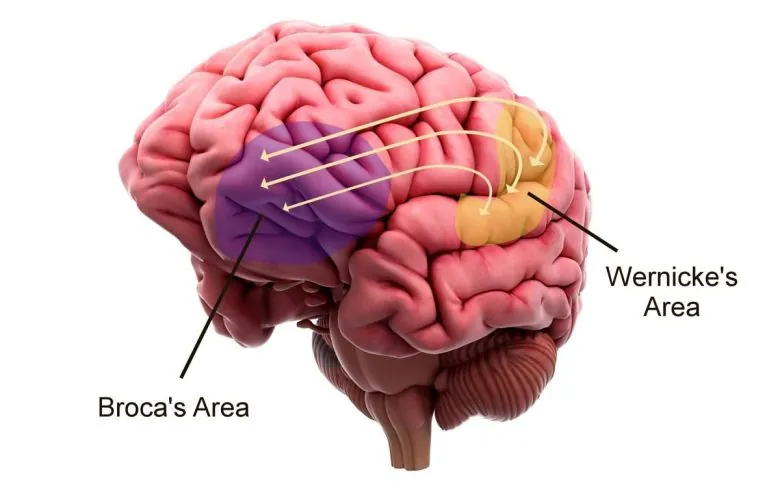
Two regions carry most of the language load, and it helps to know what each one does. Broca's area handles the production of language and speech, the part most closely tied to turning intention into spoken words. Wernicke's area handles understanding speech and picking the right word while you talk. During those word-free tasks, both stay largely still.
The results did not match what Fedorenko set out to prove. She had gone looking for a shared hub where language and complex thought meet. The data pointed elsewhere.
So a new question opened up, and it is a good one. If language is not the foundation of thought, what exactly is it doing in the mind? That puzzle is what her work turned to next.
The Patients Who Lost Language but Kept Their Minds
Ask a person with severe aphasia to describe a photograph and you may get silence, a frustrated gesture, or a single broken syllable. Aphasia is a loss of language, usually after damage to the left hemisphere of the brain, the side that houses the classic language machinery: Broca's area for producing speech, Wernicke's area for understanding it and picking the right words. When that damage is extensive, patients can lose most of their ability to understand or produce language at all. Communication becomes nearly impossible.
And yet the thinking does not stop. This is the first line of evidence that language and thought are not the same thing. When researchers set aside spoken or written instructions and let these patients work non-verbally, something remarkable shows up. People with severe aphasia solve math problems. They succeed on tests of social reasoning, the kind of task that asks you to work out what another person believes or intends. Rosemary Varley and Michael Siegal documented exactly this in a 2000 study, and the conclusion is hard to ignore: advanced thought is not necessarily chained to language.
The Scanner Agrees
The second line of evidence comes from modern brain imaging, and it points the same direction. Evelina Fedorenko, a neuroscientist at MIT's McGovern Institute for Brain Research, ran the experiment in two careful steps. First she identified the brain regions that light up for language. Then she watched those same regions while people did something else entirely: logic puzzles, memory tasks, planning out a day. The language areas stayed largely silent. The mind was clearly busy. The words were not.
Sit with that for a second. We reach for language constantly to express what we think, and it is easy to mistake the messenger for the message. But the thoughts themselves exist without words. That is the part that unsettles our usual picture of how the mind works, and it is the part that puts real pressure on Bertrand Russell's old conviction that language sits at the foundation of complex thought.
So What Is Language For? A Shortcut Between Minds
For Evelina Fedorenko, the MIT neuroscientist whose work we've been following, the answer comes down to a single sentence: language is more an effective communication tool than the source of thought. Think of it as a shortcut between minds. We cannot read each other's thoughts directly, but through words we hand information, ideas and feelings from one brain to another. That is the job language actually does, and it does it remarkably well.
Look again at the whole picture. The brain runs several distinct systems, each carrying its own kind of intellectual work. Social reasoning is one. Problem solving is another. Memory and planning each draw on their own networks, and these networks cooperate without ever needing the language regions to switch on. Language is one of the strong parts of this larger structure. It is not the structure itself, and it does not, on its own, make up all of thought.
This is where the language and thought story turns. If words were the engine of thinking, then losing words would mean losing the ability to reason. The evidence, from brain imaging and from patients with severe aphasia, points the other way. Thought keeps running even when the language network goes quiet. What we lose without language is not the thinking. It is the sharing.
"We can't read one another's minds. Language is the shortcut we use to move a thought from one brain into another."
Fedorenko didn't reach this conclusion on her own hunch. She and her colleagues laid it out across a series of peer-reviewed papers. In 2016, writing with Rosemary Varley in the Annals of the New York Academy of Sciences, she made the case directly under the title "Language and thought are not the same thing." Then in 2024, with Steven Piantadosi and Edward Gibson, she carried the argument into Nature under a title that says it plainly: "Language is primarily a tool for communication rather than thought."
So the next time you catch that inner narrator chattering away, notice what it is actually doing. It is not generating your ideas from scratch. It is packaging them, ready to be handed to someone else. That is a powerful thing, and a humble one. Language is the bridge. The thinking happens on both sides.
Frequently asked questions
What did Evelina Fedorenko discover about language and thought?
Evelina Fedorenko, a neuroscientist at MIT's McGovern Institute for Brain Research, found that language and thought are not the same thing. Her published work argues they run in different brain regions and carry out different tasks. Building language needs thought, but reasoning does not require language.
How do aphasia patients show thinking without language?
People with severe aphasia lose most of their ability to understand or produce language, usually from damage to the left hemisphere of the brain. Yet when instructions are non-verbal, they still solve math problems and succeed on social reasoning tests. That gap shows advanced thinking does not have to lean on words.
Why does the brain have separate networks for language and thought?
Brain imaging settled it. Fedorenko first mapped the regions responsible for language, then watched them during other mental work. While people solved logic puzzles, handled memory tasks or planned their day, the language regions stayed largely silent. Thought, it turns out, does not depend on them.
What did Bertrand Russell believe?
The British philosopher Bertrand Russell largely answered yes to whether language is necessary for thought. He held that language sits at the foundation of complex thought. Fedorenko's findings challenge that view directly, since reasoning keeps working even when the language system goes quiet or is damaged.
What are Broca's and Wernicke's areas?
Broca's area handles the production of language and speech. Wernicke's area handles understanding speech and choosing the right words while you speak. Together these two regions form the core of the brain's language machinery, which goes silent during non-verbal thinking.
Did crows and chimpanzees demonstrate thought without language?
They appear to, yes. Chimpanzees can outperform humans in some strategy games, and crows make tools from twigs to pull food out of hard-to-reach cavities. Neither has words like ours, yet both solve problems, which suggests thinking can happen without language.
What is language for, according to Fedorenko?
For Fedorenko, language is an effective communication tool rather than the source of thought. It works like a shortcut for transferring thoughts between minds. We cannot read each other's minds, but language lets us move ideas from one brain to another. Editorial note: Details that remain unconfirmed are presented as such, and claims are hedged where the evidence is still developing.
Got a take on this? Add your voice to the conversation below →
No comments yet. Be the first.