Jason Padgett: The Attack That Made Him a Math Genius

Jason Padgett became an acquired savant after a violent mugging outside a Tacoma karaoke bar in 2002. Before that night he had no interest in math and no reason to think a beating would change his mind. He was jumped from behind, struck in the head, and left on the ground with a concussion and a kidney injury. When he woke up, the world looked different. Curves and angles seemed to break into fine geometric patterns, and numbers he had once avoided started to feel like a language he could suddenly read.
Jason Padgett was attacked outside a karaoke bar in Tacoma, Washington, in 2002. After the assault he began seeing the world as geometric patterns and developed a fascination with mathematics. Researchers later studied him as a rare case of acquired savant syndrome.
- Jason Padgett was attacked outside a Tacoma, Washington karaoke bar in 2002, leaving him with a concussion and a kidney injury.
- After the assault he reported seeing curves and angles as intricate geometric and fractal-like patterns.
- He went from avoiding math to studying it intensely, eventually enrolling at a community college to learn more.
- Neuroscientist Berit Brogaard and colleagues later scanned his brain and published a case study on his abilities.
- He wrote a memoir, Struck by Genius, about his life before and after the attack.
The Night Outside the Karaoke Bar
On a Friday night in September 2002, Jason Padgett walked out of a karaoke bar in Tacoma, Washington, drunk after an evening of drinking with friends. Two men were waiting in the dark, watching him. They had been looking for an easy target, and Jason fit the profile perfectly.
Some retellings give the exact date as Friday, September 13, 2002, though that precise calendar detail has never been fully confirmed. What is certain is the year, 2002, and the place: Tacoma, a city on Puget Sound in Washington State, where Jason had spent years bouncing between bars, friends, and mornings he barely remembered.
The men emerged from their hiding spot and approached from behind. One of them struck the back of Jason's neck with brutal force. He dropped to his knees. Then they kicked and punched him as he lay on the ground, took his wallet and his leather jacket, and disappeared into the darkness.
The attack was fast and merciless. But luck was on Jason's side that night in one crucial way: a hospital stood directly across the street. He staggered to the emergency room and was treated immediately. Doctors found a concussion and bruised kidneys.
He was given painkillers and sent home to rest. Physically, he had escaped far worse. The injuries could have been catastrophic, even fatal. But the damage from that night was not only physical, and the effects would not show up on any X-ray.
Until that evening, Jason had been a deeply social person. He went out with friends almost every night, drank, and partied. He often showed up to work in the morning with a heavy hangover, then cleaned himself up and went out again. That version of Jason was about to disappear.
The World Turned Pixelated
Before the attack, Jason Padgett was the guy who never stayed home. He was out almost every night with friends, drinking, laughing, closing down bars. Mornings meant showing up to work hungover, then heading back out again. That version of Padgett vanished after 2002. In his place came a man who was afraid to leave the house, who could not stand sunlight coming through the windows, and who covered the glass with blankets and towels to block it out. He developed PTSD and OCD, conditions he has spoken about publicly since.
Then came the strange part. Everything he looked at seemed slightly pixelated, like he was standing inside a low-resolution video game. He noticed it in clouds, in tap water running from the faucet, in puddles on the ground. Curved surfaces made it worse. The effect was strongest when he looked at anything rounded, as if the world's smooth edges were breaking into tiny visible blocks.
He wanted to understand what was happening to him, so he went online and started reading. That search pulled him into mathematics and physics, subjects he had avoided his whole life. In school, Jason Padgett never got past basic algebra. He called math useless. Now, suddenly, he could grasp concepts that had once seemed impossible, even advanced ones. The same man who once dismissed the subject found himself reading about fractals and not wanting to stop.
Fractals hit him hardest. One evening he was watching television with his daughter when she asked how the images on the screen were made. He explained that the screen was built from tiny squares and rectangles. Mid-sentence, it landed on him: he was not just describing the TV. He was describing the real world, the one he now saw everywhere he looked.
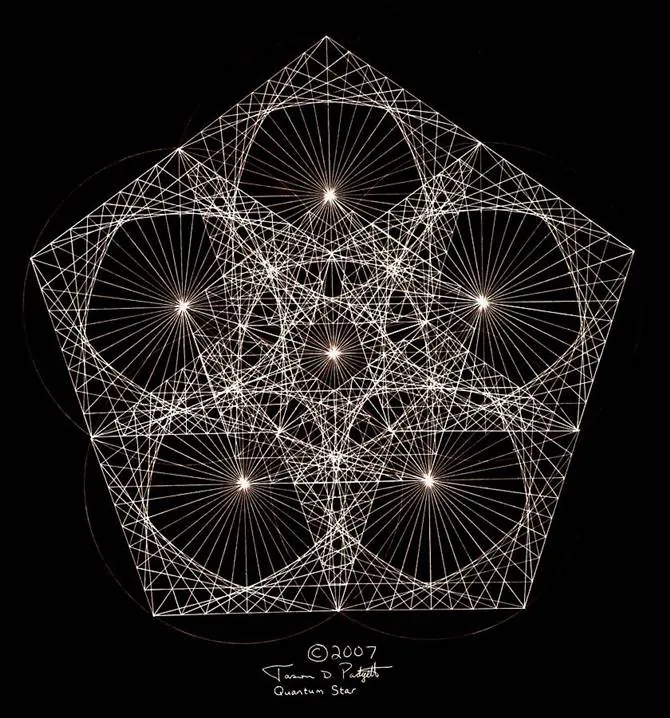
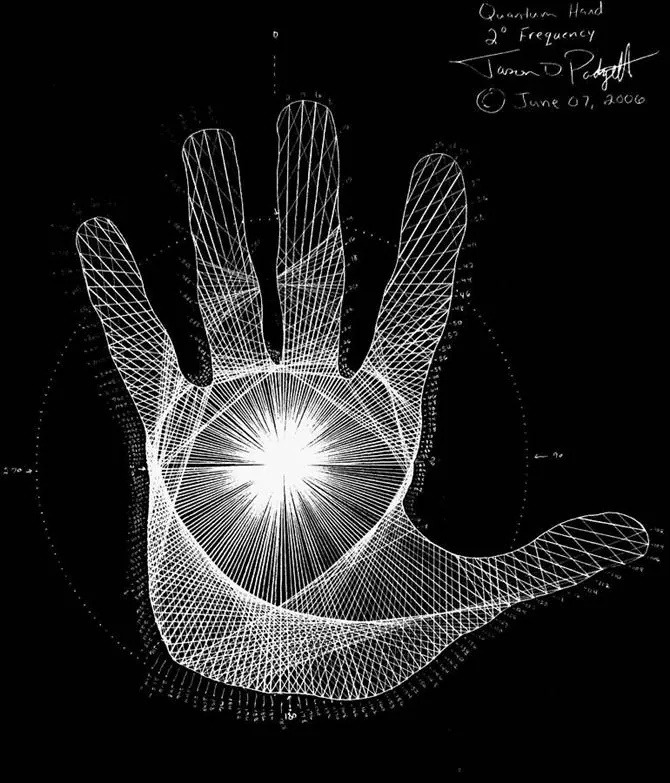
What he lacked was the language. He had no mathematical training, no vocabulary for the geometry filling his vision, so he started drawing instead. Complex geometric shapes and diagrams poured out of him, and he believed they explained the universe. He carried a notebook and pens everywhere, terrified of missing an idea when it arrived.
The Physicist at the Shopping Mall
One day, as the story is told, Jason Padgett was sitting in a shopping mall, drawing, when a stranger walked up and asked to see his work. The man studied the pages for a while, then said something that stopped Padgett cold: the drawing was mathematically highly accurate. In this telling, the stranger was himself a physicist, and he recognized the advanced mathematics on the page almost immediately. The encounter is reported but not fully verified, so treat it as part of Padgett's story rather than a documented event.
Padgett tried to explain himself as best he could. He said he was attempting to describe the discrete structure of space-time, working from the Planck length and quantum black holes. The stranger raised his eyebrows. He had noticed the sophisticated geometry right away, and he was astonished when Padgett told him he had no formal training at all. His suggestion was simple: take some classes, at least enough to learn the theoretical foundation behind what he was already drawing.
Within days, Padgett enrolled in a local college. That decision became the hinge of his life. It gave him the language he had been missing, a way to put into words what his eyes kept showing him. It also pushed him toward something he had been avoiding: treatment for the obsessive compulsive disorder that followed his head injury.
Years later, he wrote his life story in a book called Struck by Genius. A private compulsion had become a public path, and it started with a stranger in a mall who looked at a drawing and seemed to understand exactly what he was seeing.
What Acquired Savant Syndrome Actually Is
Jason Padgett's condition has a name: Acquired Savant Syndrome. It describes people who gain extraordinary abilities after the brain takes a hit, whether from an assault, a fall, a lightning strike, or an illness. Padgett is not a lone curiosity. He belongs to a small but well-documented cluster of people whose inner lives were rebuilt by injury, and their stories share a strange, repeating shape.
Take Derek Amato. He lost consciousness in a pool accident and came back an extraordinary musical composer, someone who could sit at a keyboard and let complex pieces pour out. Or Tony Cicoria, a doctor from New York, who was struck by lightning and afterward became a successful pianist and composer, gripped by a compulsion to play that he had never felt before. Alonzo Clemons suffered severe brain damage at a young age. He struggled developmentally, yet he developed a sculpting ability so precise that he could shape a horse's form with startling accuracy.
The pattern widens further. Daniel Tammet can run complex multiplication and division in his head without effort, and he can instantly tell you whether any number up to 10,000 is prime. Orlando Serrell developed complex calendar calculation after a blow to the head, naming the weekday of almost any past date on command. You may also come across the case of Adam G. Lopez, said to have gained advanced math, robotics, and programming skills after an injury, though that particular story is not reliably confirmed. These are only a few examples.
What unites them is not a single injury type or a single talent. It is the timing. The ability arrives after the person they used to be is interrupted, as if some locked door in the brain swung open when the wall around it cracked.
What the Brain Scans Showed
Berit Brogaard, a philosopher and neuroscientist at the University of Miami, put Jason Padgett inside an fMRI machine to see what his injured brain was actually doing. Functional magnetic resonance imaging tracks blood flow, which means it shows which regions light up when a person thinks. Brogaard had already spent years studying people like Padgett, and she wanted images, not anecdotes.
One leading idea is synesthesia. In Padgett's case, the senses seem to have gotten cross-wired, the way some people hear sounds as colors or feel words as textures on their skin. If math arrives through a sensory back door instead of the usual symbolic one, that could explain why someone who once struggled with basic algebra suddenly reads the geometry of the world.
Here is where the story gets murkier. Reports describe Padgett's brain images as showing intense activity in the left hemisphere, the side tied to mathematical skill, with the most striking signal in the left parietal cortex, a region where the brain stitches together information from different senses. Those specific imaging details have been reported but not confidently confirmed, so treat them as one account rather than settled science. What the field does agree on is that we still do not know whether changes like these are permanent. Nobody has watched an acquired savant's brain for decades and come back with a clean answer.
That open question is the honest heart of the Padgett case. A scan can show a brain working differently. It cannot yet tell you whether the rewiring holds, fades, or was there all along.
The Price of the Gift
Every one of us may be carrying the raw material for what Jason Padgett became. The catch is that our brains rarely wire the regions together, because in ordinary life there is simply no reason to. Savant talents rarely arrive alone. For Padgett, the price was post-traumatic stress disorder and obsessive compulsive disorder, both of which he has described openly in the years since the 2002 attack outside a karaoke bar in Tacoma, Washington.
He is not the only one paying. Across the documented cases of acquired savant syndrome, the same pattern keeps surfacing: schizophrenia, learning difficulties, or relentless headaches riding along with the new gift. The ability and the affliction seem to share a doorway.
What did the gift cost Jason Padgett?
Jason Padgett's acquired savant abilities came bundled with post-traumatic stress disorder and obsessive compulsive disorder, conditions he developed after being attacked outside a karaoke bar in Tacoma, Washington, in 2002. Other acquired savants have reported schizophrenia, learning difficulties, or severe headaches alongside their talents, which suggests the trade-off is built into the phenomenon rather than unique to him.
Years after the assault, one of the men who attacked him reportedly sent Padgett an apology letter. The name attached to that gesture in retellings is not something the record firmly confirms, so treat the signature with caution. Whether Padgett ever wrote back is unknown. If he did, the reply might not have been what you would expect from a man who was beaten unconscious and left with bruised kidneys and a concussion.
"I can't describe how good this feels. I see beauty everywhere. It's like I'm experiencing a mathematical awakening and everything around us is fascinating, almost like magic."
That is Padgett in his own words, and it lands strangely against everything that came before it. A mugging that could have ended his life instead handed him a lens he never asked for, and he would not trade it back. Not for the quiet, social, unremarkable version of himself who used to stumble into work hungover. The geometry stayed. So did the cost. He keeps both.
Frequently asked questions
Who is Jason Padgett and what happened to him in 2002?
Jason Padgett was attacked outside a karaoke bar in Tacoma, Washington, in 2002. Two men beat him, leaving him with a concussion and bruised kidneys. After the assault, he began perceiving the world in pixelated, geometric patterns and developed remarkable mathematical abilities, a case now known as Jason Padgett acquired savant syndrome.
What is acquired savant syndrome and how does it develop?
Acquired savant syndrome is a rare condition in which dormant abilities emerge after a brain injury. Padgett's case is one of several documented examples. Researchers believe the injury may unlock latent connections in the brain that are normally inactive, allowing extraordinary skills in mathematics, music, or art to surface unexpectedly.
Was Jason Padgett's mathematical ability linked to synesthesia?
Researchers believe synesthesia may play a role in Padgett's condition. In synesthesia, the senses become "cross-wired," so a person might perceive sounds as colors or words as physical textures. This blending of sensory pathways could help explain how Padgett began seeing mathematical structures in everyday objects after his injury.
What did neuroscientist Berit Brogaard find in Padgett's brain scans?
Berit Brogaard, a philosopher and neuroscientist at the University of Miami, studied Padgett using fMRI. According to one account, the scans reportedly showed intense activity in the left hemisphere and left parietal cortex. These specific imaging findings have been reported but are not fully confirmed by independent research.
Did Jason Padgett write a book about his experience?
Yes. Padgett wrote the memoir "Struck by Genius." He also enrolled in a local college to study mathematics, which helped him find language for what he was seeing and seek treatment for the obsessive compulsive disorder that followed his brain trauma.
What are other famous cases of acquired savant syndrome?
Derek Amato became a musical composer after a pool accident. Tony Cicoria, a doctor from New York, became a pianist and composer after being struck by lightning. Alonzo Clemons developed extraordinary sculpting ability after brain injury. Daniel Tammet can perform complex multiplication and division mentally and identify prime numbers up to 10,000. Orlando Serrell developed calendar calculation ability after a head injury.
What are the downsides of savant abilities like Padgett's?
Padgett developed PTSD and OCD following the attack. Other cases of acquired savant syndrome involve schizophrenia, learning difficulties, or severe headaches. The extraordinary abilities often arrive alongside serious challenges, which is why Padgett has said he would not give up his new skills despite the cost. Editorial note: Details that remain unconfirmed, including the precise nature of Padgett's perceptual experiences and the full extent of his abilities, are presented as reported rather than as established fact.
Got a take on this? Add your voice to the conversation below →
No comments yet. Be the first.