Istiklal Marsi Korkma Meaning: Why Akif Chose It in 1921
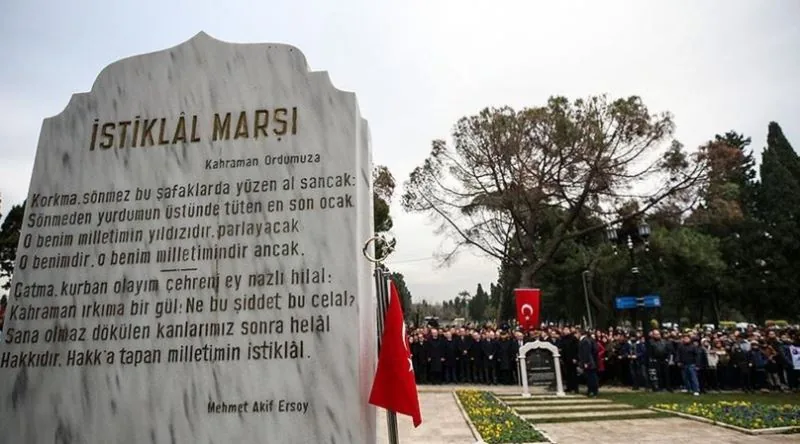
The first word of Turkey's national anthem, "Korkma" (Fear not), was chosen by poet Mehmet Akif Ersoy in 1921 to rally a nation facing foreign occupation and internal rebellions. The Istiklal Marsi Korkma meaning is rooted in defiance, a direct command to a people exhausted by war. It was a call to stand firm when the future of the homeland hung by a thread.
In 1921, with foreign troops occupying much of Anatolia and multiple uprisings threatening the resistance, Mehmet Akif Ersoy opened Turkey's national anthem with "Korkma" to replace fear with resolve. The word was a deliberate psychological weapon, urging citizens to trust their cause and their faith rather than the size of the enemy's army.
- Mehmet Akif Ersoy wrote the poem that became the Istiklal Marsi in 1921.
- The Turkish Grand National Assembly adopted the poem as the national anthem on March 12, 1921.
- At the time of writing, Allied forces occupied Constantinople (Istanbul), and Greek troops were advancing deep into western Anatolia.
- Several internal rebellions against the Ankara government were active in 1921, diverting troops from the main battlefronts.
- Ersoy addressed the people directly with the command to not fear, rather than glorifying symbols of victory.
The Word That Opens a Nation's Heart
Every Turkish schoolchild learns it by heart, but few stop to ask why it begins the way it does. The İstiklal Marşı, Turkey's national anthem, opens with a single commanding word: "Korkma," meaning "Fear not." It was officially adopted on 12 March 1921 by the Turkish Grand National Assembly, and the poet behind it, Mehmet Akif Ersoy, made a deliberate choice when he put that word first. The question is not whether the anthem is beautiful, but why a nation on the edge of collapse needed to be told, before anything else, not to be afraid.
To understand the weight of that opening word, you have to picture what the country looked like in the winter of 1921. The War of Independence was raging, and the map was being redrawn almost weekly by foreign boots on Turkish soil. İzmir had been under Greek occupation since May 1919, and the Greek commander-in-chief's headquarters had moved there. Bursa had fallen to the Greeks in July 1920. British forces had pulled out of Eskişehir and Afyon, and the Greeks had marched straight in behind them. Ardahan and Artvin had become Georgian territory and were then captured by the Red Army. Marmaris sat in Italian hands. Maraş had been under French occupation but had been liberated in February 1920, while Urfa's French occupiers had withdrawn after a bitter siege. Even leaving Istanbul, the Ottoman capital, required a visa from the Allied authorities if you were an Ottoman citizen.
And that was just the outside. Inside, the land was tearing itself apart with uprisings, many of them encouraged or organized by foreign powers. The Ali Batı rebellion, the three Bozkır rebellions, the Şeyh Eşref uprising, the two Anzavur revolts, the two Düzce rebellions, the Konya rebellion, the Zile rebellion, the Milli Aşireti uprising and its second wave, the Çapanoğlu rebellion, the second Yozgat revolt, the Koçgiri rebellion. All of these erupted between 1920 and 1921, pulling the young national movement in a dozen directions at once. A person in any village, town, or city genuinely could not know whether they would end up under Greek, Italian, French, Armenian, Soviet, or British rule, or whether they would stay among their own people.
So when Ersoy sat down to write, he was not composing a poem for a quiet library. He was writing a rallying cry for a people who had every reason to despair. The first word had to do the work of an entire speech. "Korkma" was not poetic flair. It was a command, a reassurance, and a promise all folded into one syllable, spoken to a nation that needed to hear it more than any other word in the Turkish language.
1921: A Map of Occupation
Picture the map of Anatolia in March 1921, and you will understand why the first word of the Istiklal Marsi Korkma meaning matters so deeply. The Turkish Grand National Assembly adopted the national anthem on 12 March 1921, and on that very day, foreign flags flew over nearly every corner of the homeland.
Greek forces held Izmir, where their commander-in-chief had moved the high command headquarters, and Bursa had been under Greek control since July 1920. When British troops pulled out of Eskisehir and Afyon, the Greeks moved straight in. French soldiers kept Gaziantep under siege, though the city never surrendered and would later be ceded back to Turkey. Urfa had seen the French withdraw in early 1920. Maras had been liberated in February 1920 after French occupation. Italians controlled Marmaris and stretches of the southwest coast. Up in the northeast, Ardahan and Artvin had fallen under Georgian control, and the Red Army had swept through those territories as well.
Istanbul, the Ottoman capital, sat under Allied occupation. If you were an Ottoman citizen, you needed a visa just to leave the city. The heart of the empire had become a guarded prison.
Every region faced a different occupier. Would a village wake up Italian, Greek, French, or Soviet? No one could say. That uncertainty, that daily threat of losing your hometown to a foreign power, shaped the desperation of the moment. When Mehmet Akif Ersoy wrote the anthem, he was not crafting poetry for a peaceful nation. He was writing a rallying cry for people who did not know if their street would still be theirs by sunset.
The Enemy Within: Uprisings Across the Land
The foreign armies were only half the story. By the time the İstiklal Marşı Korkma meaning took shape in early 1921, the Ankara government was fighting a second war, one fought against its own people. The rebellions came in waves, and each one drained soldiers and attention away from the Greek front.
The list reads like a roll call of desperation. In 1920 alone, the Ali Batı uprising erupted in the Beytüşşebap area, followed by three separate Bozkır rebellions in the Konya region. Şeyh Eşref led a small revolt in Sivas. Ahmet Anzavur organized two uprisings around Balıkesir and Manyas. The Düzce region saw two distinct rebellions, and Konya experienced the Delibaş rebellion, led by Delibaş Mehmet. Zile rose up in the Tokat region. The Milli tribal confederation rebelled twice in Urfa and Diyarbakır, and the Çapanoğlu family led two Yozgat uprisings. The Koçgiri rebellion, led by Kurdish Alevi tribes, simmered through 1920 and 1921 in Sivas and Dersim.
Foreign powers orchestrated many of these revolts, using them to destabilize the nationalist movement from within. One popular story claims that Demirci Mehmet Efe and Çerkez Ethem joined forces in a single rebellion. That version is wrong. These were separate figures; Ethem turned against the government in early 1921, while Mehmet Efe stayed loyal to Ankara.
Every village, every town, every city faced the same terrible question: would it remain Turkish, or fall to Greek, French, Italian, Armenian, Soviet, or British control? The sheer number of internal conflicts compounded the chaos. A nation fighting for its life on the outside was also bleeding from within. That is the world in which Mehmet Akif Ersoy sat down to write a poem meant to hold a fractured country together.
Why "Korkma" Was the Only Word That Fit
On 12 March 1921, when the Turkish Grand National Assembly officially adopted the İstiklal Marşı as the national anthem, the word "Korkma" ("Don't fear") was not poetry. It was a direct answer to a nation asking whether it would survive the week. Mehmet Akif Ersoy did not choose that opening line for literary effect; he chose it because fear was the most honest thing in the room, and courage was the only thing that could answer it.
Picture the map of Anatolia in that exact moment. İzmir had been Greek territory since May 1919, and the Greek commander-in-chief's headquarters had moved there. Bursa had fallen to Greek forces in July 1920. British troops had pulled out of Eskişehir and Afyon, and Greek soldiers walked straight in behind them. Ardahan and Artvin had become Georgian territory, then the Red Army captured them. Marmaris sat in Italian hands. Urfa had been French territory until the French withdrew after the siege. Maraş had suffered French occupation from 1919 until Turkish forces liberated it in February 1920. To leave Istanbul, the Ottoman capital, a citizen needed a visa just to step out of the city.
And that was only the outside. Inside, the rebellions were relentless. The First, Second, and Third Bozkır uprisings shook the Konya region. The Koçgiri rebellion spread through Sivas and Dersim. The Çapanoğlu rebellion rose in Yozgat, followed by a second Yozgat uprising. Two Düzce rebellions, two Milli Aşireti rebellions, the Ali Batı rebellion, the Zile rebellion, the Şeyh Eşref rebellion, two Anzavur uprisings in Balıkesir and Manyas, and a rebellion in Konya all erupted against the Ankara government.
So when Akif wrote that single word, he was speaking to people who genuinely did not know whether their village would wake up Greek, French, Italian, or Armenian. The Istiklal Marsi Korkma meaning was never abstract. It was a man telling his neighbors, in the most direct possible Turkish, that despair was not an option. He could have opened with a grand image of victory or a sweeping historical claim. Instead, he addressed the trembling in a mother's hands and the uncertainty in a father's eyes. He named the fear, and then he told it to leave.
That is why the word works. A rallying cry only lands when it acknowledges what it is fighting against. Akif did not pretend the country was safe. He stood in the middle of the chaos, listed nothing, and simply said: do not be afraid. Faith and resilience were the weapons he handed to a people who had every reason to break. The word was not a denial of reality. It was a refusal to let reality win.
Frequently asked questions
What does "Korkma" mean in English?
"Korkma" translates directly to "Fear not" or "Don't be afraid." It is the very first word Mehmet Akif Ersoy chose to open the Turkish national anthem, and it was no accident. In a single word, he addressed a nation staring down invasion from multiple directions and told them to hold their ground.
When was the Istiklal Marsi officially adopted?
The Turkish Grand National Assembly officially adopted the Istiklal Marsi as the national anthem on 12 March 1921. The timing matters deeply. On that exact day, Turkish territory was carved up by foreign powers, and the words of the anthem were meant to steady a people in the middle of that storm.
Which foreign powers occupied Turkish territories in 1921?
Greece, France, Italy, and the Allied forces, including Britain, all held parts of Anatolia in 1921. Greek troops occupied Izmir and Bursa, French forces had a grip on the south, Italians controlled Marmaris, and British troops had been present in Eskisehir and Afyon before Greek forces took over those positions.
How many internal rebellions occurred during the Turkish War of Independence?
The original account lists over a dozen distinct uprisings inside Anatolia during the independence struggle. Historians may count them differently, but the documented ones include the Ali Batı rebellion, three separate Bozkır uprisings, two Anzavur revolts, two Düzce uprisings, the Konya rebellion, the Zile rebellion, the Milli Aşireti rebellion, the Çapanoğlu rebellion, and the Koçgiri rebellion, among others. Editorial note: Some details regarding the poet's personal drafting process remain unconfirmed and are presented as such, while the timeline of the occupation and the official adoption date are verified facts.
Got a take on this? Add your voice to the conversation below →
No comments yet. Be the first.