Attila the Hun's Burial: River Diversion Mystery
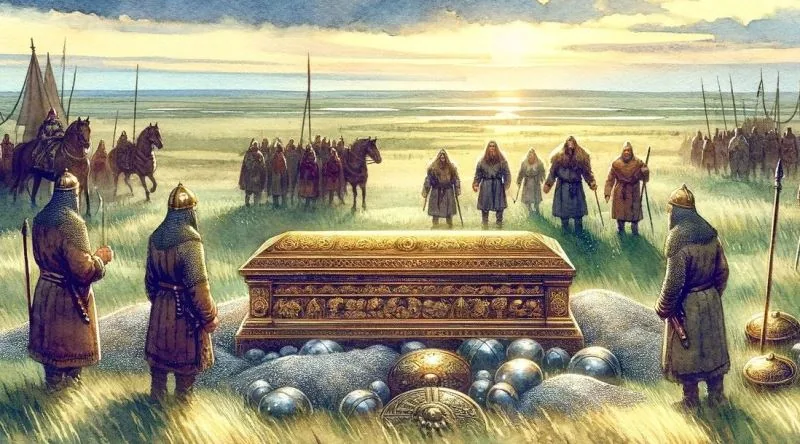
Attila the Hun's burial remains one of history's most enduring mysteries, with the legendary account claiming his body was laid to rest in the Tisza River after its course was diverted in 453 AD. The story of Attila's burial has captivated historians and treasure hunters for over 1,500 years, blending brutal ceremony with the poignant finality of a warrior king who shaped Europe's destiny. The tale speaks to something primal in us: the desire to protect a great leader's final resting place from desecration, even if it means rewriting a river's path.
The Roman historian Jordanes, writing in the 6th century, recorded that Attila the Hun was buried in 453 AD in a triple-layered coffin, with his followers diverting the Tisza River to hide the grave. After burial, they restored the water's flow and killed everyone involved in the funeral to keep the location secret. No grave has ever been found.
- Attila the Hun died in 453 AD, reportedly on his wedding night, according to the account of Priscus that Jordanes later drew upon.
- The Tisza River, located in modern-day Hungary, is the traditional site named in the burial legend, though no physical evidence has emerged.
- Jordanes, writing his work Getica around 551 AD, is the main surviving source for the river diversion story, drawing on earlier accounts now lost.
- The funeral reportedly included a triple coffin of gold, silver, and iron, symbolizing Attila's wealth, his military conquests, and his status as a warrior.
- The slaves who built the grave were killed afterward, a practice meant to ensure that no one could ever reveal the burial site.
A River That Hides a King
The Tisza River winds quietly through the Hungarian plains today, but according to legend, its waters hide one of history's most famous secrets: the final resting place of Attila the Hun. Attila died in 453 AD, reportedly on his wedding night, and the story says his followers buried him beneath the riverbed itself. Whether any of this actually happened remains one of history's most tantalizing mysteries.
The whole tale comes to us through a fascinating game of telephone that spans centuries. Around 551 AD, a Roman historian named Jordanes wrote "De origine actibusque Getarum," or simply "Getica," a history of the Goths that included a detailed account of Attila's burial. But Jordanes wasn't an eyewitness to anything he described. He relied heavily on the notes of Priscus, a Roman diplomat who likely met Attila in person during diplomatic missions to the Hunnic court.
Here's where things get tricky. Priscus's original writings survive only in fragments today. The bulk of his work, including whatever he wrote about Attila's death and burial, has been lost to time. That means everything we think we know about what happened on the banks of the Tisza comes filtered through Jordanes, writing nearly a century after the events. It's a second-hand account of a story that was already legendary by the time it was written down.
For what it's worth, the account describes something extraordinary. Attila's body was allegedly placed inside three nested coffins: an inner layer of iron to reflect his warrior nature, a middle layer of silver symbolizing his empire's wealth, and an outer casing of pure gold stripped from conquered territories, including Rome itself. His riders supposedly circled the coffin on horseback, cutting their faces with swords, mourning their leader with blood rather than tears.
The most dramatic detail involves the river itself. According to Jordanes, thousands of workers temporarily diverted the Tisza's course, dug a grave in the exposed riverbed, and placed Attila's treasure alongside his body. Then the waters were released, flowing back over the grave like a natural fortress. Every single worker who participated in the burial was killed on the spot, ensuring the location would die with them.
Modern scholars, understandably, approach this story with raised eyebrows. The account is vivid, cinematic, and utterly unverifiable. No archaeological evidence has ever emerged to confirm that Attila rests beneath the Tisza, and the practical challenges of diverting a major river with ancient technology would have been staggering. The story may be true, or it may be a magnificent piece of propaganda designed to elevate Attila from mortal conqueror to eternal legend.
The Impossible Burial
When Attila the Hun died in 453 AD, his body was not lowered into ordinary ground. Instead, the most feared ruler Europe had ever seen was sealed inside three nested coffins: an inner shell of iron, a middle layer of silver, and an outer casing of solid gold. The iron spoke to his relentless warrior nature. The silver reflected the reach of his empire. And the gold, much of it stripped from Rome itself, glittered as proof of absolute power.
Before the burial, Hun warriors reportedly rode their horses in circles around the coffin, slashing their own faces with swords until blood ran down their cheeks. For them, a leader of this magnitude deserved mourning in blood, not in the tears women might shed. The scene, as described by the 6th-century Roman historian Jordanes in his work Getica, remains one of the most vivid images of Hun funeral custom.
Then came the part that strains belief. According to Jordanes, who drew from the now-lost notes of the Roman diplomat Priscus, thousands of workers temporarily diverted the course of the Tisza River in Hungary. With the riverbed exposed, Attila's triple coffin was placed in the muddy bottom, along with treasures gathered from countless campaigns. The water was then released back into its original channel, sealing the grave beneath an impassable shield of rushing current.
To ensure the secret never leaked, every witness was killed. The builders who shaped the diversion, the slaves who dug the pit, all of them met the sword the moment the work was done. Only a handful of Hun nobles knew where the great king rested, and most of those died in the infighting that followed Attila's death.
It is a breathtaking story. Whether it actually happened is another question entirely. The engineering feat alone would have been enormous, and preserving a body that long in the open air presents obvious problems. Modern researchers treat the account with caution, noting that a nearly identical tale surrounds Alaric I, the Visigoth king buried in 410 AD after the Busento River was diverted for the same purpose. The parallel suggests a literary pattern of the era rather than a literal record of events. Attila's burial may forever remain a mystery, hidden somewhere beneath the Tisza's flowing waters, or perhaps nowhere at all.
A Legend Too Familiar
Modern archaeologists read the Tisza River story with raised eyebrows, and the more they dig into it, the more the grand tale starts to crack. It is not that they doubt the Huns were capable of dramatic gestures. It is that the details do not hold up to practical scrutiny.
The river's historical flow is the first problem. Diverting a waterway like the Tisza would have been a massive undertaking, not the quick operation the legend implies. Corpses do not wait patiently for engineering projects. In the summer heat of the Hungarian plains, preserving Attila's body through such an extended operation would have been a logistical nightmare that the story never addresses.
Then there is the uncomfortable matter of déjà vu. A strikingly similar burial tale exists for Alaric I, the Visigothic king who died in 410 AD in southern Italy. According to the account, his followers diverted the Busento River, buried him in its exposed bed, and then executed every worker who had handled the task. The parallel with Attila's story is almost exact, down to the murdered laborers.
Two warrior kings, two diverted rivers, two massacres of witnesses. Scholars see a pattern here, and it is not a coincidence. This was a literary trope, a propaganda tool that warrior cultures across the ancient world used to mythologize their leaders. For a people like the Huns, who had no written tradition of their own, placing the leader in an unreachable place, nature itself, was the surest way to immortalize him. The story may have been less about where Attila actually rested and more about crafting a legend that would outlive any grave.
Still Waiting Under the Water
The golden coffin of Attila remains one of history's great unsolved puzzles. Some accounts claim various Hungarian and Austrian researchers have searched the Tisza basin since the 1800s, but there is no well-documented systematic search specifically for Attila's grave. None have ever turned up a single piece of physical evidence, and the question still hangs in the air today.
Is the triple coffin still sitting somewhere beneath that murky current? Or was the whole story a carefully crafted legend, built to solidify Hun authority after Attila's death in 453?
The searches have come up empty, and the story refuses to resolve itself. Attila left behind ruined cities and an unsolved mystery, now lost to history. The river keeps its secret, flowing on as if nothing ever happened.
Frequently asked questions
What happened at Attila's burial?
Jordanes, writing his Getica around 551 AD, describes a ceremony that reads more like legend than history. When Attila died in 453 AD, his body was placed in three nested coffins: an inner layer of iron, a middle layer of silver, and an outer shell of gold. The Tisza River was supposedly diverted, the coffins lowered into the dry riverbed, and the water released to cover the grave forever. The workers who carried out the burial were then killed so no one could reveal the location.
Why was Attila buried in a river?
The purpose was to hide the grave from enemies and raiders who might desecrate it or steal the treasures buried alongside the Hun king. According to Jordanes, the river's current served as an impassable barrier, sealing Attila's resting place beneath tons of water and mud. It was a way to make the tomb permanently unreachable.
Who wrote about Attila's river burial?
The 6th-century historian Jordanes recorded the account in his work De origine actibusque Getarum , commonly known as the Getica . He based his narrative on the now-lost notes of Priscus, a Roman diplomat who had actually met Attila in person. This makes the story a secondhand account passed through two authors, which is why historians treat its details with caution.
How did workers divert the Tisza River?
The story claims thousands of workers temporarily changed the river's course, dug a deep grave in the exposed riverbed, and then restored the water's natural flow. However, scholars seriously doubt this was feasible. The Tisza's strong current would have required massive engineering work, and keeping Attila's body preserved during that time would have been nearly impossible with the technology of 453 AD.
Was Attila's burial similar to Alaric's?
Yes, a nearly identical tale exists for Alaric I, the Visigoth king who was reportedly buried in the Busento River in southern Italy in 410 AD. In that story, the river was also diverted, the body buried in its bed, and the workers killed. The striking parallel between the two accounts suggests this was a common literary motif of the era, used to elevate warrior leaders into mythic figures.
Has Attila's grave ever been found?
No. Some accounts claim various Hungarian and Austrian researchers have searched the Tisza basin since the 19th century, but there is no well-documented systematic search specifically for Attila's grave, and none has produced concrete evidence. The golden coffin, if it exists, remains hidden somewhere beneath the murky waters, and Attila's burial continues to be one of history's unsolved mysteries. Editorial note: Some details in this account come from ancient sources that cannot be independently verified, and any facts which remain unconfirmed are presented as such, hedged accordingly.
Got a take on this? Add your voice to the conversation below →
No comments yet. Be the first.