Göbekli Tepe: The 11,000-Year-Old Temple That Rewrote Prehistory
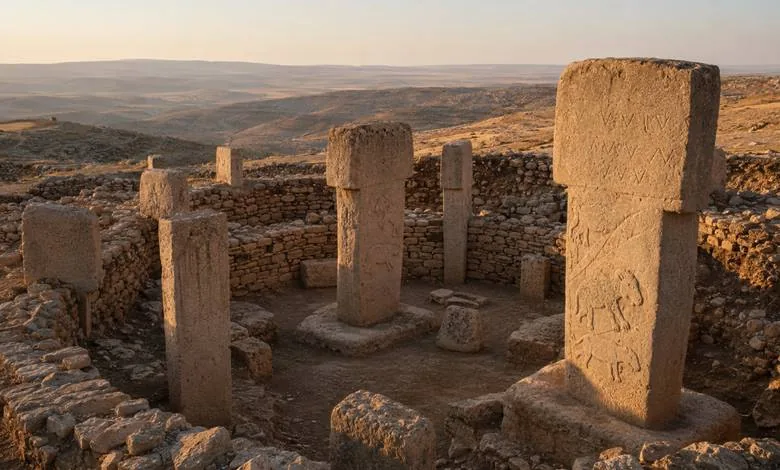
Göbekli Tepe is an 11,000-year-old monumental site in southeastern Turkey, built by hunter-gatherers before the invention of farming. Long before Stonehenge or the pyramids, people who lived by hunting and gathering carved massive T-shaped pillars and animal figures, then deliberately buried the whole complex. The discovery overturned a long-held assumption that complex societies only emerged after agriculture. It also raised a question that still drives research today: what moved these people to build something so enormous?
Göbekli Tepe is a roughly 11,000-year-old archaeological site in southeastern Turkey, raised by hunter-gatherers around the time farming was first getting started. Its T-shaped limestone pillars, many carved with animal imagery, predate Stonehenge by thousands of years. Researchers believe it served as a ritual gathering place and may have been deliberately buried.
- Göbekli Tepe sits on a hilltop in southeastern Turkey and dates to roughly 11,000 years ago, making it far older than Stonehenge or the Egyptian pyramids.
- Its builders were hunter-gatherers living during the earliest stages of the shift toward farming, which challenged the idea that agriculture had to come first and complex society followed.
- The site's most striking features are T-shaped limestone pillars, some weighing many tons, often decorated with carvings of animals such as foxes, snakes, and birds.
- German archaeologist Klaus Schmidt, who led excavations from the 1990s, argued that the site was a ritual center rather than a settlement.
- At some point in its history, the enclosures were intentionally filled in with rubble and earth, a deliberate burial that remains a subject of debate.
A Bare Ridge in Southeastern Turkey That Broke the Timeline
Head northeast out of Şanlıurfa, in southeastern Turkey, and the land turns pale and stony. About 15 km along, a bare limestone ridge rises above the fields. That ridge is Göbekli Tepe, and it has quietly wrecked the tidy story we like to tell about prehistory.
The standard version goes like this: people roamed as hunter-gatherers, then discovered farming, then settled down, and only after all that did they build anything grand. Göbekli Tepe refuses to cooperate. Its enclosures date to roughly 9500 to 8000 BCE, which plants them in the Pre-Pottery Neolithic A and the early B, before pottery, before metal, before the familiar machinery of "civilization."
Here is the part that makes people sit up. Stonehenge's main sarsen phase belongs to around 2500 BCE, and the Giza pyramids to roughly 2560 BCE. Göbekli Tepe is therefore about 7,000 years older than both. The popular retelling often splits the gap into 6,000 years for one and 7,000 for the other, and that split simply does not hold up.
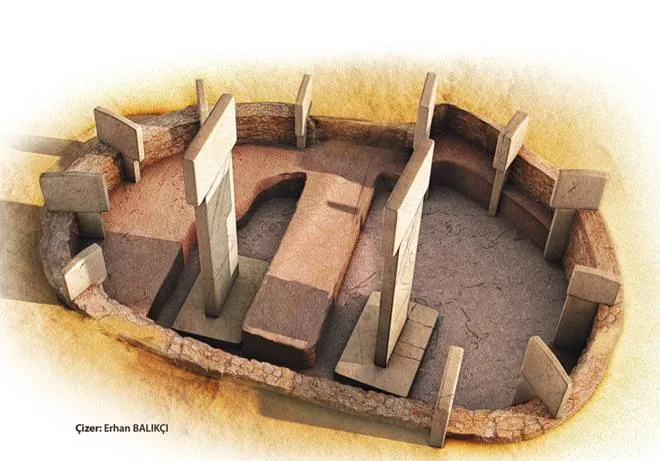
What actually stands on the ridge is a set of circular and oval enclosures, labeled A through H, the largest reaching about 20 meters across. Their edges are lined with massive T-shaped limestone pillars, and the biggest of these are estimated at up to 20 tons. The surfaces are carved with foxes, boars, bulls, snakes, scorpions, vultures, lions, cranes, and abstract symbols, cut with a control that still startles people who study stone.
One number you will see repeated is that all 200-odd pillars measure 5.5 meters and weigh 15 tons each. That blanket figure does not match the evidence. Around 200 pillars have indeed been documented, but they vary widely in size, so a single uniform measurement flattens what is actually a very uneven set of monuments.
None of this was a secret until recently. UNESCO added Göbekli Tepe to its World Heritage list in 2018, recognizing it as one of the earliest known examples of monumental stone architecture anywhere on earth. Long before that listing, though, the ridge had already forced archaeologists to rethink what people without farms or cities were capable of building.
Twenty-Ton Pillars Carved by People Who Hadn't Farmed Yet
Göbekli Tepe sits on a bare limestone ridge in southeastern Turkey, about 15 kilometers northeast of Şanlıurfa, and it is dated to roughly 9500 to 8000 BCE. That single fact rearranges a lot of assumptions. The site is not one building but a series of circular and oval enclosures, labeled A through H, and the largest of them reaches about 20 meters across.
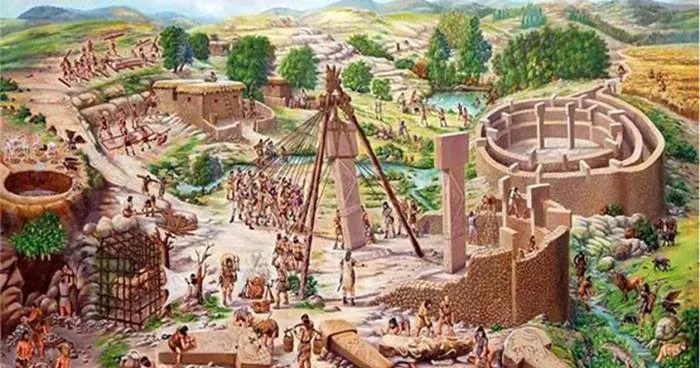
What holds those circles together is stone. Monolithic T-shaped limestone pillars stand around the edges, and the biggest are estimated at up to 20 tons each. Picture the work: quarrying blocks of that weight, dragging them, shaping them with tools that were not metal, then raising them upright in a ring. Hundreds of people had to move together to pull it off.
The surfaces of those pillars carry a whole bestiary cut in relief: foxes, boars, bulls and aurochs, snakes, scorpions, vultures, lions, cranes, plus abstract symbols that nobody has fully decoded. This is not rough, hurried work. The carving is confident and deliberate.
Why the Usual Story Runs Backward Here
The standard account of civilization goes like this: people hunted and gathered, then discovered farming, then surplus grain freed up labor, and only then could anyone build anything monumental. Göbekli Tepe is one of the world's oldest known examples of monumental architecture, and it turns that sequence on its head. The building came first.
How far "first" goes is where the story gets slippery. The popular version says the builders had not yet domesticated plants or animals, had made no pottery, used no metal tools, and lived in no permanent settlements. That absolute framing is too strong. The site is broadly contemporary with the earliest stages of the Neolithic transition, and evidence points to some plant processing and possibly early domestication in the surrounding area. So the clean slogan, ritual architecture before the Neolithic Revolution, is partly right and partly overstated.
German archaeologist Klaus Schmidt, who directed excavations from 1994 until his death in 2014, read the place as a regional ritual center. In his interpretation, mobile hunter-gatherer groups from different areas came together here at certain times of year. If that reading holds, belief and ritual could organize large numbers of people long before farming did.
Klaus Schmidt and the Idea of a Regional Ritual Center
In 1994, a German archaeologist named Klaus Schmidt took charge of excavations at Göbekli Tepe on behalf of the German Archaeological Institute, and he kept that job until his death in July 2014. For two decades he was the site's most stubborn interpreter, and the reading he pushed became the one most people know. Schmidt called Göbekli Tepe a sanctuary: a regional ritual gathering place where mobile hunter-gatherer groups from different areas came together at set times of the year.
Think about what that claim asks you to accept. The enclosures at Göbekli Tepe are ringed by giant T-shaped limestone pillars, and the heaviest of them weigh up to about 20 tons. Nobody drags a block like that alone. Someone had to quarry it, haul it, carve it and stand it upright, and that kind of job pulls in hundreds of people working in concert. Schmidt's conclusion followed from the muscle, not just the art: if these groups could organize themselves around belief and ritual, then shared faith was already binding people together before farming ever did.
It is a neat reversal of the usual script. In the standard telling, people settled down, grew crops, built up a surplus, and only then found the time and the manpower for monuments. Göbekli Tepe, dated to roughly 9500 to 8000 BCE, sits on the wrong side of that sequence. The scale of the construction implies coordination, and coordination implies something worth gathering for. Schmidt's answer was the gathering itself.
He did not live to see the argument settled, because it never was. His sanctuary idea remains the framework most later work has to argue with, whether researchers are measuring pillar alignments, tracing animal reliefs, or asking what drew scattered communities to a bare ridge near Şanlıurfa in the first place. The stones are the evidence. The reason those hundreds of hands showed up is still the open question.
Why Was Göbekli Tepe Deliberately Buried?
Here is the strangest thing about Göbekli Tepe: the people who built it also filled it in. Each circular enclosure was intentionally packed with rubble, stone, earth, bone and assorted debris, and later structures were raised on top of the buried ones. This was not collapse or neglect. It was a decision, repeated enclosure after enclosure.
You will often see this infilling described as a process that ran for roughly two thousand years before the place was finally abandoned and covered over. That long figure is not firmly established. Use of the ridge spans something closer to a millennium or more, from Layer III down into Layer II, so the two-thousand-year span is best treated as an open question.
Then comes the second jolt. Göbekli Tepe is not alone. Survey work across the Şanlıurfa region, grouped today under the Taş Tepeler project, has turned up numerous contemporaneous sites: Karahan Tepe, Nevalı Çori, Sefer Tepe, Hamzan Tepe. Many of them have barely been touched by a trowel.
Karahan Tepe sits in the same Taş Tepeler landscape and dates to roughly the same Pre-Pottery Neolithic period. It has its own T-shaped pillars, its own special structures, its own symbolic reliefs. Whatever was happening on that bare ridge near Şanlıurfa was not a one-off experiment by a single group. It looks more like a shared tradition, spread across a region, practiced by people who knew each other's monuments.
So the burial is not really a footnote to the story of Göbekli Tepe. It may be the story. A sanctuary that was carefully closed, sealed with debris, and then built over, again and again, while similar sanctuaries rose and fell nearby.
The Equilateral Triangle Hidden in the Enclosures
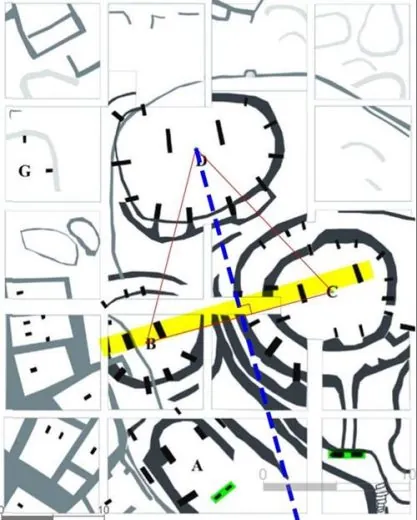
In 2020, two researchers at Tel Aviv University, Gil Haklay and Avi Gopher, published a study in the Cambridge Archaeological Journal that ran the plan of Göbekli Tepe's main structures through a special algorithm. What came back was not noise. The center points of three large circular enclosures, labeled B, C and D, lined up into a nearly equilateral triangle.
Sit with that for a second. An equilateral triangle is not something you stumble into by piling rocks where they happen to fall. It means someone, roughly 11,000 years ago, was holding a sense of proportion and distance in their head while directing a crew of hundreds across a bare limestone ridge in southeastern Turkey.
The claim is not that the builders drafted blueprints. Haklay and Gopher's point is narrower and stranger: the layout of Enclosures B, C and D suggests a level of geometric intention that hunter-gatherers were not supposed to have. The old story said monumental architecture waited for farming, for surplus grain, for villages and specialists. Here the geometry shows up first, carved into the ground by people who, by most accounts, were still moving with the seasons.
Three enclosures. Three center points. One nearly equilateral triangle. The arrangement is the kind of thing you get when someone is measuring, not guessing.
It fits a pattern that keeps surfacing at Göbekli Tepe. The T-shaped pillars, the carved animals, the sheer tonnage of stone moved before pottery or metal, all of it points to organized minds at work. The triangle is simply the cleanest piece of evidence yet that those minds understood space in a way the textbooks did not expect.
Whether the triangle was deliberate or a happy accident is still argued over. But the algorithm did not invent the alignment. It just measured what was already there, waiting under the dirt.
Could Göbekli Tepe Hold the World's First Calendar?
Some researchers have proposed that Göbekli Tepe, the roughly 11,000-year-old site near Şanlıurfa in southeastern Turkey, was not only a ritual center but also a symbolic place for watching the sky. Martin B. Sweatman and Dimitrios Tsikritsis argued this case in a 2017 paper in Mediterranean Archaeology and Archaeometry. Their reading of certain V-shaped markings as the days of a 365-day calendar is a hypothesis, not an established fact.
Here is the arithmetic that caught their attention. A solar year runs about 365 days. Twelve lunar months add up to roughly 354 days. That leaves a gap of about 11 days between the two cycles, and any society trying to track time by both the Sun and the Moon has to deal with it somehow.
Sweatman's team suggested the V-marks might encode exactly those extra 11 days, a way of reconciling the lunar count with the solar year. That specific claim is not widely accepted among archaeologists, and it remains a contested interpretation rather than a settled one. The broader astronomical reading of the site is debated too, with critical responses appearing in journals such as Cambridge Archaeological Journal and Time and Mind.
The most famous carved pillar at the site is Pillar 43, often called the Vulture Stone. Its reliefs include vultures, a scorpion and other figures, and it is these carvings, along with the V-shaped marks, that sit at the center of the calendar argument.
The idea has a companion site. Karahan Tepe lies in the same Taş Tepeler region as Göbekli Tepe and dates to roughly the same period, with similar T-shaped pillars and symbolic reliefs. Sweatman and colleagues have also linked some V-shaped markings there to timekeeping, though that too is a contested interpretation.
Sweatman published a 2024 paper in Time and Mind arguing that representations of calendars and time at both Göbekli Tepe and Karahan Tepe support an astronomical reading of their symbolism. Whether the V-marks really count days, or mean something else entirely, is a question the stones have not settled.
Karahan Tepe and the Wider Taş Tepeler Debate
Head about 50 kilometers east of Göbekli Tepe, still inside Şanlıurfa province, and you reach Karahan Tepe. It sits in the same Taş Tepeler, or "Stone Hills," a cluster of Pre-Pottery Neolithic sites scattered across southeastern Turkey. Karahan Tepe dates to roughly the same period as Göbekli Tepe, and its excavators describe the same toolkit of monuments: T-shaped pillars, purpose-built structures, and symbolic reliefs carved into the stone (Karul, Anatolian Archaeology, 2021).
That resemblance is the whole point. Göbekli Tepe stops looking like a one-off miracle and starts looking like the most famous member of a family. The Turkish Ministry of Culture's Taş Tepeler project lists Karahan Tepe alongside Nevalı Çori, Sefer Tepe, and Hamzan Tepe, and many of these sites have barely been touched by a trowel. Whatever the builders were doing, they were doing it across a region, not at a single address.
Where the Calendar Argument Goes Next
Karahan Tepe matters to the calendar hypothesis because researchers have linked some of its V-shaped markings to time calculation, the same reading they apply to marks at Göbekli Tepe. That claim comes from M. B. Sweatman and colleagues in a 2024 paper in Time and Mind. In that same paper, Sweatman argues that representations of calendars and time at both sites together support an astronomical interpretation of their symbolism.
It is a striking idea, and it is genuinely contested. Mainstream archaeologists remain largely skeptical of the archaeoastronomical and calendar readings, so the debate is live rather than settled. The pillars are real. The V-marks are real. What they meant to the people who cut them is still an open question.
Two sites, one region, one unresolved question: were these enclosures ritual gathering places, sky-watching instruments, or both at once? Karahan Tepe keeps the argument from closing too early.
Frequently asked questions
What is Göbekli Tepe and why is it important?
Göbekli Tepe is a Neolithic site on a bare limestone ridge about 15 km northeast of Şanlıurfa in southeastern Turkey, dated to roughly 9500-8000 BCE. It is among the world's earliest known monumental stone architecture, built from circular enclosures up to about 20 meters across and bounded by giant T-shaped limestone pillars weighing up to 20 tons each.
How old is Göbekli Tepe compared to Stonehenge and the Egyptian pyramids?
Göbekli Tepe, dated to approximately 9500-8000 BCE, is roughly 7,000 years older than both. Stonehenge's main sarsen phase belongs to about 2500 BCE, and the Giza pyramids in Egypt rose around 2560 BCE, so the site near Şanlıurfa predates these famous monuments by several millennia.
Who built Göbekli Tepe if agriculture did not exist yet?
Mobile hunter-gatherer groups built it. The common claim that its builders had domesticated nothing at all is too strong, since the site is contemporary with the earliest stages of the Neolithic transition and evidence points to some plant processing and possibly early domestication nearby. So the picture is more gradual than the popular version suggests.
Was Göbekli Tepe really the world's first calendar?
No, not as settled fact. Researchers M. B. Sweatman and colleagues argued in 2017 and again in a 2024 paper in Time and Mind that V-shaped markings, especially on Pillar 43, may encode a 365-day solar calendar and track the roughly 11-day gap between a solar year and 12 lunar months. Mainstream archaeologists remain largely skeptical, so this is a contested hypothesis.
Why was Göbekli Tepe deliberately buried and abandoned?
The circular enclosures were intentionally infilled with rubble, earth, bone and debris, and later structures were built on top of them. The often-repeated figure of a 2,000-year burial process is not firmly established. The site was used across Layer III and Layer II over roughly a millennium or more before being abandoned and covered.
Who was Klaus Schmidt and what did he discover at Göbekli Tepe?
Klaus Schmidt was the German archaeologist who led excavations at Göbekli Tepe from 1994 until his death in July 2014, working under the German Archaeological Institute. He interpreted the site as a regional ritual center, a sanctuary where mobile hunter-gatherer groups from different areas gathered periodically.
What role does Karahan Tepe play in the Göbekli Tepe calendar debate?
Karahan Tepe lies in the same Taş Tepeler region near Şanlıurfa and dates to roughly the same Pre-Pottery Neolithic period. It has similar T-shaped pillars, special structures and symbolic reliefs. Sweatman and colleagues have linked some of its V-shaped markings to time calculation, though that reading remains contested.
Did Göbekli Tepe prove that religion came before agriculture?
It suggests that ritual and belief could organize people before farming, since hauling and raising multi-ton pillars required hundreds of people working together. But the absolute framing that religion came strictly before agriculture is contested, because the site overlaps with the earliest Neolithic transition rather than clearly preceding it. Editorial note: Details that remain unconfirmed by ongoing research, including the precise purpose of the site and the reasons for its burial, are presented here as interpretations rather than settled fact.
Got a take on this? Add your voice to the conversation below →
No comments yet. Be the first.