Bedia Akartürk's 1974 Record Came With Free Ankara Land
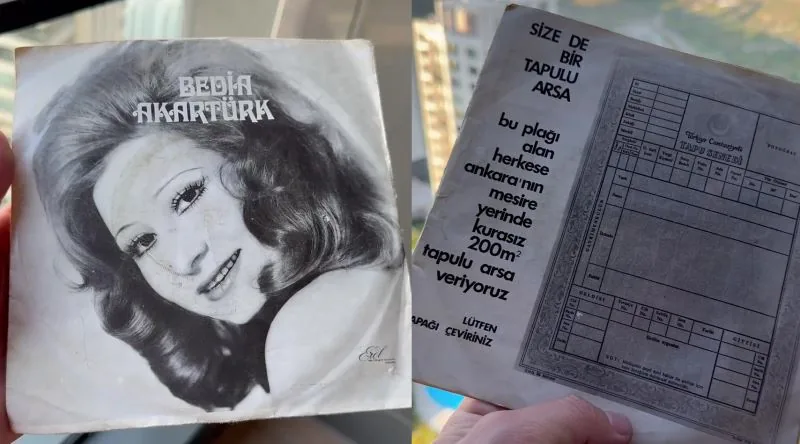
In 1974, a Bedia Akartürk record came with a free 200 square meter plot of land in Ankara, and one buyer who kept the coupon now owns property worth three apartments. This was the Bedia Akartürk record land giveaway, a promotional campaign by a Turkish record company that turned a simple vinyl purchase into a half-century-long investment. The story of that forgotten coupon, tucked away in a drawer, has become a legend among music collectors and real estate enthusiasts alike, a reminder that sometimes the most valuable thing you can buy is the thing you almost throw away.
In 1974, a record company in Turkey promoted a Bedia Akartürk album by including a coupon for a free 200 square meter plot of land in Ankara. One buyer kept that coupon for decades, and by the 2020s the land had appreciated so much that it was worth the equivalent of three apartments, making the original record purchase an unexpectedly lucrative investment.
- The promotional campaign ran in 1974, when the Bedia Akartürk record was released with a land giveaway coupon inside.
- The free plot was located in Ankara, Turkey, and measured 200 square meters per coupon.
- One buyer held onto the coupon for roughly 50 years without claiming the land during the promotional period.
- By the time the coupon was redeemed or evaluated, the Ankara property had appreciated to a value estimated at three apartments.
- The story gained attention through a video by Hamza Demirkapu, which highlighted the record's hidden value.
The 1974 Record That Came With a Free Plot of Ankara Land
Back in 1974, a Turkish record company cooked up a promotion that still makes people do a double take: buy a Bedia Akartürk record, and walk away with a 200 square meter plot of land in Ankara. The catch? There wasn't one, at least according to the story that's been circulating for years. No lottery, no fine print, just a coupon tucked inside the sleeve and a title deed waiting at the end.
Bedia Akartürk was a beloved Turkish folk singer, and her fans in Ankara were the lucky ones who got to hear about this deal. As the story goes, the record company was giving away plots in what was then described as an undeveloped recreation area, a mesire alanı, on the outskirts of the capital. One buyer reportedly held onto one of the two coupons that came in the box, used the other to claim the land, and then sat on it. Quietly. For fifty years.
That patience allegedly paid off in a big way. Over the decades, Ankara sprawled outward, and that forgotten patch of empty ground supposedly turned into something worth the equivalent of three apartments. A single record, bought for the music, becoming a small fortune is the kind of twist that makes you wonder what else is hiding in old boxes.
Now, before you start rummaging through attics, a word of caution. The year, the exact size of the plot, and its location are not independently verified. The story has been passed around, popularized in a video by content creator Hamza Demirkapu, and even sparked a claim that Bedia Akartürk herself confirmed it on X, formerly Twitter, in a post. But none of that checks out with solid documentation. The details are fuzzy, and the comparison to three apartments is more hearsay than hard fact.
What is clear is that land in Turkey during the 1960s and 1970s was a different beast entirely. Older folks will tell you that you could buy five or ten dönüm, units of land roughly equivalent to a thousand square meters each, for about a month's salary. It was cheap because it was plentiful and, at the time, useless. Nobody wanted a plot on a hillside with no road, no water, and no neighbors. That was then.
The record company's giveaway, if it happened as described, was a gamble on the future. It was also, reportedly, not the first promotion of its kind in the world, contrary to what some versions of the tale claim. Record labels had been dangling prizes for years, so the "world's first" label doesn't hold up under scrutiny. But the idea that a simple purchase could turn into a life-changing asset? That part of the story has legs, and it's why people still talk about it half a century later.
How the Land Giveaway Actually Worked
The mechanics were surprisingly simple: buy the record, find the coupon, mail it in, and wait for a title deed to arrive. According to the viral story, each record came with two coupons tucked inside the sleeve. One was meant for the promotion itself, the other for the buyer to keep as proof or a souvenir.
The plot of land sat in a part of Ankara that was then largely undeveloped. Over the decades, as the Turkish capital expanded outward, the city eventually grew around it, and that once-forgotten empty plot began to appreciate in value. The buyer reportedly used the coupon to claim the property, which was legally transferred with a title deed, no lottery involved.
It sounds almost too neat, and honestly, some of it is. The two-coupon detail and the absence of a lottery come straight from the viral retelling, not from any independently verified record. What's harder to pin down is the location itself. The story describes the land as being in a recreation area, a mesire alanı, on Ankara's outskirts, but that specific designation hasn't been confirmed by any official document. One commenter who claims to have lived in the area pointed to a development called Sinpaş Marina, noting that some coupon holders did end up with apartments in a nearby complex called Güneypark, though he described the buildings as having awkward layouts and a chaotic entrance situation, hardly the windfall the story suggests.
What's certain is that land in 1970s Turkey was a different beast entirely. Back then, as one commenter put it, you could buy five or ten dönüm of remote hillside for about a month's salary. The ground was plentiful, cheap, and largely useless to anyone who didn't farm it. Nobody was dreaming of appreciation curves or rental yields. The idea that a promotional giveaway would one day translate into apartment-level wealth would have sounded absurd at the time.
Why the Story Went Viral in 2025
In 2025, content creator Hamza Demirkapu posted a video that sent the internet digging through its collective memory, and suddenly a half-century-old record promotion became the talk of Turkish social media. The video walked viewers through the improbable chain of events: buy a Bedia Akartürk record in 1974, get a plot of land in Ankara, and watch that land appreciate into what some claimed was the equivalent of three apartments. Demirkapu's retelling sparked the question that captured everyone's imagination: "Is it possible to own three apartments 50 years later just by buying a record?"
According to the viral narrative, the story gained even more traction when Akartürk herself weighed in on X (formerly Twitter), reportedly posting a confirmation of the promotion. The alleged tweet described the campaign as a thank-you gesture from the record company to listeners, claiming it was the first such promotion in the world. But here's where the story gets murky: the authenticity of that tweet has not been verified, and contrary to the popular version, record companies had been running promotional giveaways, including real estate prizes, well before 1974. The claim that this was a global first simply doesn't hold up.
What made the story irresistible wasn't just the land itself, but the sheer absurdity of the math. A single vinyl record, bought for the price of a few songs, reportedly transformed into a small fortune over five decades. The video tapped into that universal daydream, the one where a mundane purchase becomes a life-changing investment. It's the same impulse that makes people wonder about buying Bitcoin when it cost a dollar, or hoarding items that might become collectibles decades later.
The comments section added its own layers of nuance. One user claimed to be renting in the very area shown in the video, now developed by the Sinpaş company, and noted that while some coupon holders did receive apartments, the reality was less glamorous than the viral version suggested. Another commenter pointed out that in the 1960s and 1970s, land in remote areas was cheap and plentiful, and that many original holders sold their shares before the development projects even began, often without knowing what they were giving up.
What the viral story leaves out, though, is that this wasn't a get-rich-quick scheme for everyone. The land was reportedly in an undeveloped recreation area at the time, and its value grew slowly with the city's expansion. For every person who held onto their plot and benefited decades later, there were likely others who sold early or never followed through on the promotion at all. The video made it look like a guaranteed windfall; the reality, as with most such stories, was far messier and more dependent on patience, luck, and timing than any 90-second video could capture.
The Reality Check: What Locals Say About the Land
One commenter who goes by the username ozulte claims to be a current tenant in the Sinpaş Marina area, and their firsthand account paints a more complicated picture than the viral video suggests. According to their personal observations, the land shown in the video is near Sinpaş Marina, a residential development in Ankara where they rent today. They also mentioned having previously rented in the nearby Sinpaş Altınoran complex.
Ozulte acknowledges that some people did become property owners through the record promotion, and even through newspaper coupon collections. However, they insist these individuals received apartments in the Güneypark complex, which was built specifically for landholders at the northern edge of those plots. Not from the exact location the video creator filmed. As they describe it, Güneypark is not a bad place to live, but it hardly matches the glamorous windfall the viral story suggests. The floor plans are reportedly odd, the site lacks proper Sinpaş management, and the complex has become a mixed owner-tenant population with chaotic entry and exit points. They even recall a rumor about one homeowner allegedly cutting through a structural column in the middle of their living room, which stirred up quite a commotion among residents.
The commenter also speculates that many coupon holders sold their shares before the project even broke ground, often unaware of what the land might one day be worth. Local real estate agents, they say, never left those people alone. So while some did walk away with apartments, ozulte suspects the reality for many others was a quiet, early sale at a fraction of the eventual value. It is a reminder that the romanticized version of the Bedia Akartürk record land giveaway often leaves out the human decisions, missed opportunities, and less-than-perfect outcomes that followed.
What This Tells Us About 1970s Turkey and Land Value
To understand why a record company would even think of giving away plots of land, you have to look at how Turks in the 1960s and 1970s viewed dirt itself. As one commenter on the thread, going by the name "adebayorun hirsiz kardesi rotimi," pointed out, land in remote areas back then was cheap, abundant, and often considered practically worthless. You could reportedly buy 5 to 10 dönüm, a dönüm being roughly a thousand square meters, with just a single month's salary if you were willing to look at plots that were, by the standards of the time, in the middle of nowhere.
The population was smaller, cities hadn't sprawled outward yet, and that empty terrain was seen as useless rather than as a future investment. The commenter draws a sharp parallel to Bitcoin: people look back now and marvel that you could have bought it for a dollar, but how many of us actually did? It's the same principle. The people who bought those records in 1974 weren't thinking about real estate portfolios. They just wanted to hear Bedia Akartürk sing. The land was a bonus, a low-cost incentive that the company could afford to hand out because nobody, not even the recipients, believed it would ever be worth much.
That context makes the whole Bedia Akartürk record land giveaway feel less like a wild anomaly and more like a product of its specific moment. It was a time when a business could treat land as a throwaway promotional trinket, the way a cereal box might include a cheap plastic toy. The fact that those same plots would eventually become valuable enough to trade for apartments wasn't a foretold destiny. It was a shift in perception, a slow change in what people believed dirt was worth.
Frequently asked questions
What was the Bedia Akartürk record land giveaway in 1974?
According to the viral story, in 1974 buyers of a record by Turkish singer Bedia Akartürk received a 200 m² plot of land in Ankara as a promotional gift. The claim lacks reliable verification, so treat the specific year and plot size as part of the tale rather than confirmed history.
How did the promotion work?
As the story goes, buyers found coupons inside the record sleeve. They could claim the land with a title deed, no lottery required, directly through the record company that ran the campaign. The mechanism sounds simple, but no official documentation confirms these details.
Who was Hamza Demirkapu?
Hamza Demirkapu is a content creator who reportedly made a video about the story, which popularized it in 2025. According to the original account, his video showed how the record's land gift supposedly grew into a major investment over the decades. His role in spreading the tale is itself unverified.
Did Bedia Akartürk confirm the story?
She reportedly tweeted confirmation, but the tweet's authenticity is unverified. The alleged post claimed the promotion was a world first and thanked listeners for the success of the record. No independent evidence of this tweet has been confirmed.
What happened to the land?
Per the story, the land appreciated over 50 years to the value of three apartments. This figure is not independently confirmed, and no data exists on the plot's current worth. The tale suggests a single record purchase became a small fortune, but that outcome remains part of the narrative.
Was this the first such promotion worldwide?
No. Record-company promotions with prizes existed before 1974, so the claim of a global first is false. Companies had long used giveaways, including real estate in some cases, to boost sales. The Bedia Akartürk record land giveaway may have been unusual, but it was not unprecedented.
Got a take on this? Add your voice to the conversation below →
No comments yet. Be the first.