Why Australia and Austria Share Such Similar Names
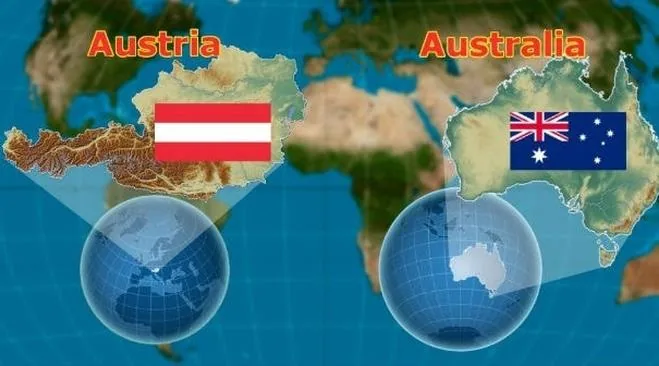
Australia and Austria carry nearly identical names in English, yet the two countries sit on opposite sides of the planet and share no history of naming each other. The confusion is entirely a quirk of language: why Australia and Austria have similar names comes down to two unrelated roots that happen to sound alike. Australia traces to a Latin word meaning "southern," while Austria comes from an old Germanic phrase meaning "eastern realm." The resemblance is pure coincidence, and it has tripped up mail carriers, travel agents, and schoolchildren for generations.
Australia's name comes from the Latin "australis," meaning southern, tied to the old idea of a great southern land. Austria's name comes from "Ostarrichi," an Old German term meaning eastern realm, first recorded in a document from 996. The two names look alike in English but grew from unrelated roots.
- The name Australia derives from the Latin "terra australis," or southern land, a term used for a hypothetical continent long before Europeans reached the region.
- The name Austria comes from "Ostarrichi," an Old High German phrase meaning eastern realm, first documented in a 996 charter.
- The continent now called Australia was known as New Holland before the name Australia gained official use in the 19th century.
- The imagined southern landmass was long labeled "terra australis" on European maps, and the name Australia was later reassigned to the real fifth continent.
- The two countries have no shared naming history, and the similarity of their English names is coincidental.
Two Names That Sound Like Cousins
Australia and Austria sit on opposite ends of the planet, yet their names trip up airline clerks, mail sorters and quiz contestants on a weekly basis. The resemblance is pure coincidence. The two words grew out of different languages, described different directions on the compass, and were coined centuries apart for reasons that had nothing to do with each other. That is the puzzle worth pulling apart: why Australia and Austria have similar names at all, when one means "southern" and the other means "eastern realm."
Start with the southern half of the pair. The name Australia comes from the Latin word australis, meaning "southern," and more specifically from Terra Australis, the hypothetical landmass that pre-modern geographers assumed must exist somewhere far to the south to balance the globe. It was a placeholder on maps before it was a country. And here is the twist that surprises most people: for a long stretch of history, that name pointed at the frozen continent at the bottom of the world, not the sunburned one.
So the two nations were never linguistic relatives. One borrowed its name from a Latin compass direction, the other from an Old High German word for a frontier district facing east. Same opening syllable, completely separate family trees. By the end of this, the coincidence will look almost deliberate, which is exactly what makes it fun.
Australia's Name Actually Belonged to the South Pole First
Here is the twist that makes this naming story worth pulling apart: the word Australia started out pointing at the bottom of the world, not the top. It comes from the Latin australis, meaning "southern," and it reached us through terra australis, the great hypothetical landmass that mapmakers once assumed had to exist down there to balance the globe.
For a long stretch of European map history, that imagined southern continent was simply called Australia. The name was applied to the south polar landmass, the one we now know as Antarctica, and not to the place we call Australia today.
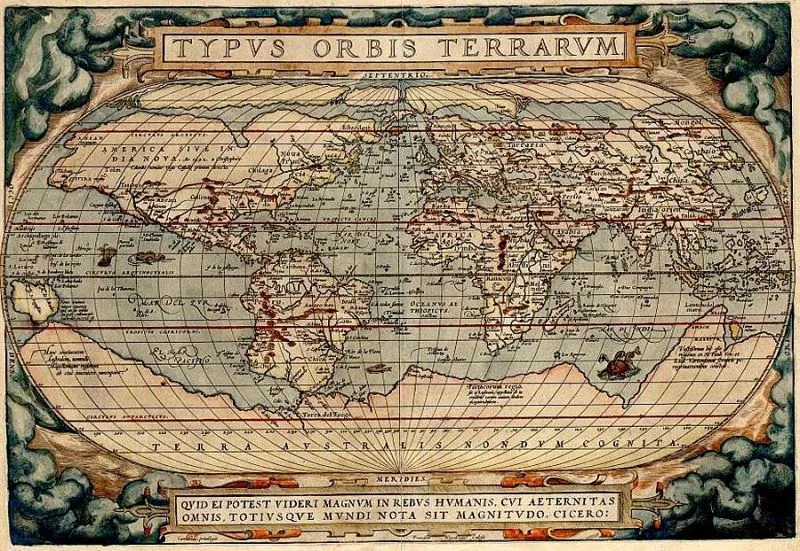
You can watch the idea take shape on paper. Abraham Ortelius's 1570 world map labels a vast southern continent Terra Australis Nondum Cognita, "the southern land not yet known," and it gives the Arctic a continent of its own too, a mirror-image guess at the top of the map. The engraving is a beautiful piece of confident guesswork, and it kept the name alive for anyone who looked at it.
There is an even earlier trace, though it comes with a warning label. As the story goes, the name Australia shows up in Latin in 1545, carved into an engraving of the globe in an astrology textbook. Treat that one gently. The year, the city, and even the genre of the book are contested, so it is best filed under "reportedly" rather than carved in stone.
Then the reversal lands. During the 19th century, the name Australia was reassigned to the fifth continent, the one then known as New Holland. That was the land Britain had been using as a penal colony, shipping thieves and other convicts there from 1788 onward, so an island of exiles ended up wearing a borrowed name.
The south polar continent, meanwhile, was left nameless. As the story goes, it stayed that way for roughly seventy years, until the name Antarctica was finally invented for it. That figure is approximate, so take it as the tale tells it. So the next time the two names trip you up, remember the order of events: the south got the name first, and the continent we now call Australia took it.
The Name Gets Stolen, and Antarctica Is Left Nameless
Here is the twist that makes this naming story stranger than it first looks. The continent we now call Australia was not always Australia. For centuries European mapmakers had been using Australia or Terra Australis, Latin for "southern land," as a label for a hypothetical southern continent, one that sat at the bottom of the world and had never actually been seen. Then, during the nineteenth century, that name was reassigned to the real landmass sitting in the south Pacific, the fifth continent, which until then had been known as New Holland.
And the south polar continent? As the story goes, it sat without a proper name for roughly seventy years after that, until the word Antarctica was coined for it. Treat that seventy-year figure as approximate. The south polar land was not formally named Antarctica until the nineteenth century, but the exact length of the nameless gap is unverified, so take the number as the story tells it rather than as a settled record.
There is a sharper irony buried in the swap. New Holland, the continent that took over the name Australia, was a British penal colony. From 1788 onward, Britain shipped thieves and other convicted criminals there. So a nation that began as a dumping ground for convicts started its new identity by borrowing another continent's name, one that had never been confirmed to exist in the first place.
Notice what this means for the two similar-sounding countries. Nothing about this chapter touches Austria at all. The Austrian name has its own separate history, one that runs through Old High German and a document from the tenth century, not through Latin geography or southern seas. The resemblance between Australia and Austria is a coincidence of sound, and the story of how Australia got its label only makes the coincidence more striking, because the name arrived by theft and guesswork rather than by any shared root.
Austria Means Something Else Entirely
Say "Österreich" out loud and you are not saying anything close to "Australia." You are saying "eastern realm." The name traces back to Old High German ostarrîchi, and it shows up for the first time in a deed dated 996. That single document is the earliest known appearance of the word that would eventually become the name of a country.
Linguists generally treat ostarrîchi as a local Bavarian dialect rendering of the Medieval Latin marchia orientalis, which means "eastern march" or "eastern borderland." So the German name was not invented from scratch. It was a vernacular translation of an administrative label the Latin-speaking world was already using.
That label made sense because of where the territory sat. Around 976, the region was established as a frontier march of Bavaria, the easternmost stretch of Bavarian territory along the Danube. Geographically, that area corresponds roughly to what we now call Upper and Lower Austria. It was a border zone, a march, a place where the settled Bavarian world met whatever lay further east.
The word "Austria" itself is a Latinized form of the German name, and it first appears in records in the 12th century. So the sequence runs: a Latin administrative term, then a German dialect version of it, then a Latinized version of that German version. The name made a full loop through two languages before it settled into the form English speakers use today.
This is the crucial contrast with Australia. One name comes from Latin australis, meaning "southern." The other comes from Old High German ostarrîchi, meaning "eastern realm." South versus east. Different languages, different directions, different centuries. The resemblance between "Australia" and "Austria" is a coincidence of how both names happened to pass through Latin on their way into English, not a shared origin.
So Why Do Australia and Austria Have Similar Names?
Strip away the shared letters and the two names have nothing to do with each other. Australia comes from the Latin australis, meaning "southern." Austria comes from the Old High German ostarrîchi, meaning "eastern realm." One points south, the other points east, and the resemblance between them is a coincidence of Latinization and sound.
That is the whole answer, and it is a strange one. Two countries on opposite sides of the planet ended up with near-identical English names because both passed through Latin on their way into modern usage. Australia kept a Latin root almost untouched. Austria is a Latinized spelling of a German word, first recorded in the 12th century as Austria, which happens to echo the southern name by pure accident.
Two roots, two directions
| Country | Root | Meaning |
|---|---|---|
| Australia | Latin australis | southern |
| Austria | Old High German ostarrîchi | eastern realm |
The Austrian side of the story is surprisingly well documented. Ostarrîchi first appears in a deed dated 996, and it is generally regarded as a local Bavarian dialect rendering of the Medieval Latin marchia orientalis, the eastern march. The March of Austria itself was established as a Bavarian frontier province around 976, and at that time it was simply the easternmost slice of Bavaria along the Danube basin, roughly the territory we now call Upper and Lower Austria.
So the next time someone mixes up the two, you can tell them the confusion is built into the names themselves. Southern and eastern, Latin and German, and a coincidence that has been fooling people for centuries.
Frequently asked questions
Why do Australia and Austria have such similar names?
They look almost identical on paper, but the two names grew from completely different roots. Australia traces back to the Latin word australis, meaning southern. Austria is a Latinized form of the German Österreich, meaning eastern realm. So one country is named for the south, the other for the east, and the resemblance is pure coincidence.
Does the name Australia come from the Latin word for south?
Yes. Australia derives from the Latin australis, meaning southern, and specifically from Terra Australis, the hypothetical southern landmass that mapmakers assumed existed long before anyone laid eyes on it. The name entered European geography as a label for an imagined continent at the bottom of the world, not for the real one.
Where does the name Austria come from?
Austria's local name, Österreich, comes from the Old High German ostarrîchi, meaning eastern realm. The term first appears in a document dated 996, and it is probably a local dialect rendering of the Medieval Latin marchia orientalis. Austria itself is simply a Latinized spelling of that German name, first recorded in the 12th century.
What was the continent of Australia called before it was named Australia?
It was known as New Holland. During the 19th century, the name Australia was reassigned to the fifth continent, the landmass previously called New Holland, and that is when the name we use today settled onto the country. Before that shift, the label had pointed somewhere else entirely.
Was Antarctica ever called Australia?
No. That popular claim gets the history backwards. The name Australia was once applied to the imagined southern landmass, and as the story goes, the south polar continent then went without a formal name for roughly seventy years before Antarctica was coined. Antarctica itself was never called Australia.
When did the name Australia get applied to the continent we know today?
In the 19th century. That is when Australia was adopted for the fifth continent then known as New Holland, a place that had served as a British penal colony for thieves and other criminals. The reassignment is what gave the modern country its name and left the southern polar region waiting for its own. Editorial note: Details that remain unconfirmed, including exact dates and early naming usages, are presented here as approximations rather than settled facts.
Got a take on this? Add your voice to the conversation below →
No comments yet. Be the first.