Simeon Stylites: 37 Years on a Pillar
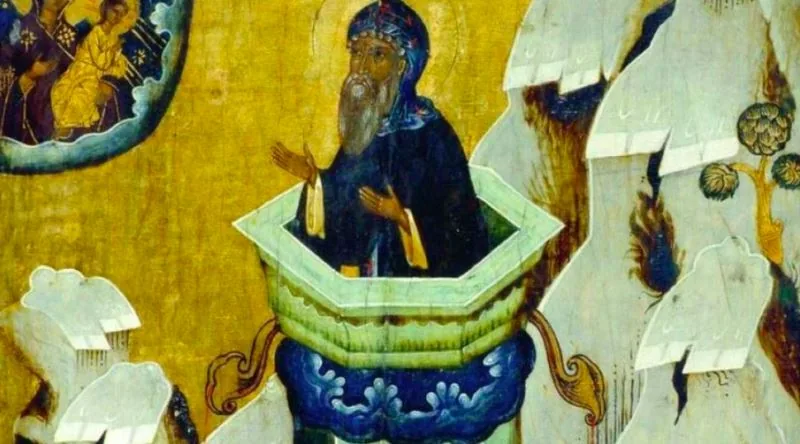
Simeon Stylites was a Christian ascetic who spent roughly 37 years living on top of a pillar in Roman Syria, from about 423 until his death in 459. He was not hiding from the world up there. Crowds climbed the hills to hear him, emperors wrote to him for advice, and his strange perch turned him into one of the most famous holy men of late antiquity. Whatever you make of his choice, it is hard to look away from a man who decided the best place to pray was a stone column a few feet wide.
Simeon Stylites was a Christian monk in Roman Syria who lived atop a pillar for about 37 years, from roughly 423 until his death in 459. Pilgrims, local crowds, and even emperors sought his counsel, making him the most famous of the stylite monks. A great church was later built around his pillar near Aleppo.
- Simeon Stylites began living on a pillar around 423 in the hills near Telanissos, in the region of Roman Syria.
- His pillar was gradually raised in height over the years, and he reportedly spent about 37 years in total on top of it.
- Pilgrims and visitors traveled to consult him, and tradition says he corresponded with the emperor Theodosius II.
- He died in 459, and a large church complex, the Church of Saint Simeon Stylites, was later built around his pillar near Aleppo.
- His feast day is observed on January 5 in the Western church and September 1 in the Eastern churches.
Simeon Stylites: The Monk Who Chose a Pillar Over the World
Simeon Stylites was born around 390 AD in Sis, a town in Cilicia that belonged to the Roman Empire of his day. If you want to find that place on a modern map, look for Kozan, a district in Turkey's Adana Province. He was a Syriac ascetic, and in later records he carries the longer name Saint Simeon Stylites the Elder, a title meant to keep him from being confused with the monks who copied his strange way of life.
The world he was born into was about to split in two. In 395 AD the Roman Empire divided permanently into East and West, and the town of Sis fell on the eastern side of that line. Christianity was spreading fast through those provinces, and something in Simeon caught fire. Before he turned 16, he walked into a monastery.
He did not fit. The brothers found him unsuited to communal life, too extreme in his hunger for self-denial, and they asked him to leave. So he went further out. According to the traditional account, he shut himself inside a small hut for roughly a year and a half, and during that time he reportedly went 40 days without eating or drinking anything at all. The precise details of that fast are hard to verify, and the sources do not agree on every figure. What the tradition does insist on is the moment he stepped back out into daylight: people called it a miracle.
Then came the decision that gave him his name. He chose a rocky outcrop on the slopes of Sheikh Barakat mountain, a spot he could pace in a few short steps, and settled there to pray without interruption. It did not stay quiet for long. Pilgrims arrived in crowds, climbing the slope to ask his advice, to beg for a prayer, to simply stand near him. He could not find a spare hour for the devotion that had driven him out there in the first place.
That is the problem the pillar solved. Crowds cannot climb what has no stairs.
Why Simeon Stylites Lived on a Pillar for 37 Years
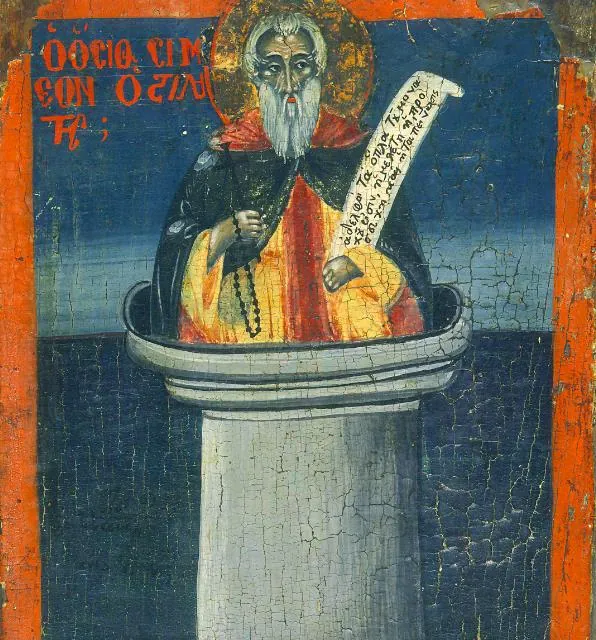
Near Taladah, in the rocky country of northern Syria, Simeon Stylites found a ruined column that still had its platform intact on top. Crowds had chased him up mountainsides and into huts, and he could not pray for the press of pilgrims. So around 423 AD he climbed up and stayed. He would live on that pillar, and the ones that replaced it, for 37 years.
The first column he settled on stood about 2.7 meters high, low enough that the villagers below could still reach him. The traditional account says he later moved to one roughly 15 meters tall, topped by a platform of about one square meter ringed with iron railings. Those measurements come from tradition rather than firm record, but the picture they paint is vivid: a man balanced on a scrap of stone, high above the dust.
He did not feed himself. Children from the surrounding villages brought him bread and goat's milk, and he hauled the food up in a basket on a rope. Sometimes the children simply climbed the pillar and handed it to him directly. That was the whole of his supply line, and it worked.
Word of the strange ascetic reached the elders of a nearby monastery, and they were not impressed. They wanted to know whether this stunt came from humility or from pride, so they set a trap. They would order Simeon to come down. If he refused, they would drag him down by force. If he obeyed, they would leave him alone.
Simeon obeyed without argument. He showed complete submission, and the elders, having gotten the answer they wanted, walked away and let him stay. Humility had passed the test.
So the pillar became his home for the next 37 years, until his death in 459 AD. What he built up there was not isolation. It was a life lived in public, one basket of bread at a time.
The Pillar as a Pulpit: Emperors, Patriarchs, and Daily Sermons
Simeon Stylites never treated the pillar as a way to disappear. If anything, the new perch made him more reachable than the monastery cell ever had. Crowds that had once followed him to the rocky slope now knew exactly where to find him, and they came in numbers that kept growing.
Every afternoon he talked with the people gathered below. A ladder let them climb close enough to hear him speak, and so the pillar became less a hiding place than a standing appointment. The man who had fled company ended up keeping daily office hours for anyone who made the walk.
Some of the letters he wrote to his disciples survive. In them he instructed them especially about blasphemy and usury, two sins he treated as serious threats to a Christian community. The advice he gave on how to live was striking for its balance. He counseled mercy, common sense, avoidance of fanaticism, and moderation, a message that sat oddly against the extreme austerity of his own life. The man who stood on a pillar for decades told others not to go to extremes.
He also served as an impartial arbitrator among peasant farmers and the small towns around him. When neighbors had a dispute, they brought it to the man on the column rather than to a local magistrate, and he settled it without favoring either side.
Word of him traveled far beyond the fields. Reports of Simeon reached the church hierarchy and the imperial court, and that is where the story gets harder to pin down. According to the traditional accounts, Emperor Theodosius II and his wife held him in great respect and followed his advice throughout his reign. Those same accounts say Leo I showed great sensitivity to a letter Simeon sent to the Council of Chalcedon. Some traditions also hold that Domninos II, Patriarch of Antioch, visited him and celebrated the holy liturgy on the pillar itself. These are the claims the old sources pass down, and they should be read as tradition rather than as documented record.
What is clear is the reach. A monk who began by shutting himself in a hut ended up with his name spoken in the highest rooms of the empire, and the ladder at the base of his pillar stayed busy every afternoon until the end.
The Walled-Off Mother and the Ulcer He Would Not Treat
Somewhere in the later years on the pillar, an ulcer opened on Simeon's foot and kept getting worse. He did not come down. He did not let it touch his routine of prayer, counsel and correspondence, and he stayed where he was while the wound spread.
Word of the stubborn old ascetic reached the imperial court. According to tradition, Theodosius II sent three bishops up to the pillar to talk him into descending for medical care, though this detail is not reliably documented. Simeon refused. As the story goes, he answered that he would wait for his healing from God alone, not from physicians.
The crowds were the other problem. Pilgrims pressed in close to pray, and the noise and the jostling broke his concentration. So two walls went up around the pillar, a double barrier between the holy man and the faithful who had walked days to see him.
According to the traditional account, women were generally not admitted past that wall, and some versions say even his mother was kept out. When she came, the story goes, he told her: if we are worthy, we will see each other in the afterlife. She obeyed. She respected the wish and went home.
That is the shape of the bargain Simeon Stylites made with his own family, and it is the part of the story that unsettles people most. The pillar had already cost him his monastery, his mobility and his privacy. Here it cost him his mother too.
Death, Burial, and the Birth of the Stylites
Simeon Stylites died on September 2, 459, after 37 years on his pillar. A disciple climbed up and found the body still folded into a praying position, as if the old man had simply stopped mid-sentence. One of the most famous ascetics in Christian history had spent his final morning doing exactly what he had done every morning since 423.
The Patriarch of Antioch led the funeral service, and the crowd that gathered around the pillar was thick with clergy. He was buried near the pillar itself, close to the spot where he had stood above them for nearly four decades. That patch of rocky ground northwest of Aleppo would not stay quiet for long.
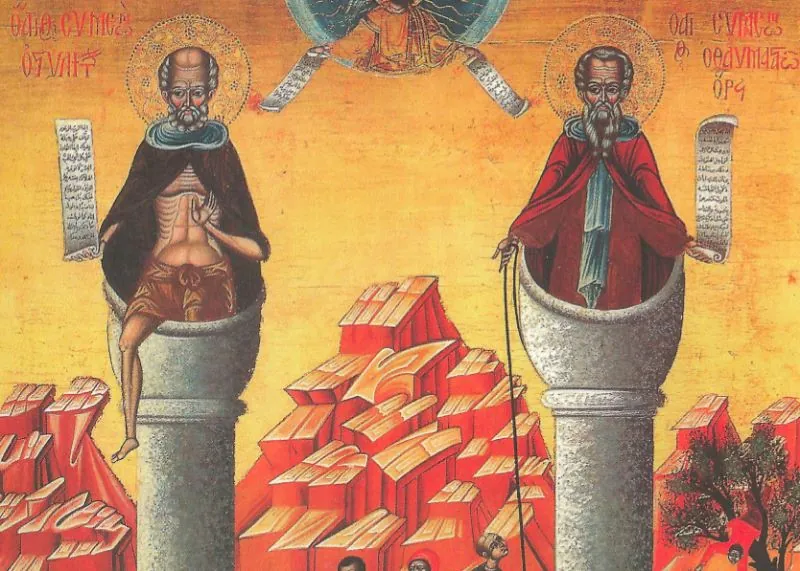
What happened next is the part that outlived him. Imitators appeared almost immediately, men who climbed their own pillars and took up the same strange vertical life. They were called stylites, from the Greek word for pillar. The practice took hold among Christians across the Levant and became a recognizable feature of Byzantine monasticism, a whole tradition of holy men living above the ground.
His legacy also became a prize. A rivalry reportedly arose between Antioch and Constantinople over who could claim him, and according to the traditional account, most of that inheritance stayed with Antioch. That particular framing is contested, so treat it with some caution. What is not contested is what you can still walk up to today: the ruins of a large structure, the Church of Saint Simeon Stylites at Qalaat Seman, stand roughly 30 kilometers northwest of Aleppo. The pillar is gone. The site is not.
His memory kept its own calendar. The Eastern Orthodox and Eastern Catholic churches commemorate Saint Simeon on September 1. The Roman Catholic Church remembers him on January 5. Fifteen centuries after a disciple found him still kneeling, people are still marking the day.
Frequently asked questions
Who was Simeon Stylites and why is he famous?
Simeon Stylites was a Syriac ascetic born around 390 AD in Sis, in Cilicia, which is now Kozan in Adana Province, Turkey. He's famous for spending roughly 37 years living on top of a pillar, from about 423 to 459 AD, as a monk devoted entirely to God.
Why did he live on a pillar?
He climbed onto a pillar near Taladah to escape the crowds of pilgrims who kept invading his rocky outcrop, asking for advice and prayers. On the pillar, he could finally devote himself to God without interruption. Every afternoon, though, he still spoke with visitors who gathered below.
How did he survive on the pillar?
Village children brought him bread and goat's milk. He pulled the food and drink up in a basket, and sometimes the children simply climbed the pillar to hand it to him. As the story goes, he'd earlier spent about 1.5 years in a hut and gone 40 days without food or water, though the precise details are hard to verify.
Was he consulted by Roman emperors?
Reportedly, Emperor Theodosius II and his wife held Simeon in high regard and followed his advice during his reign. According to tradition, Leo I also showed great sensitivity to a letter Simeon sent to the Council of Chalcedon. These imperial connections are part of the traditional account rather than firmly documented history.
Did he ever come down?
No. Even when a leg ulcer worsened, he refused to descend for medical treatment. According to tradition, Theodosius II sent three bishops to persuade him to come down, but Simeon declined, saying he awaited healing from God alone. He stayed on the pillar until his death.
What happened to his body?
Simeon died on September 2, 459. A disciple found his body in a praying position. The Patriarch of Antioch conducted a funeral service before a large gathering of clergy, and Simeon was buried near the pillar where he had lived. The site later became the location of the Qalaat Seman basilica.
Who were the stylites?
After Simeon's death, many imitators followed his example and lived on pillars themselves. These ascetics became known as stylites. The practice spread among Christians in the Levant and became a notable feature of Byzantine monasticism.
When is his feast day?
The Eastern Orthodox and Eastern Catholic Churches commemorate Saint Simeon on September 1. The Roman Catholic Church remembers him on January 5. The ruins of the Church of Saint Simeon Stylites, known as Qalaat Seman, still stand roughly 30 kilometers northwest of Aleppo, Syria. Editorial note: Details about Simeon's daily life and his exchanges with emperors rest on early accounts that cannot be independently verified, so they are presented here as such.
Got a take on this? Add your voice to the conversation below →
No comments yet. Be the first.