Screaming Mummy: Prince Pentawere's Harem Plot
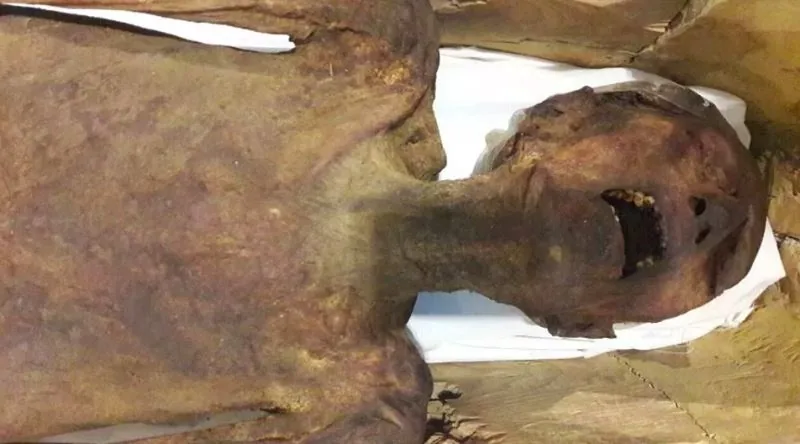
The Screaming Mummy is an ancient Egyptian man whose face is frozen in an open-mouthed scream. Modern study suggests he may be Prince Pentawere, a son of Pharaoh Ramesses III who was caught up in a plot to kill his father. For more than a century he lay in a plain coffin among royals, unnamed and unexplained. Then CT scans let researchers look beneath the bandages and read the story written in his bones. What they found turned a museum curiosity into one of the most human crime scenes in Egyptian archaeology.
Researchers have proposed that the Screaming Mummy is Prince Pentawere, son of Ramesses III, who was implicated in the harem conspiracy against his father. That identification remains a scholarly hypothesis, not a settled fact, and the same caution applies to the claim that he was forced to take his own life. His body was mummified without the usual royal care. The separate Screaming Woman is generally explained as a natural death.
- The Screaming Mummy was found in 1881 in the Deir el-Bahari royal cache near Luxor, buried among kings and queens yet placed in an unmarked coffin.
- The harem conspiracy was a palace plot against Ramesses III, and the surviving judicial records describe the punishment of the conspirators.
- CT scans of the Screaming Mummy revealed a compressed neck and an intact heart, findings consistent with hanging rather than natural death.
- Genetic testing linked the Screaming Mummy to Ramesses III as a son, supporting the proposed identification as Prince Pentawere.
- The Screaming Woman, a separate mummy, showed no such evidence of execution, and researchers attribute her expression to a natural death.
The Screaming Mummy: A Face Frozen in a Death Cry
In 1881, near Luxor, workers stumbled onto the Deir el-Bahari royal cache, a hidden tomb complex where priests of the 21st and 22nd Dynasties had gathered royal bodies to keep tomb robbers away from them. Among the kings and nobles lay one coffin that did not fit the pattern. Inside was a man whose mouth hung open, his face locked in what looks like a scream.
Researchers called him the Screaming Mummy. In the records he became "Unknown Man E," a body with no name attached, and for decades nobody could say who he was or why he had been left that way. Other royal mummies rest flat, jaws closed, faces composed. His face is not peaceful. His face is a shout.
What made the case so hard to crack was the mummification itself. This man was never properly prepared. Instead of being eviscerated and wrapped in linen like the kings beside him, he was simply left to dry, then covered in sheepskin. To ancient Egyptians, sheepskin was ritually impure, which makes its use here read less like an oversight and more like a statement.
The Egyptian Mummy Project, led by the Egyptologist Zahi Hawass, finally brought modern tools to the question, using CT scans and DNA to build a forensic picture of the body. As Hawass put it, such an unusual mummification had baffled Egyptologists, and no one managed to learn the story behind this mummy until the project created a complete forensic database for the Egyptian Museum's mummy collection.
One theory has grown louder than the rest. According to the research team, the body may belong to Prince Pentawere, a son of Pharaoh Ramesses III, who was reportedly forced to take his own life by hanging for his part in the plot against his father. That identification is a scholarly hypothesis, not a settled fact, but it would explain a great deal: the dried flesh, the impure sheepskin, the open mouth, and a burial that sits among royalty while refusing to behave like one.
Prince Pentawere and the Harem Conspiracy Against Ramesses III
The plot against Ramesses III is recorded in the Harem Conspiracy Papyrus, also known as the Turin Judicial Papyrus. It reads like a cast list for a betrayal: royal family members, military commanders, household servants, women of the harem, and even magicians, all drawn together by a plan to kill the king. This is not legend or rumor. It is a court record.
And yet the papyrus leaves one enormous question hanging. It describes how the conspirators were caught and tried, but it never says whether the murder actually worked. The only hint that a real crime took place is a strange coded phrase, translated as "the royal barque overturned," a line that seems to gesture at something unspeakable without ever naming it.
One name surfaces again and again in the story of the Screaming Mummy: Prince Pentawere, a son of Ramesses III. According to the research team led by Egyptologist Zahi Hawass and radiologist Sahar Saleem, whose 2012 study appeared in the British Medical Journal, this is the man behind the contorted face found in the royal cache. They argue that DNA evidence, marks on the body, and the unusual burial style all point to the disgraced prince. It is a striking conclusion, but it remains a hypothesis rather than a settled fact, and the same caution applies to the claim that he was forced to take his own life by hanging.
Historical records do indicate that Pentawere was condemned to hang for treason, and the marks visible on the mummy's neck are consistent with that account. What makes the body so strange is everything around it. The man was never properly mummified. Instead of being eviscerated in the traditional way, he was simply left to dry, and rather than the linen used for nearly every other royal mummy, he was wrapped in sheepskin. For the ancient Egyptians, sheepskin was considered ritually impure, a detail that reads almost like a deliberate mark of shame.
Hawass has said that such an extraordinary mummification puzzled Egyptologists for years, and that no one managed to uncover the story behind this mummy until the Egyptian Mummy Project began building a complete forensic database of the museum's collection.
Did the Plot Kill Ramesses III? CT Scans Reveal a Slit Throat
Ramesses III died around the age of 60, and for more than a century nobody could find a wound on his body. That changed in 2012, when CT scans of his mummy revealed a deep cut across his throat. The pharaoh, it turns out, was almost certainly murdered, and the harem conspiracy against him likely got exactly what it wanted.
The earlier assumption was simple enough: an aging king, worn down by health problems, slipping away in his sleep. Examinations of his remains did show a man who had reached roughly 60 and was not in good shape. But old age alone stopped explaining the evidence once the imaging work was done. A cut that deep does not happen on its own.
What makes the finding land so hard is the paperwork sitting on the other side of the story. The plot against Ramesses III is laid out in the Harem Conspiracy Papyrus, which describes how members of his own family, military commanders, servants, women of the harem, and even magicians arranged to kill him. The document follows the conspirators through their capture and trial. What it never does is tell us whether they pulled it off. The closest thing to a verdict is one cryptic line, translated as "the royal barque capsized."
Read that line next to the 2012 CT scans and the ambiguity starts to dissolve. A slit throat fits the capsized boat. It fits the trial record. It fits the fact that a conspiracy this elaborate was built by people who clearly intended to finish the job. The old theory that he died of natural causes no longer holds up against the wound.
So the Screaming Mummy story has a second half, and it belongs to the father. The son's punishment tells us the plot was real. The father's throat tells us it worked.
The Screaming Woman: Another Mummy, Another Mystery
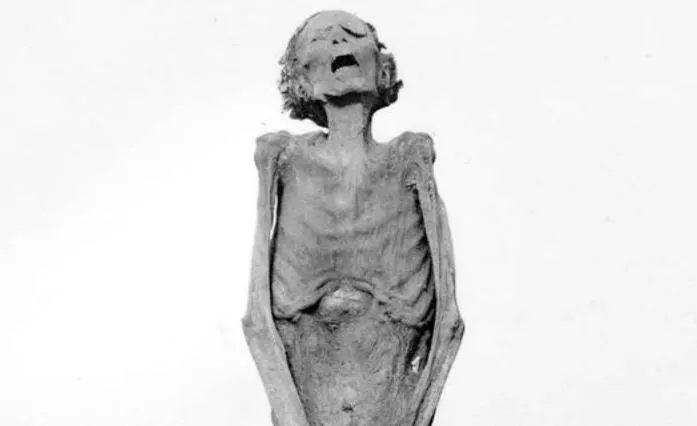
Not far from where the screaming man had lain, in the same Deir el-Bahari royal complex near Luxor, archaeologists found a second body frozen in the same impossible pose. This one was female. Her face carried the marks of terror, pain, and an open-mouthed scream, and she would come to be known as the Screaming Woman. The question was immediate: had she met the same violent end as the screaming man?
Everything about her burial broke the rules. Other mummies in the royal cache were laid flat, mouths closed, hands folded. Hers was not. Her head is tilted to the right. Her legs are bent. Her ankles are bound together. Whoever wrapped her could not close her mouth or straighten her limbs, and they left her that way.
Hieratic inscriptions on linen scrolls refer to her as "king's daughter, king's sister Meritamen." That name, however, opens more doors than it closes. Several princesses carried it. Among them: a daughter of Seqenenre Tao of the 17th Dynasty, and a daughter of Ramesses II of the 19th Dynasty. Because the name could not be pinned to a single woman, she was labeled "Unknown Woman A."
To solve the puzzle, Egyptologist Zahi Hawass and Sahar Saleem, a radiology professor at Cairo University, ran the mummy through a Siemens CT scanner at the Egyptian Museum in Cairo. Their 2024 study, published in Frontiers in Medicine, did not confirm her identity as Meritamen. What it did establish was how she died.
Unlike the screaming man, whose body was dried and wrapped in ritually impure sheepskin, this woman received the full treatment. Her internal organs had been removed. Her body cavity was packed with expensive resins and perfumes. She was wrapped in pure linen. This was costly, careful mummification, the kind reserved for someone of standing.
The scans told a different story than the one her face suggested. Her coronary arteries, carotid arteries, abdominal aorta, iliac aorta, and the arteries of her lower legs were all hardened with severe atherosclerosis. The study concluded that a coronary thrombosis damaged her heart muscle and caused sudden death. The open mouth and tilted head were not signs of execution or torture. They were the result of cadaveric spasm: her muscles and joints locked in that bent position at the moment of death, holding her there for thousands of years.
Ancient Egyptian medicine knew this killer. The Ebers Papyrus, a medical text some 3,500 years old, describes a doctor examining a man with stomach pain, arm pain, and chest pain. The text names the condition "wad" disease, equivalent to a heart attack, and instructs the physician to tell the patient that death is approaching.
So the two screaming mummies, found in the same royal complex, died in ways that could not have been more different. One was punished, denied proper embalming, wrapped in a material his culture considered unclean. The other was honored with resins, perfumes, and fine linen. Yet both were left with mouths open, faces frozen in a scream. The difference was not in how they died, but in what their deaths did to their bodies in the final, irreversible moments.
How Did the Screaming Woman Die? Heart Attack and Cadaveric Spasm
The 2024 study by Zahi Hawass and Sahar Saleem, a radiology professor at Cairo University, concluded that the Screaming Woman died suddenly from a heart attack, and that postmortem spasm locked her body into its bent pose. CT scans run on a Siemens scanner at the Egyptian Museum in Cairo showed severe atherosclerosis in artery after artery: the right and left coronary arteries, the neck arteries, the abdominal and iliac aorta, and the vessels of the lower limbs and legs. Coronary thrombosis had damaged the heart muscle, and that damage, the authors argued, is what killed her.
Atherosclerosis is a slow, degenerative disease. It thickens the artery wall, narrows the channel, and eventually blocks the vessel. Nobody develops it overnight, and nobody develops it in a single decade. The woman in the linen wrappings had been living with it for a long time before her heart finally gave out.
Ancient Egyptian medicine knew exactly what that kind of death looked like. The Ebers Papyrus, a medical text roughly 3,500 years old, records a doctor examining a man with stomach pain and pain in his arm and chest. The verdict written into the papyrus is blunt: this is the "wad" disease, the equivalent of a heart attack, and you must tell the man that death is near. No treatment. No false comfort. Just the truth, delivered plainly at the bedside.
What happened to the body afterward is the part that still stops people cold. Death came so fast, and the muscles seized so hard, that the pose never loosened. Cadaveric spasm, also called postmortem spasm, fixed her legs in their bent position and her ankles in their bindings. Her head tilted to the right. Her jaw muscles relaxed, and her mouth fell open.
There the evidence sits, and it sits in one direction. The body stayed in that position for a very long time before anyone found it. The spasm held the muscles and joints rigid, and it kept holding them for thousands of years. When the embalmers took over, they could not close her mouth the way they closed the mouths of other royal women. They could not straighten her into the ordinary burial pose either. So they did the only thing left to them: they wrapped her as she was, mouth open, legs drawn up, and let her keep screaming.
Her treatment in death was not the treatment of a criminal. Unlike Pentawere, whose body was dried and wrapped in ritually impure sheepskin, her internal organs had been removed, and her body was wrapped in pure linen. Expensive resins and perfumes were placed inside the body cavity. That is the signature of careful, costly mummification, the kind a family arranges when it wants to honor the dead.
So the Screaming Woman's open mouth is not a punishment and not a curse. It is a medical record written in muscle and bone. A woman with hardened arteries, a sudden coronary death, and a body that froze in its final moment and refused, for three thousand years, to relax.
Frequently asked questions
What is the Screaming Mummy and why does it have that name?
The Screaming Mummy is the mummy of a man known to Egyptologists as Unknown Man E, found in the Deir el-Bahari royal cache near Luxor in 1881. His face is frozen in a contorted, open-mouthed scream, which is why he carries that name. Researchers have proposed that he is Prince Pentawere, son of Pharaoh Ramesses III.
Who was Prince Pentawere and why was he forced to commit suicide?
Pentawere was a son of Ramesses III, implicated in the harem conspiracy against his father. According to the research team, he was condemned to hang for his role in the plot, and marks on the mummy's neck appear to confirm this. His identification as Unknown Man E remains a scholarly hypothesis, not a settled fact.
How did CT scans and DNA identify the Screaming Mummy?
The Egyptian Mummy Project, led by Egyptologist Zahi Hawass, used CT scans and DNA analysis to examine the mummy. The combined evidence, including the neck marks and the unusual burial, points to Pentawere. Even so, the identification is presented as a strong hypothesis rather than a proven conclusion.
What was the harem conspiracy against Ramesses III?
The plot is recorded in the Turin Judicial Papyrus, which describes how family members, commanders, servants, harem women and magicians conspired to kill the pharaoh. CT scans in 2012 revealed a deep cut to Ramesses III's throat, suggesting the conspiracy may actually have succeeded. The papyrus itself does not state whether the plot worked.
Who was the Screaming Woman and how did she die?
The Screaming Woman is another mummy from the same Deir el-Bahari complex, known as Unknown Woman A. CT scans showed severe atherosclerosis affecting her coronary and other arteries, and the 2024 study by Hawass and Sahar Saleem concluded she likely died suddenly from a heart attack. She was around 48 years old, not in her sixties as some versions claim.
Why was the Screaming Mummy wrapped in sheepskin instead of linen?
Unlike most royal mummies, Unknown Man E was not properly mummified. He was left to dry rather than eviscerated, and wrapped in sheepskin instead of linen. Ancient Egyptians regarded sheepskin as ritually impure, so this treatment appears to have been a form of punishment or disgrace.
Was the Screaming Woman Princess Meritamen?
Hieratic inscriptions on her linen wrappings read "royal daughter, royal sister Meritamen," which suggests that name. However, many princesses across different dynasties shared the name Meritamen, so the identity cannot be confirmed. The 2024 study did not confirm her as Princess Meritamen.
What did the Egyptian Mummy Project discover about these mummies?
The Egyptian Mummy Project, directed by Zahi Hawass, used CT scanning and DNA analysis to build a forensic database of royal mummies. For these two, the work revealed causes of death and unusual mummification practices. The Screaming Woman's organs were removed and she was wrapped in fine linen with expensive resins, while the Screaming Mummy received none of that care. Editorial note: Details that remain unconfirmed, including the precise circumstances of the prince's death and the identity of the Screaming Woman, are presented here as the subject of ongoing scholarly interpretation.
Got a take on this? Add your voice to the conversation below →
No comments yet. Be the first.