Library of Ashurbanipal: World's Oldest Library in Nineveh
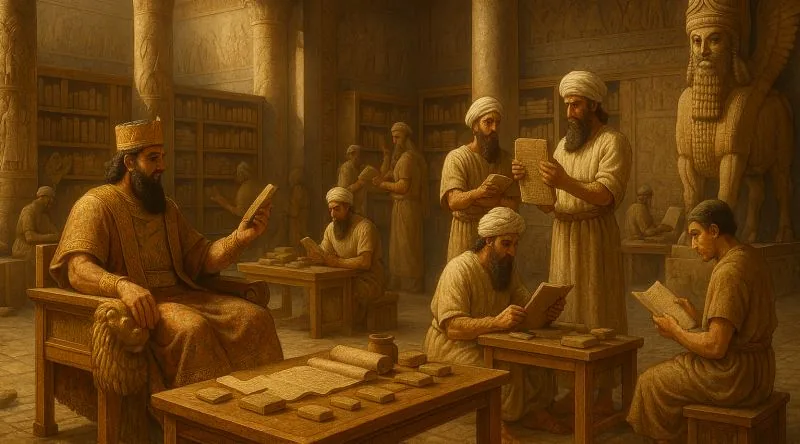
The Library of Ashurbanipal was assembled in Nineveh, the second capital of the Assyrian Empire, during the 7th century BC, and it is often called the oldest known library in the world. Its shelves held tens of thousands of clay tablets. When the city fell, the fire that destroyed it also baked those tablets hard, preserving words that would otherwise have crumbled to dust. Among them sat the Epic of Gilgamesh, a story of grief and friendship that had been forgotten for more than two thousand years. The man who gathered it all was a king who could actually read, a rare thing in his time. What he saved, he saved by accident as much as by design.
King Ashurbanipal of Assyria collected a vast library of clay tablets at Nineveh in the 7th century BC, and it is often named as the oldest known library in the world. When the city was destroyed in 612 BC, the fires that burned it hardened the tablets instead of erasing them, and around 30,000 pieces survive today, mostly in the British Museum.
- The Library of Ashurbanipal was established at Nineveh, in modern northern Iraq, during the reign of the Assyrian king Ashurbanipal in the 7th century BC.
- It is generally described as the oldest known library in the world, predating the Library of Alexandria by roughly four centuries.
- Its collection is commonly estimated at around 30,000 clay tablets and fragments, covering literature, religion, medicine, astronomy, and royal records.
- Nineveh fell to a coalition of Medes and Babylonians in 612 BC, and the resulting fires baked the clay tablets, which helped preserve them.
- The Epic of Gilgamesh survived in this collection, and a flood narrative within it was recognized in 1872 by the Assyriologist George Smith.
Was the Library of Ashurbanipal Older Than Alexandria?
Ask most people to name the world's first great library and they will say Alexandria. The Library of Ashurbanipal was already centuries old by the time Alexandria opened its doors in the early 3rd century BC, roughly four hundred years later. Its ruins sit at Kuyunjik, the mound of ancient Nineveh near modern Mosul in northern Iraq, and Nineveh served as the second capital of the Assyrians.
The king behind it was Ashurbanipal, who reigned from 668 to 627 BC. He was a Neo-Assyrian ruler, and the collection he assembled at Nineveh was built with a clear purpose: to gather and preserve the history and culture of Mesopotamia under one roof. Think of clay tablets stacked and catalogued in a palace, not scrolls on Mediterranean shelves.
Whether it deserves the title of the world's oldest library depends on where you draw the line. Older archives existed at Ebla and Hattusa, so the claim that Ashurbanipal's was the first is contested. What is not in dispute is that it was the oldest systematically organized library, and that distinction is the one that matters for how knowledge was stored, sorted and kept.
For a long stretch, everything the wider world knew about ancient Assyria came secondhand, filtered through the Bible or through Greek and Roman writers. The Library of Ashurbanipal changed that. When its tablets surfaced, Assyrians were finally able to tell their own story in their own words, and the record they left behind was anything but dry.
What Was Inside the Library of Ashurbanipal
Imagine a room where one of the world's earliest great flood stories sat on a shelf next to a doctor's manual and a king's private mail. That is roughly what the Library of Ashurbanipal held. The single most important literary find pulled from those ruins is the Epic of Gilgamesh, the long poem about a Mesopotamian king wrestling with death and fame. Among its tablets is the famous Flood tablet, a cuneiform account of a great deluge that startled nineteenth-century readers because it echoed the biblical flood so closely.
The collection was not just epic poetry. Scribes filled it with administrative and legal documents, foreign correspondence, and treaties, the daily records of imperial rule. There were medical treatises, magical manuscripts, divination texts, omens, spells, and hymns addressed to a range of gods. A king who wanted to know the future could consult the omens; a healer could reach for the medical texts. The library was, in effect, an entire civilization's operating manual.
How many tablets are we talking about? The figure usually cited is over 30,000 documents in Akkadian and Sumerian, recovered across excavations that are often dated to a window between 1850 and 1930. Treat that framing with caution. The tablet count is widely repeated, but the specific 1850 to 1930 span and the idea that all the digging was British Museum work are imprecise. And the original collection is thought to have been far larger than the roughly 30,000 texts ever recovered.
Two other texts often come up in these discussions. The Babylonian creation myth Enuma Elish and the Adapa myth, which some writers link to Adam, are genuine Mesopotamian compositions. Their presence in this particular library, and any connection between Adapa and Adam, are scholarly interpretations rather than established facts, so hold them loosely.
What makes the contents so striking is the range of voices. You can follow court intrigues, read secret intelligence reports, trace rituals step by step, and hear the words of prayers. The Library of Ashurbanipal did not just preserve stories. It preserved the Assyrians telling their own story, in their own words, on clay.
How Fire Saved the Tablets
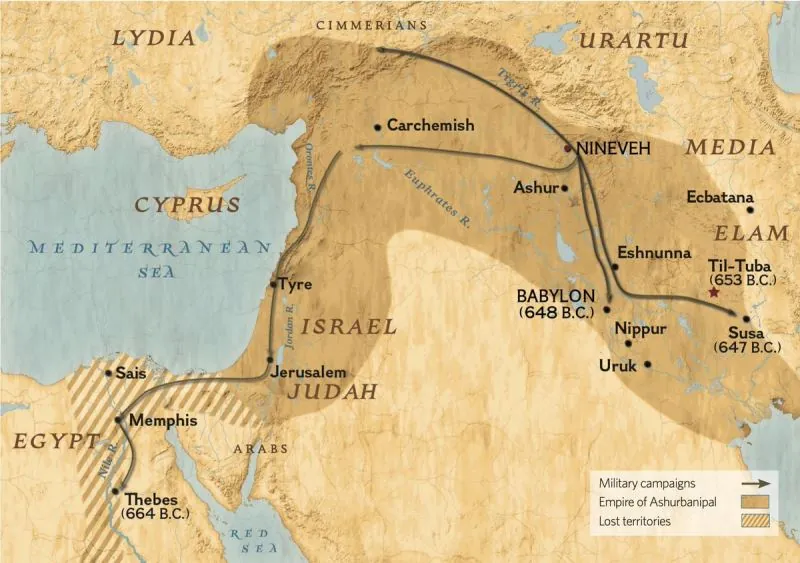
Around 612 BC, an alliance of Babylonians, Scythians, and Medes stormed Nineveh, the Assyrian capital on the Tigris, and burned it to the ground. The fire did not stop at the palace walls. It tore through the Library of Ashurbanipal itself, and in a strange irony, that destruction is the reason we can still read these tablets today.
Think about what fire does to a book. A papyrus scroll, a parchment codex, a modern paper volume: gone in minutes. Ash and nothing. But these were clay, pressed and inscribed in cuneiform while still soft. Clay does not burn the way paper burns. It bakes. The flames that leveled Nineveh hardened the tablets instead of consuming them, leaving them fired like pottery in a kiln. Thousands of years later, that accidental firing is why Mesopotamian documents from this period survive better than almost anything else from the ancient world.
There is a quieter loss buried in the same event. According to some accounts, some texts may have been written on wax boards rather than clay, the reusable writing surfaces of Mesopotamian scribes. Wax is organic, and organic material does not last. If those boards existed in the collection, no trace of them has ever been recovered. That part is not firmly established, so treat it as a possibility rather than a fact.
The irony is striking. The army that wanted to erase Assyria ended up sealing its memory in fired clay. Every cuneiform tablet that reached the British Museum in the nineteenth century owes something to the flames of 612 BC.
Who Found the Library, and Where the Tablets Went
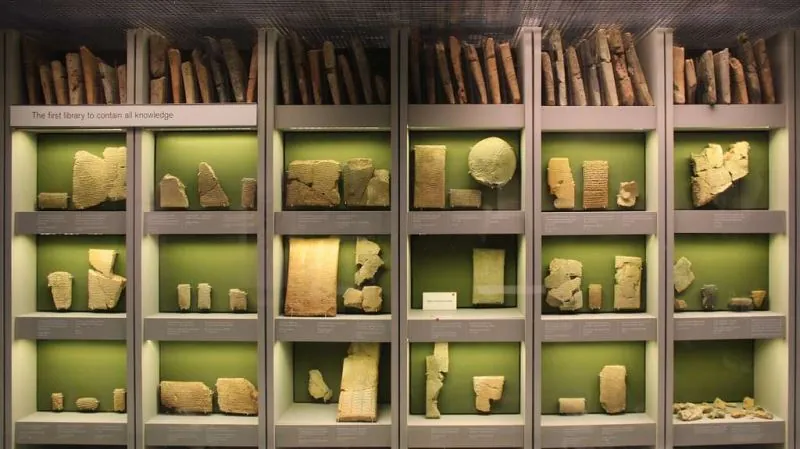
Excavation at the site is usually tied to the name Austen Henry Layard, the British excavator who dug at Kuyunjik in the late 1840s and pulled tablets out of the ground. According to some accounts, though, the identification of those finds as a royal library is often credited instead to Hormuzd Rassam and, later, to George Smith. What is not in doubt is the destination: the majority of the tablets were carried to England and are now housed in the British Museum, where they are exhibited, even if only a fraction sits on public display.
Smith, a British Assyriologist working on behalf of the museum, organized the surviving records on baked clay cylinders and tablets relating to Ashurbanipal's life. He published cuneiform copies with interlinear translations as History of Assurbanipal, Translated from the Cuneiform Inscriptions. Sources date that volume to 1871, with his famous Flood tablet announcement arriving in 1872.
Before all of this, almost everything anyone knew about ancient Assyria came secondhand, from biblical accounts or classical historians. The tablets changed that. For the first time the Assyrians told their own story, in their own words, and the Library of Ashurbanipal became the primary source for what we know about Mesopotamian science and learning in that era.
Frequently asked questions
What was the Library of Ashurbanipal and when was it built?
The Library of Ashurbanipal was a royal collection of cuneiform texts established in the 7th century BC in Nineveh, the Assyrian capital near modern Mosul, Iraq. It was built under King Ashurbanipal, who reigned from 668 to 627 BC, and gathered Mesopotamian history, law, medicine, and literature under one roof.
Was the Library of Ashurbanipal older than the Library of Alexandria?
Yes. The Library of Ashurbanipal was assembled in the 7th century BC, while Alexandria was founded in the early 3rd century BC. That makes the Assyrian collection roughly four centuries older, which is why it is often named as the world's earliest systematically organized library.
How many cuneiform tablets were found in the Library of Ashurbanipal?
Excavators recovered more than 30,000 documents written in Akkadian and Sumerian, covering administrative records, legal documents, medical treatises, and literary works. The exact total and the precise span of the digs are imprecise, and the original collection is thought to have been considerably larger than what survived.
Why did the fire that destroyed Nineveh help preserve the clay tablets?
Nineveh fell to a Babylonian, Scythian, and Median coalition around 612 BC, and the burning of the palace is thought to have spread to the library. That fire partially baked the clay tablets, hardening them, while paper or parchment would simply have burned away.
Who discovered the Library of Ashurbanipal and where are the tablets now?
Excavation at Kuyunjik began with Austen Henry Layard, though identification of the library is often credited to Hormuzd Rassam and George Smith. The majority of the tablets were taken to England, and most are now housed in the British Museum, though only a fraction is on public display.
What famous texts were found in the Library of Ashurbanipal?
The most celebrated find is the Epic of Gilgamesh, including the Flood tablet that George Smith translated. Other notable records include the Babylonian creation myth Enuma Elish and the Adapa myth, which some scholars have linked to Adam, though that connection remains an interpretation rather than an established fact.
How did George Smith translate the Epic of Gilgamesh flood tablet?
In 1872, the English Assyriologist George Smith organized the surviving cuneiform copies of Ashurbanipal's records for the British Museum and published them with interlinear translations as "History of Assurbanipal, Translated from the Cuneiform Inscriptions." His work on the Flood tablet that year brought the epic to wide public attention. Editorial note: Details that remain unconfirmed, including exact tablet counts and the precise circumstances of the library's final destruction, are presented here as estimates or possibilities rather than settled facts.
Got a take on this? Add your voice to the conversation below →
No comments yet. Be the first.