Last Supper: What Really Happened at Jesus' Final Meal
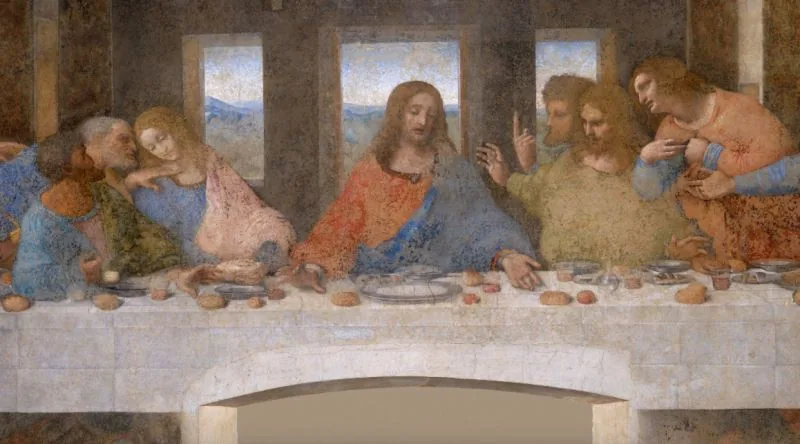
The Last Supper was the final Passover meal Jesus shared with his twelve disciples in Jerusalem in the early 30s AD, where he instituted the Eucharist and predicted his betrayal. It is the night that set the Passion Week in motion, a moment so intimate and so fraught that it has defined Christian worship for two thousand years. You can almost feel the weight of the room: oil lamps flickering, men murmuring, a sense that something terrible is coming as Jesus speaks of bread, wine, and a traitor in their midst.
The Last Supper was a Passover meal Jesus held with his twelve apostles in an upper room in Jerusalem, likely on the Thursday of Passion Week. During it, he broke bread and shared wine as his body and blood, told the disciples one would betray him, and gave them a new commandment to love one another.
- The meal took place in Jerusalem during the Jewish festival of Passover, likely in the spring of the early 30s AD.
- Jesus identified Judas Iscariot as the betrayer during the meal, and Judas left the gathering shortly afterward.
- Jesus instituted the Eucharist, telling his disciples the bread was his body and the wine was his blood, a practice still central to Christian worship.
- The Gospel accounts of the meal differ in some details, with John's Gospel omitting the bread and wine words while emphasizing Jesus washing the disciples' feet.
- The event is commemorated in Christian tradition as Maundy Thursday, and it has inspired countless works of art, including Juan de Juanes' famous painting.
The Last Supper: The Night That Changed Everything
Think of the most consequential dinner party in human history, and you are likely picturing the same table. The Last Supper, the final meal Jesus shared with his twelve disciples before his crucifixion, is where betrayal and faith collided in a single evening. Everything Christians believe about communion, the Eucharist, and the new covenant traces back to those few hours in an upper room in Jerusalem.
Our window into that night comes from four texts: the Gospels of Mark, Matthew, Luke, and John. Most scholars place their composition between roughly 65 and 110 AD, though some conservative scholars propose earlier dates for Matthew and later for John. What matters is that these are not court transcripts or news reports. They are faith narratives, composed decades after the events they describe, shaped by the communities that preserved and retold them. Paul, not the Gospel writers, gives us the first written account of what the meal meant. In his first letter to the Corinthians, penned between 54 and 58 AD, Paul records Jesus taking bread, giving thanks, breaking it, and saying, "This is my body, which is for you; do this in remembrance of me." That single passage, 1 Corinthians 11, is the oldest surviving account of the Eucharist anywhere.
To understand the weight of that evening, you have to understand the man at the center of it. Jesus was a Galilean Jew, associated with Nazareth, bound by the law of Moses like every observant Jew of his time. That law carried a heavy obligation: three pilgrimages to Jerusalem every year. The first was Pesach, or Passover, celebrated in March or April. Fifty days later came Shavuot, the Festival of Weeks. Then, in September or October, there was Sukkot, the Festival of Tabernacles. Each journey meant walking dusty roads, joining streams of fellow pilgrims, and climbing the hills toward the holy city.
The Gospels compress all of Jesus's Jerusalem activity into a single week, from the triumphant entry on Palm Sunday to the crucifixion the following Friday. But that timeline raises questions. The palm branches the crowds waved as Jesus entered the city are more closely associated with Sukkot, the autumn festival, than with Passover. Some scholars see this as a sign that the Gospel writers folded multiple visits into one dramatic week for narrative power. The real Jesus likely made several pilgrimages to Jerusalem over the years, each one a chance to teach, to clash with the religious authorities, and to draw closer to the fate waiting for him there.
Setting the Scene: A Passover Meal in Jerusalem
Jerusalem in the days before Passover was a city bursting at the seams. Pilgrims poured in from every corner of the region, and there was simply no room for everyone within the city walls. So Jesus and his disciples did what countless other Galilean pilgrims did: they stayed on the Mount of Olives, just a short walk east of the city, where the air was cooler and the crowds thinner.
When the day of Passover preparation arrived, Jesus sent two of his disciples on a peculiar errand. He told them to go into Jerusalem, where they would spot a man carrying a water jar. They were to follow him to a house, and there they would find an upper room already prepared for the meal. The instructions were specific, almost theatrical, and the disciples went without question.
That upper room needed serious work before it could host the sacred meal. Jewish law required the complete removal of all leaven, a cleansing ritual known as urhatz. Every crumb of bread, every trace of fermentation had to be swept away. A lamb had to be purchased, taken to the Temple, and sacrificed by the priests. Then it was brought back to the room and roasted over an open fire, its skin crackling and darkening as the evening approached.
The meal itself followed the ancient Seder order. The leader of the gathering would recite four blessings, each accompanied by a cup of wine. Three matzot, the flat unleavened breads, sat on the table, broken and distributed in small pieces. Bitter herbs called maror were dipped into haroset, a sweet paste meant to soften the sting of slavery, and the roasted lamb anchored the second half of the feast. The room was furnished with couches, a Greek custom that had become fashionable among Jerusalem's elite, so the men likely reclined as they ate, leaning on their left elbows and reaching for the shared dishes.
Here is where the story takes a curious turn. The Gospels never actually mention the lamb or the bitter herbs at the Last Supper. They describe bread and wine, yes, but the central elements of the Passover table are strangely absent. Some scholars have taken this silence as a clue, suggesting the meal may have happened a day or two before Passover proper, when the lamb had not yet been sacrificed and the traditional rituals were still ahead. The timing remains an open question, but the setting itself, the crowded city, the prepared room, the ritual cleansing, all of it places this night firmly within the rhythm of Jewish holy days.
The Bread and the Cup: Instituting the Eucharist
At that Passover table in Jerusalem, Jesus took hold of the flat, unleavened bread and said something no Jewish host had ever said before. This is not just the bread of affliction our ancestors ate in Egypt, he told them. This is my body. Then he lifted the cup of wine and called it his blood, the seal of a new covenant. With those two gestures, the Last Supper stopped being a memorial of an old escape and became the founding moment of a new kind of faith.
The break with tradition was deliberate and startling. For centuries, the Passover meal had centered on the roasted lamb, the bitter herbs, and the story of Moses leading the Israelites out of bondage. The leader of the seder would hold up the matzah and recite the familiar words about suffering in Egypt. Jesus replaced that entire framework with himself. The bread was no longer a symbol of hardship; it was his body, given for them. The wine was no longer just one of the four cups of blessing; it was his blood, poured out to establish something entirely fresh.
This language of covenant and blood would have echoed in every ear at that table. It reached straight back to the book of Exodus, where Moses sealed God's agreement with the people of Israel by sprinkling blood over them and declaring, "This is the blood of the covenant." Jesus was deliberately remaking that moment. The old covenant had been written on stone tablets and sealed with animal blood. The new one, he insisted, would be written in his own life and sealed in his own death.
We know exactly what he said because the earliest written record of this moment survives. It comes not from the Gospels but from the apostle Paul, writing to the Christian community in Corinth between 54 and 58 AD. In his First Epistle to the Corinthians, chapter 11, Paul passes on the tradition he received: "On the night he was betrayed, the Lord Jesus took bread, and when he had given thanks, he broke it and said, 'This is my body, which is for you; do this in remembrance of me.' In the same way, after supper he took the cup, saying, 'This cup is the new covenant in my blood; do this, whenever you drink it, in remembrance of me.'"
Paul's account predates every Gospel by at least a decade, making it the foundational text for how Christians understand this meal. The instruction to remember was not a passive suggestion. It was a command to repeat the ritual, to break the bread and share the cup as an act of communal memory. For Paul, this was not merely a sentimental recollection. He told the Corinthians that whenever they ate this bread and drank this cup, they were proclaiming the Lord's death until he comes again. The meal was a proclamation, a declaration of faith made with hands and mouths and shared loaves.
The practice took root quickly. The book of Acts describes the earliest believers devoting themselves to the breaking of bread and to prayer, gathering in homes to share meals that carried this new weight of meaning. What had started as one Passover night in Jerusalem became the central ritual of a movement spreading across the Mediterranean. This understanding shaped the Gospels that came later. Mark, Matthew, and Luke all include versions of Jesus's words over the bread and cup, each one echoing the tradition Paul had already recorded. Only the Gospel of John leaves the institution out entirely, choosing instead to tell the story of Jesus washing his disciples' feet on that same night.
And just like that, a Jewish memorial meal became a Christian sacrament. The man at the center of the table had redefined what his followers would remember about him for the next two thousand years.
A Tale of Two Timelines: John's Gospel vs. the Synoptics
Here is where the story of the Last Supper takes its most dramatic turn. The four Gospels do not agree on when this meal actually happened, and the difference hinges on a single day on the Jewish calendar.
The Synoptic Gospels, those being Mark, Matthew, and Luke, place the meal squarely on the eve of Passover, the night when the lamb was sacrificed. In these accounts, Jesus and his disciples gather for the traditional Seder meal, complete with unleavened bread and cups of wine. But the Gospel of John tells a different story. John sets the supper a day earlier, possibly on a Tuesday or Wednesday, before the Passover lamb was killed. This is not a small detail lost in translation; it is a deliberate and profound theological choice.
In John's version, the mood is different from the start. There is no blessing of bread and wine, no institution of a new ritual. Instead, Jesus gets up from the table, takes off his outer clothing, and wraps a towel around his waist. He pours water into a basin and begins to wash his disciples' feet. This act of humble service, so striking in its intimacy, is John's way of symbolizing what is about to happen. Just as the water cleanses the dust from their feet, Jesus's impending death will cleanse the world of its sin. It is a lesson in servanthood, but it is also a sign pointing straight at the cross.
Why would John shift the timeline? The answer, scholars suggest, lies in the Temple. By placing Jesus's death on the same day as the Passover lambs were being slaughtered in Jerusalem, John aligns his crucifixion with the sacrifices. Jesus becomes the ultimate "Lamb of God," the one whose blood takes away the sins of the world. The Synoptics see the Last Supper as the Passover meal itself, a celebration of the old covenant being renewed. John sees Jesus's death as the true Passover sacrifice, with the supper as a prelude to that cosmic event.
Many scholars consider this discrepancy irreconcilable. You cannot have the Last Supper on both the eve of Passover and the day before it. The two timelines simply do not line up. The Synoptic Gospels present Jesus as the host of a sacred meal, while John presents him as the sacrifice about to be offered. Both versions, however, carry deep theological weight. One emphasizes the community gathered around a table; the other emphasizes the solitary path to the cross. Both invite the reader to see the last night of Jesus's life as something far more significant than a final dinner with friends.
The Traitor at the Table: Judas and the Betrayal
Judas Iscariot sat down to the Last Supper knowing exactly what he was about to do, and every one of the four Gospels agrees on one thing: he did it for money. The betrayal itself is not in dispute, but what happened around that table, and whether Judas was even still in the room when Jesus spoke the words that would echo through two thousand years of Christian teaching, is far murkier than most retellings suggest.
The Synoptic Gospels, Mark, Matthew, and Luke, each describe Jesus announcing that one of his own disciples would hand him over. In Mark and Luke, the warning comes without a name attached. Jesus simply states, while they are eating, that one of the twelve will betray him, and the implication hangs in the air with no direct accusation. Matthew alone gives us the dramatic exchange. When Judas asks, "Surely not I, Rabbi?" Jesus answers with the chilling phrase, "You have said so."
Here is where the accounts diverge in a way that has puzzled scholars for generations. None of the Synoptic Gospels actually tells us that Judas got up from the meal and went to inform the authorities. The moment simply passes, and the narrative moves forward. Only the Gospel of John, written around 90 to 110 AD and traditionally, though not historically confirmed, associated with Ephesus, states explicitly that Judas left the table. John writes that after receiving a piece of bread from Jesus, Judas went out immediately, and John adds the detail that it was night.
Some scholars have pushed this even further with an alternative reading that changes the entire scene. According to this interpretation, Judas may not have been present at the meal at all. The argument rests on the possibility that Jesus's announcement, "one of you will betray me," was not a statement about someone currently in the room, but a prediction about what was already unfolding elsewhere. In this reading, Judas's absence is precisely what confirmed Jesus's suspicion. As the story goes, this would explain why the Synoptic Gospels never describe Judas leaving, because he was never there to leave in the first place.
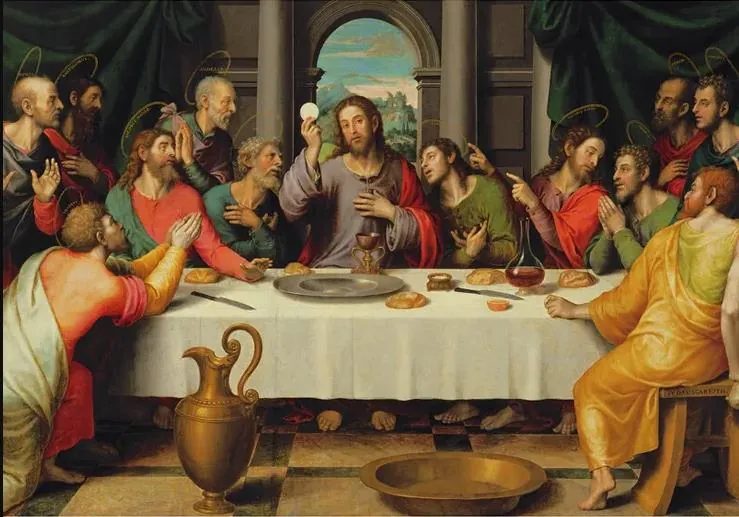
The Spanish painter Juan de Juanes, working between 1555 and 1562, had no such doubts about Judas's presence. His famous depiction of the Last Supper places the traitor on the left side of the composition, dressed in yellow, a color that had become a visual shorthand for betrayal and wickedness in Western art. In his hand, Judas clutches a money bag, the payment he reportedly received for selling out his teacher. The painting, which shows Jesus holding the host in the center of a perfectly symmetrical table, makes the moral contrast unmistakable. Every other apostle has a halo with his name inscribed around it. Judas alone goes bare-headed, marked not by holiness but by the coins in his fist and the yellow of his garments.
The money bag is the one detail that ties the visual tradition to the textual one. All four Gospels independently confirm that Judas betrayed Jesus for payment, and Juan de Juanes chose to make that motive the defining feature of his traitor. The chalice at the center of the table, which legend, not historical evidence, identifies as the Holy Grail now housed in Valencia Cathedral, sits in pointed contrast to the purse in Judas's hand. One object represents the new covenant Jesus was instituting with his body and blood. The other represents the price of abandoning it.
A Painter's Vision: Juan de Juanes and the Last Supper
Juan de Juanes, a Valencian painter working in the mid-1500s, turned the biblical Last Supper into a visual feast of symbols. His version, completed between 1555 and 1562, freezes the exact moment when Jesus takes bread and wine and transforms them into something eternal. The canvas breathes with theological meaning, every object and gesture carefully placed to tell the story of that night in Jerusalem.
Jesus sits at the dead center of the composition, holding the host, the thin unleavened wafer used in Catholic ritual. His hand lifts it slightly, as if offering it to the viewer as much as to the disciples gathered around him. This is the institution of the Eucharist, the ritual that would become the beating heart of Christian worship. The symmetry of the table, drawn flat rather than curved, pulls every eye toward him. Western artists had favored this arrangement since the 12th century because it made the sacred figure impossible to miss.
On Jesus's right sits Peter, the fisherman who would become the first pope. In front of him rests a jug and basin, the tools for the foot-washing that John's Gospel describes. Those humble objects speak of service and humility, the virtues Peter would need to lead the early church. On the left, John leans toward Jesus, his body language whispering intimacy. The beloved disciple, the one who reclined close enough to ask Jesus who would betray him, cannot keep his distance even in paint.
The other apostles wear halos inscribed with their names, marking them as saints. Judas does not. He stands apart on the left side, dressed in yellow, the color that Renaissance artists reserved for treachery. In his hand he clutches a money bag, the payment he reportedly received for his betrayal. The Gospels all agree that Judas sold his teacher for money, and Juanes makes that transaction impossible to overlook.
At the center of the table sits a chalice, the cup from which Jesus would have drunk. According to tradition, this very vessel is the Holy Grail now housed in Valencia Cathedral, though that identification rests on legend rather than historical proof. Five loaves rest on the tablecloth, a quiet nod to the miracle of feeding the five thousand. The painter packs the scene with bread and wine, betrayal and devotion, all circling the one figure who knew exactly what was coming.
Frequently asked questions
What was the Last Supper and why is it important?
The Last Supper was Jesus' final meal with his twelve disciples in Jerusalem before his crucifixion, an event that marks the beginning of Passion Week in Christian tradition. Its importance rests on one moment above all: Jesus took bread and wine, blessed them, and declared them his body and blood. That act instituted the Eucharist, also called Holy Communion or the Lord's Supper, which remains a central sacrament practiced by nearly all Christian denominations today.
Was the Last Supper a Passover Seder meal?
The Synoptic Gospels, Matthew, Mark, and Luke, each state that the Last Supper was a Passover meal, eaten on the first day of Unleavened Bread when the Passover lamb was sacrificed. However, the Gospel of John places the meal a day earlier, before the festival began. Notably, none of the Gospel accounts mention lamb or bitter herbs, the defining foods of a traditional Seder, which has led scholars to debate whether the meal followed standard Passover practice.
Why do the Gospel accounts of the Last Supper differ?
The four Gospels were written decades apart for different communities, each with its own theological priorities. Mark, written first, emphasizes Jesus' suffering; Matthew and Luke expand on his teachings; John, the last Gospel, takes a strikingly different approach. In John's version, there is no institution of the Eucharist at all. Instead, Jesus washes the disciples' feet and delivers long discourses about being the Lamb of God, reframing the entire meal around his impending sacrificial death.
How did Jesus institute the Eucharist at the Last Supper?
The earliest written account of the Eucharist comes from Paul, who wrote his First Epistle to the Corinthians between 54 and 58 AD. In chapter 11, Paul records Jesus taking bread, giving thanks, breaking it, and saying, "This is my body, which is for you; do this in remembrance of me." After supper, Jesus took the cup and declared it "the new covenant in my blood." The Synoptic Gospels, written later, preserve essentially the same words, commanding disciples to repeat the ritual in his memory.
What did Judas do at the Last Supper?
All four Gospels agree that Judas Iscariot betrayed Jesus for money, and the Synoptic accounts describe Jesus announcing during the meal that one of those present would betray him. However, only John's Gospel says that Judas actually left the meal to inform the authorities, noting that he went out immediately after receiving a piece of bread. Whether Judas remained at the table throughout the supper is genuinely debated, since the other Gospels never explicitly state that he departed.
Who painted the Last Supper and what does the painting show?
The Valencian painter Juan de Juanes created his version of the Last Supper between 1555 and 1562, and it captures the moment Jesus consecrates the bread and wine. Jesus stands at the center holding the host, the thin unleavened wafer used in Catholic ritual. Peter sits at his right with a pitcher and basin nearby, symbols of the foot-washing. John leans toward Jesus, and Judas appears on the left in yellow robes clutching a money bag, the traditional markers of his betrayal.
When was the Last Supper according to the Bible?
The Synoptic Gospels place the Last Supper on Passover eve, which would have been a Thursday evening, with the crucifixion following on Friday. John's Gospel, however, suggests the meal happened a day earlier, since his narrative has Jesus before Pilate on the day of Passover preparation. This discrepancy is a well-known scholarly issue with no definitive resolution, though various harmonization attempts have been proposed over the centuries.
Why did Jesus wash the disciples' feet at the Last Supper?
Only John's Gospel records the foot-washing, which took place during the meal when Jesus took a basin and towel and washed each disciple's feet. He explained that he was modeling humility and service, telling them that a servant is not greater than his master. The act also carried deeper symbolism, prefiguring Jesus' death as a cleansing sacrifice, since he told Peter that unless he washed him, Peter could have no part with him. Editorial note: Any facts which remain unconfirmed are presented as such, hedged with appropriate caution.
Got a take on this? Add your voice to the conversation below →
No comments yet. Be the first.