Greek Fire: Byzantium's 673 AD Secret Weapon
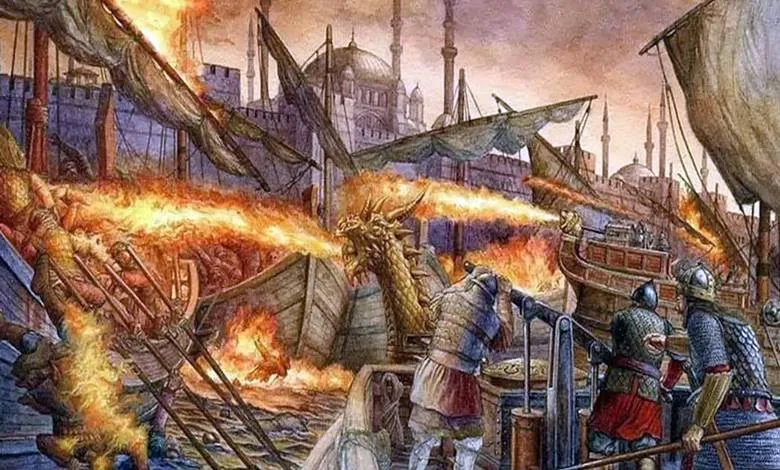
Greek fire was the Byzantine Empire's most closely guarded military secret, a liquid incendiary that reportedly burned on water and shattered enemy fleets from 673 AD onward. For centuries it saved Constantinople from Arab sieges and terrified everyone who saw it in action. Yet the exact recipe slipped away long before the empire itself fell, and historians still argue about what was actually inside those bronze siphons. What we do know is stranger and more interesting than the legend.
Greek fire was a Byzantine incendiary weapon, first used around 673 AD during the Arab siege of Constantinople. Sprayed from bronze siphons mounted on ships, it ignited on contact and reportedly kept burning on water. The precise formula was a state secret and is generally believed to have been lost or obsolete well before the empire ended.
- Greek fire is first recorded in use around 673 AD, when Byzantine forces defended Constantinople against an Arab naval siege.
- A Syrian refugee engineer named Kallinikos is often credited by ancient writers with bringing the weapon to the Byzantines.
- The weapon was deployed from bronze siphons on warships and is said to have continued burning even on water.
- The recipe was restricted to the imperial court, and the knowledge is generally thought to have faded by the 1180s.
Greek Fire: The Weapon That Turned the Sea Into a Trap
Picture a wooden galley in the Eastern Mediterranean, sometime around 673 AD. From the prow of a Byzantine warship, a bronze tube coughs out a stream of liquid fire. It hits the enemy hull, clings to the planks, and keeps burning even as waves wash over it. That weapon was Greek fire, and for roughly five centuries it gave the Eastern Roman Empire a terror advantage at sea.
The Crusaders, who faced it or heard about it from a distance, called it ignis graecus, "Greek fire." The name stuck, even though the weapon belonged to the Byzantine Empire, not to Greece. In Turkish it is remembered as Rum ateşi, the fire of the Romans. From about 673 AD until the 1180s, Byzantine fleets carried it into battle across the Eastern Mediterranean, and enemies learned to dread the sight of a ship pointing its nose at them.
If that image feels familiar, there is a reason. In Game of Thrones, the Battle of the Blackwater shows wildfire sweeping across the water and swallowing Stannis Baratheon's fleet in green flame. George R. R. Martin drew that scene straight from Greek fire. The wildfire on screen burns on water and refuses to be put out, which is exactly the property that made the real weapon so feared.
What gave Greek fire its bite was a simple, brutal trick. The liquid stuck to whatever it touched, and it kept burning on the surface of the sea. Soldiers could not smother it with water, and they could not easily scrape it off a hull already catching. Modern writers reach for one comparison again and again: napalm. That is the closest everyday thing most of us have to picture.
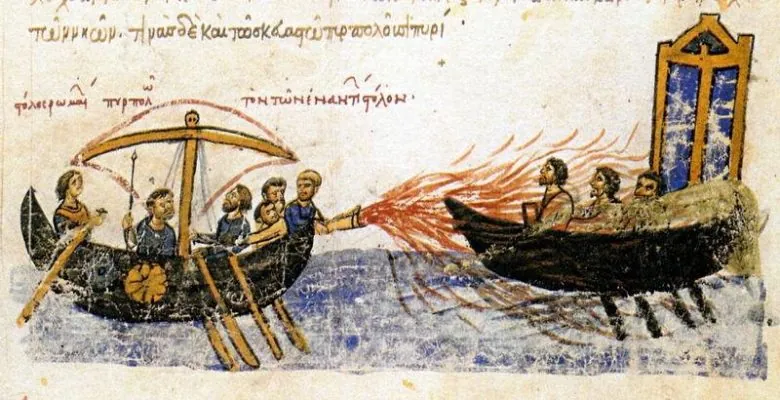
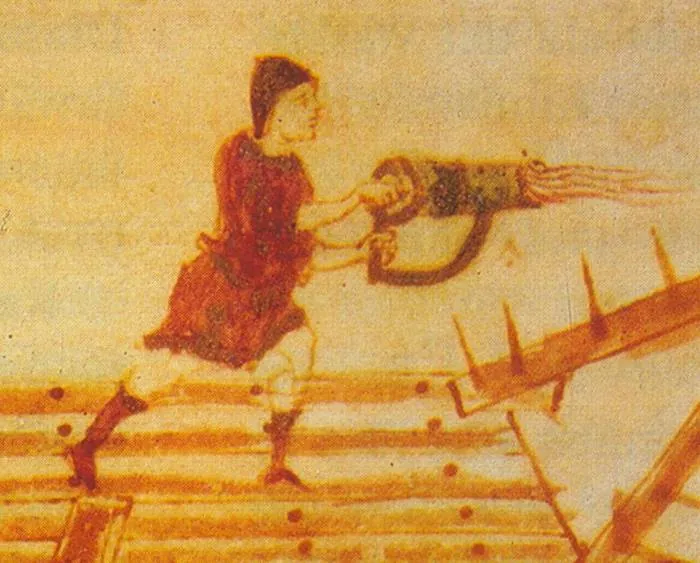
The Byzantines did not just have a recipe. They had a machine. Crews mounted a brass or bronze tube on the prow of the ship, and this device was called a siphon. Heated and pressurized, it sprayed the burning mixture onto enemy vessels at close range. The combination of chemistry and engineering is what made Greek fire work, and it is also why copying the formula alone would never have been enough.
For an empire that spent centuries fighting to hold its coastline, that was not a curiosity. It was survival, and the emperors knew it.
How Greek Fire Actually Reached Enemy Ships
The weapon lived inside a tube. Byzantine engineers mounted a brass or bronze pipe on the prow of their warships and called it a siphōn, and through that heated metal throat they forced a flammable liquid straight at the enemy hull. No cannon, no fuse, just pressure and fire pointed where it would do the most damage.
What came out of the siphon was the terrifying part. The mixture clung to whatever it touched, and it kept burning on water. Sailors who tried to douse it with the sea only spread the flames further. Modern writers reach for the comparison to napalm, and it fits: Greek fire gave the Byzantine navy a weapon its rivals could not answer, one that turned a wooden deck into a trap in seconds.
The device itself could be a spectacle as well as a weapon. Anna Komnene describes bronze fire-projectors shaped like animal heads fixed to ship prows, the kind of detail that turns a weapon into a piece of theater. The story is usually tied to the year 1099, but treat that date and its context with caution, since neither can be reliably confirmed. What scholars do accept is the general picture of bronze fire-projectors shaped like beasts, part artillery and part psychological warfare.
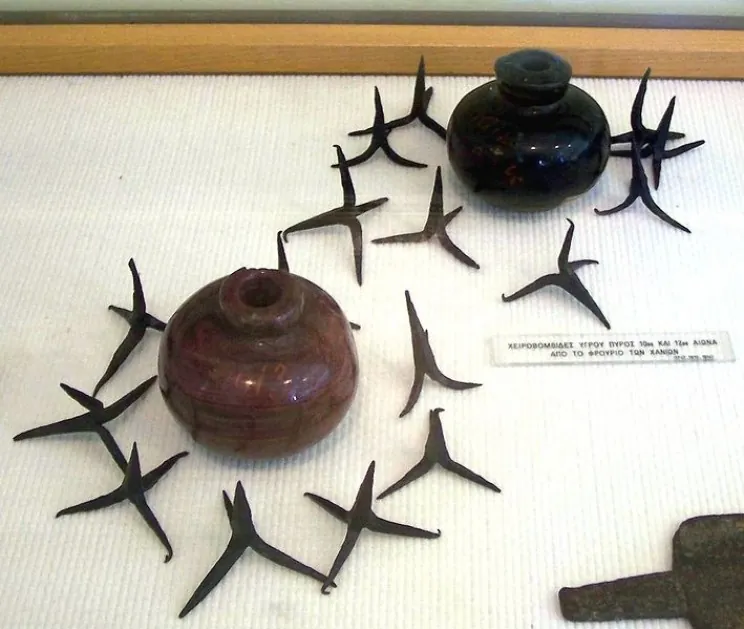
At sea was not the only place it fought. Soldiers on land launched the substance with catapults, flinging burning payloads over walls and into formations. Sometimes they sealed it into containers and threw them by hand, an early ancestor of the hand grenade. The same chemistry, delivered by completely different means.
Why the Byzantines Needed It
Timing explains a lot. Through the 7th century the Arab navies grew stronger year by year, and their sailors adopted the triangular lateen sail, which let a ship sail closer to the wind and wheel into position faster than the old square rigs allowed. A fleet that maneuvers better than yours is a fleet that chooses where the fight happens. Greek fire was the Byzantine answer to that problem, a weapon that did not care how gracefully the other ship turned.
Emperors framed the technology as more than engineering. They presented it as a privilege God had granted them, a mark of divine favor that protected both their throne and their cultural standing. A weapon you believe heaven gave you is a weapon you guard with everything you have.
The Man Who Fled Heliopolis: Kallinikos and the Fire That Saved Constantinople
Picture a Syrian city called Heliopolis, and a man packing up his tools as Arab armies close in. His name, as the story comes down to us, was Kallinikos. He was an architect, and he carried something with him that would change naval warfare for centuries.
The main origin story for Greek fire comes from Theophanes, a monk and historian writing in the early 9th century. According to his account, the weapon was developed by a Jewish architect named Kallinikos who fled Heliopolis in Syria as Muslim forces advanced. Whether he was specifically Jewish is debated by modern scholars, but the flight itself and the name are what Theophanes hands down to us. Theophanes called the weapon "sea fire," and it was used against Arab ships besieging Constantinople around 673 AD.
What happened next was the stuff of legend. The Byzantine navy destroyed a large portion of the enemy fleet, giving the capital a crucial defensive advantage at a moment when it could have fallen. The weapon worked because it stuck to whatever it touched, and it kept burning even on the surface of the water. Enemy soldiers could not easily put out the flames. Modern writers have compared it to napalm, and that comparison is not far off.
The timing mattered. Arab naval power had been growing through the 7th century. Arab sailors had sharpened their seamanship and started using the triangular lateen sail, which let their ships sail closer to the wind and maneuver more easily in battle. The Byzantines needed an answer. Greek fire was it.
Emperors framed the weapon as a gift from God, a divine privilege that protected their rule and their cultural superiority. That framing was not just propaganda. It was a way of saying: this fire belongs to us, and to no one else.
The State Secret Guarded by God and Emperors
For the Byzantines, Greek fire was never just a weapon. It was a trust. The formula lived inside the palace walls, passed down like a relic, and the emperors treated it as something closer to a divine gift than a chemical recipe. Lose the secret and you lost an edge no rival fleet could match.
Constantine VII, who ruled the empire from 913 to 959, made that rule explicit. In De Administrando Imperio, his handbook on governing the realm, he warned his successors in plain terms: do not teach the recipe to foreigners. Not an ally, not a client king, not a visiting dignitary. The knowledge stayed home.
He backed the ban with theology. According to Constantine VII, God had revealed the secret to Constantine the Great, the first Christian emperor, through an angel, with one condition attached. The fire was meant for Christians alone. Read that framing closely and you see what it did: it turned a military advantage into a sacred inheritance, and a sacred inheritance is very hard to hand over without feeling you have committed sacrilege.
The emperor did not stop at doctrine. He reinforced the prohibition with a story about a ruler who revealed the secret and suffered divine punishment for it. Whether the tale was history or warning, the message landed the same way. Share the fire and you answer to heaven.
Practical rules followed from the spiritual ones. Production had to happen only in the capital, Constantinople, where the workshops and the craftsmen could be watched. The weapon was never to be given to any foreign people. A secret that never leaves one city is a secret you can actually keep.
So the formula sat at the center of an apparatus built from equal parts faith, law and fear. Emperors guarded it. Angels had supposedly delivered it. God, the story went, punished those who let it slip. For centuries, that combination held.
What Was Greek Fire Made Of, and Why We Still Don't Know
The exact composition of Greek fire remains unknown today. Chemists, historians and experimental archaeologists have mixed and tested dozens of candidate recipes, and not one experiment has definitively reproduced the original formula. The secret that Byzantine emperors guarded for centuries is still, in the most literal sense, a secret.
What scholars can say with confidence is that the mixture needed a very particular kind of fuel. Researchers have suggested that the Byzantines added pine resin or pine oil to the base liquid, because resin makes a burning substance cling to whatever it touches and raises its flammability at the same time. Pitch-thickened oil would have stuck to hulls, ropes and men instead of running off into the sea, which is exactly the behavior the weapon needed.
One widely repeated account describes a 2002 attempt led by the Byzantine historian John Haldon to reconstruct the weapon, working from a light, easily flammable crude oil found in the region between the Black Sea and the Caspian Sea, territory the empire once partly controlled. That specific reconstruction and its oil source cannot be reliably confirmed, so treat the detail as one strand of the legend rather than settled history. What the account does capture is the logic: a low-density, free-flowing oil is thin enough to be driven through a nozzle under pressure, which a heavy, syrupy fuel would not be.
Here is the part most retellings skip. The formula alone never explained the weapon's success. The pumps, the pressure system, the pipes and the ignition method mattered at least as much as the mixture. Someone holding the recipe but lacking the right apparatus could not have achieved the same result, and that is precisely why the Byzantines could keep the trick to themselves even when outsiders glimpsed the flames.
How the Secret of Greek Fire Was Lost
Greek fire did not vanish in a single dramatic night. It faded, the way most secrets do, through shrinking borders and broken apprenticeships. The Byzantine Empire ended in 1453 when the Ottomans took Constantinople, yet the weapon's formula had already slipped away long before that date. Anyone who tells you the secret died with the city in May 1453 is telling a tidier story than the record supports.
Think about what the weapon actually required. It was not just a liquid. It was a whole system: pumps, a pressure mechanism, pipes, and an ignition method that had to work on a pitching deck in the middle of a sea battle. The craftsmen who built and operated those siphons held knowledge that lived in hands, not on parchment. When the empire lost territory, it lost the workshops, the supply routes, and the raw materials that fed them. The chain of masters and apprentices simply thinned out until there was no one left to teach.
There was also a quieter reason. New weapons arrived, and Greek fire's importance shrank alongside them. A weapon that once decided sieges became one option among many. When something stops being decisive, the urgency to protect its secret fades too. The recipe and the machinery that fired it were gradually forgotten together.
So the popular version, that 1453 was the moment the secret was lost, gets the timing wrong. The formula was already effectively lost or obsolete well before the Ottoman conquest. By the time the Byzantine Empire ended, the weapon's secret had long since disappeared.
Frequently asked questions
What was Greek fire and how did the Byzantine Empire use it?
Greek fire was a flammable liquid ejected from a bronze or brass siphon mounted on the prow of Byzantine warships. The Byzantine Empire used it in naval battles across the Eastern Mediterranean from about 673 AD until the 1180s. It burned on water and stuck to whatever it touched, which made it nearly impossible for enemy sailors to extinguish.
Who invented Greek fire according to Theophanes the Confessor?
Theophanes the Confessor, a monk and historian writing in the early 9th century, recorded that the weapon was developed by an architect named Kallinikos who fled Heliopolis in Syria. Theophanes calls him Jewish, though scholars still debate whether that detail is accurate. He describes the new weapon, which he called "sea fire," being turned against Arab ships besieging Constantinople around 673 AD.
Why did the Byzantines keep the Greek fire formula a state secret?
Emperor Constantine VII, who ruled from 913 to 959, warned in his governance manual De Administrando Imperio that the recipe must never be taught to foreigners. He framed it as a divine gift, revealed by an angel to Constantine the Great with the instruction to reserve it for Christians. The secret was to be produced only in the capital.
How did the siphon device launch Greek fire at enemy ships?
A heated bronze or brass tube, called a siphōn , was mounted on the ship's prow and ejected the burning liquid at enemy vessels. The pumps, pressure system, piping and ignition method mattered as much as the mixture itself. Someone who knew the formula but lacked the right apparatus could not reproduce the same result.
Was Greek fire the inspiration for the wildfire in Game of Thrones?
Yes. George R. R. Martin drew on Greek fire when he created wildfire, the green flame that appears in the Battle of the Blackwater, where it engulfs Stannis Baratheon's fleet and shifts the battle in the Lannisters' favor. The real weapon burned on water and stuck to surfaces, much like its fictional counterpart.
Did anyone ever successfully recreate Greek fire in modern times?
No definitive reconstruction exists. The exact composition of Greek fire remains unknown today, despite work by historians and chemists. According to reports, a 2002 team led by Byzantine historian John Haldon experimented with a light, easily flammable crude oil from the region between the Black Sea and the Caspian Sea, possibly with pine resin or pine oil added to help it stick and burn hotter.
Why was the secret of Greek fire lost after 1453?
Contrary to the popular version, the formula was already effectively lost or obsolete well before the Ottoman conquest of Constantinople in May 1453. As the empire lost territory, access to the necessary raw materials grew harder, and the craftsmen who built the pumps and siphons could not pass their knowledge to new generations. Newer weapons also reduced Greek fire's importance, so by the time the empire ended, the secret had long since slipped away.
What did Anna Komnene write about Greek fire in 1099?
Anna Komnene described bronze fire-projectors shaped like animal heads mounted on ship prows, which the Byzantines used to spray Greek fire at enemy vessels. The story is usually tied to the year 1099, though that specific year and context cannot be reliably confirmed. The device served as both a destructive weapon and a terrifying sight. Editorial note: Details that remain disputed or unconfirmed by the historical record are presented here as such, and no claim in this piece should be read as settled fact.
Got a take on this? Add your voice to the conversation below →
No comments yet. Be the first.