Byzantine Chariot Racing: The Nika Revolt of 532
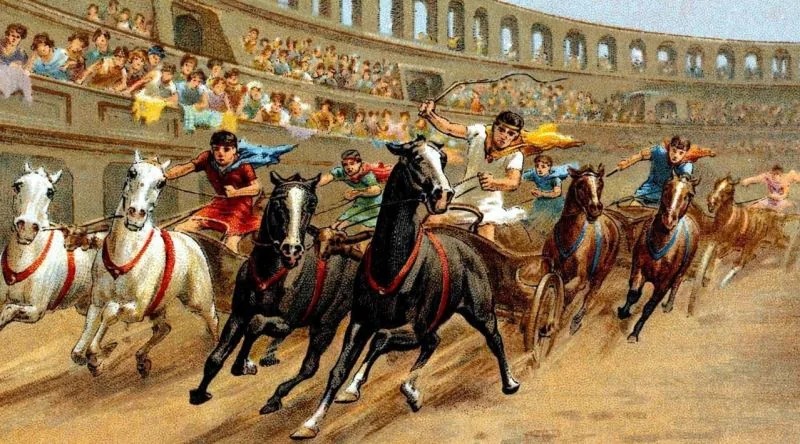
Byzantine chariot racing at the Hippodrome of Constantinople ignited the Nika Revolt of 532, a deadly uprising that nearly toppled Emperor Justinian. The spectacle of Blues and Greens, originally a sporting rivalry, became a political powder keg that transformed the city and the empire forever.
In January 532, chariot racing factions in Constantinople united against Emperor Justinian, sparking days of riots and arson across the city. The Hippodrome, the heart of Byzantine chariot racing, became the stage for a rebellion that threatened the throne before being brutally suppressed, costing tens of thousands of lives.
- The Nika Revolt broke out in January 532 during the Hippodrome races in Constantinople.
- The Blues and Greens, rival Byzantine chariot racing factions, briefly united against Emperor Justinian.
- Much of Constantinople burned as the rebellion spread beyond the Hippodrome.
- Generals Belisarius and Mundus crushed the revolt in the Hippodrome after Justinian divided the rebels.
- The uprising led Justinian to rebuild Constantinople, including the Hagia Sophia.
When the Hippodrome Was More Than a Race Track
In the heart of the Byzantine Empire, the Hippodrome of Constantinople was never just a place to watch horses run. It was where the city came alive, a stage where emperors and ordinary citizens met face to face. Long before the roar of modern stadiums, this ancient arena gave the people of Constantinople something they could find nowhere else: a direct line to their ruler.
Byzantine chariot racing at the Hippodrome was a spectacle unlike anything we know today. The races were a release valve for a crowded, restless city, a place where social discontent or harmony, imperial problems or prosperity, were voiced openly and without filter. When the emperor appeared in his box, the crowd's cheers or silences told him everything he needed to know about the mood of his people. In turn, the races gave ordinary citizens a rare, precious chance to petition their ruler directly, to make demands, to complain, to be heard. This exchange kept alive a sense of belonging, a feeling that even the humblest subject had a stake in the empire.
It is a dynamic that feels strikingly familiar. Think of the modern football stadium, where tens of thousands gather to pour their collective energy into a single afternoon. The colors, the chants, the tribal loyalty, the way a crowd can turn from celebration to fury in a heartbeat. The Hippodrome worked the same way, centuries before the first football was ever kicked. The social contract between the governed and those who govern found its most vivid expression not in palaces or courts, but in the dust and thunder of the racetrack.
From Circus Maximus to Constantinople: The Rise of Chariot Racing
Long before the Hippodrome became the beating heart of Constantinople, chariot racing had already conquered the Roman imagination at the Circus Maximus, where winning drivers became household names and walked away with fortunes that would make modern athletes jealous. The sport reached its peak of popularity there during the Roman era, with champion charioteers enjoying both enormous fame and substantial cash prizes for their victories. But something curious happened as the centuries rolled on and the empire shifted eastward: the Church, growing stronger with the adoption of Christianity, began to look at gladiatorial combat with increasing disapproval.
The bloody spectacles that had thrilled Roman crowds for generations suddenly seemed pagan and morally corrupt to church leaders. They watched as congregations emptied on race days, with Sunday services drawing only a fraction of the faithful who once filled the pews. The church's influence won out in the end, and gladiatorial games were gradually phased out across the empire. Yet people still craved entertainment, and that void needed filling fast. Chariot racing stepped in with remarkable speed and vigor, becoming more than just a popular pastime. At the Hippodrome of Constantinople, these races were woven directly into the fabric of official state ceremonies, transforming from mere sport into a stage where emperors and citizens could meet face to face.
The track itself was no small arena. Historian Gilbert Dagron noted that the Hippodrome's course measured roughly 35 meters in width, a space wide enough for four chariots to race side by side without descending into immediate chaos. That number of competitors, Dagron argued, made practical sense, even if later commentators tried to dress it up with mystical meanings about seasons and elements. The real magic, though, was not in the geometry of the track. It was in what happened there, the rituals, the rivalries, and the raw emotion that would eventually explode into one of the most famous uprisings in Byzantine history. Byzantine chariot racing had found its true home, and nothing would ever be quite the same again.
The Blues, Greens, Whites, and Reds: More Than Just Colors
Walk into the Hippodrome of Constantinople on any race day in the 6th century and the first thing you would notice, before the thunder of hooves or the roar of the crowd, would be the sea of color. Four distinct groups, each with their own uniform, their own charioteers, and their own fierce loyalty, divided the massive arena into rival camps. These were not mere fashion choices; they were the banners of organized fan groups that shaped Byzantine life for centuries.
Each color represented a fully organized faction with its own structure and following. From the 5th century onward, these groups carried the formal name "demoi," a term that could mean either "the people" or "free citizens of an urban district." Other sources called them "meros," which translates to "faction" or "part." Whatever the label, their presence in the stands was impossible to miss.
The meaning behind the four colors has sparked scholarly debate for generations. Two 6th-century writers, John Malalas and John the Lydian, offered a poetic interpretation: the colors symbolized the four seasons and corresponded to the four classical elements. Green stood for earth, blue for water, white for air, and red for fire. Some have even suggested the colors trace back to the sun cult of Sol Invictus, though this origin story remains contested among historians. The historian Gilbert Dagron took a more practical view, noting that with a track roughly 35 meters wide, limiting the number of chariots to four simply made good sense for safety and order. He dismissed the cosmic explanations as artificial depth.
Whatever their origins, the factions themselves underwent a dramatic evolution. The Whites and Reds gradually faded from prominence over the centuries, leaving the Greens, known as the Prasinoi, and the Blues, called the Venetoi, to dominate Byzantine chariot racing. Each group fielded its own charioteers, and spectators divided themselves accordingly, packing the Hippodrome to cheer for their chosen colors. By the time the dust settled, the rivalry between Green and Blue had become one of the defining features of life in Constantinople.
Imperial Favoritism and the Political Muscle of the Factions
The emperors themselves were fans, and they picked sides just like anyone else in the stands. Theodosius II, who ruled from 408 to 450, leaned Green, as did Leo (457-474) and Zeno (474-475). Marcian (450-457) and Justinian (527-565) threw their weight behind the Blues, and that imperial preference could make or break a faction's fortune.
Take Theodosius II and Chrysaphius, the leader of the Greens. The emperor showered him with gifts and granted his every request. When Chrysaphius had a complaint or a favor to ask, he walked straight into the imperial presence without hesitation. That cozy arrangement ended abruptly when Marcian took the throne in 450. His very first act was to have Chrysaphius executed and his property confiscated. It is easy to read the political calculation here: Chrysaphius belonged to the Greens, Marcian sympathized with the Blues, and the new emperor was settling old scores through the language of the Hippodrome.
The factions could also tip the scales of power in dramatic fashion. In 610, when Heraclius moved to overthrow the emperor Phocas (602-610), the Greens flocked to his cause as his fleet approached Constantinople. After seizing power, Heraclius made a pointed gesture at the first race he attended: he ordered Phocas's icon and the Blues' banner burned in the Hippodrome, a public humiliation aimed squarely at the rival faction that had backed his deposed enemy.
Scholars have long argued about what these factions really represented. Some researchers, including Francis Dvornik and Gavro Manojlovic, claimed the Blues stood for Orthodoxy while the Greens represented Monophysitism, a major theological controversy of the era. Averil Cameron dismantled that theory, showing that the religious divisions were overstated and that both factions counted plenty of Orthodox believers among their ranks. Manojlovic also floated the idea that the Blues were an upper-class elite living in refined districts like Blachernae, while the Greens were workers, sailors, and merchants clustered around the port of Chalcedon. That geographic and social split remains speculative, a tidy theory that the surviving evidence does not fully support.
The Nika Revolt: When Chariot Racing Ignited a City
In January 532, the Hippodrome of Constantinople became the flashpoint for one of the most destructive uprisings in Byzantine history, the Nika Revolt, named after the Greek cry "Nika!" meaning "Victory!" What began as factional anger at the chariot races spiraled into a city-wide conflagration that nearly toppled Emperor Justinian from his throne.
The trouble started on January 11, 532, when Justinian, who had reigned since 527, showed visible favoritism toward the Blues during race preparations. The Greens, already nursing grievances, felt the emperor had crossed a line. To calm the rising tension, Justinian sent a Mandator, an imperial messenger, to speak with the Green faction's leadership. As the traditional account has it, the Greens accused a man named Kalopodias of fixing matches, declaring he would suffer divine punishment like the traitor Judas. The Mandator, reportedly losing his temper, shouted back at the Greens, calling them Jews and Samaritans. The Blues then waded into the argument, and when the Mandator sided with them, the Greens stormed out of the Hippodrome, declaring they would rather be pagans than Blues. In the world of Byzantine chariot racing, that exit was the ultimate insult to imperial authority.
Arrests and executions followed as Justinian tried to reassert control. By January 13, the unthinkable happened: the Blues and Greens, bitter rivals who had fought each other for generations, united against the emperor. They demanded pardons for their arrested members, but their pleas were rejected. The city erupted. Crowds flooded the streets chanting "Nika! Nika!" and the rebellion quickly spread beyond the Hippodrome walls.
The rebels knew exactly whom they blamed for their misery. They demanded the dismissal of John the Cappadocian, the praetorian prefect who had amassed a vast fortune by plundering his subjects' property, and Tribonian, the quaestor who reportedly sold justice to the highest bidder, repealing and introducing laws based on whoever paid him. They also called for the removal of the head of the legal commission. Both men were corrupt in ways that touched every layer of society, and the mob wanted them gone. Justinian, surprisingly, agreed to their removal, but the gesture was not enough to quell the fury.
As the revolt raged, fires broke out across Constantinople. The Great Church, the original Hagia Sophia, burned to the ground. The Baths of Zeuxippus, a beloved public complex, was destroyed, and the imperial courtyard itself went up in flames. The city looked as though a foreign army had sacked it.
Justinian tried a direct approach. He appeared before the crowd in the Hippodrome and offered a general amnesty, but the people shouted him down. Facing the collapse of his reign, he switched tactics. He distributed money to split the rebels, sowing discord among the united factions. Then he sent in his troops, led by the general Belisarius, to deliver the final blow. The massacre that followed in the Hippodrome was staggering. According to contemporary accounts, around 35,000 people lost their lives, their bodies filling the arena that had once echoed with cheers for their favorite charioteers.
The revolt was crushed, but the damage was immense. Constantinople lay scarred, its greatest buildings reduced to ash. Justinian would go on to rebuild the Hagia Sophia in spectacular fashion, but the memory of those January days, when Byzantine chariot racing turned into rebellion, lingered over the city for generations.
Frequently asked questions
What was the Hippodrome of Constantinople?
The Hippodrome of Constantinople was the grand arena where Byzantine chariot racing came alive, serving as the city's center for both sport and state ceremony. Located in the heart of the capital, this massive U-shaped structure could hold tens of thousands of spectators who gathered to watch four-horse chariots thunder down the track. Beyond entertainment, it functioned as the political stage where emperors met their people and public sentiment was made visible.
Who were the Blues and Greens in Byzantine chariot racing?
The Blues and Greens were the two dominant factions of Byzantine chariot racing, each with its own distinct color, organized fan base, and political weight. Known formally as the Venetoi and Prasinoi, these groups evolved from four original colors, with White and Red gradually fading away by the later period. Their rivalry extended far beyond the racetrack, shaping everything from street violence to imperial succession.
Why did the Nika Revolt happen?
The Nika Revolt erupted in January 532 when long-simmering factional tensions finally boiled over into open rebellion against Emperor Justinian. The immediate spark came from his perceived favoritism toward the Blues, which enraged the Greens during the races held on January 11. When both factions united against the emperor after their members were arrested and executed, their combined fury exploded into a citywide uprising that nearly toppled his throne.
How did chariot racing influence Byzantine politics?
Byzantine chariot racing gave the public a rare platform to voice grievances directly to their emperor, making it a pressure valve for political expression. During race days, crowds could shout demands, protest unpopular policies, or show support for imperial decisions, and emperors paid close attention. This informal channel sometimes escalated into real political upheaval, as demonstrated when Heraclius used Green support to overthrow Emperor Phocas in 610.
What happened after the Nika Revolt?
After the Nika Revolt was brutally suppressed, with roughly 35,000 people killed in the Hippodrome, Emperor Justinian launched an ambitious rebuilding program. The destroyed Great Church was replaced by the magnificent Hagia Sophia that still stands today, while the Zeuxippus Baths and imperial courtyard were also reconstructed. The revolt permanently reshaped the relationship between the throne and the racing factions, leaving a legacy of caution on both sides.
Did chariot racing survive the Byzantine Empire?
Yes, Byzantine chariot racing continued for centuries after the Nika Revolt, remaining a beloved institution well into the medieval period. The factions persisted even as their political influence waned, with the Blues and Greens maintaining their presence in Constantinople for generations. Though the sport eventually declined alongside the empire itself, its impact on Byzantine culture and politics never fully disappeared. Editorial note: Any facts which remain unconfirmed are presented as such, hedged with appropriate uncertainty.
Got a take on this? Add your voice to the conversation below →
No comments yet. Be the first.