10 Battles That Changed History: From Marathon to Iwo Jima
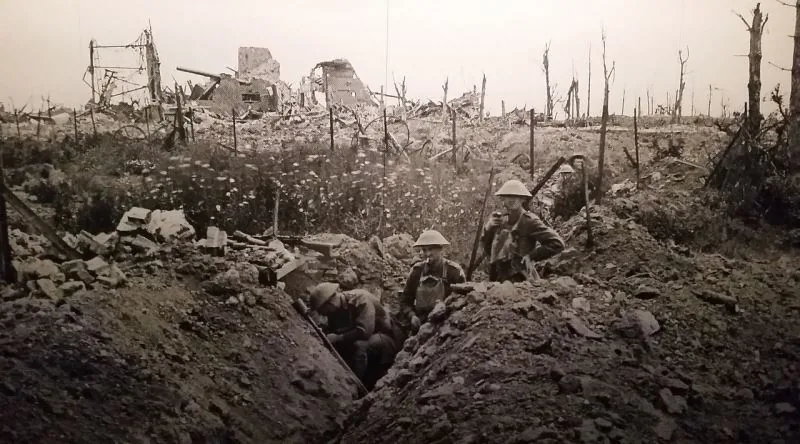
The battles that changed history, from Marathon to Iwo Jima, are the pivotal clashes where a single day's outcome redirected the fate of nations and entire civilizations. These ten engagements, spanning over two millennia, each represent a moment when courage, strategy, and sheer chance combined to forge the world we live in today. They are not just stories of swords and guns, but of human willpower at its most extreme, reminding us that the course of history often hangs on the sharpest of edges.
This article examines ten decisive battles that changed history, from the Greek victory at Marathon in 490 BC to the American capture of Iwo Jima in 1945. Each engagement is presented as a critical turning point, where the outcome shaped the political, cultural, or military landscape of its era, with lasting consequences for the modern world.
- The Battle of Marathon in 490 BC saw the Athenians defeat a larger Persian force, preserving Greek independence and the cradle of Western democracy.
- Hannibal's tactical masterpiece at Cannae in 216 BC remains a textbook study in the art of encirclement and annihilation.
- The Battle of Waterloo in 1815 ended Napoleon Bonaparte's reign as Emperor of the French, reshaping the European balance of power.
- The Battle of Stalingrad, fought from 1942 to 1943, marked the turning point of World War II on the Eastern Front, halting the German advance into the Soviet Union.
- The Battle of Iwo Jima in 1945 provided a vital airbase for Allied bombers, bringing the Japanese home islands within striking range and influencing the decision to use atomic weapons.
10 Battles That Changed History: From Marathon to Iwo Jima
Some battles are just clashes over territory. Others rewrite the entire script of human civilization. The ten conflicts below fall firmly into the second category, spanning from the plains of ancient Greece in 490 BC to a volcanic island in the Pacific in 1945. Each one pivoted the course of empires, cultures, and the modern world in ways their commanders could never have fully predicted.
The Battle of Marathon (490 BC)
Picture it: 490 BC, and the Athenians are staring down the Persian Empire. Darius I is out for blood. After Athens and Eretria sent troops to support the Ionian Revolt and even burned the city of Sardes, Darius burned with a desire for revenge. Legend has it that a servant reminded him three times before dinner each night with the words, "Master, remember the Athenians."
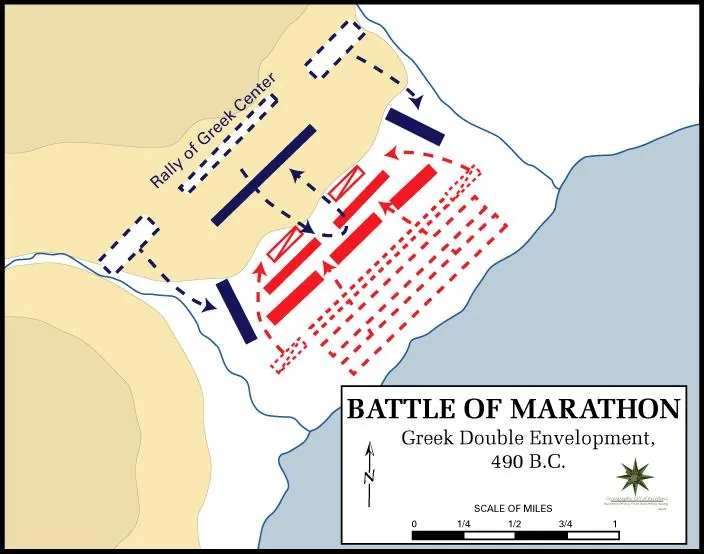
In September 490 BC, a Persian invasion force landed north of Athens. Ancient sources mention 600 ships, but the troop figures are modern estimates and not confirmed. The Greeks fielded around 10,000 Athenian hoplites and 1,000 from Plataea. Outnumbered and facing potential annihilation, the Greek generals hesitated until Miltiades made a passionate call to attack.
Miltiades ordered a direct charge into the Persian lines. The Persians thought the Greeks had gone mad. The Greek center weakened under pressure, but their wings swept around and enveloped the enemy. When the Persians broke and fled toward their ships, many drowned in the sea. The Persians left about 6,400 dead on the field. Athens lost 192 men, Plataea just 11. The victory proved that Greek culture could survive, and it set the stage for the greater test at Salamis a decade later.
The Battle of Salamis (480 BC)
Ten years after Marathon, Darius's son Xerxes I picked up where his father left off. After crushing an Egyptian revolt, he built bridges across the Hellespont and even cut a canal through the isthmus of Mount Athos to move his massive forces into Europe. The sheer engineering genius left the ancient world speechless. This time, the showdown would happen at sea.
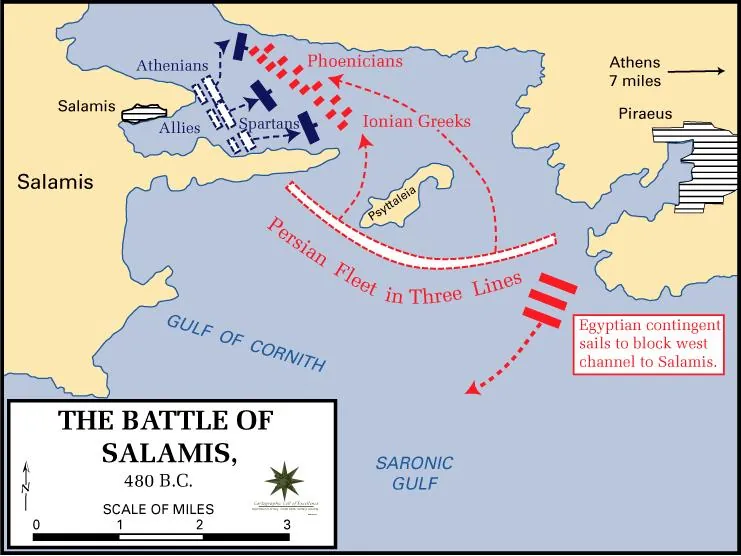
The Greeks mustered 371 ships. The Persians? A staggering 1,207, though that number is likely inflated. The Athenian general Themistocles persuaded the Greeks to make a stand in the narrow straits of Salamis. Xerxes, eager for a decisive victory, took the bait and sent his fleet into the channel.
Once inside the cramped waters, Persian numbers became a liability. Their ships could not maneuver, and the Greeks struck hard. The Persians lost 200 to 300 ships. The Greeks? Just 40. The surviving Persian fleet withdrew, and Greek civilization was saved from conquest.
The Battle of Gaugamela (331 BC)
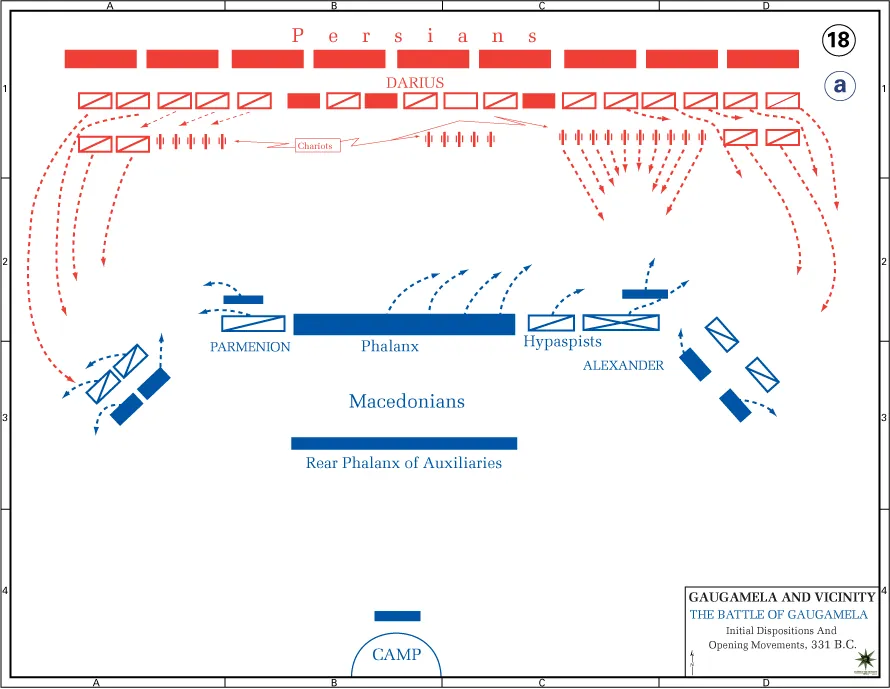
The third clash between Greeks and Persians flipped the script entirely. In 331 BC, Alexander the Great of Macedon went on the offensive against Darius III. At Gaugamela, Alexander had about 47,000 men. The Persians? Between 90,000 and 120,000. Despite being heavily outnumbered, the Macedonians were elite fighters with morale on their side after a string of victories.
Alexander knew his flanks were vulnerable, so he angled his infantry to prevent encirclement. He advanced with his Companion cavalry on the right, drawing out the Persian horse to create a gap in their center. When he struck through that opening, the Persian line crumbled. Darius fled the field before the battle was fully decided, and his army dissolved behind him.
Alexander wanted to pursue, but his left wing under Parmenion was under heavy pressure, so he turned back to help. Darius was later killed by Bessus, one of his own satraps. The casualty figures for Gaugamela vary wildly across ancient sources, with Persian losses reported between 40,000 and 90,000 and Alexander's losses anywhere from 100 to 1,000. Modern historians consider these figures unreliable and exaggerated. What is certain is that the Persian Empire effectively ended that day.
The Battle of Cannae (216 BC)
Hannibal of Carthage had already stunned Rome with victories at Trebia and Lake Trasimene. But Cannae, fought on August 2, 216 BC, became the stuff of military legend. Hannibal had 40,000 infantry and 10,000 cavalry. Rome, meanwhile, assembled its largest army ever: 80,000 infantry and 6,400 cavalry, led by consuls Lucius Aemilius Paullus and Gaius Terentius Varro.
Hannibal deliberately weakened his center and placed his elite troops on the wings. The Romans, confident in their nearly two-to-one advantage, pushed hard into the middle. As they advanced, the Carthaginian center fell back in a controlled retreat. Then the stronger Carthaginian wings closed in from both sides while the Numidian cavalry, having driven off their Roman counterparts, struck from the rear. Rome's army was caught in the first recorded double envelopment.
With no escape route, roughly 70,000 Roman soldiers were slaughtered and 10,000 captured. Carthage lost only about 5,700 men. Rome declared national mourning, and for a time, no family in the city was untouched by loss. The disaster cost Rome roughly one-fifth of its adult male population within 17 years, yet Hannibal could not finish the job. Rome would return for revenge.
The Battle of Tours (732)
Also known as the Battle of Poitiers, this clash on October 10, 732, pitted Frankish and Burgundian forces under Charles Martel against the Umayyad Caliphate led by Abdul Rahman Al Ghafiqi. The Muslim advance into Europe had been swift, and their mounted archers outmaneuvered the heavily armored European armies they faced. The Frankish kingdom stood as the last major obstacle.
The size of both armies remains highly speculative. All figures, ranging from 15,000 to 75,000 for the Franks and 60,000 to 400,000 for the Umayyad cavalry, are not reliably sourced. Charles Martel arranged his troops in a defensive formation on a battlefield between Poitiers and Tours. The Muslims were forced to charge uphill into a fight shaped by their enemy's terms.
Several cavalry attacks failed to break the Frankish line. When part of Charles's army began harassing the Muslim baggage train, a portion of the Umayyad forces pulled back to protect it. In the confusion, they were surrounded and killed. Abdul Rahman Al Ghafiqi fell in the fighting, and the Umayyad army withdrew. Charles earned the nickname "Martel," meaning "the Hammer," for his decisive stand.
The Battle of Agincourt (1415)
King Henry V of England invaded France in 1415, claiming the French crown. Disease and combat whittled his force down to just 6,000 to 9,000 soldiers by the time he faced the French at Agincourt on October 25, 1415. Most of his men were longbowmen, with only a fraction being mounted knights and men-at-arms. The French army numbered between 12,000 and 36,000, mostly heavily armored knights.
Henry chose to fight immediately, knowing the French would only grow stronger with time. He positioned his men on a muddy slope flanked by woods, preventing any French flanking maneuver. The English planted sharpened stakes to break cavalry charges and let their longbows do the rest. French knights had to climb the churned-up mud under a relentless rain of arrows.
The first cavalry charge churned the ground further, and many French soldiers drowned in the mud under the weight of their own armor. Bodies piled up, making each successive assault harder. When the English took prisoners, they had too few men to guard them, so they executed their captives. French losses ranged from 1,500 to 11,000 killed, with about 2,000 captured. The English lost between 112 and 600 men. The battle proved just how devastating the English longbow could be when massed in large numbers.
The Battle of Waterloo (1815)
After Napoleon returned to power in March 1815, the Seventh Coalition formed to stop him. The coalition split into two forces: one under the Duke of Wellington and another under Prussian Field Marshal Gebhard Leberecht von Blücher. Napoleon knew his best chance was to defeat them separately before they could combine.
He struck first at the Prussians near Ligny, forcing them to retreat. Wellington fell back to a defensive position near Waterloo, where he had about 68,000 troops. Napoleon faced him with roughly 73,000 men. Wellington's plan was simple: hold the line until Blücher, who had about 50,000 men, could regroup and return to the fight.
The British and their allies absorbed wave after wave of French attacks, but by late afternoon they were hanging on by a thread. Then Blücher's Prussians appeared on the field. Napoleon diverted troops to hold them off and, as a last resort, ordered his Imperial Guard to assault Wellington's center. Hidden coalition troops rose from behind the ridge and fired into the Guard at close range. The French broke, and the battle turned into a rout. France lost 41,000 men, the coalition 24,000. Napoleon was exiled to Saint Helena, where he died.
The Battle of the Atlantic (1939-1945)
Britain is an island nation, and almost everything it needed to fight World War II arrived by sea. Germany understood this vulnerability perfectly. With a navy weakened by the Treaty of Versailles, the Kriegsmarine never planned to challenge the Royal Navy directly. Instead, German U-boats and surface raiders waged a guerrilla war against merchant shipping.
The campaign began on September 3, 1939, and stretched on for five years, eight months, and five days, making it the longest continuous battle of the war. In the early years, U-boats sank merchant ships faster than the Allies could replace them. The Allies responded with convoys, and the Germans countered with "wolf packs" that hunted in groups. Depth charges and improved radar gave the escorts an edge, while Germany developed submarines with lower radar signatures and longer underwater endurance.
In the end, Germany could not sink enough ships to starve Britain into submission. After the United States entered the war, Allied production capacity became overwhelming. The Allies paid a heavy price: 3,500 merchant ships and 175 warships. Germany and Italy lost 783 submarines and 47 warships. Britain held the Atlantic lifeline, and the Allies kept the supply routes open.
The Battle of Stalingrad (1942)
Stalingrad was the turning point of World War II's Eastern Front, the place where the myth of German invincibility shattered. The city carried Stalin's name, which gave it enormous symbolic weight. Its loss would have devastated Soviet morale, so Stalin ordered that it be held at all costs.
The battle began on August 23, 1942. German forces captured more than half the city through brutal street fighting, and air bombardments reduced much of it to rubble. But Soviet resistance, including deadly sniper operations, bled the invaders daily. Winter arrived before the Germans could secure full control.
The Soviets had prepared for the cold; the Germans had not. On November 19, 1942, the Red Army launched Operation Uranus, encircling the German 6th Army inside the city. Hitler ordered the trapped troops to hold and promised supplies and reinforcements that never came. On February 2, 1943, the 6th Army surrendered. The Germans and their allies lost over 647,300 men. The Soviets? More than 1.1 million. From that point forward, the Red Army never looked back.
The Battle of Iwo Jima (1945)
Iwo Jima was a barren volcanic island with little industrial value, but it sat within range of the Japanese home islands. American planners wanted its airfields as a base for fighter operations. Japanese commander Tadamichi Kuribayashi was ordered to defend the island to the last man, and he prepared accordingly.
About 20,000 Japanese troops and 23 tanks defended the island against 110,000 U.S. Marines supported by over 500 ships. With no naval or air support, the Japanese garrison was doomed from the start, yet they refused to surrender. Kuribayashi instructed his men to hold fire until the Americans landed, keeping their positions hidden.
The landings began on February 19, 1945. The fighting was ferocious, with progress measured in yards. Taking Mount Suribachi proved one of the toughest objectives. When the island finally fell, the Americans lost 6,821 dead and 19,217 wounded. The Japanese? Nearly 18,000 dead, with only 216 taken prisoner.
The staggering cost of Iwo Jima sent a clear message to American leadership: invading the Japanese home islands would be catastrophic. The high casualty figures were cited as a justification for using the atomic bomb on Hiroshima and Nagasaki, bringing World War II to a sudden and devastating close.
Editorial note: Any facts which remain unconfirmed are presented as such, hedged to reflect the current state of historical knowledge.
Got a take on this? Add your voice to the conversation below →
No comments yet. Be the first.