Was Atlantis Real? Plato's Allegory Behind the Myth
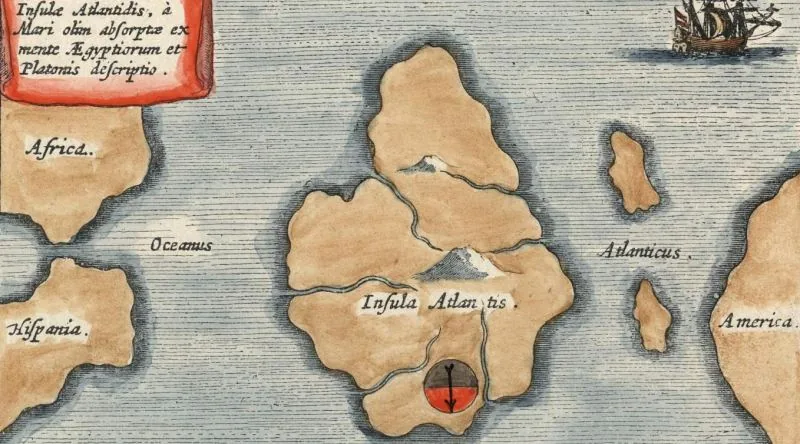
Atlantis is the lost island civilization that Plato described in two dialogues, Timaeus and Critias. He placed it beyond the Pillars of Hercules and described a wealthy sea power that grew arrogant and sank beneath the waves in a single day and night. Yet Plato never claimed to have visited it, and no surviving text before him mentions it at all. The question of whether Atlantis was real or just Plato's story has kept the myth alive for more than two thousand years.
Atlantis appears first in Plato's Timaeus and Critias as a moral and political allegory about a powerful island empire that grew arrogant and was destroyed by the gods. No earlier source mentions it, and most historians treat it as Plato's philosophical fiction rather than a real place.
- Plato introduced Atlantis in the Timaeus and Critias, two dialogues that form the earliest known account of the island.
- In the story, Atlantis lies beyond the Pillars of Hercules and sinks into the sea in a single day and night as divine punishment.
- No surviving text before Plato mentions Atlantis, which is a key reason most scholars treat it as fiction.
- The Santorini eruption on the island of Thera, dated to roughly 1600 BCE, is one of the most cited real-world events linked to the legend.
- Ignatius Donnelly's 1882 book Atlantis: The Antediluvian World revived the idea of a real lost continent and shaped modern Atlantis lore.
Was Atlantis Real? Plato's Allegory Behind the Myth
Was Atlantis a lost continent swallowed by the sea, or did it never exist outside one philosopher's imagination? For most serious scholars, the answer is the second one. Atlantis is, in their reading, nothing more than Plato's political and philosophical allegory, a story built to make a point rather than to record a place. That is the dominant interpretation, though it remains an interpretive position rather than settled fact. The question of whether Atlantis was real has been asked for well over two thousand years, and the evidence has not moved.
Ask ten people and you get ten Atlantises. Some picture a vanished continent. Some picture the greatest civilization history ever produced. Some picture the fuel for a thousand YouTube conspiracy videos, complete with crystal pyramids and underwater alien technology. The gap between those pictures and the actual source material is enormous. The surviving written record of Atlantis begins and ends with Plato, who described it in just two works, Timaeus and the unfinished Critias.
And in those pages, Plato placed the island "beyond the Pillars of Hercules." In the ancient world that phrase meant something specific: the edge of the known world, the strait we now call Gibraltar and whatever lay past it. It was not a map coordinate. It was a way of saying over there, past everything we know. Plato even had Atlantis be larger than Libya and Asia combined, a detail that reads less like geography and more like myth-making, the same instinct that gives fairy tales their impossible castles.
That framing matters, because it tells you what kind of story you are reading. Plato was not filing a report. He was teaching. Atlantis was his example, his thought experiment, a cautionary case study dropped into a lesson about ideal states and moral decay. And for centuries, that is all it was.
Then in 1882, an American writer named Ignatius Donnelly published Atlantis: The Antediluvian World, arguing that Atlantis had been a real, advanced civilization. That book turned a philosophical exercise into a movement, and eventually into a permanent fixture of popular culture. The article that inspired this piece was published on eksiseyler.com in the FELSEFE channel on 7 August 2025, where it drew over 5,800 reads and 288 shares, a small sign of how durable the fascination remains.
What does the evidence say? There is no archaeological or geological evidence for Atlantis. None. No ruins, no harbor works, no pottery shard, nothing that mainstream scholarship accepts as a trace of the place Plato described. Scientists have been politely repeating the same request for generations: show us real proof first, then we can talk. So far, nobody has.
Beyond the Pillars of Hercules: Plato's Deliberate Nowhere
In the Timaeus (24e-25a) and the unfinished Critias (108e), Plato puts Atlantis "beyond the Pillars of Hercules." For a reader in classical Athens, that phrase was not a set of coordinates. It was a border marker. Beyond the Pillars, which are often identified with the Strait of Gibraltar, lay the edge of the known world, and past that edge there was nothing to map.
That is exactly the point. The author of the original account argues that Plato never intended Atlantis as a real geographic location at all. He placed it past the boundary of human knowledge, imagination and civilization itself, an unreachable "other place" that exists because it cannot be reached. In other words, beyond the Pillars of Hercules means: here is where the world we know ends, and there the myths we invent begin.
Plato also gave his island a scale that no map could hold. In the Timaeus (24e) he describes Atlantis as larger than Libya and Asia combined. Not a modest island, not a trading post, but a landmass that dwarfs everything the audience has ever seen. The exaggeration is the signal. A real place does not need to be bigger than two known continents.
What frustrates the author most is what happened next. Plato openly signalled that he was working in metaphor, and yet theories are still being built underneath that metaphor today. The author calls the situation absurd, and it is hard to argue with the logic: if the original text announces its own fictional frame, then every later attempt to dig it up starts from a misreading.
So Atlantis becomes something stranger than a lost continent. It is a deliberately chosen abstraction, an invented case study in a philosopher's lesson plan. That reading does not make the story smaller. It makes it sharper.
Ignatius Donnelly and the Birth of a Modern Legend
For roughly twenty-three centuries, Atlantis stayed where Plato left it: a lesson dressed up as an island. Then, in 1882, an American politician and writer named Ignatius Loyola Donnelly published a book called Atlantis: The Antediluvian World, and the metaphor escaped the classroom.
Donnelly did not hedge. He declared that Atlantis was real, a genuine advanced civilization that had flourished and vanished, and he argued his case across hundreds of pages. The book found readers far beyond scholarly circles. It turned a philosophical allegory into something closer to a small popular movement, and from there into a permanent fixture of popular culture. Sunken continents, advanced ancestors, a drowned mother civilization: that whole vocabulary of modern speculation traces back, in large part, to a single 1882 volume and the man who wrote it.
So the pivot happened here, in the space between a philosopher's parable and what later hardened into pseudo-archaeology. Plato's Atlantis was a story built to make a point about pride and decline. Donnelly's Atlantis was a place you could go looking for. The second version, the lost-continent version, is the one that stuck.
What the first version actually looked like, and why scholars still treat it as a literary invention rather than a sunken address, is worth setting out plainly.
The Evidence Problem: No Archaeology, No Geology, Just Speculation
Ask a working archaeologist about Atlantis and you will usually get a polite shrug. There is no archaeological or geological evidence for the lost island, and that absence is not a gap waiting to be filled. It is the mainstream scholarly consensus, and it has held for a very long time.
Plato wrote his Atlantis account in two works, the Timaeus and the unfinished Critias, and he placed the island beyond the Pillars of Hercules, the strait we now call Gibraltar. He called it larger than Libya and Asia combined. He gave it orichalcum, a precious metal second in value only to gold, and he filled it with harbors, canals, temples sheathed in gold and silver. Impressive on the page. Invisible in the ground.
That is the wall. Every claim about a real Atlantis runs into the same problem: no pottery, no harbor works, no drowned city, nothing a trowel can touch. What we have instead is a philosopher's vivid description of a place designed to sit past the edge of the known world.
What about Santorini?
Some researchers have tried to anchor the story in a real catastrophe. The volcanic eruption on Santorini, also called Thera, around 1600 BCE was one of the largest in recorded history, and it tore through the Aegean. Some have linked this eruption to the collapse of the Minoan civilization, but that causal claim is disputed and not established. Any broader connection to Atlantis rests on speculation and loose geological resemblance only.
Here the record gets slippery. The eruption's date is roughly consistent with the timeline, but it is not enough to carry the weight placed on it. According to the original account, the disaster may have hardened into myth over time, and that is as far as the evidence carries us. No direct proof ties the eruption to Atlantis.
So the honest position is not "we haven't found it yet." It is that a story built to make a philosophical point may never have been meant to be found at all. The ocean floor is not hiding a continent. It is hiding nothing, which is exactly the problem.
What Plato Actually Wrote: Size, Orichalcum and Impossible Engineering
Open Critias at 114e and you will not find a fable. You will find specifications. Plato hands his readers a metal called orichalcum, a substance he ranks second in value only to gold, and then he keeps going: harbors, canals, bridges, ditches, hot springs, cold springs, baths, aqueducts. This is the detail that fools us. A vague legend is easy to dismiss. A legend with plumbing is not.
Start with the scale. In Timaeus 24e, Atlantis is described as an island larger than Libya and Asia combined, which in Plato's world meant something closer to a continent than a kingdom. That single line does a lot of work. It tells you this is not a fishing village that sank. It is a rival power, an entire civilization parked past the known edge of the map.
Then comes the engineering. Plato describes grand harbors carved with canals and spanned by bridges, advanced water management, enormous ditches cut into the land, and springs that ran both hot and cold. Baths and aqueducts appear in the account as well. Read that list again and notice what it is: public infrastructure. Not temples to unnamed gods, not vague golden halls. Water systems. The kind of thing a city builds when it expects to last.
The ornamentation is lavish too. Palaces and temples sheathed in gold, silver and orichalcum, colossal statues standing among them. In Critias 114e through 116c, orichalcum is the signature material, precious enough to be spoken of in the same breath as gold. No one has ever found it. That has not stopped anyone from looking.
And then, the part that reads almost pastoral. Channels carry water in from the forests. Wide plains are irrigated. Plato's Atlantis is not a brute empire grinding the earth down. It is a civilization that has learned its landscape, planned around it, and drawn abundance out of it. Sophisticated, and apparently in harmony with the natural world it sits on.
Why would a philosopher bother with ditches and springs? Because that is exactly how you make a story stick. The original account treats all of this detail as Plato's rhetorical strategy, an early form of science fiction built from real-world science and history. He borrows the texture of things his audience knows, harbors, irrigation, metalwork, and drapes it over a place that never existed. The familiar makes the impossible feel reported rather than invented.
It is worth being precise about what this section can and cannot establish. That Plato wrote the Atlantis account in Timaeus and the unfinished Critias is settled. That he placed it beyond the Pillars of Hercules is settled. That he called it larger than Libya and Asia combined is settled. That orichalcum was second in value only to gold is settled. What remains open is the question scholars themselves have never closed: whether the whole narrative is a philosophical allegory rather than a historical record. That is the dominant reading, but it is an interpretation, not a verdict.
So when someone tells you the engineering proves Atlantis was real, the honest answer is that the engineering proves Plato could write. He gave his invented island harbors you could sail into and baths you could soak in. The specificity is the trick, not the evidence.
Zeus, Moral Decay and the Echo of Sodom and Gomorrah
By the final pages of Critias, Plato stops describing Atlantis's harbors and starts describing its appetite. The island that began as a marvel of engineering has curdled into something greedy and arrogant, and the gods are watching. In Critias 120e through 121c, Zeus convenes the other deities to decide what to do about the civilization that has lost its way. The punishment that follows is not random catastrophe. It is a verdict.
Here is the part that makes the story stick. For all its Greek machinery, the logic of Atlantis's fall reads like something out of a very different tradition. Moral corruption draws divine attention. Divine attention brings destruction. The destruction then stands as a warning for everyone left behind. Some readers have noted a thematic parallel between this and the Abrahamic idea of God's wrath, and the destruction of Sodom and Gomorrah in particular, though no direct literary dependence has been established. The comparison is interpretive, not proven. Still, the shape of the story is hard to miss.
There is one real difference worth holding onto. In the Abrahamic accounts, punishment flows from God's will, a deliberate decision by a personal deity. In Plato's system, the collapse reads more like a consequence of universal order, as though cosmic justice simply works itself out. The gods intervene, but they feel less like angry judges and more like enforcers of a balance that corruption has already broken.
Plato's closing logic lands hard: power corrupts, corruption brings collapse, and the collapse becomes divine. The more advanced Atlantis was, the more its ending appeared deserved. Its sophistication is not a defense. It is the indictment.
Frequently asked questions
Was Atlantis a real place, or did Plato invent it?
The dominant scholarly reading is that Atlantis is Plato's political and philosophical allegory rather than a real place, though that remains an interpretive position rather than settled fact. Plato's account appears only in two works, Timaeus and the unfinished Critias, and no accepted archaeological or geological evidence has ever surfaced to support a lost continent.
Why did Plato write about Atlantis in Timaeus and Critias?
Plato used the Atlantis tale to deliver a philosophical message about ideal statecraft and moral decline. In Critias, the island's fall comes after its people turn corrupt, prompting Zeus to convene the gods and punish them, a lesson about how power decays into collapse rather than a literal history of a vanished land.
What does "beyond the Pillars of Hercules" mean?
In antiquity, "beyond the Pillars of Hercules" marked the end of the known world, the outer edge of Greek geography past the Strait of Gibraltar. Plato placed Atlantis there deliberately, outside real, mappable territory, which is why scholars read the location as symbolic rather than a genuine coordinate.
Did the Santorini eruption destroy the Minoan civilization?
The volcanic eruption of Thera, modern Santorini, around 1600 BCE is tied in the original account to the collapse of the Minoan civilization in the Aegean, but that causal claim is disputed and not established. Any link between the eruption and Atlantis is speculation, resting on loose geological resemblance rather than proof.
Who was Ignatius Donnelly?
Ignatius Donnelly was the author of Atlantis: The Antediluvian World , published in 1882, which argued that Atlantis was a real advanced civilization. His book popularized modern Atlantis speculation and turned a philosophical allegory into a small popular movement that later fed straight into pop culture.
What is orichalcum?
Orichalcum is a precious metal described in Plato's Critias, ranked second in value only to gold. Atlantean palaces and temples were said to be covered in it alongside gold and silver, a detail that made the island read as magnificent and almost divine within the narrative.
Is there archaeological evidence for Atlantis?
No. Mainstream scholarship accepts no archaeological or geological evidence for Atlantis, and researchers have long answered the story with a simple demand: show real proof first, then talk. What lies beyond the Pillars of Hercules, scientifically speaking, is only a myth lost in the deep ocean. Editorial note: Details that remain unconfirmed, including the exact historicity of Atlantis and the precise dating of the Santorini eruption, are presented here as debated rather than settled.
Got a take on this? Add your voice to the conversation below →
No comments yet. Be the first.